

You're staring at three messages before coffee. A guest can't get in because snow is piled at the entry, a tenant says water is staining a ceiling, and an owner wants last month's statement. None of these jobs is hard on its own. Running all of them, in the right order, with proof they were done, is the work.
That's what property management services are for. They're not a single product you buy off a shelf. They're a system for deciding what gets done, who does it, how fast, what it costs, and how you'll check the result at month end.
What Property Management Services Include
Say you buy a Flagstaff cabin, rent it for a season, and learn about gutters only when meltwater runs down an inside wall. Nothing failed suddenly. Needles collected, water backed up, ice formed, and nobody had it on a calendar. That gap between owning a property and operating it is where management sits.
Property management services are the ongoing work of running a property for its owner. That includes maintenance, vendor coordination, inspections, tenant or guest communication, and money matters such as collecting rent and paying invoices.
Two Models Owners Confuse
Full-service management runs day-to-day operations. The manager takes the calls, assigns vendors, tracks money, and reports to you. Task-based vendor contracts handle one job at a time, such as window cleaning or snow removal. Many owners need both, one manager coordinating several specialists.
If you're comparing what's typically bundled elsewhere, the rental insights from Royal LePage Brookside Realty give a useful second view of common inclusions. For exterior work specifically, our own commercial property maintenance services show how task-based contracts slot under a manager or directly under an owner.
Property management services by category
| Service | What It Covers | Typical Frequency | Best Fit |
|---|---|---|---|
| Routine maintenance and repairs | Work orders for filters, plumbing, appliances, locks and fixtures | Monthly checks, repairs as reported | Homes, rentals, offices |
| Preventive inspections | Roof, exterior, mechanical and safety walkthroughs | Quarterly, plus after storms | Cabins, hotels, short-term rentals |
| Interior and common-area cleaning | Turnover cleaning, lobbies, restrooms, shared areas | Between tenants or guests, or weekly | Rentals, hotels, offices |
| Window cleaning | Exterior and interior glass and frames | Typically 2 to 4 times a year | Homes, storefronts, hotels, medical buildings |
| Gutter and downspout cleaning | Clearing debris and checking water flow | Spring and fall, plus after heavy needle drop | Homes near pines, multi-story buildings |
| Pressure washing | Walkways, siding, dumpster pads, entries | Annually or as needed | Commercial sites, rentals before listing |
| Snow and ice removal | Driveways, walks, access paths, parking areas | Per storm during winter | Every Flagstaff property, especially rentals |
| Tenant or guest and leasing | Screening, bookings, complaints, move-in and move-out | Ongoing | Long-term rentals, short-term rentals |
| Financial management | Rent or booking collection, owner statements, vendor payments | Monthly | Portfolios and absentee owners |
| Energy and utility tracking | Monthly consumption baseline and deviation checks | Monthly | Commercial buildings, hotels, campuses |
A single-family home, a cabin, a hotel, and a campus don't need the same mix. Your first task is listing each property and the services it requires.
The three services owners miss most often are exterior care, seasonal preparation, and written inspection records. If those aren't named, they usually aren't happening.
What Property Management Fees Really Cost
Start with a worked example. If a home rents for $2,000 a month and a manager charges 10% of collected rent, you pay $200 a month, or $2,400 a year, before leasing fees or vendor work. That percentage is the base price, not your total.
Most owners pay either a percentage of collected rent or a flat monthly fee, plus separate charges for leasing, maintenance coordination, and the vendors who do the physical work.
Common fee structures and what they cost
| Fee Type | Typical Range | What It Pays For | Watch For |
|---|---|---|---|
| Percentage of collected rent, long-term residential | 8% to 12% of monthly rent | Ongoing management and owner reporting | Whether the percentage applies to gross or net rent |
| Leasing fee | Set per contract | Marketing, screening, lease signing | Often waived for renewals; confirm this in writing |
| Flat monthly fee, single-family or small portfolio | Set per contract | Standard management tasks | Which tasks are excluded and billed extra |
| Short-term rental management | 15% to 30% of booking revenue | Guest turnover, cleaning coordination, listing care | Whether cleaning fees pass through to owners |
| Commercial percentage of gross rent | 3% to 6% of gross collected rent | Asset oversight, vendor management, reporting | Reimbursable costs billed on top of the percentage |
| Maintenance markup | 10% to 20% over vendor invoice, or a flat hourly rate | Coordinating and supervising vendor work | Request copies of vendor invoices |
| Vendor services such as window, gutter and snow | Quoted per job or per season | The actual work performed | Written scope, frequency and exclusions |
Why the Percentage Buys Mostly Time
The Better Business Bureau industry report on property management identifies labor and wages as the industry's largest cost category, accounting for 43.7% of expenses. That same report estimates U.S. property management generated $109.4 billion in revenue in 2022.
So the fee mostly pays for coordination. Someone schedules inspections, calls vendors, answers guests, collects rent, and closes the loop. It feels high until you count the calls it removes from your week.
Edge Cases That Change the Bill
Short-term rentals carry a higher percentage because turnover adds guest messages, cleaning coordination, and restocking between stays. Commercial contracts often pair a lower percentage with reimbursable costs billed on top, so ask for that list upfront.
Capital items sit outside management fees entirely. If an inspection flags a failing roof, for example, this guide to tile roof replacement cost from America Roofing helps you budget that project separately from routine operations.
Ask for vendor invoices whenever a markup applies, and get the markup disclosed in the contract. On our side, we're candid that we don't beat or match written prices from other companies. Price matching tells you nothing about scope.
Practical rule: Compare scopes line by line before you compare totals. Two quotes at the same rate can cover very different work.
Window, Gutter and Exterior Care Explained
A clean window makes cracks in seals, failing frames, and early water damage easier to spot. Gutters serve a different purpose: they direct water away from the building. When leaves and pine needles collect in them, routine cleaning can help maintain that drainage path.

The Professional Method
Window cleaning methods and equipment depend on the building and the project. For property owners, the key is to define the scope clearly: which glass is included, whether the work is inside or outside, and which additional tasks carry a separate charge.
This short video shows the equipment and pace of a professional visit:
How We Care for the Home
Pine Country Window Cleaning provides residential and commercial window cleaning in Flagstaff. A friendly staff member comes out to look at the home, building, or project after a customer calls or schedules online. Customers can book service online or by phone at (928) 527-0671.
Clarify screen work before approving the quote. Screen cleaning and reinstallation are not part of standard window cleaning and cost extra. A written scope helps owners compare the quoted work with the invoice and track exterior maintenance spending month by month.
Height, Extras, and Gutters
For high-level access, Pine Country Window Cleaning owns boom lifts, scissor lifts, and a 95 ft. atrium lift. The company serves high-rise buildings, hotels, and medical buildings, as well as homes and businesses.
Standard window cleaning does not include window track cleaning, paint or stain removal from glass, hard-water removal, sunscreen removal, cleaning and re-installing screens, ceiling fans, or mirrors. These services cost extra. Ask the provider to list any requested add-ons in the quote so the approved scope and final bill can be compared.
Pine Country Window Cleaning also offers gutter cleaning, pine needle cleanup, post-construction window cleaning for windows and frames, pressure washing, and snow removal and shoveling. In a property maintenance budget, record each service separately; that makes it easier to compare recurring work with one-time requests and see what each monthly invoice covers.
Before booking an exterior vendor, ask:
- Equipment: What tools and lifts will the crew use for this building?
- Extras: Which requested tasks are outside the standard price?
- Site visit: Will someone look at the property before quoting?
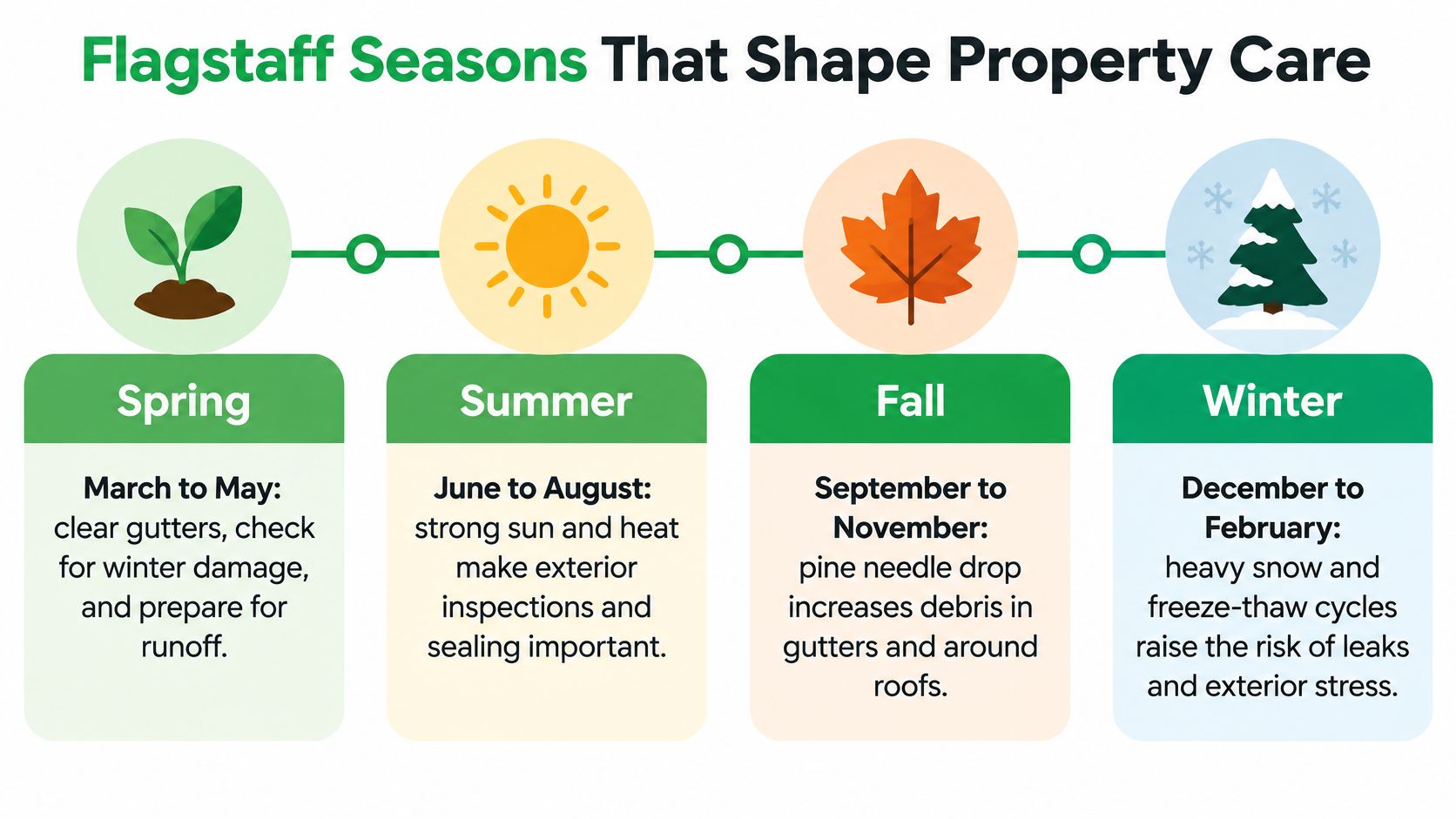
Flagstaff Seasons That Shape Property Care
An October gutter packed with pine needles looks harmless. In December it holds water, that water freezes, and by January you're looking at an ice dam forcing meltwater under shingles. Flagstaff's elevation, heavy snow, freeze-thaw cycles, needle drop, and strong sun turn small delays into expensive repairs. The fix is a calendar, not faster reactions.
The Four Blocks
- Spring, March to May: Clear gutters and downspouts of winter debris and needles, remove grit from walks and entries, and clean glass after snowmelt so you can spot seal and frame damage.
- Summer, June to August: Run exterior inspections, pressure wash entries and dumpster pads, and check window seals. Strong UV dries sealants and fades paint and frames, and summer storms reveal leaks while they're still small.
- Fall, September to November: Clean gutters after needle drop, inspect roofs and gutters, and finish pre-winter checks on access paths, exterior doors, and drainage.
- Winter, December to February: Schedule snow and ice removal per storm, watch roof snow load, and keep access paths clear for tenants, guests, and emergency services.
The order follows a cause chain. Needles and grit clog gutters in spring. Clogged gutters in fall hold water that freezes in winter. Snow load then stresses roofs and flat areas already weakened by standing water. Each block prevents the next block's emergency.
You can see how these blocks translate into scheduled visits in our seasonal property maintenance program, which ties exterior tasks to Flagstaff's weather instead of a generic national calendar.
Different Properties, Different Pressure
Homes near pines need gutter checks after heavy needle drop, not just twice a year by habit. Cabins and second homes need storm checks when owners are away, because a small leak runs undetected for weeks. Our Munds Park location serves the Pinewood Community and can be reached at (928) 440-8030 for exactly that kind of local coverage.
Hotels and campuses need snow plans that scale past a couple of shovels. We offer residential snow shoveling and removal of driveways and sidewalks using shovels and snow plows. For bigger projects such as parking lots and commercial buildings, we refer customers to Flagstaff Snow Removal.
Anchor your calendar to the first hard freeze and the last snow of the season, not to fixed dates. Flagstaff weather doesn't read contracts.
Prioritizing Competing Work Orders
A roof leak, a failed lock, and an icy entry land in the same week. Your budget and your vendors can't do everything today. You don't need a bigger inbox. You need triage, written down, that everyone follows the same way.
A Three-Tier Triage
- Tier 1, same day: Anything threatening occupants or access. That includes ice on entries, exposed wiring, water entering a unit, or a failed exterior door. Safety and safe entry come before everything else.
- Tier 2, within the agreed response window: Problems affecting comfort or operations. Think a failed heater, clogged gutters with a storm forecast, or a dirty lobby before an event. These get a scheduled date, not a shrug.
- Tier 3, scheduled: Cosmetic and planned preventive work, such as window cleaning rounds or pressure washing. These belong on the seasonal calendar so they don't compete with emergencies at all.
Record and Communicate Every Order
For every work order, record five things:
- Report date: When the issue reached you
- Tier: How it was classified and why
- Vendor assigned: Who owns the fix
- First action: What happened first, even if it's a temporary measure
- Closing photo: Evidence the work is complete
Then communicate in three messages. First, acknowledge the request within the agreed response time. Second, confirm the tier and expected date so the tenant or guest knows the plan. Third, send the closed-out report with photo evidence.
Tenant and guest requests center on comfort, faster work-order responses, and better communication. That means message timing matters almost as much as the repair itself. A fast, honest update about a Tier 2 date beats silence followed by a surprise visit.
When several issues compete, tell the owner what's being deferred and why. A deferred item with a date and a reason is management. A deferred item nobody mentions is how small problems become Tier 1 emergencies.
KPIs That Show Your Provider Is Performing
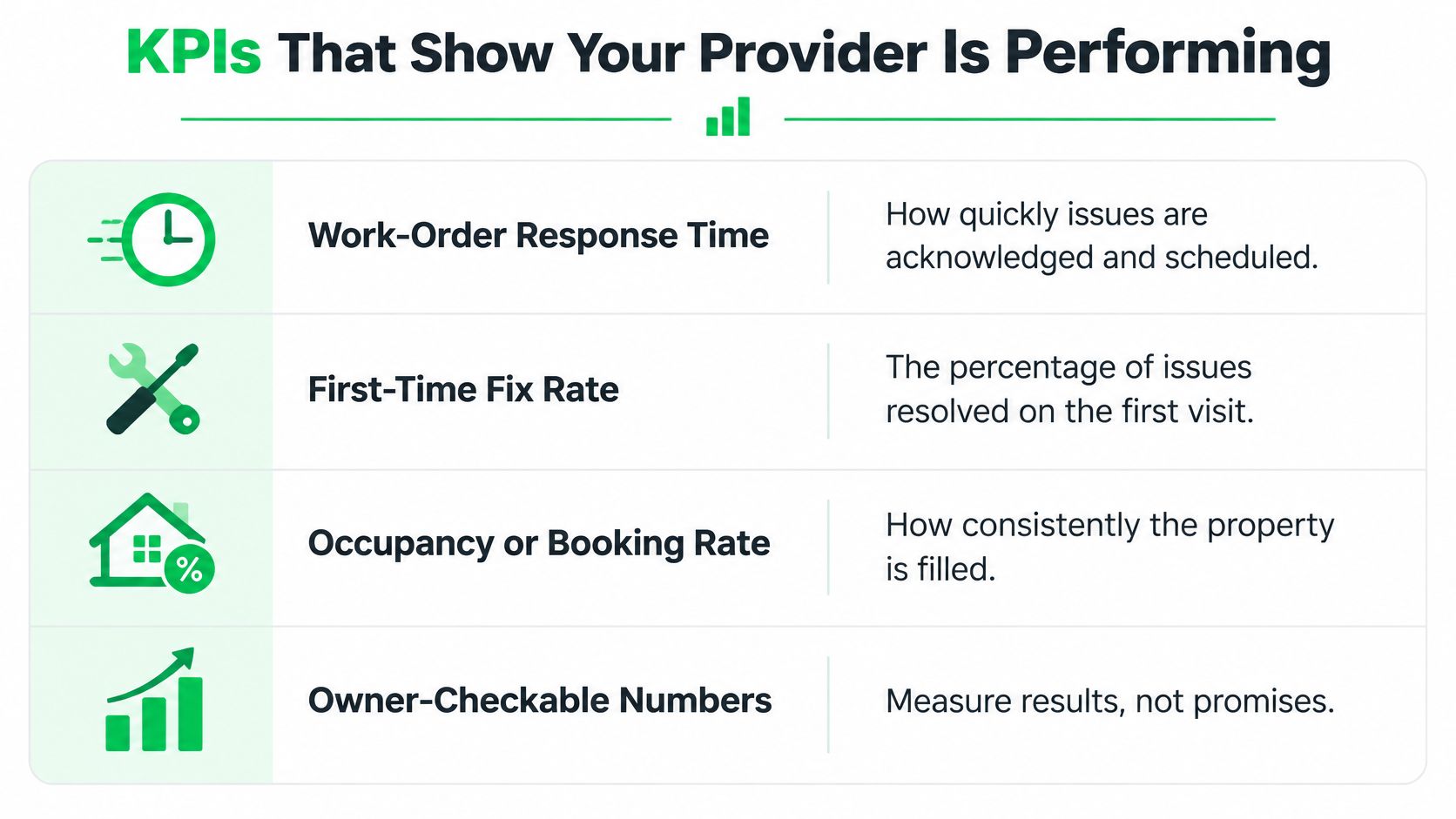
Judging a provider only by speed is a trap. A vendor can arrive fast, patch the symptom, and return three times for the same fault. You need numbers you can check each month, paired so one good-looking figure can't hide a bad one.
Property performance KPIs and how to calculate them
| KPI | How to Calculate It | Reasonable Target | Why It Matters |
|---|---|---|---|
| Work-order response time | Hours from report to first action | Same day for Tier 1, next business day acknowledgment for others | Shows accountability to the owner |
| First-time fix rate | Jobs closed without a return visit, divided by total jobs | Rising trend, with no repeat visits for the same fault | Controls repeat cost and disruption |
| Occupancy or booking rate | Occupied units or nights, divided by available units or nights | Compare with the same period last year | Shows revenue health |
| Collection rate | Rent or booking revenue collected, divided by billed | All billed revenue collected, minus agreed vacancy losses | Shows cash flow reliability |
| Maintenance cost per unit or square foot | Maintenance spend, divided by units or square feet | Budget against prior year and trend | Reveals rising cost early |
| Energy use intensity | Annual energy use, divided by square feet | Trend down against a monthly baseline | Flags equipment faults and leaks |
| Inspection completion rate | Completed inspections, divided by scheduled | Every scheduled inspection completed and documented | Proves preventive work happened |
| Satisfaction trend | Average guest or tenant survey score, tracked over time | Stable or rising from prior period | Shows whether service is working |
Energy Is the KPI Owners Skip
ENERGY STAR's benchmarking guidance reports that certified buildings use, on average, 35% less energy than typical buildings nationwide. It also reports high-performing buildings save approximately $0.60 per square foot annually in operations and maintenance expenses, $0.50 per square foot in janitorial expenses, and $0.53 per square foot in utility expenses.
The monthly method is simple. Set a baseline for energy use intensity, investigate deviations beyond a threshold you agree in advance, log the corrective action, and connect vendor work orders to the next month's data. A spike often points to a control failure, degraded equipment, or a leak you'd otherwise miss.
Satisfaction deserves the same discipline. If you want a model for tying scores to follow-up actions, this resource on how to track satisfaction after disaster restoration from Restore Heroes shows how service businesses close the loop after urgent work.
Pair response time with first-time fix rate in every report. Fast and wrong is not performance.
Ask for a monthly report with five numbers and three short notes. Response time, first-time fix rate, collection rate, maintenance cost, and inspection completion, plus notes on what changed, what's deferred, and what's next.
How to Choose a Property Management Provider
The strongest signal is written scope, not a confident sales pitch. A provider who'll list services, frequencies, exclusions, and response times on paper is telling you how they'll behave when something goes wrong.
Provider screening criteria
| Criterion | Strong Answer | Red Flag |
|---|---|---|
| Scope in writing | Named services, frequencies and exclusions in the contract | We handle everything, with no list |
| Fee transparency | Every fee itemized, markups disclosed, reimbursables listed | Charges appear only on later invoices |
| Response commitment | Stated response times and an after-hours contact | No after-hours contact for emergencies |
| Local presence | Staff or vendors within driving distance who know snow routes | Management run remotely with no local vendor |
| Evidence of work | Before-and-after photos and written service reports | Verbal updates only |
| Safety and insurance | Insurance certificates and documented crew training | Reluctance to share certificates |
| Written guarantee | Satisfaction remedy stated in the agreement | Promises made only in conversation |
| Documented standards | Written procedures for service levels, escalation and inspections | No written procedures at all |
What Documented Standards Look Like
ISO 41001, the facility management standard, is sector-neutral and applies to organizations of any size, geography, or facility type. In practice it expects service levels, vendor qualification, incident escalation, work-order response times, and inspection records to be planned and written down.
Your provider doesn't need certification on the wall. Ask whether their procedures follow that structure. If escalation lives only in one person's phone, you don't have a system.
The Site Visit and the Guarantee
A good provider walks the property before quoting. That's how they spot exterior hazards, access problems, and snow routes a spreadsheet misses. When you call or schedule online with us, a friendly staff member comes out to look at your home, building, or project before we price it.
Check the guarantee in the agreement itself. We guarantee customer satisfaction, and if a customer isn't satisfied, we'll visit the property to remedy the situation. Whatever provider you choose, that remedy should be written, not implied.
The Absentee-Owner Test
If you won't be on site, ask three direct questions. Who answers after hours? What photos or reports arrive after each visit? How quickly are exterior hazards like iced entries or a failed gate escalated, and to whom? Vague answers here predict exactly how a January emergency will go.
Confirm Scope, Fees and KPIs Before You Sign
You don't need a longer contract. You need five confirmations in the right order:
- List each property and the services it needs, using the scope table as your checklist.
- Request written quotes showing scope, frequency, and exclusions for every service.
- Compare total annual cost, including leasing, markups, and vendor work, not the monthly rate alone.
- Agree in writing on the KPI report, response times, and after-hours contact.
- Book a site walk before the contract starts, so hazards and access routes are known.
Exterior work such as window, gutter, and snow care slots into the seasonal calendar once scope is confirmed, and a structured facility maintenance contract keeps those visits from becoming one-off emergencies. We schedule service fast and answer our calls, and you can book a free estimate online or by phone at (928) 527-0671.
The right provider is one whose scope, fees, and numbers you can check on paper.
If your Flagstaff home, cabin, hotel, or commercial property needs exterior care that runs on a calendar instead of a crisis, we offer window cleaning, gutter and downspout cleaning, pressure washing, and seasonal snow removal with written scope and a satisfaction guarantee. Visit Pine Country Window Cleaning to schedule a free estimate and put your property on a plan you can verify.