
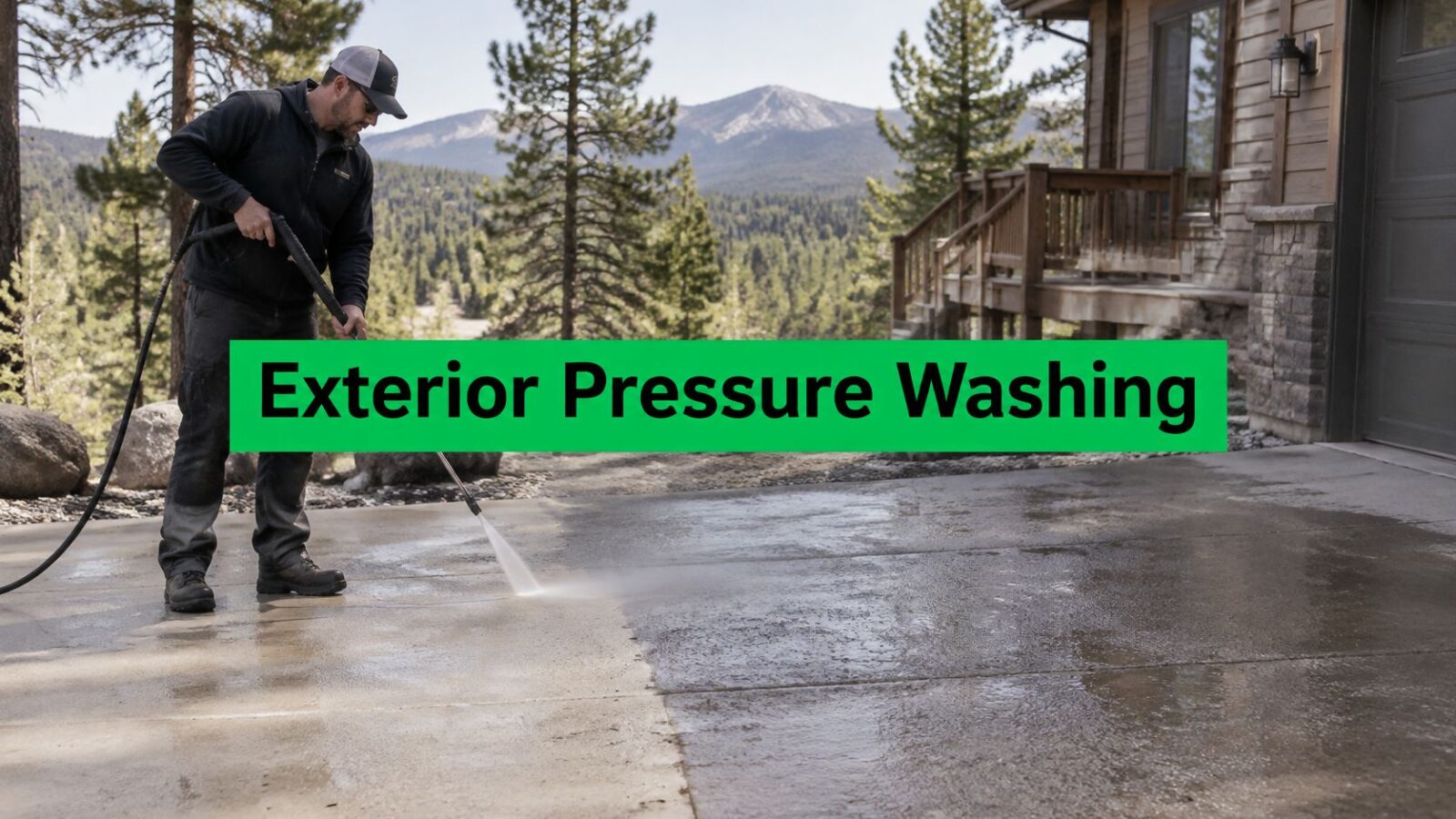
The south wall of a Flagstaff cabin looks tired the week the snow finally leaves. Sand sits in the driveway cracks. A gray film coats the siding. Needles clog the gutter, and the shaded deck is darker than the boards that get afternoon sun. It is tempting to rent a washer and turn the pressure all the way up.
That punch is not the useful wash. Exterior pressure washing services that fit Northern Arizona match the force to freeze-thaw materials, and they decide where the dirty water goes before the first trigger pull. Highest pressure and strongest soap are the two settings most likely to scar paint, drive water into a wall, or send oil toward a curb inlet.
A good visit treats each surface on its own. Concrete can take a focused rinse. Soft mortar, chalking paint, and old shingles cannot. Water trapped in masonry can freeze overnight and crack the face. The notes below are the same ones a crew should walk through with you before anyone uncoils a hose.
Surfaces Exterior Pressure Washing Services Include
Walk the place after snowmelt and the job splits itself. Winter sand and tire film mark the concrete. Pollen and windblown soil dull the siding. Shade holds mildew on the deck. Needles pack the gutters, and the roof only wants a gentle rinse so granules and seals stay put. One machine setting cannot cover that list.
Pine Country Window Cleaning washes driveways, sidewalks, garages, roof shingles, roof eaves, and home siding. The mix is set after a look at the property, not from a package printed in advance. Two stories, stone or older stucco, a request for soap, or a commercial lot at a hotel, dealership, or campus all change the plan. So does peeling paint, a soft deck board, or a storm drain sitting at the curb.
What an exterior wash covers
Use the table to build a first-visit list, and flag anything fragile before you book.
| Surface | Typical Flagstaff soils | What the crew does | Flag before booking |
|---|---|---|---|
| Driveways and sidewalks | Winter sand, meltwater film, tire marks | Controlled concrete wash | Oil stains or a storm drain at the curb |
| Garage floors | Tire residue and stored-item dust | Spot treat, then rinse | Chemical containers or floor coatings |
| Siding | Pollen, dust, pine debris | Low pressure matched to the material | Paint that is chalking or peeling |
| Decks and railings | Shade mildew and weathered dirt | Wider fan and more distance | Soft, splintered, or newly stained wood |
| Roof shingles and eaves | Needles and light staining | Low pressure only, no zero-degree tip | Missing granules, lifted tabs, or active leaks |
| Gutters and downspouts | Packed needles and silt | Lift debris out, then flush | Overflow staining on fascia or a detached hanger |
| Brick, stone, or stucco | Dust and biological growth | Test patch and low pressure | Open joints, cracks, or a historic facade |
A driveway wash and a roof rinse are different jobs even when they happen the same morning. Concrete gets a controlled pass for sand and tire film. Garage floors often need a spot treatment for stored-item dust before a rinse, and chemical jugs or a coated floor should be called out first. Siding dulled by pollen wants low pressure matched to the material. A deck in shade wants a wider fan and more distance, especially if the wood is splintered or newly stained.
Roof shingles and eaves only tolerate low pressure, and a zero-degree tip stays in the truck. Gutters have to be emptied of needles before any flush, or the downspout just packs the silt tighter. Brick, stone, and stucco start with a test patch.
Practical rule: If a surface is on the fragile column, say so when you schedule. A look at the house beats a guess from the curb.
Height changes the tools, not the rule. Upper siding still gets the pressure the material can stand. Commercial lots add oil and foot traffic a cabin deck never sees, so the crew plans containment before the wide rinse.
How Pressure Is Chosen for Each Material
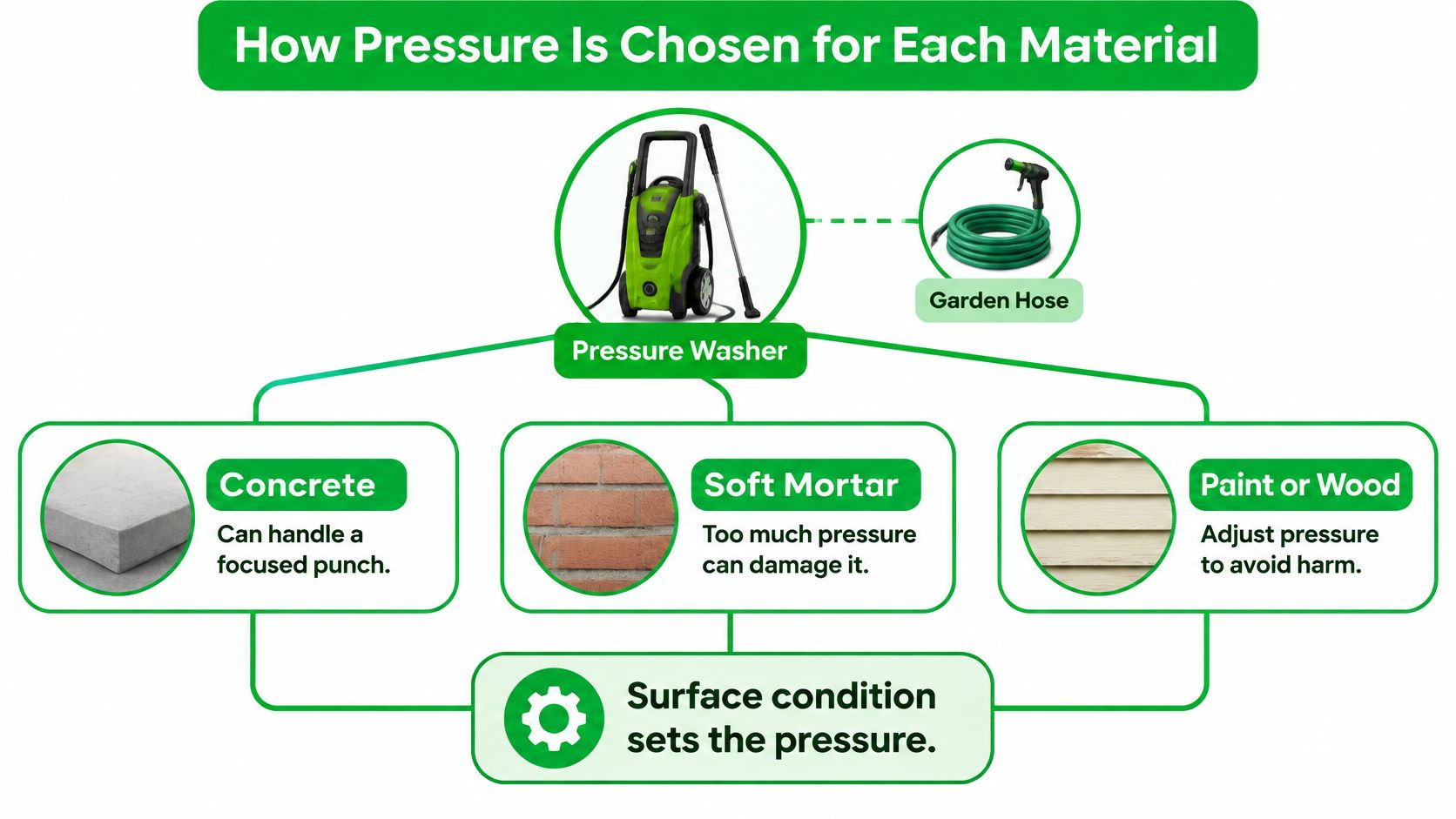
Think of a pressure washer as a garden hose with a focused punch. On sound concrete that punch lifts sand and tire film. The same punch on soft mortar, chalking paint, or weathered wood cuts the surface instead of cleaning it. The highest number on the machine is not the setting. Surface condition sets the pressure.
Masonry starts low
For brick, stone, and many stucco walls, the General Services Administration historic-masonry procedure and National Park Service guidance both say to begin at 100 psi or below and rise only as needed. For many historic-masonry jobs that ceiling stays under 300 to 400 psi, and GSA specifies starting at 100 psi or less and not exceeding 400 psi. That slow rise is what keeps mortar joints from eroding and keeps water out of cracks.
Picture a discreet test patch before anyone washes a whole wall:
- Look for open joints, failed sealant, spalling, and porous or already damaged faces.
- Wash one small spot at the low starting pressure.
- Let it dry, then compare clean color against any new etch or loosened grit.
- Only then widen the work, and only if the patch looks sound.
Preservation guidance treats pressures above roughly 1,200 psi as able to scar or etch fragile masonry for good. A cabin chimney or an older commercial facade can look dirty and still be too soft for a "quick blast."
Paint, stucco, and decks
The same idea carries to painted siding, stucco, and wood. Water alone takes off a lot of dirt. Extra soap or extra force can lift a coating or push water behind trim. On vinyl, the safer path is the one described in our guide to vinyl siding pressure washing, where distance and a fan tip matter more than raw pressure.
Flagstaff adds a clock. Water left in masonry can freeze, expand, and crack or spall the wall. Schedule the wash so the surface can dry before frost, and delay the job when a hard freeze is close. Cosmetic clean is not worth a split joint in March.
Injury Risks and the Gear That Limits Them
A pressure washer is a cutting tool that happens to use water. Treat it that way and the safety talk stops sounding optional.
A safety summary of Consumer Product Safety Commission data, published by the BHHC Safety Center, counted 6,057 U.S. emergency-room visits for pressure-washer injuries in 2017, and 14% of those visits ended in hospitalization. The same summary counted more than 6,000 emergency-room admissions in 2014, with nearly 15% requiring a hospital stay.

What actually gets people hurt
Reported injuries include lacerations, puncture wounds, bruises, eye injuries, infections, chemical injection, slips, electrocution, and falls from ladders or work at heights. High-pressure injection is often underestimated. A review of 435 upper-extremity cases found an amputation rate of 30%. A pinhole in a hand or foot is an emergency, not a bandage-and-finish-the-driveway moment.
Gas-powered machines add carbon monoxide inside a closed garage. Operating noise can contribute to hearing loss. None of that shows up in a before-and-after photo.
What you should see before the first trigger pull
Our technicians are background-checked and industry safety trained. Before spray starts, you should be able to see the controls, not just hear a promise:
- Hoses and tips: Inspected, with pressure already matched to the surface in front of the wand.
- Eyes and ears: Protection on, because spray and debris do not stay in a neat line.
- People and pets: An exclusion zone, and no spray toward anyone or toward glass at close range.
- Power and chemicals: Outlets kept dry, and detergent handled instead of dumped.
- Height: Fall protection where the work is on a roof, a raised deck, or a multi-story wall.
Those controls matter most on commercial facades and any job that uses detergent. Owners and facility managers should ask who is trained and what protection is on site before they compare price. A cheap bid that skips eye protection or sprays from a loose ladder is not a bargain.
Where Pressure-Washing Wastewater Goes
A curb inlet is a storm drain, not a sanitary sewer. Pressure moves oil, paint flakes, sealant, sediment, metals, and detergent off the surface and into whatever path is downhill. "Biodegradable" on the jug does not make that discharge acceptable. The pollutants that came off the concrete still count.
EPA guidance on pressure-washing discharges says to map every storm drain first, avoid illegal discharges, use cold water without soap when rinse will reach a storm sewer, and capture or divert water that carries soaps, oils, sediment, or other pollutants. Fairfax County's pressure-washing sheet tells crews to use less water, set inlet barriers, send cleaner rinse toward suitable vegetation, and contain water mixed with chemicals or hazardous material. GSA practice adds a drainage check, containment, and disposal under federal, state, and local rules. A vegetated area, a sanitary connection, or off-site disposal can each be the right answer. Nobody gets one universal rule.
Where exterior wash water should go
| What is in the water | Destination | What the crew does |
|---|---|---|
| Plain dirt with cold water and no soap | Vegetated area away from a drain | Use less water and sheet the rinse onto plants that can take it |
| Flow aimed at a storm sewer and no soap | Not the curb inlet | Map the inlet and wash with cold water only |
| Soap, oil, metals, or paint flakes | Capture, a sanitary connection, or off-site disposal | Berm the area, block the inlet, and recover the water |
| Heavy sediment or construction dust | Contained on site, not a storm drain | Keep solids out of the gutter and off the inlet |
| Commercial petroleum film on a lot | Recovery or a locally allowed diversion | Treat hotel, dealership, and loading runoff as contaminated |
On a Flagstaff driveway, find the curb inlet first. If the concrete is oily, berm it. Wash with cold water. Let only light soil sheet into landscaping that can take it. Hotel drives, dealership rows, loading zones, and building fronts often carry petroleum residues, metals, detergents, paint debris, and thick sediment. That water gets recovered or diverted under the local rule before anyone starts a wide rinse.
The pre-job note should name the destination, the outlets that will be covered, and a last check that the collection points held.
Our approach to eco-friendly pressure washing starts with that path, not with a greener-sounding soap. Foundations, plants, and the storm system all sit downstream of the wand.
The Steps of a Professional Exterior Wash
A Flagstaff wash should follow the surfaces, not the urge to use more pressure. A careful sequence helps protect paint, siding, shingles, and plants while keeping rinse water on its planned route.
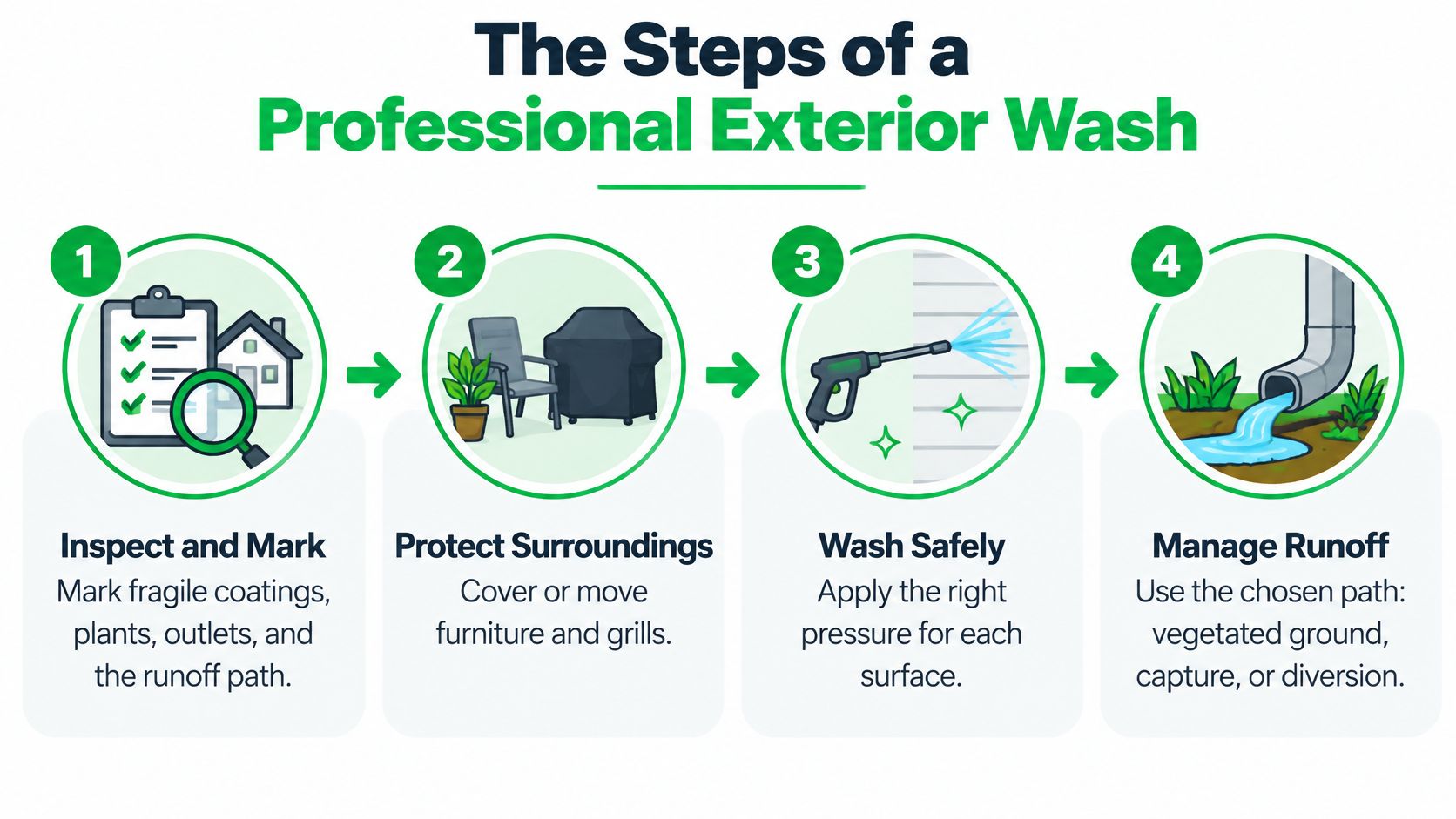
Mark the limits. Identify fragile coatings, plants, outlets, and the path rinse water will take. Choose the wash area with freeze-thaw surfaces in mind: water left in a vulnerable joint can cause trouble as temperatures shift.
Clear the spray zone. Move or cover furniture, grill covers, and pots. Keep people and pets out of the work area, and protect anything that should not get wet.
Set the ladder before climbing. Place a straight or extension ladder on firm, stable ground and keep your body centered as you climb. The OSHA portable ladder quick card advises that the ladder extend at least 3 feet above the landing. Avoid climbing while handling a pressure-washer hose, which can pull you off balance.
Test a small patch. Wash a discreet section of siding, masonry, or wood, then check it after it dries. Adjust the spray tip, distance, and pressure based on how that material responds. A setting that is safe for concrete can strip paint or force water behind siding.
Wash walls from the top down. Use a fan-shaped spray to rinse without streaking areas that are already clean. Keep a narrow, concentrated jet away from coatings and roof shingles, where it can cut or loosen material.
Clear gutters before flushing. Remove needles and silt first, then flush the downspouts. Pushing debris through a gutter without clearing it can shift the blockage farther along.
Use detergent only where rinsing is not enough. Check that barriers and collection measures remain in place before applying or rinsing any product. If a barrier slips, stop and reset it before continuing.
Inspect after drying. Look for even color, attached paint, and undamaged plants. Point out surfaces left untouched because they are soft or fragile, so the owner knows the reason for the limit.
When windows are on the same visit
Window cleaning is a separate part of the visit from pressure washing. Pine Country Window Cleaning's residential service includes outside and inside windows, removing, cleaning, and reinstalling bug screens, wiping window frames inside and out, and wiping inside sills. Glass can be cleaned with squeegees or poles using pure water filtered to remove contaminants and minerals, delivered to a soft brush at the top of a pole.
Before the truck leaves, ask which surfaces were cleaned and why any were left alone. A soft board, loose joint, or vulnerable pane should not be treated as a missed spot.
Flagstaff Weather and What It Leaves Behind
Flagstaff does not dirty a house once a year and then stop. Flagstaff climate figures list average annual precipitation at 22.96 inches and average annual snowfall at 108.8 inches. January averages about 22.5 inches of snow, February 22.2, March 21.9, and December 17.9. That is a winter of meltwater, sand, and packed needles, not a single storm.
What each season sticks to the house
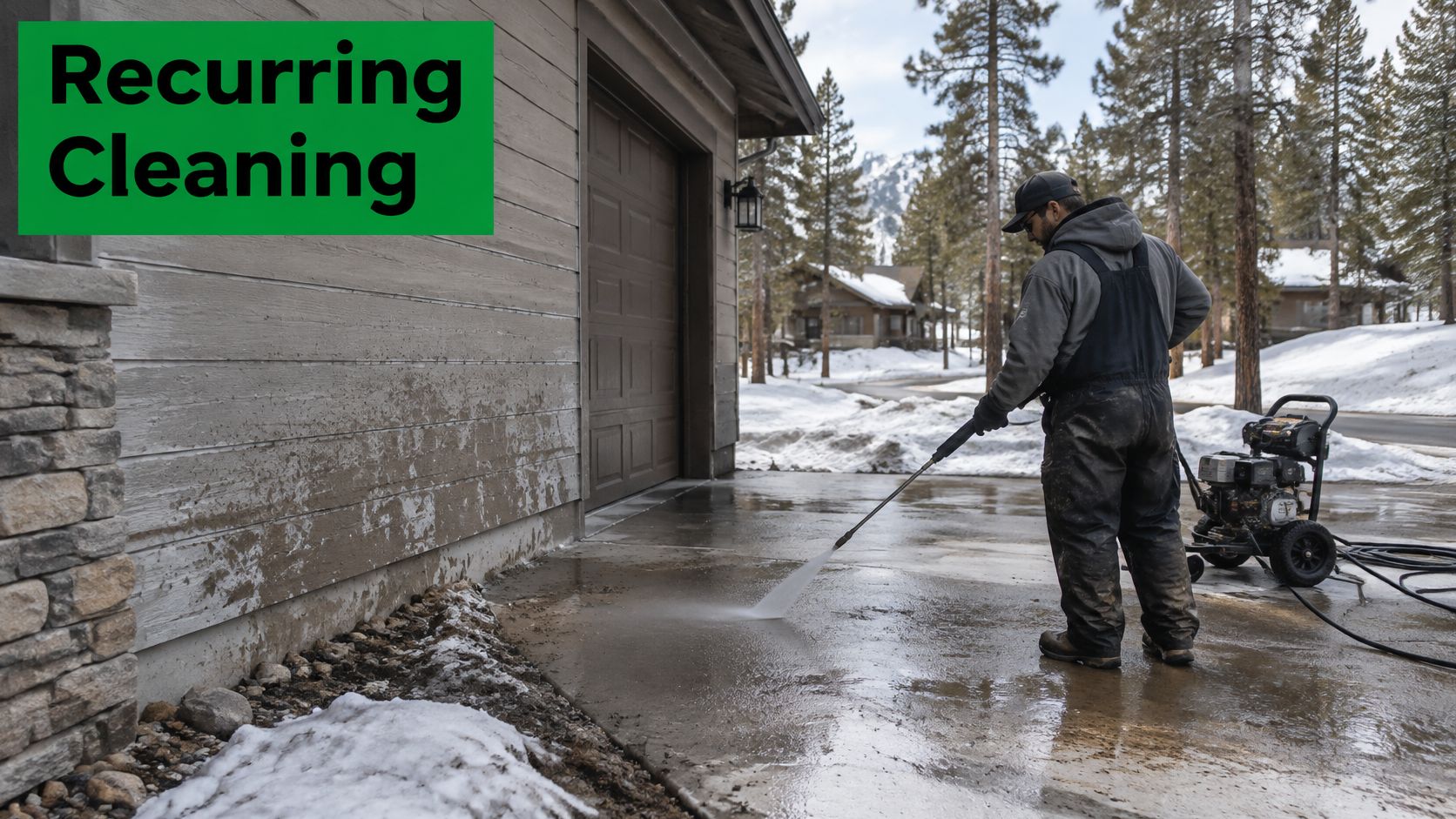
The Flagstaff weather summary describes a semi-arid climate with four seasons, cold winters with plentiful snow, mild summers with average highs in the 80s, and thunderstorms from July through September. Winter leaves sand and melt film on drives, and needles in gutters. Monsoon storms add dust and splatter. Summer heat bakes that film onto siding and concrete, so a fall wash is often about a crust, not a loose rinse.
We serve homes, businesses, hotels, NAU, car dealerships, high-rise buildings, and medical buildings, including cabins and houses in Flagstaff, Munds Park, Forest Highlands, Pine Canyon, and Flagstaff Ranch. A second home or short-term rental often wants a wash after winter closure, and another after monsoon dust if guests are coming. A dealership row or a hotel drive adds oil and foot traffic a cabin deck does not. Medical entries and campus walks collect the same winter sand, plus constant use.
When to put it on the calendar
Time the wash away from a hard freeze so masonry can dry, and away from a day when rinse will sit in shade. A simple seasonal picture is enough for most properties, and it lines up with seasonal property maintenance rather than a one-time makeover:
- Spring: Melt residue on concrete, siding, and the first gutter clean after the needles drop from snow load.
- Late summer: Storm dust and splatter once the monsoon pattern eases, before heat sets the film.
- Any month the needles pile up: A gutter check, because a packed trough overflows onto fascia long before the next full wash.
Commercial lots do not follow the cabin calendar exactly. Oil and daily traffic keep coming, so a facility manager may want a shorter cycle on entries and a longer one on upper walls.
Book Pine Country for a Flagstaff Exterior Wash
A Flagstaff driveway can hold winter grit while siding collects monsoon dust. Pine Country Window Cleaning has served Flagstaff and Northern Arizona since 1999, offering pressure washing alongside window cleaning for homes, cabins, and commercial buildings. The useful wash is the one suited to each surface and the route rinse water will take, not the highest pressure.
Call (928) 527-0671 or schedule online to arrange a free estimate. A friendly staff member comes out to look at the home, building, or project. Have the address ready and name the surfaces you want cleaned. Point out peeling paint, soft wood, or a storm drain near the driveway so the crew can consider those conditions.
Pressure washing is one of the company's services, alongside residential and commercial window cleaning, gutter cleaning, pine needle cleanup, post-construction window cleaning, and snow removal. For a window visit, screens are removed, cleaned, and reinstalled as part of the service. Pine Country schedules service quickly, answers calls, and guarantees its work.
If you want to compare invoice layouts while considering a job, pressure washing billing with AurenWell is an invoice template. Call or book online for a free look at your project. In Flagstaff's freeze-thaw climate, matching the wash to the surface and managing where the water flows matter more than choosing maximum pressure.