

A Flagstaff property can look quiet after a snowstorm, then start shedding meltwater as soon as the sun reaches the roof. If pine needles have packed the gutters, that water may spill over the edge instead of draining away from the house. For owners of cabins, rentals, and second homes, the trouble can start while nobody's there to see it.
Gutter cleaning in Flagstaff, AZ, is about keeping stormwater moving through a climate of dry spells, snow, wind, and freeze-thaw cycles. A useful visit clears debris, checks the downspouts, and notes any drainage or attachment problems. It's preventive maintenance for the roofline and the ground around the building, not just a fall cleanup.
Why Gutter Cleaning Flagstaff AZ Cannot Wait for Fall
The morning after a heavy snow in Flagstaff or Munds Park, a roof can still be carrying a deep blanket of snow while sunlight starts to soften its edges. Meltwater runs toward the eaves, where pine needles may already be packed into the gutter. If the outlet is blocked, water spills over the lip or backs up instead of traveling down the downspout.

That's a drainage failure, not just a dirty-gutter nuisance. Runoff can reach fascia and siding, collect near foundations, or make walkways and entries wet when people need to use them. An overflow you notice from the driveway may be the first visible sign that water has been taking the wrong route.
The local snowfall record is a good reason not to wait for that warning. The National Weather Service's Flagstaff office reports that Flagstaff Pulliam Airport receives an average of 90.1 inches of snow between October and May. Its record for snowfall in a single 24-hour period is 35.9 inches. Those conditions make roof-edge drainage a year-round concern.
Who may not see the blockage
Cabin owners, second-home owners, short-term rental hosts, and commercial property managers can't always check a building after each storm. At a cabin or rental, a quiet blockage might go unnoticed until a guest reports water near an entry or an owner returns to find runoff has marked the siding. On a commercial building, a blocked section over a walkway can create a problem for tenants and visitors before anyone sees the cause overhead.
A practical schedule starts with a cleaning before winter, followed by checks after heavy storms and during spring melt. Those are useful service windows, not a guarantee that every property needs the same visit pattern. Tree cover, roof layout, and how often someone is on site all affect what makes sense.
How Snow and Meltwater Overload Flagstaff Gutters
Flagstaff's debris-and-water cycle often begins during a dry spell. Pine needles, dust, leaves, and roof granules settle in the gutter channel, sometimes collecting around an outlet. When a storm or snowmelt sends runoff down the roof, a partly blocked channel can't carry water away as freely. The water slows, backs up, and may spill over the edge.
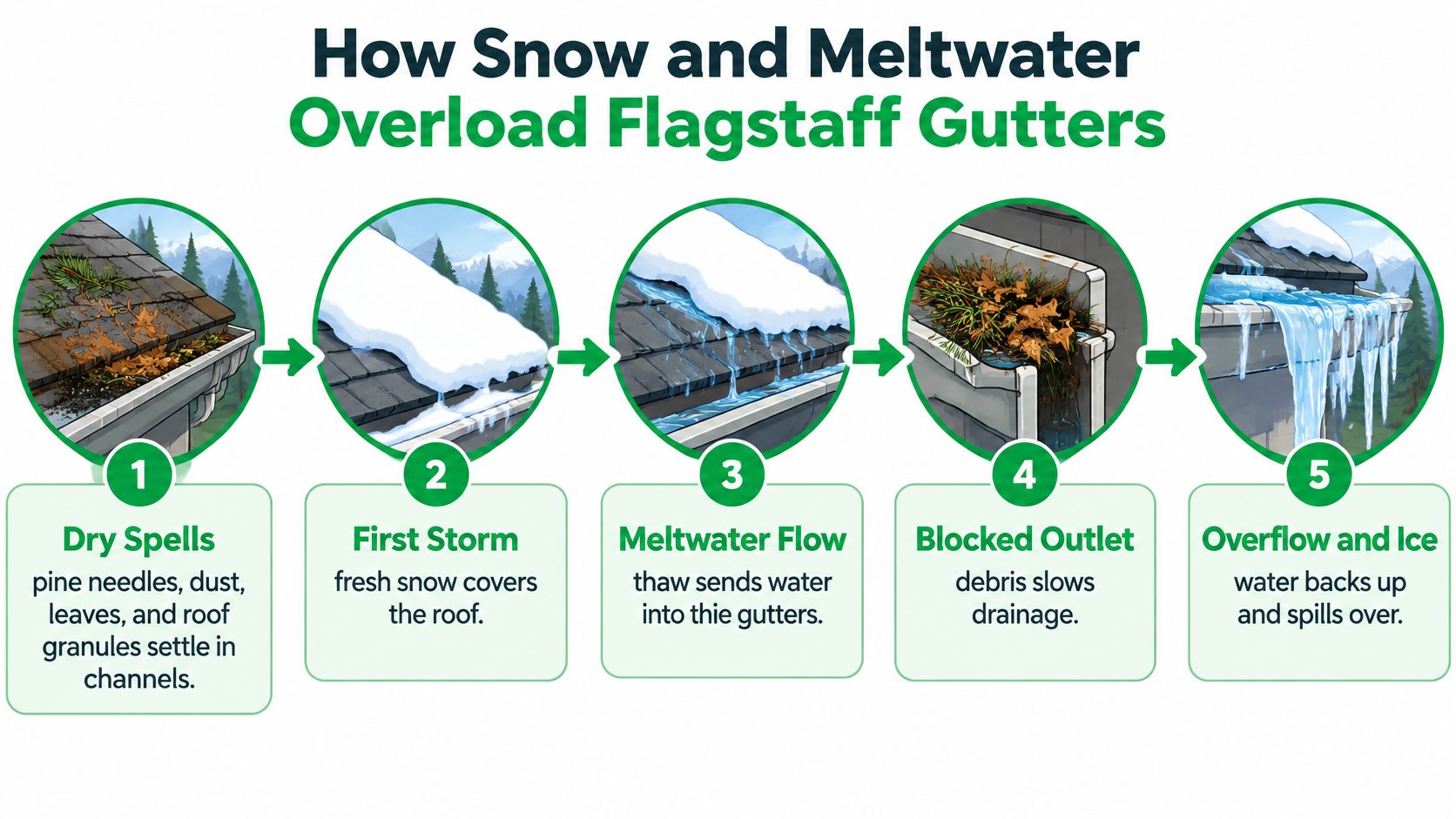
The local backdrop includes approximately 22.96 inches of annual precipitation and 108.8 inches of annual snowfall, with substantial winter accumulation concentrated between November and March, according to the Flagstaff area weather summary. Those conditions make a clear drainage path important when snow begins to melt. If water can't move through the gutter and downspout, repeated freezing can contribute to ice dams, trapped water, gutter deformation, and leakage at fascia or roof edges.
The load isn't just water
In snowy climates, the gutter's attachment points may be stressed by compacted snow, ice, and snow sliding off the roof, not just by water from a light rain. A gutter that's already sagging or pulling at a seam has less room to handle that stress. Clearing debris gives a technician a chance to spot those warning signs while checking drainage.
A sound visit should confirm that downspouts discharge away from the foundation, that fasteners and seams haven't shifted, and that roof areas where snow tends to gather are noted. Standing water can point to an obstruction or poor slope. Sagging sections, separated joints, and crushed outlets are signs that the system may need attention beyond debris removal.
A clean-looking trough isn't proof that the system drains. The outlet and downspout have to carry water away from the building.
How Often Gutters Need Cleaning in a Variable Climate
A citywide average can't tell you how quickly a particular roofline will clog. A U.S. Geological Survey climate assessment covering 1950–2007 reports that Flagstaff precipitation averaged about 22 inches per year, but annual totals ranged from 9 to 39 inches. Average annual snowfall was 97 inches. NOAA local climatological data also describes years with less than 10 inches of precipitation and others with more than 35 inches. In some winters, snowfall can exceed 100 inches in a month and 200 inches in a season.
The useful lesson isn't to treat those historical figures as a forecast for your house. It's to build a plan around exposure. A spring-and-fall cleaning is a reasonable baseline for many properties, but ponderosa pines, windblown debris, and long absences can make that schedule insufficient. The Northern Arizona wildfire guidance discussed below also recommends clearing gutters at least twice annually, or more often when needed.
| When to Schedule Flagstaff Gutter Cleaning | ||
|---|---|---|
| Property situation | When to schedule | What to verify |
| House with limited tree cover | Before the wet or snowy season, then check after major storms | That channels and outlets are clear |
| Home beneath ponderosa pines | Before winter and again when debris builds up | That needles haven't formed a mat around the outlet |
| Cabin, rental, or second home that's often empty | Before extended vacancy, after wind or heavy snow, and during spring melt | That water exits the downspouts away from the foundation |
| Commercial property with several roof areas | Arrange checks around weather exposure and building access | That outlets and discharge paths are clear at roof intersections |
Use the calendar as a reminder, not as the only trigger. A storm can drop enough debris to change how a gutter drains, while long dry weather can let pine needles and grit build up before the next rainfall. For owners coordinating multiple exterior tasks, seasonal property maintenance planning can help keep inspections from slipping while a property is vacant.
What Cabins Rentals and Commercial Roofs Actually Face
A cabin under ponderosa pines in Munds Park may sit empty while needles collect around its gutter outlets. From the ground, the roof can look fine. The first clue may come later, when meltwater spills over an eave or a visitor finds water near the foundation. For cabins in wooded areas such as Forest Highlands, Pine Canyon, or Flagstaff Ranch, the risk depends on how much debris reaches the roofline and how long the property goes unchecked.
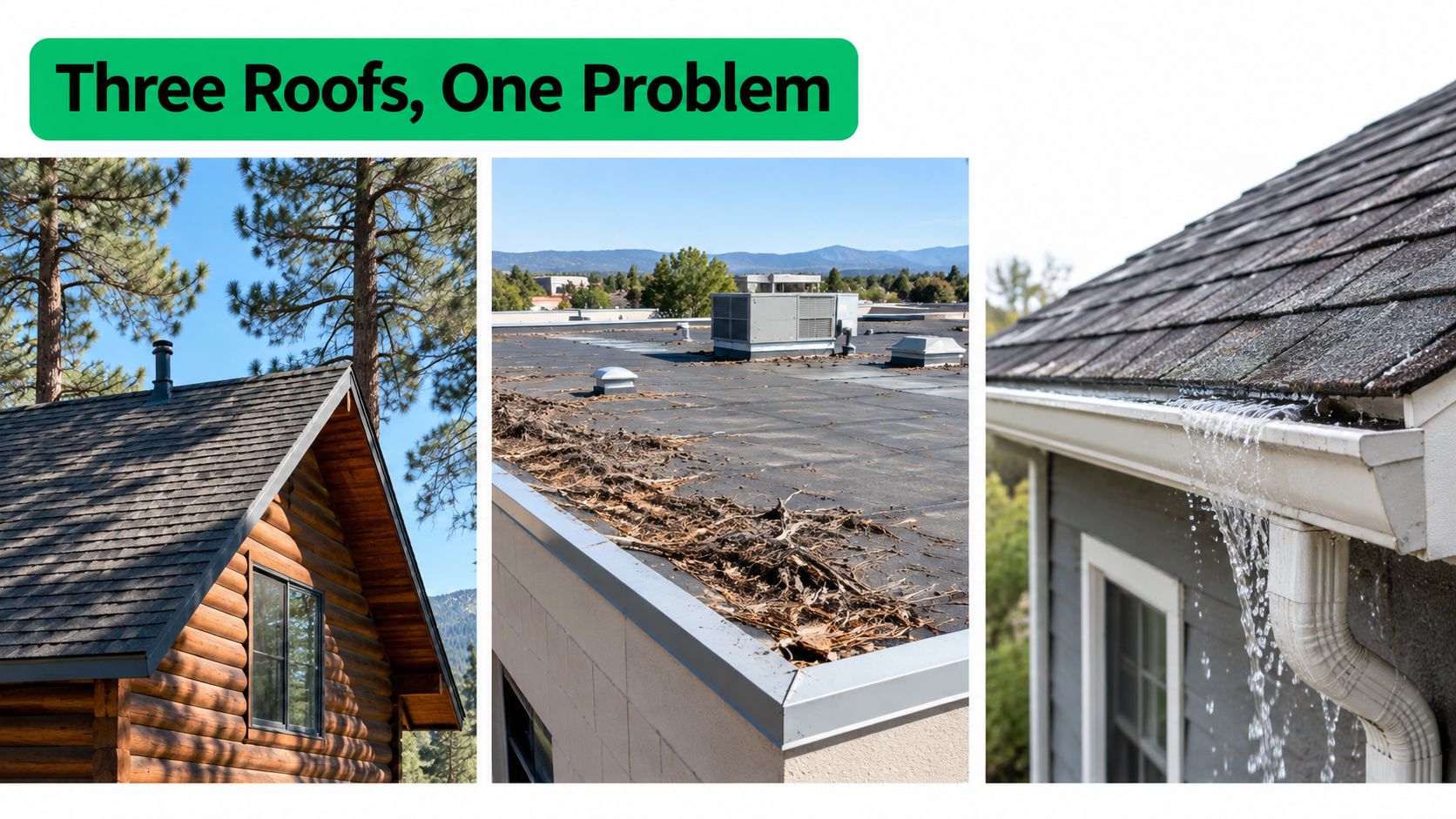
A short-term rental has a different weak spot. Guests come and go, while the host may not be on site to notice a gutter overflowing over a walkway or by an entry. A complaint about water near the door can be the first sign of a blockage that started with needles or roof debris. A host needs a maintenance check that doesn't depend on someone spotting trouble during a stay.
Larger buildings have more to coordinate
A hotel, dealership, medical building, campus facility, or other large property may have roof sections that meet at different points and several downspout outlets to track. One blocked outlet can send runoff toward a busy walkway or entry while other parts of the building drain normally. For a facility manager, documenting which areas need attention can make follow-up maintenance more practical than treating the whole roof as one uniform system.
The common factor is who notices. A full-time homeowner may see an overflow soon after a storm. A commercial manager may hear about it from staff or visitors. At a vacant cabin, nobody may notice until the next visit. Maintenance frequency should follow debris loading and occupancy, not just the month on the calendar. For property managers arranging work across bigger buildings, commercial gutter cleaning is a service option to consider when planning the site's maintenance.
Safety Checks Before Anyone Climbs to the Eaves
A proper gutter visit checks capacity and attachment, not only whether pine needles have been scooped out. One technical drainage guide recommends a gutter slope toward downspouts of at least 1/16 inch per foot, about 1/4 inch over 10 feet. For snow country, it recommends hidden hangers spaced roughly 16–18 inches apart, compared with about 24 inches in ordinary conditions. See the exterior drainage guidance for those installation details.
Those dimensions are useful questions to raise when a gutter shows signs of holding water or pulling away. Standing water can indicate poor slope or a blockage. Sagging runs, open joints, loose hangers, and crushed downspouts suggest that the system is losing capacity or that its attachments need attention. A cleaning visit won't correct every defect, but it can reveal where a repair should be considered.
What to expect from the inspection
A careful crew should clear outlets, check that downspouts discharge away from the house, look for movement at seams and hangers, and identify areas where roof shape concentrates snow or runoff. The point is to leave with a clear account of what was cleaned and what may need repair, rather than assuming debris removal solved every drainage issue.
The work itself also calls for sound fall protection. OSHA recognizes window cleaning as work that can require personal fall-protection systems and says employers must choose equipment for the situation, train employees in its proper use, and provide prompt rescue capability if someone falls. OSHA also states that a personal fall-arrest system must be arranged so an employee can't free-fall more than 6 feet, or 1.8 meters. The agency's fall-protection guidance for window cleaning is relevant to exterior work done at height.
Homeowners can look for visible overflow from the ground, but climbing to a roof edge or working from a ladder is a different decision. For background on safe ladder use, review ladder safety requirements. If access is awkward, the ground is uneven, or the gutters are high, leaving the work to a properly equipped crew is the safer choice.
Choosing a Local Crew That Protects the Whole Property
A ground check after a storm is useful: look for visible overflow, wet areas below the eaves, or water tracking toward an entry. It won't show whether a raised gutter is clear all the way to its outlet or whether a downspout is carrying water away from the house. That's the practical difference between observing the system and cleaning and checking it.

There's another reason to keep gutters clear in a wooded area: wildfire preparation. The City of Flagstaff's wildfire guidance identifies rain gutters as potential ember entry points and advises residents to inspect them regularly and remove combustible material. The Northern Arizona Wildland Fire Action Guide recommends removing dead leaves, debris, and pine needles from roofs and gutters at least twice annually, or more often when necessary.
Cleaning gutters is only one part of reducing wildfire exposure. Roof valleys, roof edges, downspout outlets, and nearby vegetation also deserve attention. Gutter service doesn't replace roof repairs or a broader wildfire-mitigation plan.
Ask how the visit protects the building
When comparing crews, ask whether they clear the outlets, check downspout flow, remove debris from the work area, and let you know if they see sagging or loose sections. A ground-level check can help you decide when to call. Cleaning higher areas, especially around difficult access or winter conditions, requires equipment and training appropriate to the work.
Pine Country Window Cleaning is a Flagstaff-based exterior-maintenance option. Flagstaff native David Kaminski started the company in 1999. Its window crews use professional squeegees, ladders, extension poles, and pure-water brushes. With every window service, technicians remove, clean, and reinstall screens. The company says its technicians are background-checked and OSHA safety-trained, and it uses in-house lifts for challenging commercial and atrium work.
That window-care detail matters when you're choosing a crew for more than one exterior task. Care for the home includes communicating clearly, handling screens carefully, and leaving the work area orderly. For gutter and downspout cleaning, expect the same attention to access, debris, and where water leaves the building.
Schedule Gutter Cleaning Before the Next Storm Cycle
Start with three questions: What kind of property is it? How much tree cover reaches the roof? Will anyone be there through winter? A wooded cabin, rental, or second home may need a late-fall cleaning and a plan to check the system again after major snow or wind. If the property will be empty, arrange those checks before a blockage goes unnoticed.
For a hotel, campus, dealership, or other commercial building, ask for a documented look at outlets, discharge paths, and any sagging or loose hangers, especially where roof sections meet. The purpose is to know which areas drain as intended and which need follow-up. Don't rely on a single general note if the building has several rooflines and discharge points.
A deep snow day can be followed by sunshine and meltwater. The water can only drain through an open channel and downspout. Book before the next storm cycle, and ask the crew to include the gutter and downspout cleaning, confirm where the water discharges, and note any visible concerns that need repair. If window cleaning is part of the same appointment, confirm that screen removal, cleaning, and reinstallation are included.
Done means more than an empty-looking gutter. The outlets are clear, the downspouts carry water away from the building, and you know about any visible drainage or attachment concerns. That gives you a practical next step, whether it's arranging a repair, planning another inspection, or just keeping the property on schedule.
Pine Country Window Cleaning offers residential and commercial gutter and downspout cleaning, along with window cleaning that includes screen removal, cleaning, and reinstallation. Contact the team for a free estimate and ask for a check of your property's drainage paths before the next storm cycle. Visit Pine Country Window Cleaning to get started.