

A bright Flagstaff morning can make a clean pane look almost invisible. It can also expose every mineral spot, streak, and dusty edge left behind by an improvised cleaning job. Across storefronts, hotels, offices, homes, and cabins, the difference usually comes down to controlled water removal, sound equipment, and a technician who respects the glass and the property around it.
A commercial window cleaning squeegee is simple, but it isn't casual equipment. The channel, rubber, handle, pole, water, and operator all have to work together. Northern Arizona adds its own demands, including strong sun, dry air, high-altitude exposure, dust, and water that can leave visible residue as it dries.
Why the Squeegee Remains King in Commercial Cleaning
On a clear Flagstaff morning, clean glass should pull your eyes toward the San Francisco Peaks, not toward pale arcs left by a rushed wipe. A hotel entrance, dealership showroom, or office lobby can have excellent architecture and still look neglected if the glazing carries streaks. The squeegee earns its place because it removes the wash water in a deliberate, visible path, leaving the operator in control of the result.
That control matters more than raw force. A power washer can move dirt from a façade, but it isn't a substitute for direct blade contact on delicate glass, seals, frames, or interior panes. A trained technician can adjust pressure, angle, direction, and stroke length as the surface changes.

A simple tool with demanding technique
The squeegee doesn't clean a contaminated pane by itself. A washer or pure-water brush first loosens dust, pollen, film, and other deposits. The rubber blade then creates a moving seal against the glass, pushing water and suspended soil away instead of spreading it across the surface.
That sequence is especially useful in Northern Arizona. Dry conditions can make settled dust abrasive, while strong sun can expose marks quickly as water evaporates. A careful operator watches the pane, keeps the blade clean, and avoids dragging grit across the surface.
Practical rule: A squeegee should remove clean wash water, not grind dry debris into glass.
Commercial work also demands consistency. Broad, unobstructed glazing rewards a longer channel and a steady pull. Divided lights, mullions, narrow reveals, and irregular frames require a smaller, more maneuverable setup. The right tool lets a technician maintain contact without forcing the rubber into corners or losing control.
Why professional control protects the property
The value isn't only a brighter pane. Controlled work helps protect seals, frames, screens, landscaping, flooring, and finished surfaces around the window. Ladders, extension poles, pure-water brushes, and lifts each have a role, but they must be used with judgment.
That combination of a basic blade and skilled handling explains why the squeegee remains central even as equipment improves. Its job is direct and measurable. The operator wets the glass, establishes a clean edge, and removes the water without leaving the pane to dry unpredictably.
The Evolution and Anatomy of a Professional Squeegee
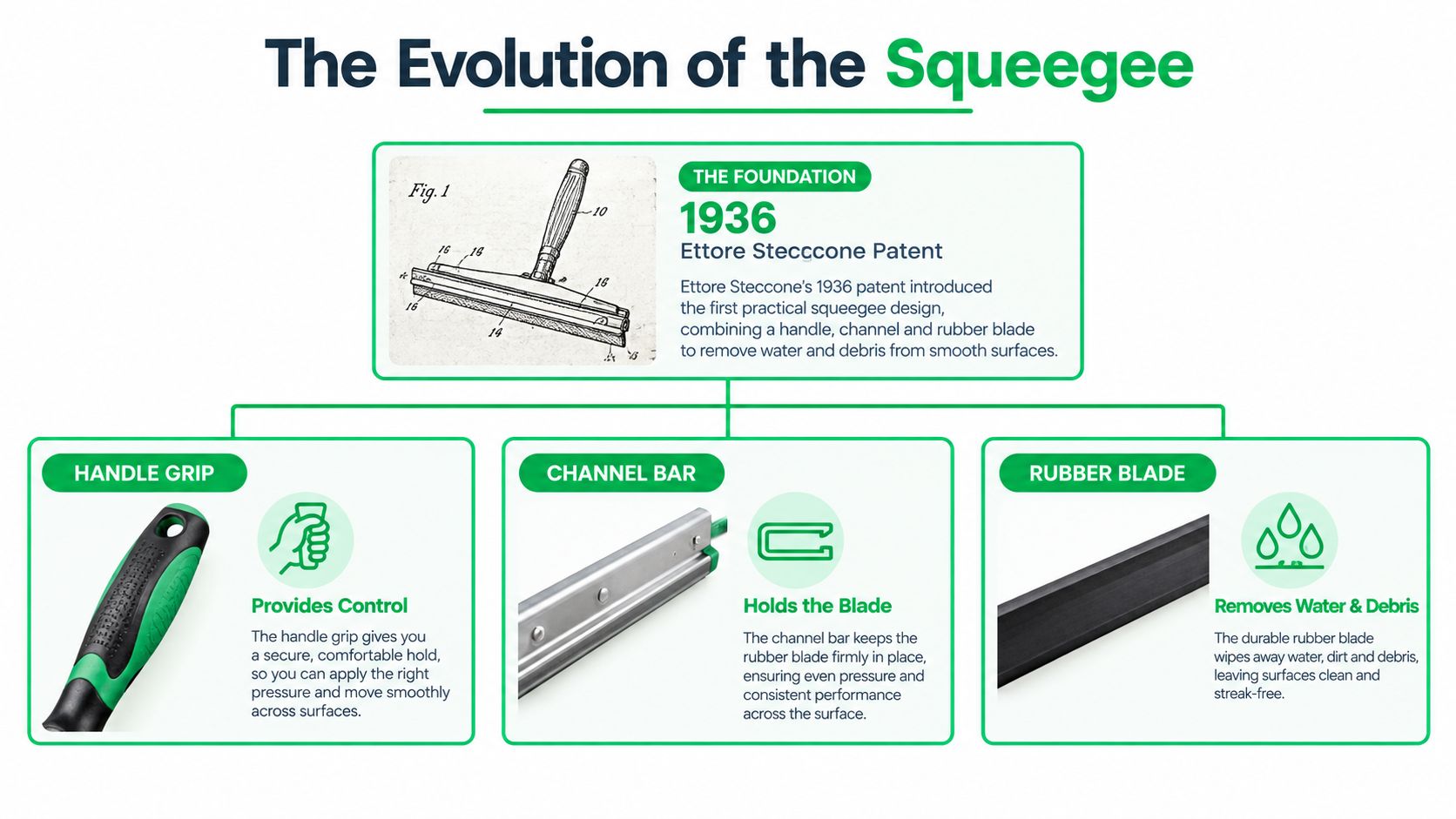
The modern commercial tool grew from a practical need: remove liquid and dirt across changing angles and applied pressures without forcing a heavy implement across the glass. Ettore Steccone's U.S. patent application for a redesigned squeegee was filed on October 24, 1936, and granted on July 12, 1938, as U.S. Patent No. 2,123,638. The patent's objective focused on efficient removal across a wide range of operating angles and pressures, a requirement that still describes professional window work. The original Steccone patent record shows why the design was more than a household convenience.
Historical reporting describes Steccone's tool as substantially lighter than the older “Chicago” squeegee. That shift toward a lighter, flexible, single-blade format made it easier to control across large panes, framed windows, and changing working positions.
Three parts carry the load
A professional squeegee has three working components:
- Channel: The channel holds the blade and distributes the operator's pressure. A rigid stainless-steel channel is valuable on broad panes because it resists unwanted flex and helps the edge maintain more even contact.
- Blade: The replaceable rubber edge forms the seal against the glass. Its hardness, cleanliness, and condition determine whether water leaves smoothly or breaks into lines.
- Handle: The handle transfers the operator's movement to the channel. Grip shape, angle, and swivel action affect control, particularly during repetitive or off-axis work.
Cheap generic tools often fail at the interfaces between these parts. A soft channel may bow, a loose blade may chatter, and an uncomfortable handle can make the operator compensate with the wrist or shoulder. The result isn't just slower work. It can be inconsistent pressure, missed water, and unnecessary strain.
Adaptation became part of the design
The patent record continued to address real architectural obstacles. U.S. Patent No. 3,013,290, filed in 1960 and published in 1961, described a reversible squeegee that could work in both pull and push directions. Its design addressed lower window areas obstructed by flower boxes, ornamental grids, and broad ledges. The reversible squeegee patent reflects a point technicians still encounter: access and direction can matter as much as blade length.
Earlier window-cleaning devices were patented by 1927, while later applications in the 1990s addressed specialized configurations and replaceable components. The pattern is clear. A professional squeegee isn't merely a strip of rubber on a handle. It's an adaptable system refined around pane geometry, access, replaceability, and operator control.
Selecting the Right Blade, Handle, and Pole System
The largest squeegee isn't automatically the fastest. A broad channel can reduce passes on open glass, but it also demands more continuous force and becomes awkward around muntins, mullions, seals, corners, and narrow reveals. A mixed commercial portfolio needs equipment that matches the pane, not a single oversized tool.
Choose rubber for the conditions
Blade hardness is one of the first decisions. Practical professional guidance commonly places routine blade hardness near 60–70 Shore A, with softer rubber conforming more readily to small surface irregularities and harder rubber resisting deformation in warm conditions. Professional squeegee guidance on blade hardness explains the trade-off between conformity and edge stability.
For ordinary interior work and moderate conditions, a replaceable medium-hardness natural-rubber blade is a sensible starting point. On hot, sun-exposed exterior glass, a harder formulation can hold its edge more reliably. It may also require more applied pressure, so it isn't a universal upgrade.
Glass condition matters too. Coated, textured, construction-dusted, or mineral-marked panes need inspection before the blade touches them. Grit can interrupt the seal and may scratch glass when dragged under pressure. A pre-cleaning check should identify stickers, damaged seals, hard-water deposits, and any surface contamination that calls for a different process.
Match channel width to pane geometry
Commercial channels commonly range from 6 to 24 inches, according to professional equipment guidance. Testing and selection guidance for commercial squeegees describes the usefulness of adjustable handles, swivel action, rigid channels, and wet-grip contours.
Use a wider channel where the pane is broad, open, and easy to reach. Choose a smaller channel where the glass is divided or surrounded by obstructions. A modular set gives a crew more control than forcing one length onto every window.
| Working condition | More suitable choice | Why |
|---|---|---|
| Broad, unobstructed glass | Longer rigid channel | Covers more surface per pass |
| Divided lights and muntins | Shorter channel | Maneuvers around bars and reveals |
| Angled or repetitive work | Swivel handle | Reduces extreme wrist and upper-arm positions |
| Hot exterior glazing | Harder replacement rubber | Resists excessive pliability |
| Mixed properties | Several channel widths | Matches changing pane geometry |
Treat the handle and pole as one system
A fixed handle offers direct feedback and can feel precise on straightforward pulls. A pivoting or swivel handle is more forgiving at awkward angles and can reduce strain during repetitive work. An ergonomic analysis reported that pivoting-handle tools can virtually eliminate major injurious upper-arm postures in window-cleaning tasks, as described in the cited professional testing guidance.
Poles must fit the handle securely and provide a stable reach. A loose connection turns a controlled squeegee into a difficult lever, especially on atrium glazing or high exterior panes. Pine Country Window Cleaning's commercial window cleaning equipment includes squeegees, replaceable rubber blades, and channel lengths selected for pane size.
For higher or harder-to-reach glass, a water-fed pole system may be the better choice. Pure water delivered through the pole can dry without the mineral spotting associated with dissolved residue, while reachable glass still benefits from the direct control of a traditional squeegee.
Techniques for Streak-Free Results Every Time
A clean result starts before the first pull. Inspect the pane, choose a washer or pure-water brush suited to the contamination, and check that the squeegee channel is straight and the rubber edge is free of grit. If the operator skips soil removal, the blade can carry debris across the glass and create lines that no final detail will fully hide.
Establish a clean working surface
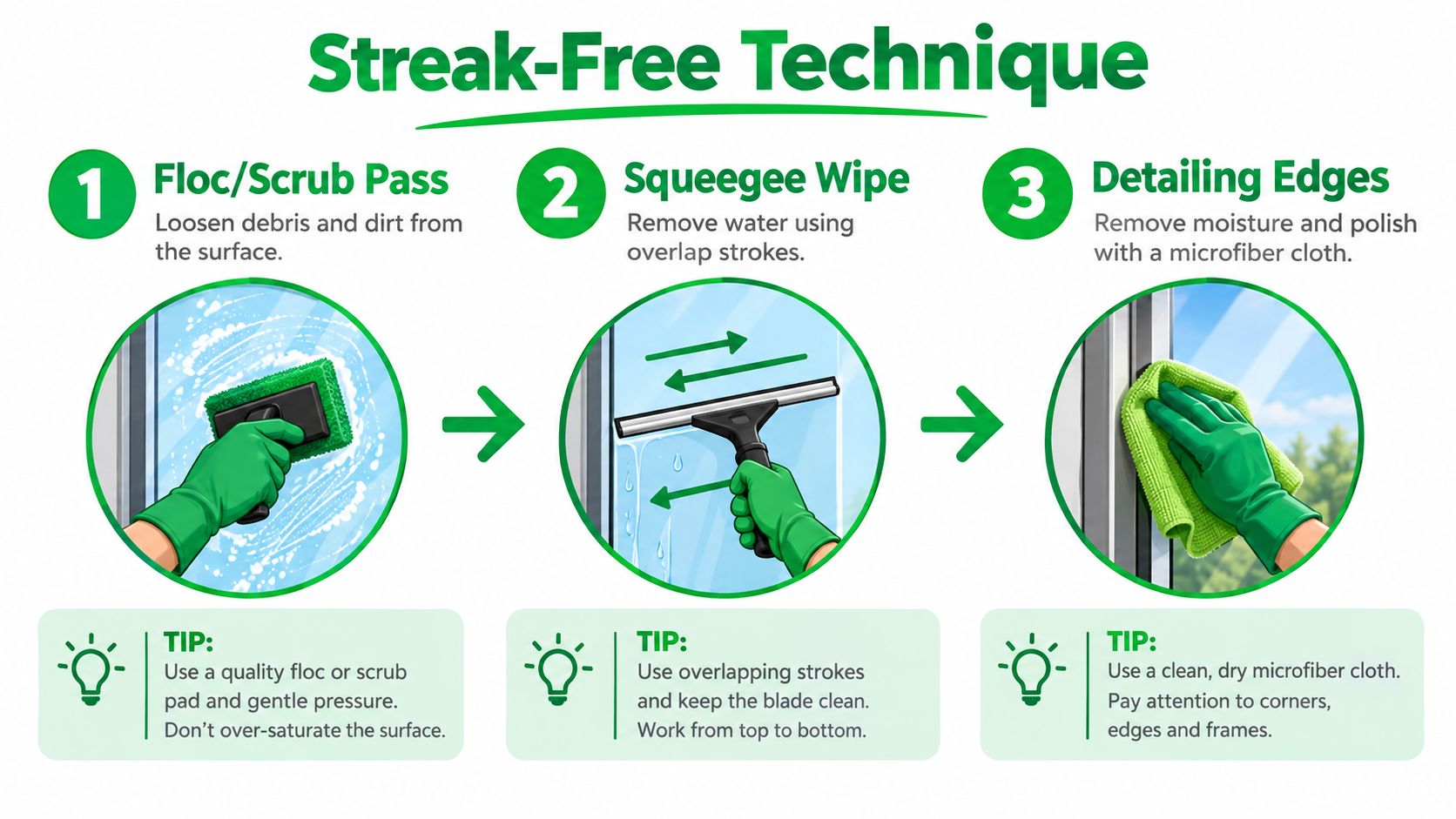
Begin with a thorough scrub or floc pass. Work enough water and cleaning solution across the pane to loosen dust, pollen, fingerprints, and surface film. On exterior glass, pay attention to corners and lower edges, where dirt often collects.
Keep the washer wet, but don't flood surrounding trim or finished surfaces unnecessarily. With a pole, confirm that the connection is locked and that the working length lets you stand securely instead of reaching into an unstable posture.
The basic sequence is straightforward:
- Scrub first: Loosen contamination throughout the pane, including corners and edges.
- Set the blade: Place the rubber at a controlled angle, commonly around 45 degrees, so the edge maintains a continuous seal.
- Pull with overlap: Move in consistent strokes, overlapping the previous path enough to prevent untouched strips.
- Cut in the edges: Use a controlled edge pass to keep water from collecting at frames, seals, and corners.
- Detail last: Remove remaining droplets from edges and check the pane from more than one viewing angle.
Let the rubber do the work
Too little pressure leaves a broken trail of water. Too much pressure increases friction, distorts the blade, and tires the operator. Keep the handle movement smooth, maintain the chosen angle, and wipe the rubber edge when accumulated water or soil begins to interfere.
A short practice pass reveals more than a long explanation. Watch where water gathers. If a line repeats in the same location, inspect the blade for a nick or embedded grit before changing your stroke.
Operator's check: If the same streak appears twice, stop and inspect the edge. Don't simply press harder.
Water quality can complicate even good technique. Dissolved minerals may leave a pale haze or spots as rinse water evaporates, particularly on sun-warmed exterior glass. For persistent mineral film, a guide to fixing glass haze from APEX NANO, Titan Coatings can help identify treatment considerations, though the correct approach still depends on the glass and deposit.
For a broader walkthrough of controlled passes and edge detailing, use this streak-free window cleaning guide.
Maintaining Your Squeegee for Longevity and Performance
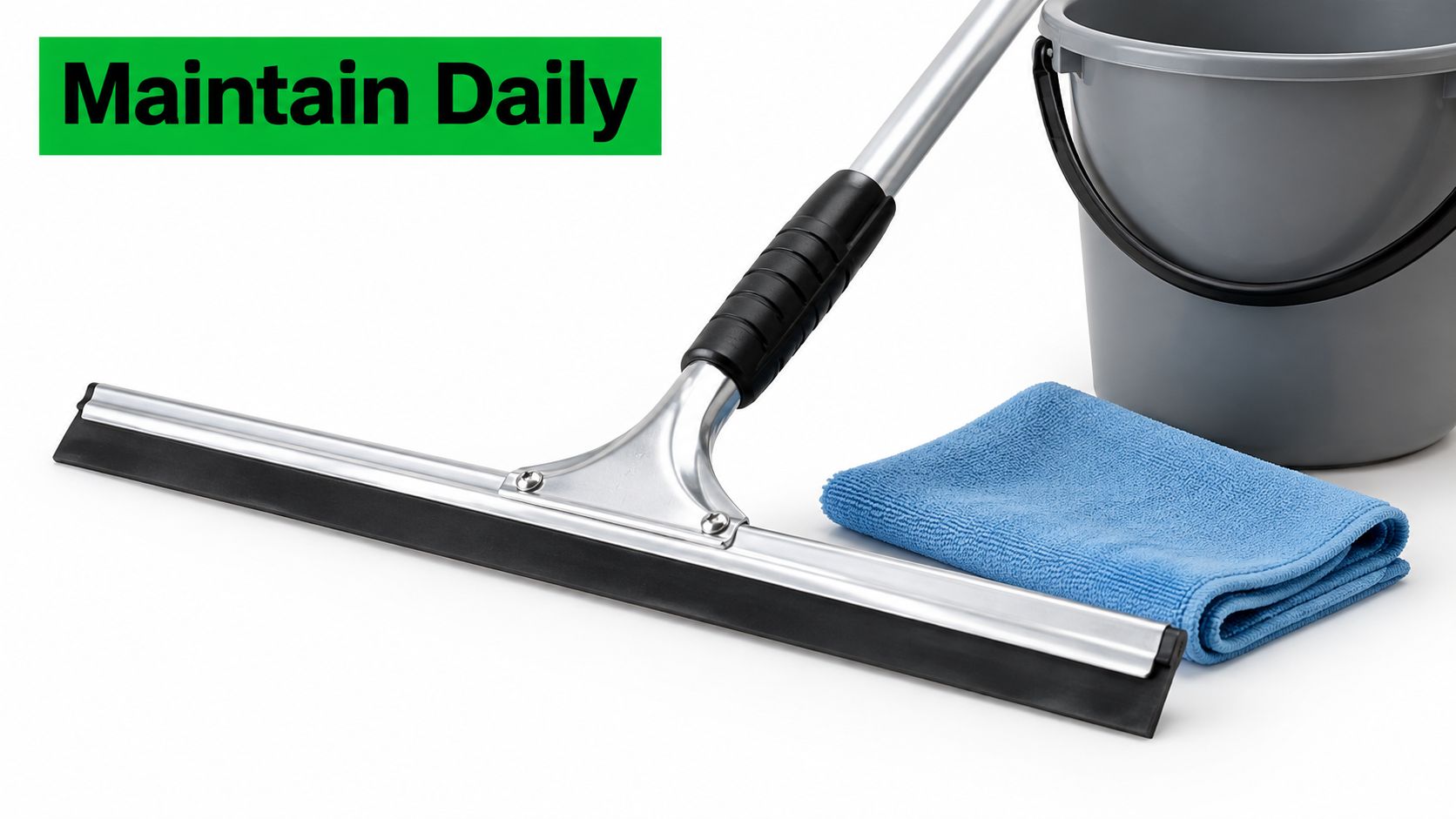
A squeegee's condition should be checked before every shift, not only when a customer notices streaks. Run a clean finger visually and carefully along the wiping edge, looking for nicks, flattening, curling, or embedded grit. Any discontinuity breaks the water seal and can create a repeatable vertical or horizontal line across an otherwise clean pane.
Rinse the channel and rubber after use, then dry them before storage. Leaving detergent, mineral residue, or abrasive soil on the blade can shorten its useful life and make the next job harder. Store the rubber so it isn't crushed under buckets, tools, or other channels.
Replace the edge when the edge fails
Blade replacement should follow condition, not a calendar. A damaged rubber edge can compromise an entire pane even when the handle and channel remain serviceable. Keep replacement blades available so a technician doesn't continue using a defective edge because the rest of the tool looks fine.
Weekly maintenance should include checking channel alignment, handle fittings, pole connections, and any hardware that has loosened during transport. A rigid channel is useful only when it remains straight and securely attached to the handle.
Maintenance habit: Clean rubber, clean water, and a straight channel protect one another. Neglect one, and the operator has to compensate with pressure or repeated passes.
Account for Northern Arizona water
Water quality affects both the finish and the workflow. High-mineral water can leave white spotting or cloudy film as it dries, especially on dark frames, large exterior panes, and sun-exposed façades. A technically correct squeegee pass can't remove minerals that remain in the water after the blade leaves the glass.
Traditional detergent-and-squeegee work, filtered water, purified water, and spot treatment each have a place. The decision should consider the glass condition, access, rinse requirements, water use, transport, and the expected finish. For higher windows, pure-water systems reduce the need to reposition ladders while delivering water with very few dissolved minerals.
Teams can document water readings, weather, pane temperature, and re-spotting during recurring work. That record helps facility managers choose a sensible process instead of assuming one method fits every building.
Beyond the Glass, Caring for the Whole Property
A window service isn't complete when the pane looks clear. The technician also has to return the window assembly and surrounding property in good condition. That means handling screens carefully, placing ladders securely, controlling poles around siding and landscaping, and keeping equipment away from surfaces that can scratch or mark.
Screens deserve particular attention. They hold dust, pollen, insects, and other debris close to the glass, so leaving them dirty can undermine the appearance of a freshly cleaned window. Pine Country Window Cleaning removes screens, cleans screens, and reinstalls them during the same visit, returning the assembly to its original condition rather than leaving the customer to sort out the parts.
Respect shows in the small decisions
A careful crew checks where ladder feet sit, protects landscaping from unnecessary contact, and avoids dragging equipment across finished floors. On larger properties, lift equipment must be positioned with the same attention. Clean glass doesn't justify damaged trim, disturbed plantings, or a screen placed back incorrectly.
This standard applies beyond window cleaning. Facility managers who need coordinated exterior upkeep may also benefit from working with a trusted commercial landscape team, because grounds protection and building access often overlap during maintenance.
Match the service to the building
Storefronts, hotels, campuses, medical buildings, dealerships, homes, and cabins don't share the same access or scheduling needs. Reachable panes may suit a traditional squeegee and ladder, while upper glazing may call for extension poles, pure-water brushes, boom lifts, scissor lifts, or an atrium lift.
Pine Country Window Cleaning has operated since 1999, and its published history identifies founder David Kaminski as a Flagstaff native. That local connection matters because Northern Arizona properties face recurring dust, sun, mineral residue, and seasonal access concerns. The company's commercial building exterior cleaning service combines traditional squeegee work with poles and pure-water systems for different reach and finish requirements.
The best commercial window cleaning squeegee is only part of a professional service. The complete job includes sound technique, maintained equipment, careful screen handling, safe access, clear communication, and respect for the customer's home or business.
If your Flagstaff-area property needs cleaner glass without careless equipment handling, contact Pine Country Window Cleaning for commercial or residential service using professional squeegees, ladders, poles, and pure-water brushes. The team can remove, clean, and reinstall screens as part of the visit while matching the cleaning method to your glass, access, and water conditions.