

You've watched the windows dry before, expecting clear glass, then noticed pale spots appearing in the bright Flagstaff sun. On a cabin, those marks can show up after a routine wash. On a business, they can make an otherwise well-maintained property look neglected. The problem usually isn't leftover dirt. It's mineral residue carried by the rinse water.
Spot-free window washing controls that residue before it reaches the glass. The process combines water-quality testing, purification, proper brushes or squeegees, controlled pressure, safe access, and careful property protection. In Northern Arizona, that combination matters for homes, cabins, second properties, hotels, campuses, and commercial façades exposed to dust, pollen, smoke residue, and variable water supplies.
Why Spot-Free Window Washing Matters in Flagstaff
A Flagstaff homeowner may see a crew finish a standard wash and assume the job is done. Then the sun moves across the glass, the water evaporates, and small white marks become visible. Those marks are often dissolved calcium and magnesium left behind by hard water, not streaks caused by poor wiping.
Water hardness is commonly measured as milligrams per liter of calcium carbonate. The U.S. Geological Survey's water hardness guide classifies water from 0 to 60 mg/L as soft, 61 to 120 mg/L as moderately hard, 121 to 180 mg/L as hard, and water above 180 mg/L as very hard. The exact supply at a property can vary, especially where private wells or changing site conditions are involved.

What spot-free actually means
A spot-free finish is a streakless, residue-free result after the rinse water dries. The goal is not just to make the glass look wet and shiny while a technician is working. The true test comes afterward, when evaporation leaves either clean glass or a mineral outline.
That's why spot-free cleaning is a process outcome, not just a marketing phrase. The operator has to control the rinse water, keep brushes and rubber clean, use consistent pressure, overlap passes correctly, and prevent dirty runoff from flowing back across finished panes.
The professional squeegee still has an important place in this work. On October 24, 1936, Ettore Steccone filed a patent for a single-blade design using lightweight brass and a flexible rubber blade, a milestone documented by Ettore's company history. The basic principle remains useful: remove contaminated water from glass before it dries. Purified-water systems complement or replace squeegee work in some applications, but neither method works well with dirty rubber, uneven pressure, or poorly prepared glass.
Why local properties show the difference
A cabin near Munds Park, a home in Pine Canyon, and a commercial building near central Flagstaff can face different soil conditions. Dust and pollen settle on exterior glass, while hard-water deposits may develop around frames, irrigation spray, and masonry. Smoke residue can also leave a film that requires more than a quick rinse.
Household rags, Windex, and newspaper aren't professional spot-free methods. They may move surface dirt, but they rely on tap water, manual wiping, and materials that can leave lint or redistribute residue. For a taller window, they also place the homeowner in awkward positions where reach and safety become part of the problem. A local window-cleaning schedule guide can help match service timing to the property's exposure and use.
How Spot-Free Window Washing Actually Works
Professional purified-water cleaning starts with ordinary tap water, then removes the dissolved material that creates spots. A typical system uses reverse osmosis followed by deionization, although the exact equipment configuration depends on the site and the operator's maintenance program.
The important distinction is simple. Tap water goes into the system. Purified water comes out through the water-fed pole. The pole lets a technician scrub and rinse glass from the ground where access allows, without carrying a bucket of detergent from pane to pane.
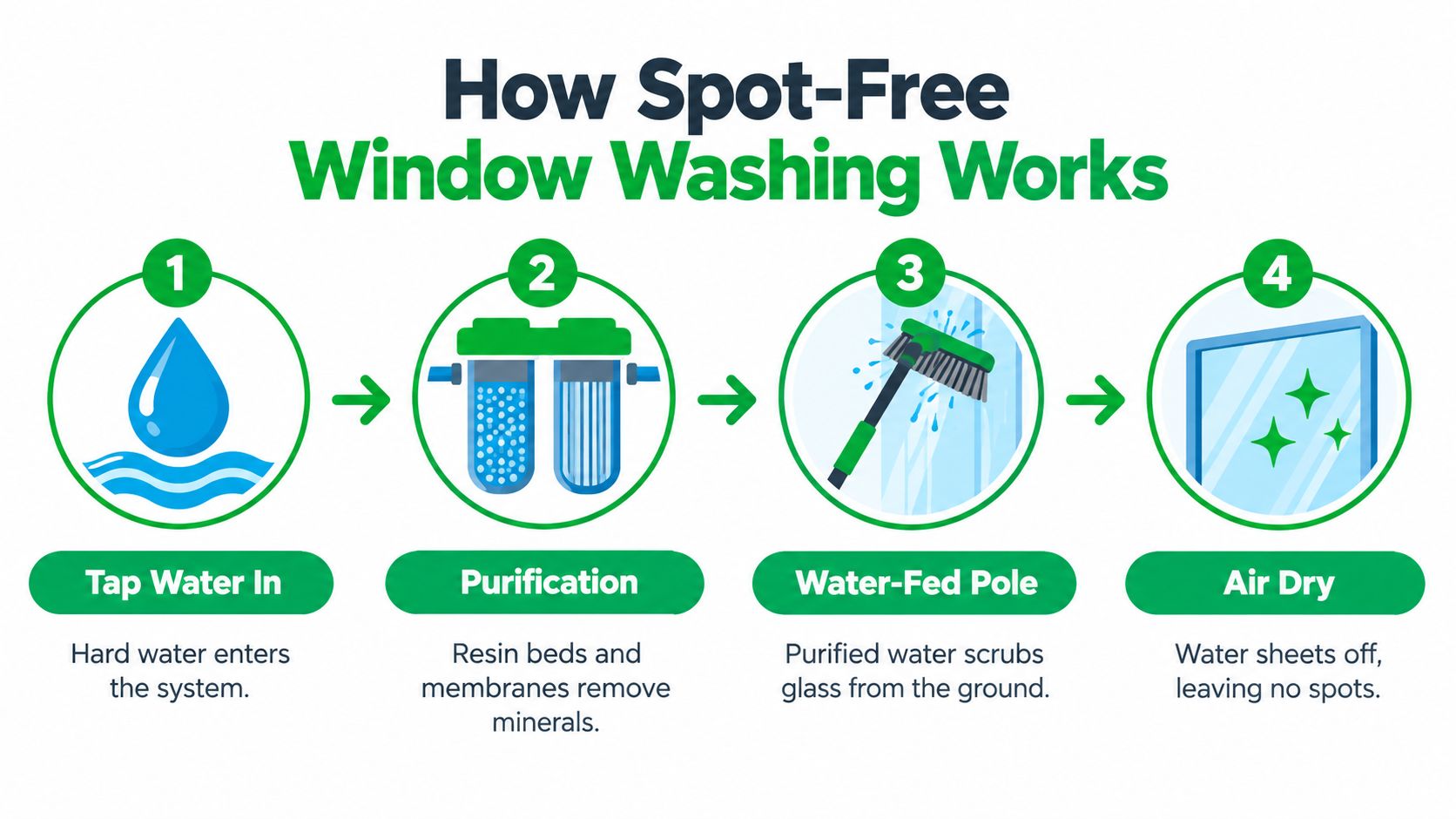
The working sequence
Inspect the glass and frames. The technician checks for loose screens, heavy soil, existing mineral scale, construction residue, and conditions that could send dirty water back onto finished glass.
Pre-wash with purified water. The first passes loosen dust, pollen, and surface film. This stage matters because a brush can spread dry soil if the glass hasn't been thoroughly wetted.
Agitate with a soft pure-water brush. The brush works across the glass and often reaches frames and sills as well. The operator uses controlled pressure rather than scrubbing aggressively, which helps protect seals, coatings, and delicate surfaces.
Rinse from the pole. The final rinse carries loosened soil away. The technician must keep the rinse water pure and avoid switching back to untreated tap water at the end.
As the purified water dries, it leaves little or no mineral residue because the dissolved solids have been removed. That doesn't mean every pane will behave perfectly without skill. Dirty brushes, worn equipment, incomplete rinsing, contaminated frames, and existing scale can still affect the finish.
Practical rule: Pure water removes one major source of spots, but it doesn't replace inspection, maintenance, or technique.
Water quality should be checked before difficult exterior work, particularly at rural properties, cabins, and sites with variable supplies. A hardness meter or total-dissolved-solids meter gives the operator a useful starting point. If mineral content is high, reverse osmosis and deionization are more suitable than adding more detergent. Softening can reduce calcium and magnesium, but it doesn't necessarily remove every dissolved solid.
The method also has an environmental trade-off. Purified-water cleaning can reduce reliance on detergents, but spot-free doesn't automatically mean water-saving. Flagstaff's official climate guidance says residents and businesses have reduced per-capita water use by more than 50% since 1989, while climate change is expected to increase demand and reduce natural replenishment of surface water and aquifers, as described by the City of Flagstaff's water and climate guidance. Operators should use measured flow, target rinsing, avoid repeat washes that aren't needed, and reuse water where the application allows.
For a visual demonstration of the equipment and sequence, this video shows how water-fed pole cleaning works:
A detailed explanation of the pole system is available in this guide to how water-fed pole window cleaning works.
Standard Washing vs Spot-Free Professional Cleaning
Standard washing and spot-free professional cleaning solve different problems. A homeowner may use a rag, sponge, household glass cleaner, or newspaper to remove fingerprints and visible film. Those methods can be adequate for a small interior touch-up, but they aren't designed to control mineral content or safely reach difficult exterior glass.
The typical household process uses tap water and solution, followed by manual drying. If the water contains dissolved calcium or magnesium, evaporation can leave residue. Wiping may remove some of it, but it can also spread the residue, leave lint, or create streaks when the cloth becomes damp and dirty.
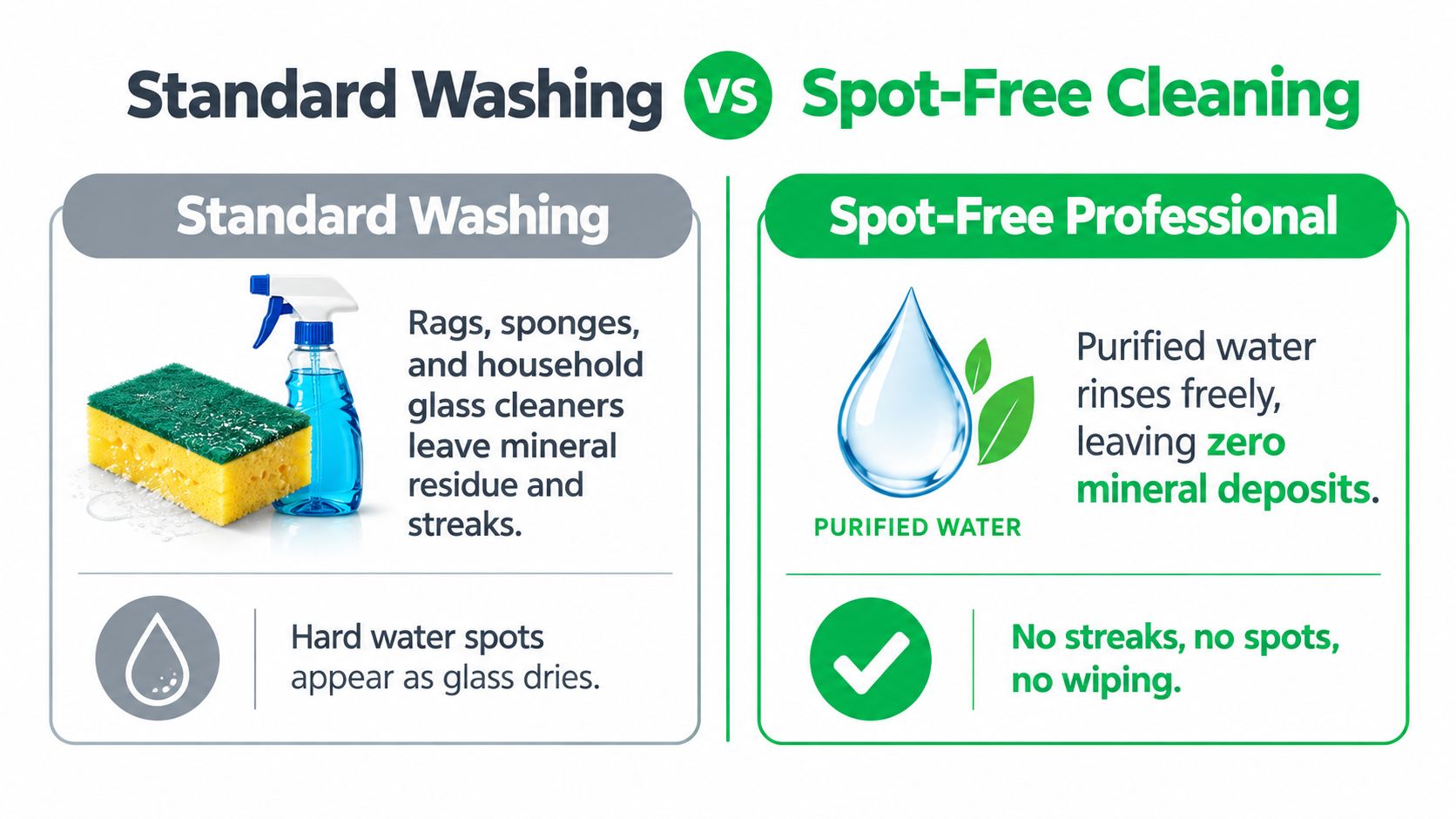
The practical differences
| Standard household washing | Professional spot-free cleaning |
|---|---|
| Uses tap water and detergent | Uses purified water for the final rinse |
| Requires wiping or drying | Can air-dry when the glass and surrounding surfaces are properly prepared |
| May leave mineral residue, lint, or streaks | Controls mineral residue through filtration and rinsing |
| Often depends on ladders or awkward reach | Uses water-fed poles or purpose-built access equipment where appropriate |
| Usually treats the glass alone | Can include frames, sills, screens, and property protection |
Purified water isn't magic. A technician still needs clean brush fibers, properly maintained filters, good hose management, and enough overlap between passes. A water-fed pole used carelessly can leave dirty runoff on the sill or send contaminated water back across the pane. On some interior glass, recessed windows, post-construction surfaces, or delicate architectural features, a squeegee and controlled detailing may remain the better choice.
The access question is just as important as the chemistry. Historical OSHA analysis summarized by HealthDay identified 88 window-cleaning accidents over a 15-year period, with 62 fatalities, approximately 70.5% of the reported incidents. That record isn't a current annual industry fatality rate or a measure of every accident worldwide. It does show why a low price based on improvised ladder work can carry a serious trade-off.
A clean pane isn't a successful job if the access method puts a worker, resident, pedestrian, or building at unreasonable risk.
For ground-access windows, a purified-water pole may provide an efficient combination of reach and rinse quality. For higher or obstructed glass, the provider may need ladders, lifts, traffic controls, exclusion zones, or other fall-prevention measures. The right choice depends on the building, not on a promise that one tool works everywhere.
When Northern Arizona Properties Need Spot-Free Washing
Spot-free service makes the most sense where water marks are highly visible, repeat visits are inconvenient, or access creates meaningful risk. A small ground-level pane and a large atrium are both made of glass, but they don't belong in the same work plan.
Cabins and second homes often need extra attention because owners may not see the glass until a weekend visit or a rental turnover. Dust, pollen, weather residue, and irrigation overspray can build while the property is unoccupied. Private wells can also vary in mineral content, so a rinse that looks fine at one property may spot badly at another.

Homes and cabins
Properties in Forest Highlands, Pine Canyon, Flagstaff Ranch, and Munds Park often combine expansive glass with slopes, landscaping, decks, and challenging exterior access. A homeowner may want the view restored without putting a ladder on uneven ground or leaning equipment against finished surfaces.
Spot-free washing is particularly useful when:
- The view is the feature. Large cabin windows show every mineral outline when bright mountain light hits the glass.
- The property is seasonally occupied. A scheduled service can handle the glass before owners arrive or guests check in.
- The site is dusty or pollen-heavy. A thorough rinse removes more than a quick interior wipe.
- The water supply is uncertain. Testing and purification reduce the risk of leaving new deposits behind.
Existing hard-water scale is a separate restoration problem. Purified water prevents new mineral residue, but it won't automatically dissolve deposits that have already bonded to the glass. Those panes need inspection before anyone promises a maintenance wash will restore them.
Commercial and institutional sites
Hotels, car dealerships, retail storefronts, medical buildings, campuses, and NAU facilities have a different standard. Customers, students, patients, and staff see the glass throughout the day, and managers need predictable access plans that don't interfere with public areas.
A commercial plan may include exterior glass, interior panes, frames, screens, atriums, and scheduling around business hours. The method should also account for sidewalks, parking areas, overhead obstacles, weather, roof edges, balconies, and surfaces that could be damaged by runoff.
Drought-aware maintenance
Northern Arizona's water constraints change the conversation. The National Weather Service's 2025 regional drought reporting described parts of northern and central Arizona with streamflow below the 10th percentile for the time of year and persistent drought conditions. Spot-free cleaning still has value, but responsible operators should measure flow, rinse only where needed, avoid unnecessary repeat work, and match frequency to actual soil.
The aim is cleaner glass with a deliberate water plan, not unlimited rinsing just because purified water is available.
What Professional Service Includes Beyond the Glass
A responsible window-cleaning appointment has two quality tests. The glass should look clear after drying, and the property should be left in the condition the crew found it, or better. That requires more than a brush, hose, and good intentions.
Access planning comes first. A water-fed pole is useful for many elevations, but it isn't the answer for every recessed window, atrium, balcony, post-construction pane, or façade. Ladders may be appropriate in one location and a poor choice in another. A qualified provider evaluates roof edges, uneven ground, overhead obstacles, public walkways, weather, and the equipment needed for the task.
Equipment matched to the building
Pine Country Window Cleaning was started in 1999 by Flagstaff native David Kaminski and describes itself as Flagstaff's largest window-cleaning company. Its stated equipment includes squeegees, ladders, extension poles, and pure-water brush systems, along with boom lifts, scissor lifts, and a 95-foot atrium lift for high-access work, according to its commercial building window-cleaning information.
That range matters because a crew shouldn't force one method onto every property. A pole can keep technicians on the ground for suitable windows. A lift can provide controlled access where a pole can't reach or where the glass needs closer inspection. Squeegees remain useful for interior work and situations where water-fed cleaning isn't the right fit.
The historical safety record makes training and planning more than a formality. The Vermont Department of Health's hardness guidance is useful for understanding the water-quality side, while access decisions require a separate safety assessment. Clean glass and safe work have to be planned together.
Care for the home
Screen handling is part of the described service process. Crews remove screens, clean them, and reinstall them during the same service. That keeps screens from being overlooked while the glass receives attention and helps the finished window operate as a complete assembly.
Property protection also includes careful ladder placement, drop cloths, and shoe covers. Those details protect floors, walls, landscaping, furniture, and furnishings while technicians move through the home or work near exterior planting beds. Customers aren't hiring someone only to improve the view. They're trusting a crew to work around the things they've invested in.
Pricing, Scheduling, and What to Expect
Professional spot-free pricing varies with property size, window count, access, glass condition, and the equipment required. A straightforward ground-level home won't be planned like a steep cabin, commercial façade, or atrium. Gutter cleaning, downspout cleaning, pressure washing, and post-construction work can also change the scope.
A reputable provider should inspect or discuss the property before work begins, explain what's included, and provide a free estimate where available. The residential window-cleaning cost guide can help homeowners understand why access, screens, interior panes, and restoration needs affect the final quote.
A useful appointment sequence
- Before the visit: Discuss window count, stories, screens, access concerns, water conditions, landscaping, pets, and any construction residue.
- During the work: The crew protects interior and exterior surfaces, removes and cleans screens, selects the appropriate tools, and manages rinse water.
- At completion: Technicians inspect the glass, reinstall screens, check the work from useful viewing angles, and communicate any existing stains or conditions that need separate restoration.
Cleaning frequency should follow exposure rather than a rigid calendar. Cabins near dust, pollen, roads, or trees may need attention sooner than sheltered homes. Commercial properties often benefit from a recurring plan because managers can coordinate access and maintain a consistent appearance. Second-home owners and short-term rental operators may prefer service around occupancy changes.
A local company also brings practical knowledge about Flagstaff weather, mountain access, seasonal soil, and property layouts. Pine Country Window Cleaning has served Northern Arizona since 1999 and describes services for residential, commercial, institutional, and difficult-to-reach windows. The right provider should offer clear communication, safety-trained technicians, respectful property care, and a satisfaction policy that gives the customer a defined path if something needs attention.
For Flagstaff homes, cabins, hotels, campuses, and commercial properties, Pine Country Window Cleaning combines squeegees, ladders, poles, pure-water brushes, screen cleaning, and high-access equipment to deliver spot-free results with care for the surrounding property. Visit Pine Country Window Cleaning to request a free estimate and plan a water-conscious service for your Northern Arizona glass.