

A tenant calls at 11:30 on a Tuesday because the storefront glass still looks streaky after the latest monsoon. In another building, a new tenant's windows are cloudy with construction haze. Across town, an atrium team is switching on electric lights at noon because dust and residue have reduced the useful daylight.
These problems rarely begin as emergencies. They start as deferred maintenance, an unclear scope, or a low bid that excluded the difficult glass. For facility managers in Northern Arizona, window cleaning for business belongs in the planned maintenance program alongside exterior washing, HVAC inspections, and roof work. The right schedule protects presentation, access safety, occupant comfort, and the condition of the glazing itself.
Why Commercial Window Cleaning Deserves More Attention Than It Gets
The facility manager usually sees the complaint before seeing the cause. A tenant notices glare, a customer sees fingerprints at the entrance, or a maintenance technician reports mineral spotting that won't come off with routine washing. By then, the glass may need restoration rather than a standard cleaning visit.
Commercial glazing does more than reflect a company's image. Clean, unobstructed windows help preserve the practical benefits of daylight and outdoor views. A field study comparing offices with windows to interior offices found that employees in windowed offices spent 15% more time on work-related tasks, while lighting energy was saved 18% of the time in windowed offices compared with less than 1% in interior offices. A separate peer-reviewed study found that office workers with windows slept an average of 46 minutes longer per night during the workweek than workers in windowless workplaces. Those findings don't prove that cleaning alone increases productivity or sleep, because blinds, glare, building design, job type, and behavior also matter. They do show why maintaining the window as a building feature matters. The daylight and workplace findings are documented in this field-study reference.
What gets missed when glass is treated as cosmetic
A neglected window line creates several practical problems:
- Tenant friction: People complain about streaks, haze, blocked views, and dirty entrances because those conditions affect their daily environment.
- Brand damage: Retailers, hotels, dealerships, and medical practices present their reputation at the glass line before a visitor reaches the reception desk.
- Harder restoration: Mineral deposits, construction film, and embedded debris can require specialized treatment instead of ordinary squeegee work.
- Access hazards: Dirty interior glass, wet sills, and poorly managed cleaning activity can create slip, trip, and pedestrian-control issues.
- Warranty concerns: Coated or specialty glazing may have manufacturer care requirements that a careless chemical choice or abrasive process can violate.
Northern Arizona adds its own scheduling realities. Dust settles quickly around busy entrances and exposed façades. Wind can make work at height unsafe, while monsoon conditions can turn a carefully planned exterior visit into a stop-work decision. Lift staging may affect parking, loading zones, fire lanes, and guest access.
Operator's view: If your team only calls a window cleaner after someone complains, you're managing the symptom, not the maintenance cycle.
Treat commercial glass more like an HVAC filter than a decorative extra. The service doesn't guarantee lower energy use or better tenant performance, but it preserves a building component that supports daylight, views, presentation, and occupant comfort. For broader exterior upkeep, facility managers may also compare specialized services such as Water Works Power Washing exterior services when the building needs coordinated façade and hard-surface maintenance.
A written commercial building window cleaning program should identify the glass inventory, access method, interior and exterior scope, screen handling, weather contingencies, and callback expectations. That document gives operations staff something better than a vague promise to “keep the windows clean.”
The Three Main Types of Commercial Window Cleaning Service
A commercial quote should identify the service type before it identifies the price. Routine glass maintenance, high façade work, and post-construction restoration require different crews, equipment, production rates, and risk controls.
| Service Type | Access Method | Typical Equipment | Best Fit For |
|---|---|---|---|
| Routine interior and exterior cleaning | Ground access, ladders, extension poles, or suitable water-fed poles | Squeegees, scrubbers, ladders, poles, pure-water brushes, floor protection | Storefronts, low-rise offices, entrances, clinics, and recurring maintenance |
| High-access cleaning | Rope descent, suspended platforms, boom lifts, scissor lifts, or atrium lifts | Fall-protection systems, lifts, suspended access equipment, ropes, squeegees, pure-water systems | Multi-story offices, hotels, medical buildings, campuses, atriums, and high-rise façades |
| Post-construction or post-renovation restoration | Ground equipment, ladders, lifts, or platforms based on the building | Scrapers selected for the glass, restoration tools, squeegees, poles, pure-water brushes, protective materials | New builds and tenant improvements with paint, concrete, adhesive, dust, or sticker residue |
Routine work needs a defined scope
Routine service covers the glass that can be reached safely and efficiently with standard commercial equipment. A serious crew may use professional squeegees and scrubbers for detail work, extension poles for reach, and pure-water brushes for suitable exterior glass. The scope should state whether the team cleans one side or both, wipes frames and sills, handles doors, protects interior floors, and removes, cleans, and reinstalls screens.
Quarterly service may suit some low-rise offices, clinics, and storefronts, but the correct interval depends on exposure, occupancy, dust, pollen, traffic, and how quickly the glass loses presentation quality. High-traffic entrances deserve closer attention than a quiet upper elevation.
High-access work is a separate operation
Rope descent, suspended platforms, boom lifts, scissor lifts, and atrium lifts aren't interchangeable. The building profile, anchor information, roof layout, façade geometry, pedestrian exposure, and rescue plan determine the workable method.
A hotel with an atrium may need a different setup from a three-story medical building. A lift may require parking control and a clear route, while suspended access may require verified anchors, exclusion zones, tenant notifications, and weather monitoring. The crew should arrive with more than glass tools. It needs access equipment, inspection records, communication procedures, and a plan for protecting people below.
Post-construction glass requires restoration judgment
Construction cleaning is where bad classification becomes expensive. Paint flecks, concrete residue, tape adhesive, silicone, and fine dust may need controlled removal. A routine maintenance quote may exclude those tasks, while a contractor treating every pane as a restoration project may overprice a simple service visit.
The warning signs are obvious. If a one-story building receives a high-rise access quote, ask what condition or access issue justifies it. If a new tenant improvement receives routine pricing with no line item for residue removal, ask what happens when ordinary washing doesn't remove the film.
Match the service to the building, the access, and the condition of the glass. If one of those three is missing from the scope, the quote isn't ready for approval.
What Drives the Price of Commercial Window Cleaning
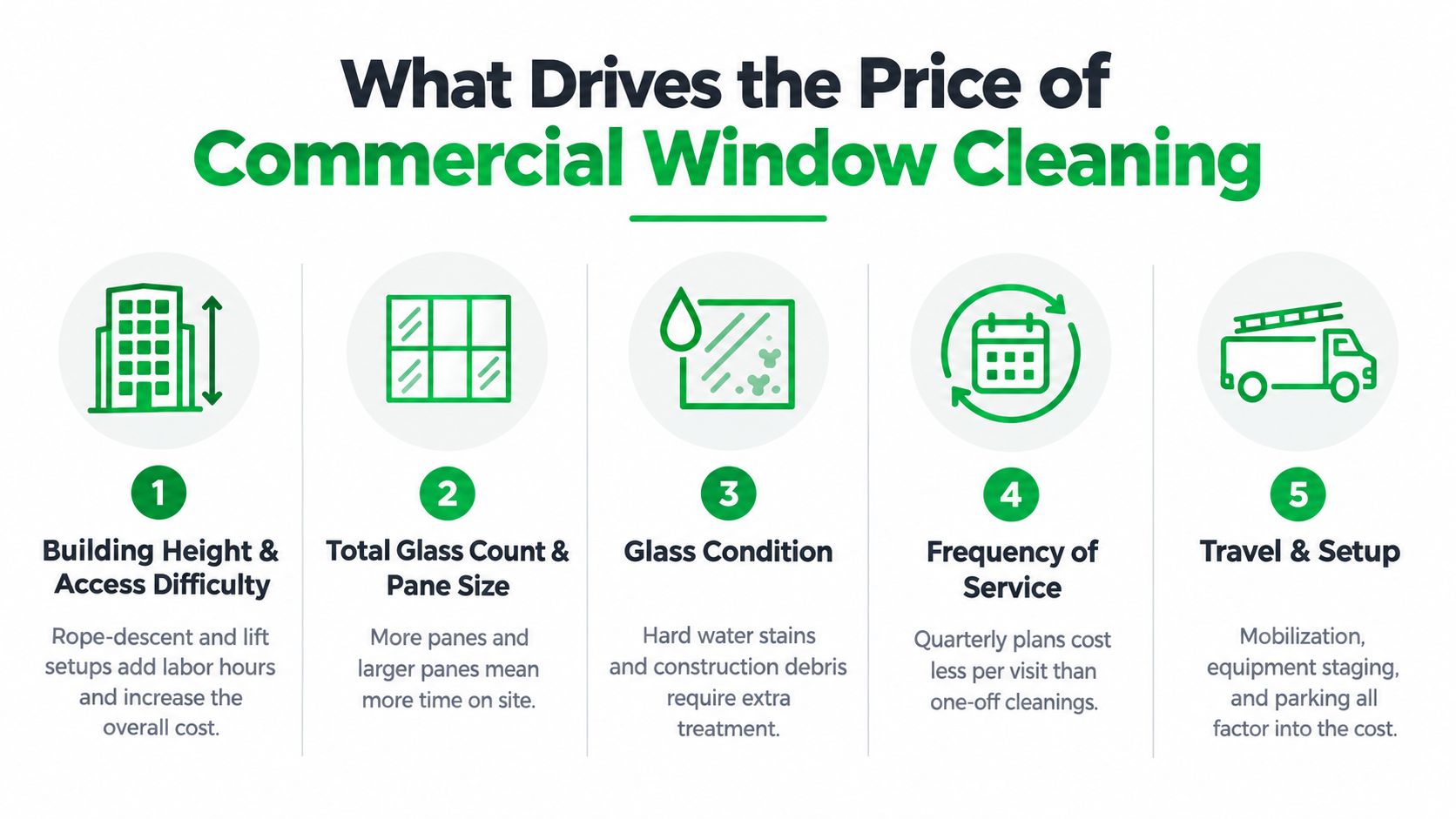
Commercial pricing reflects labor, access, risk, condition, and coordination. The number of panes matters, but it isn't the whole quote. A large ground-level storefront may be faster to service than a smaller façade over landscaping, a public walkway, or a restricted loading area.
The variables behind the number
Height and access difficulty drive setup time and equipment requirements. Ground-level work may use ladders, poles, or pure-water brushes. High-level glass may require lifts, suspended platforms, or rope descent, along with staging, inspection, and pedestrian controls.
Glass count and pane size affect production time. Large panes can require more reach, more water, and more detailing. Divided lites, doors, sidelites, transoms, skylights, and atrium glass add handling and inspection time.
Glass condition changes the job category. Dust and fingerprints belong in routine maintenance. Mineral residue, hard-water spotting, construction debris, paint, and adhesive may require restoration steps, testing, and a separate approval.
Frequency changes the economics of each visit. A recurring plan can reduce mobilization waste and keep the building from reaching a heavily soiled condition. A one-off visit often carries more setup and correction work because the contractor is starting from the current condition, not maintaining a known baseline.
Travel and setup matter in Flagstaff and surrounding Northern Arizona communities. Equipment staging, parking, lift delivery, roof access, tenant coordination, and weather delays all affect the time a crew spends on the property.
How to read a commercial quote
A per-pane quote can reveal the assumed glass count but may hide access surcharges, difficult panes, or add-ons. A per-visit quote simplifies budgeting but needs a detailed scope so the property doesn't receive fewer tasks than expected. An annualized contract can stabilize planning, but only if it states the number of visits, seasonal adjustments, restoration exclusions, and response terms.
Ask each bidder to list:
- Glass scope: Interior, exterior, doors, skylights, atriums, frames, and sills.
- Screen scope: Removal, washing, inspection, labeling, and reinstallation.
- Access scope: Ladders, poles, lifts, suspended systems, staging, and traffic control.
- Condition exclusions: Hard-water removal, construction residue, scratched glass, failed seals, and damaged screens.
- Scheduling terms: Service window, weather delay process, tenant coordination, and callback response.
A suspiciously low bid often omits the work that creates risk. Look for missing fall-protection planning, no insurance documentation, vague equipment assumptions, and a frequency that doesn't match the stated scope. Compare quotes on the same building inventory, access plan, visit frequency, condition assumptions, and cleanup expectations. For a deeper pricing discussion, use this guide to commercial window cleaning cost as a starting point, then require a site-specific proposal.
Safety, Compliance, and What to Require Before Work Begins
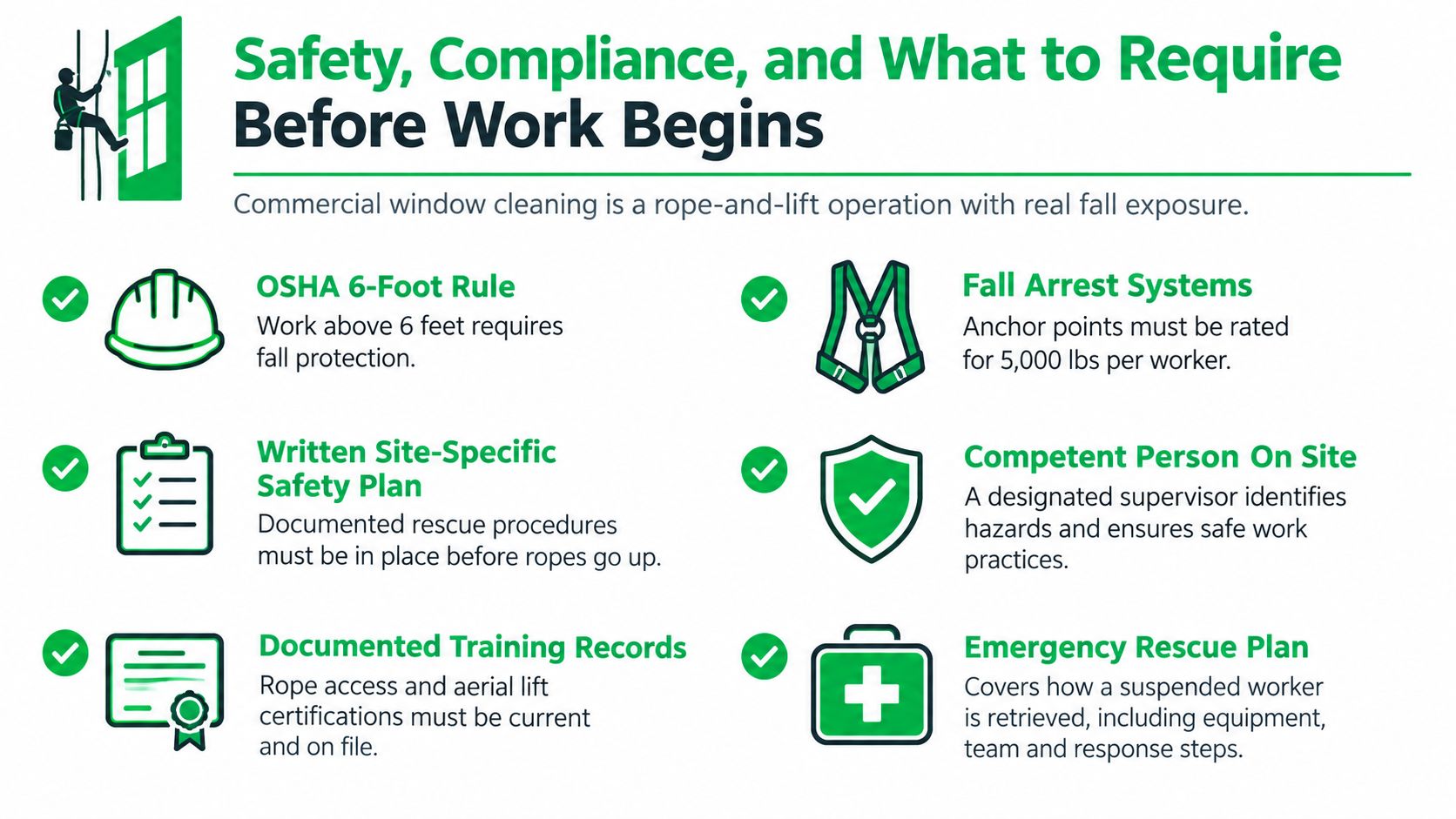
Commercial window cleaning at height is a rope-and-lift operation with real fall exposure. Facility managers shouldn't accept “we're OSHA compliant” as a complete answer. They should ask how the crew will access the glass, prevent a fall, protect people below, inspect equipment, and retrieve a worker after an emergency.
OSHA guidance identifies window cleaning as building maintenance covered by powered-platform requirements. It calls for fall-arrest protection, written emergency procedures for power or equipment failures, and competent-person training in hazard recognition, safe operation, maintenance, inspections, and personal fall-arrest systems. Workers must understand anchorage, tie-off technique, free-fall and deceleration distances, equipment limits, inspection, and storage. Fall-arrest systems must be inspected before initial use during each work shift and rigged so free fall doesn't exceed 6 feet, or 1.8 meters. OSHA's powered-platform guidance explains these requirements.
Require a site-specific access package
Before a ladder, lift, rope, or platform arrives, request:
- Certificate of insurance: Confirm current general liability and workers' compensation coverage, then verify the requested additional-insured or waiver language with your risk team.
- Written fall-protection plan: Require access methods, anchor points, exclusion zones, weather limits, communications, and rescue procedures.
- Anchor documentation: Ask for current building anchor information and inspection records where suspended or rope-descent work is proposed.
- Training records: Verify that the actual technicians assigned to the job have training relevant to ladders, lifts, fall arrest, and the planned access system.
- Equipment records: Request inspection and maintenance documentation for lifts, platforms, ropes, harnesses, and related systems.
- Emergency contacts: Identify who can stop the job, who calls emergency services, and how a suspended or stranded worker will be retrieved.
The property owner has responsibilities too. Provide current roof, façade, and anchorage information. Identify fragile surfaces, restricted areas, fire lanes, patient routes, guest entrances, vehicle lanes, and tenant operations. Don't assume a contractor can discover every building hazard after mobilizing.
Choose prevention over recovery
For low-rise work, a trained crew may use stable ladders, extension poles, or pure-water systems. OSHA ladder guidance requires workers to maintain three-point contact, face the ladder, keep their bodies near the center of the step, and use ladders on stable, level surfaces unless secured against displacement. A CDC/NIOSH investigation of a fatal window-cleaning fall recommended reducing unnecessary ladder climbing through engineering controls such as extender poles or aerial lifts. OSHA's portable-ladder checklist provides the applicable ladder practices.
For elevated work, tie off ladders where necessary, control pedestrian traffic below suspended platforms, barricade lift work zones, and stop for unsafe wind, lightning, ice, smoke, or other conditions. After service, the crew should remove debris, return furniture and screens, clear walkways, close gates, and report glass damage or access problems. That cleanup is part of professional work, not a favor.
Clean Glass as a Daylight and Energy Decision
Clean glazing is a daylight-management task, but facility managers should keep the claim precise. Cleaning doesn't guarantee a specific energy reduction. It maintains the transparency of the glass so the building's daylighting strategy, views, lighting controls, and occupant experience can perform as designed.
A commercial-building simulation found that daylighting can save approximately 8 to 10 kilowatt-hours per square foot of window area annually, equal to roughly 5% to 7% of whole-building electricity use in the modeled large office building. Those are modeled benchmarks, not a promised result from cleaning. Actual performance depends on glass type, shading, sensor calibration, occupancy, climate, and the baseline condition of the windows. The daylighting simulation and its limitations are detailed by ACEEE.
Read the glass condition before approving work
Visible light transmittance, or VLT, describes how much visible light passes through glazing. Dirt, mineral film, construction residue, and haze reduce the useful transmission occupants experience. Hard-water spotting can also obscure views and may require more than routine washing, especially when deposits have bonded to the surface.
| Glass Condition | Estimated VLT | Daylight Loss | Typical Interior Lighting Impact |
|---|---|---|---|
| Clean, unobstructed glazing | High | Minimal from surface soil | Lighting controls can respond to available daylight |
| Dusty or lightly spotted glazing | Reduced | Noticeable in affected areas | Occupants or controls may use electric lighting more often |
| Hazy, residue-covered glazing | Significantly reduced | Material in the affected zone | Interior lights may run longer, especially in daylight-dependent spaces |
| Failed seal, damaged coating, or etched glass | Varies by failure | Not solved by routine cleaning | Repair or replacement assessment may be appropriate |
Prioritize south-facing façades, atriums, clerestories, skylights, entrances, and heavily occupied spaces. After service, check daylight sensors and lighting-control behavior for abnormal readings. A lighting-runtime comparison can help the facility team evaluate the maintenance decision without claiming that cleaning alone caused every change.
For broader capital planning, Breaking Glass Co.’s window replacement guide is useful when the inspection points beyond dirt and residue toward failed seals, damaged coatings, glare, condensation, or inefficient glazing. Lawrence Berkeley National Laboratory reports that commercial-building windows affect loads representing more than 6% of annual U.S. primary energy use, while nationwide upgrades could yield roughly 4% to 6% site-energy savings in typical buildings and as much as 26% in buildings with the greatest potential. That window-performance research is available from Lawrence Berkeley National Laboratory. Cleaning is maintenance. Replacement is a capital decision. Don't confuse them.
How to Choose the Right Commercial Window Cleaning Provider
You can vet a commercial provider in one afternoon if you ask for evidence instead of slogans. Start with the compliance package, then test whether the company can actually operate around your building.
Verify the basics first
For an Arizona property, ask for a valid Arizona contractor registration or ROC information appropriate to the work, current insurance documents, workers' compensation coverage, and fall-protection training for the crew assigned to your site. Confirm the policy details with your broker or risk department rather than relying on an email assertion.
Then examine the operating model:
- Equipment fit: Can the company use water-fed poles for suitable low-rise glass and provide the correct lift or suspended-access equipment for high work?
- Crew capability: Are the technicians trained for the actual ladders, lifts, ropes, anchors, and rescue procedures your building requires?
- Self-performance: Will the quoted company perform the work, or will it subcontract the difficult heights to an unknown crew?
- Property protection: Does the team bring interior floor protection, corner guards, cones, barriers, and runoff controls?
- Communication: Who handles schedule changes, tenant notices, weather delays, and streak-related callbacks?
Northern Arizona conditions should be part of the conversation. Ask how the provider handles dust after a windy period, monsoon-related rescheduling, winter access, snow and ice, smoke, and lift staging in a busy parking area. A provider who can't explain stop-work criteria will create avoidable risk when conditions change.
Compare the service layer, not just the bid
The lowest number can exclude screen handling, sills, interior protection, difficult access, traffic control, or post-construction residue. A quote that sits 30% below the field isn't automatically wrong, but it deserves a line-by-line comparison. Ask why the scope differs before treating the difference as savings.
Check references from comparable properties. Ask whether the crew has worked on a building with similar height, glass type, occupancy, and access restrictions. Then ask the question that exposes weak operators: Has the assigned crew worked with this exact anchor system or lift arrangement before?
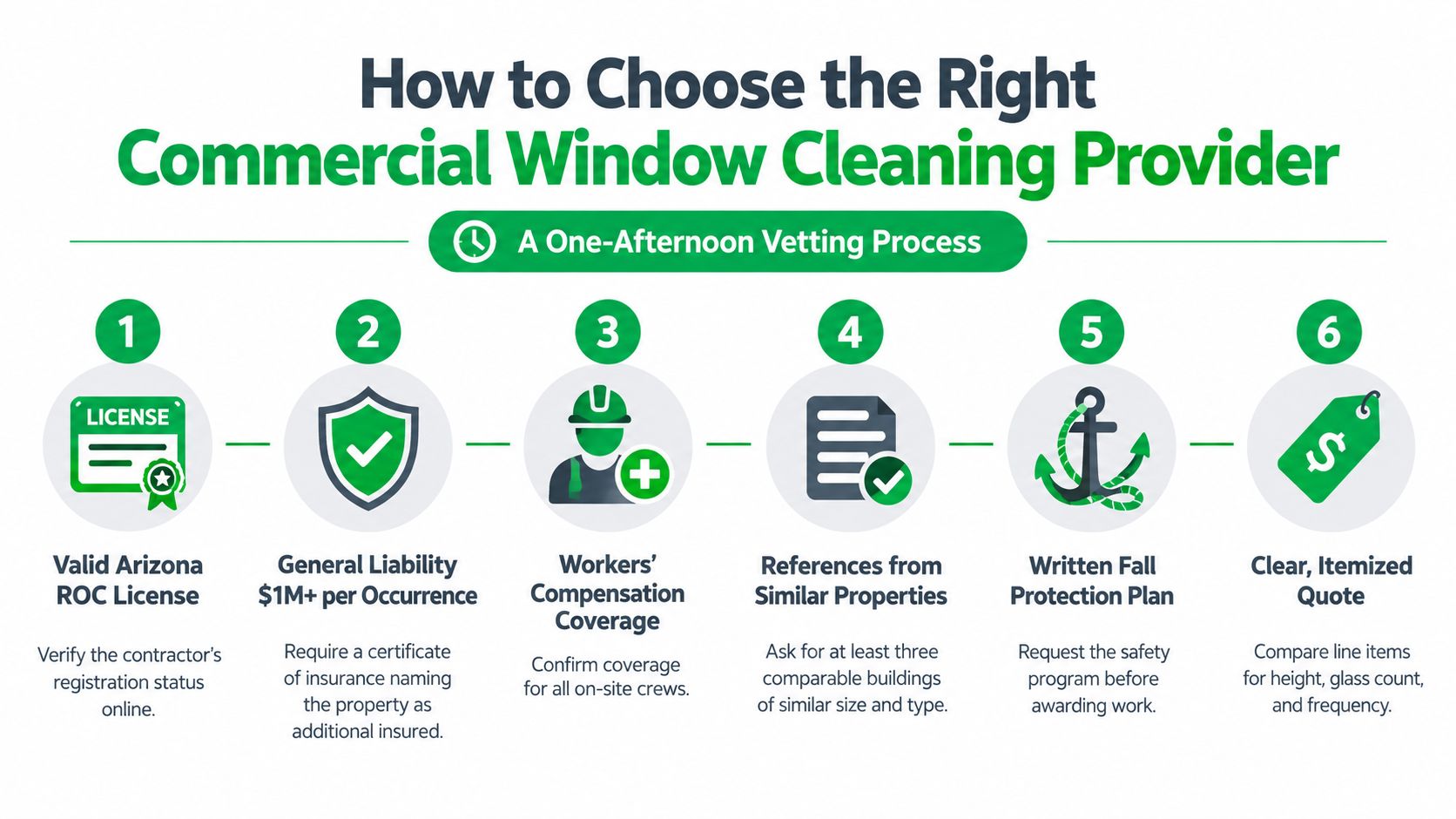
Use a written scope that states frequency, access, glass condition, screens, frames, sills, doors, cleanup, weather delays, callbacks, and damage reporting. Commercial window cleaning services should be evaluated on that complete operating picture, not on a per-visit number stripped of context.
Putting It All Together for Your Property
A defensible program starts with an inventory, not a complaint. Walk the property and record ground-level panes, doors, skylights, clerestories, atriums, upper elevations, screens, sensitive interiors, roof access points, lift routes, anchor locations, and pedestrian exposure. Photograph unusual conditions and separate routine dirt from residue, failed seals, damaged coatings, etched glass, and broken hardware.
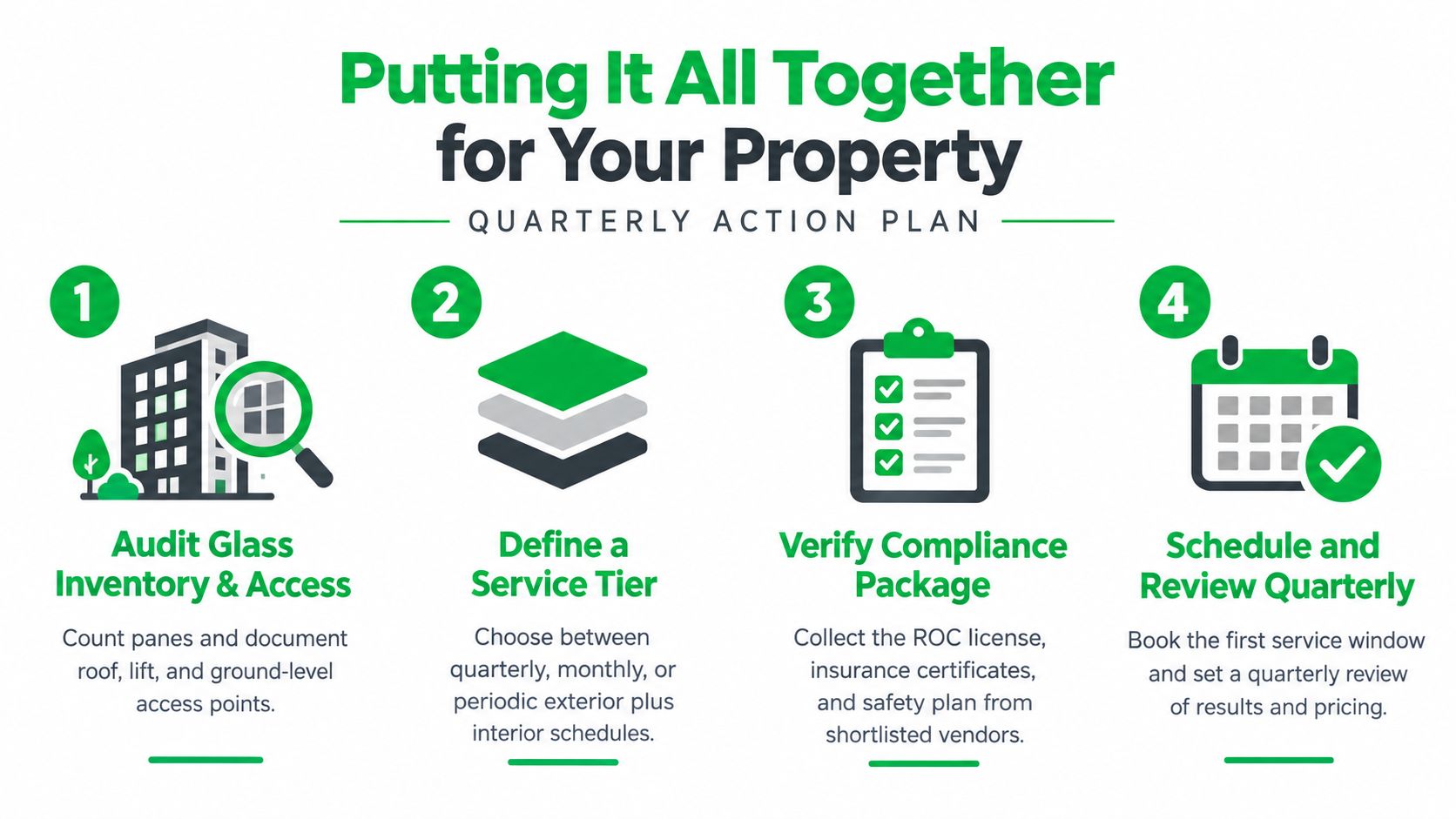
Four decisions to make this quarter
- Audit the glass and access: Count the glass, identify difficult elevations, document roof and anchor information, and map lift staging, parking, fire lanes, tenants, and public routes.
- Define the service tier: Choose routine maintenance, high-access work, post-construction restoration, or a combination. Put interior, exterior, screens, frames, sills, doors, and residue removal in writing.
- Set the frequency: Match the schedule to building use, entrance traffic, dust, pollen, monsoon exposure, winter conditions, and daylight-dependent spaces. Don't apply one interval blindly to every elevation.
- Review the provider: Confirm insurance, training, access equipment, written safety planning, weather procedures, response time, and comparable references before award.
Treat the next service as a building-performance checkpoint. Record the glass condition, lighting-control observations, tenant complaints, access issues, weather delays, and any repairs recommended after cleaning. That record helps you decide whether the next action is another cleaning, restoration, seal repair, coating evaluation, or capital replacement.
Pine Country Window Cleaning is a Flagstaff company founded by Flagstaff native David Kaminski and operating since 1999. Its commercial crews handle interior and exterior glass, screens, frames, sills, post-construction work, and challenging access using professional squeegees, ladders, extension poles, pure-water brushes, boom lifts, scissor lifts, and a 95-foot atrium lift. The company serves properties including hotels, NAU facilities, dealerships, medical buildings, and high-rise sites, with technicians described by the publisher as background-checked and OSHA safety-trained.
Assign one person to own the program, put the next scope review on the calendar, and stop treating clean glazing as a nice-to-have. In Northern Arizona, a planned window-maintenance line item is easier to schedule, defend, and improve than a reactive call after the glass has already become a tenant problem.
For a site-specific plan, Pine Country Window Cleaning can assess your building's glass, access conditions, screens, scheduling constraints, and safety requirements, then provide a clear commercial scope for routine, high-level, or post-construction work. Visit Pine Country Window Cleaning to request an estimate and build a maintenance schedule that fits your property.