
You finish an exterior window, step back, and see faint spots forming as the glass dries. The brush did its job. The rinse water didn't. In Flagstaff and Munds Park, the difference between a clean pane and a callback often comes down to what remains dissolved in the water before it reaches the brush.
Professional crews don't rely on rags, Windex, or newspaper for this work. They use squeegees, ladders, poles, and pure-water brushes, with resin systems that remove the minerals responsible for spotting. The result should be clean glass, a protected home, and a customer who doesn't have to wonder whether the windows will look worse once they dry.
Why Pure Water Window Cleaning Resin Matters
On a large Flagstaff property, a crew can finish rinsing an upper pane, move to the next elevation, and return to find the first glass drying with white mineral marks. The brush and pole may be working properly. The resin may have reached the point where it no longer removes enough dissolved material from the water.
Tap water contains dissolved calcium, magnesium, sodium, iron, chloride, sulfate, bicarbonate, and silica. Once that water evaporates, those minerals remain on the glass. The marks stand out on sunlit windows, dark frames, storefronts, and broad exterior panes. Local Flagstaff water quality provides the practical benchmark: resin life depends on the mineral load entering the system, not on how clear the water looks.
Pure-water cleaning puts mineral control before brushing and rinsing. The technician uses a soft-bristle brush to loosen dust, pollen, and grime, then uses purified water to carry that soil away. With the dissolved ionic load removed, the rinse can dry without the residue associated with tap-water cleaning, as described in Pine Country's explanation of pure-water window cleaning in Flagstaff.

The practical difference on a job
A cabin with exterior glass that has gone uncleaned for a season needs thorough agitation and a reliable rinse. A correctly operating resin system lets the technician clean upper panes from the ground or a safe pole position, instead of moving a ladder between windows. If the resin is exhausted, that same workflow can spread a drying mineral film across every pane.
The equipment may include a deionization vessel, reverse-osmosis stage, water-fed pole, soft brush, and meter. Our guide to how pure-water window cleaning works explains how those pieces fit together. Resin condition remains the deciding factor for whether the final rinse is safe to leave on the glass, so crews should track output quality and plan replacement before a busy job exposes the problem.
Practical rule: If the water is leaving spots, changing brushes or adding more agitation won't solve the underlying mineral problem.
Reliable service also protects the property around the glass. Control hoses near landscaping, avoid dragging equipment across flooring, use ladders responsibly, and explain the workflow before work begins. Screen handling matters as well. Pine Country's stated process is to remove, clean, inspect, and reinstall screens with every service, rather than wipe only the visible mesh while leaving frames or damaged splines unchecked. Resin makes a spot-free rinse possible, while careful handling protects the customer's home.
How Deionization Resin Removes Minerals From Water
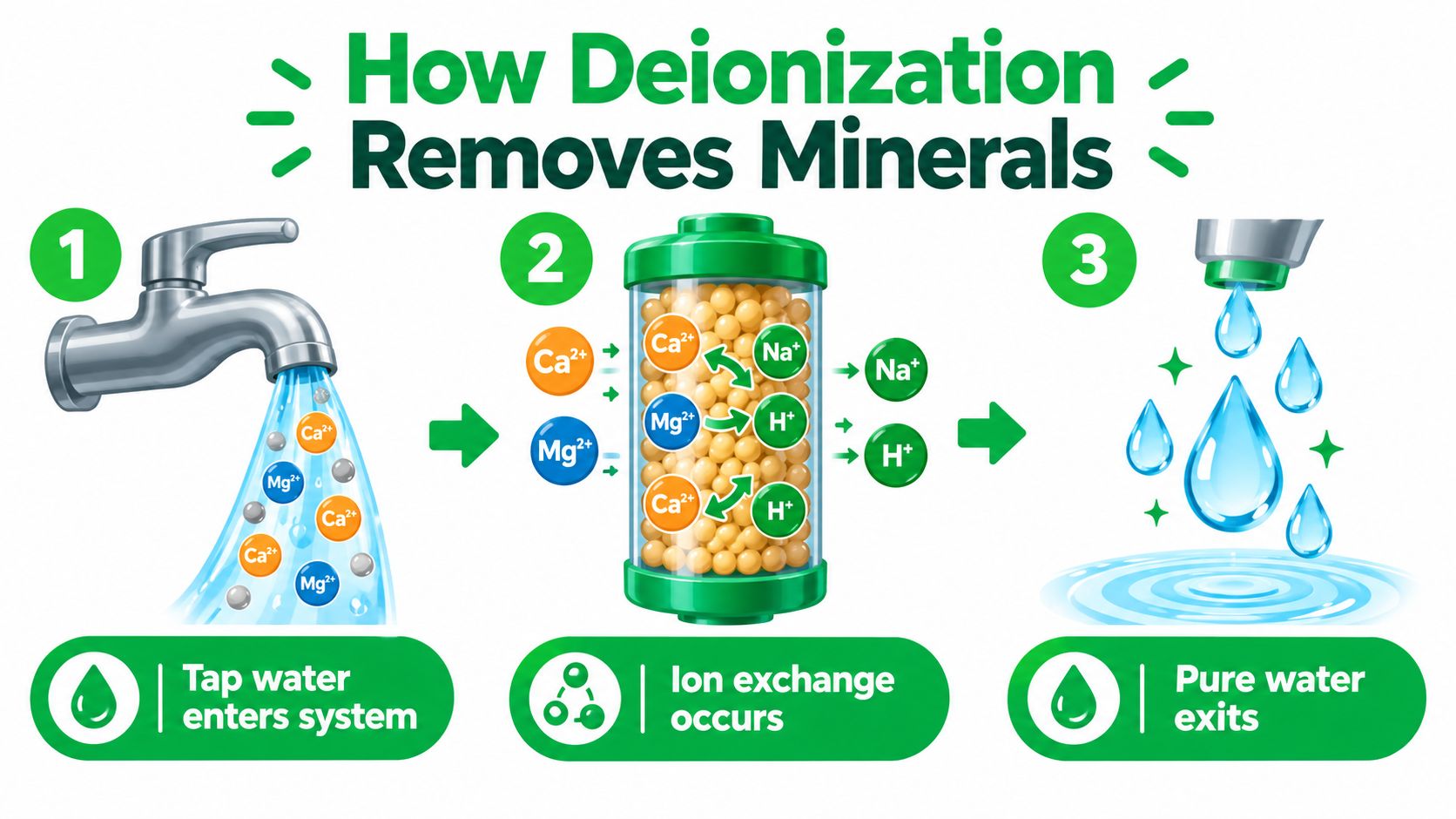
Deionization resin doesn't work like a simple sediment filter. A sediment filter catches particles. An ion-exchange bed removes dissolved charged minerals that are too small to see and would otherwise pass through ordinary filtration.
The working model is straightforward:
- Tap water enters the vessel carrying positively and negatively charged ions.
- Cation resin exchanges hydrogen ions for positively charged minerals such as calcium, magnesium, sodium, and iron.
- Anion resin exchanges hydroxide ions for negatively charged substances including chloride, sulfate, bicarbonate, nitrate, and silica-related anions.
- The released hydrogen and hydroxide combine to form water.
The resin beads aren't an unlimited sponge. Each bead has exchange sites, and those sites gradually fill with minerals. Once the available sites are occupied, more ions pass through the bed. The treated water's conductivity rises, and the spotting risk rises with it.
Why the meter matters more than appearance
Water can look perfectly clear while carrying enough dissolved material to mark glass. A conductivity or resistivity meter gives the operator information that eyesight can't provide. As the ion load begins leaking through the resin, the reading changes before every pane on the property shows visible spotting.
The highest commonly recognized purity level for deionized water is approximately 18.2 megohm-centimeters of resistivity, equivalent to conductivity of about 0.055 microsiemens per centimeter under standard reference conditions, according to this technical explanation of purified-water quality and resistivity. That is a laboratory-grade benchmark. Field crews may use water with a lower reading and still achieve suitable spot-free exterior cleaning, but they need a defined operating limit and consistent checks.
A useful field diagnosis starts at the meter, not at the glass. If output conductivity is climbing, inspect the resin and source water before blaming the brush, pole, or technique. Operators who want to compare equipment configurations can also review Labs USA deionized water systems for a broader view of vessel and treatment arrangements.
The video is useful for visualizing the process, but the on-site decision still comes from the meter. Resin removes ions through exchange, and the meter shows whether that exchange is still protecting the final rinse.
Understanding Cation, Anion, and Mixed Bed Resin Types
The word “resin” covers several arrangements, and they don't all behave the same way on a window-cleaning rig. Choosing the right configuration requires matching the bed to the mineral profile, required purity, water volume, and maintenance capability.
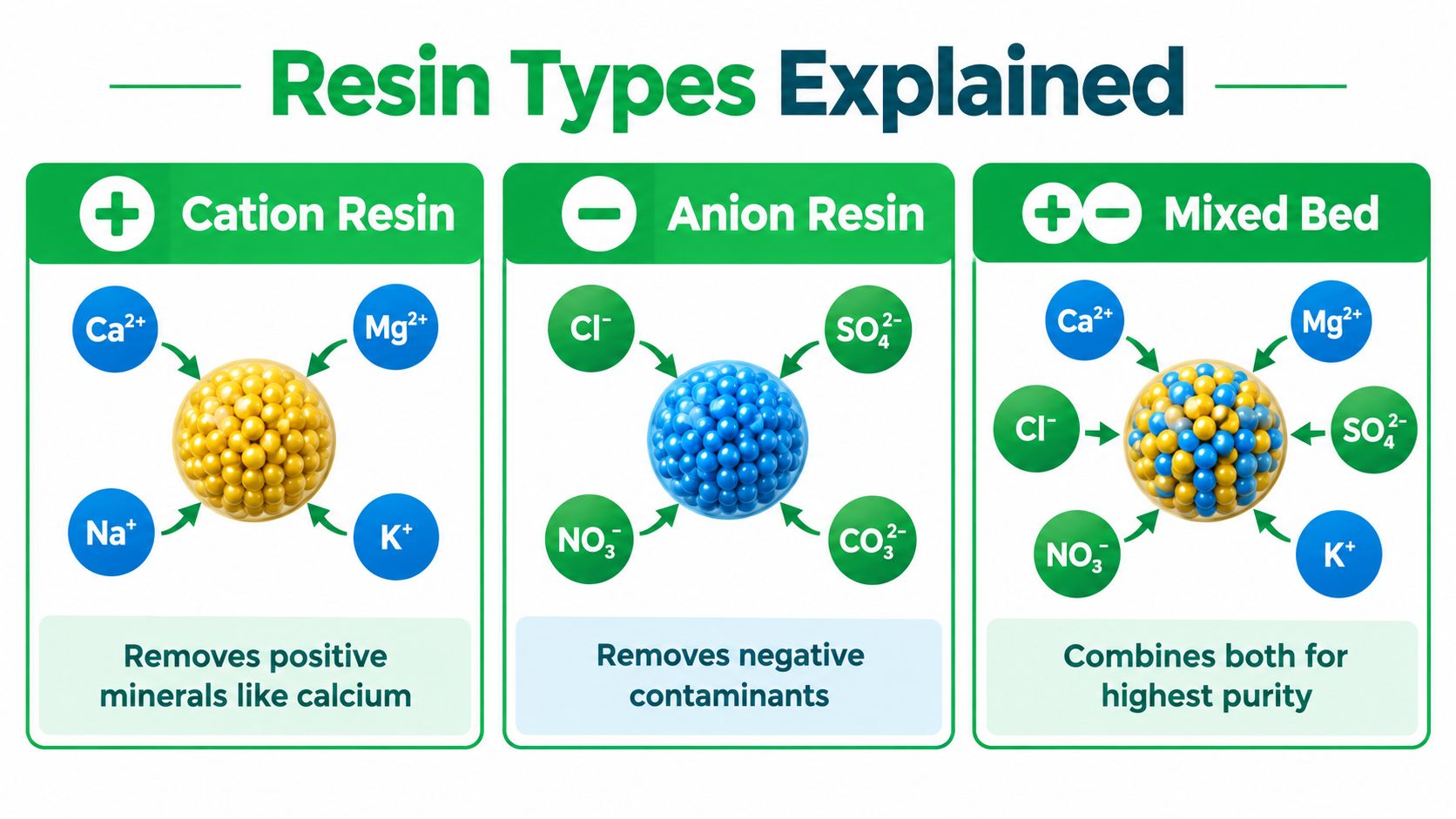
Cation resin handles the positive load
Cation resin targets positively charged ions. In Flagstaff water, that includes the calcium and magnesium associated with hardness, along with sodium and iron when present. The resin exchanges those ions for hydrogen. By itself, a cation bed doesn't remove the negatively charged contaminants that can also contribute to residue.
A cation vessel can make sense as part of a larger treatment train, but it isn't a complete spot-free solution. If an operator runs only cation resin and expects it to remove silica or chloride, the remaining anions can still pass through and affect the finished glass.
Anion resin completes the other side
Anion resin exchanges hydroxide for negatively charged ions such as chloride, sulfate, bicarbonate, nitrate, and silica-related contaminants. It works in conjunction with cation treatment, because the two exchange processes need to address both sides of the dissolved mineral load.
Silica deserves particular attention. It can remain weakly ionized under some conditions and leak through an anion bed, which means a general conductivity reading may not tell the entire story when conditions are unfavorable. Technical guidance on AmberLite ion-exchange resin performance and silica control identifies silica leakage, fouling, and incomplete regeneration as important causes of poorer output.
Mixed bed resin polishes the rinse
Mixed bed resin blends cation and anion media in one vessel. The combined bed provides repeated contact with both resin types and is commonly selected when the operator needs very low conductivity at the brush. That makes mixed bed resin a practical choice for exterior window cleaning, especially when the final rinse must dry on the glass.
The trade-off is service life. In hard-water conditions, mixed bed media handles the entire dissolved ionic load in one compact vessel, so it can exhaust quickly if the incoming water carries a heavy mineral concentration. Separate beds may be easier to regenerate, while disposable mixed bed cartridges are often replaced when the meter reaches the operator's limit.
| Resin type | Main role | Exhaustion warning |
|---|---|---|
| Cation | Removes positive ions such as calcium and magnesium | Remaining anions can still contribute to residue |
| Anion | Removes negative ions, including silica-related contaminants | Silica leakage and rising ionic load can affect rinsing |
| Mixed bed | Combines both exchange functions for high purity | Conductivity can rise and spotting can appear across finished glass |
A two-bed deionizer has a practical capacity benchmark of approximately 20,000 grains per cubic foot, although actual capacity depends on feed-water chemistry and total exchangeable ions, as explained in this independent deionization process guidance. The number on the vessel doesn't tell you when the job is safe. The output reading does.
Monitoring Conductivity and Managing Resin Capacity
Resin life follows mineral load, not the calendar. Two crews can use identical vessels for different properties and get very different service runs because their source water contains different concentrations of hardness, silica, iron, or other dissolved ions.
Flagstaff's official water-quality guidance reports hardness ranging from 25 to 325 ppm, with an average of 125 to 200 ppm, equivalent to 7.3 to 11.7 grains per gallon. That range is wide enough to make a fixed replacement promise unreliable, as shown in the City of Flagstaff water-quality information.
Build a repeatable meter routine
A technician doesn't need a complicated laboratory protocol to manage a field system. The useful routine is consistent sampling and a written record.
- Test the source: Measure incoming water before treatment, especially when moving between municipal supplies, tanks, cabins, and commercial properties.
- Test the product: Check treated water before it reaches the pole. A clear sample isn't proof of low ionic content.
- Watch the trend: A single reading can be an anomaly. Consistently rising treated-water conductivity indicates that the bed is approaching exhaustion.
- Log throughput: Record gallons processed alongside inlet and outlet readings. Gallon totals help compare jobs, but they shouldn't replace direct purity checks.
- Act before failure: Replace or regenerate the resin when the output reaches the limit established for the operation, rather than waiting for visible spotting.
The useful trigger isn't “the cartridge is old.” It's “the product-water reading is moving in the wrong direction.”
Resin capacity is finite. During service, exchange sites become occupied, and conductivity begins to increase as the bed loses its ability to capture ions. Regeneration can restore only about 60% to 80% of original resin capacity, according to this technical review of ion-exchange capacity and regeneration. Disposable mixed bed cartridges are therefore often replaced at breakthrough, while regenerable systems need documented regeneration and post-regeneration testing.
For technicians using or evaluating a mobile system, Pine Country's water-fed pole system rental information illustrates the kind of equipment category used for exterior work at height. The operational principle remains the same across systems: check the water at the brush, record the result, and don't let an exhausted bed stay connected because the vessel still looks full.
When to Use RO Pre-Treatment With Deionization Resin
A resin-only system is compact and straightforward. Tap water enters the deionization vessel, the resin captures the dissolved ions, and the operator monitors the output. For lighter residential work or source water with a manageable mineral load, that simplicity can be a real advantage.
Reverse osmosis changes the workload before the water reaches the resin. The RO membrane removes much of the dissolved-solids load upfront, so the deionization stage acts as a polishing barrier rather than carrying the full burden. That can extend resin service life and make output more consistent during heavy use.
Resin-only systems suit simpler routes
A single DI vessel has fewer components to maintain. There's no membrane flush routine, storage tank management, or RO reject stream to plan around. The operator can also diagnose the system quickly because the resin is the primary treatment stage.
The limitation is consumption. Hard municipal supplies push more calcium, magnesium, and other ions into the bed, and the cartridge reaches exhaustion sooner. A property supplied by a different source may also change the economics from one job to the next.
RO and DI suit sustained demand
RO pre-treatment becomes more attractive when the crew processes substantial volume, works across properties with high hardness, or sees meaningful changes in source-water quality. Hotels, campuses, dealerships, and large post-construction projects can place enough demand on a DI vessel that reducing the incoming load is worth the added equipment.
The combined system introduces trade-offs:
- Lower resin burden: RO reduces the mineral load reaching the DI stage.
- More equipment: Pumps, membranes, valves, and prefilters create additional maintenance points.
- Water waste: RO produces a reject stream that must be handled responsibly.
- Higher setup cost: The system requires more space and a more deliberate operating routine.
- More consistent polishing: DI can focus on removing the remaining ions before the water reaches the brush.
The right decision depends on the relationship between water quality, processed volume, labor, and replacement cost. RO isn't automatically better for every truck or property. It earns its place when the resin-only setup consumes media too quickly or struggles to maintain stable output during demanding work.
Troubleshooting Resin Issues Before They Spot Glass
A sudden change in water quality usually has a cause that can be found. The mistake is to keep cleaning while hoping the next pane will dry differently. Once conductivity rises, every rinse on the route deserves attention.
Start with the incoming water. A crew may have filled from a municipal supply at one property and a tank or alternate source at another. Flagstaff's hardness range means those sources can carry materially different mineral loads, so a cartridge that performed well earlier in the day may be challenged by the next fill.
Follow the failure in order
If the treated-water reading rises suddenly, use this sequence:
- Test inlet water first. Confirm that the source has changed or that mineral concentration is higher than expected.
- Inspect the resin condition. Look for exhaustion, uneven settling, contamination, or signs that the bed has been allowed to dry or freeze.
- Check flow and distribution. Excessive flow, poor packing, or channeling can let water bypass active exchange sites.
- Look for fouling. Iron, manganese, chlorine, organic material, and turbidity can reduce effective capacity or damage performance.
- Retest the outlet. Don't return to glass until the treated-water reading is stable within the operating limit.
Channeling deserves special attention. Water follows the easiest path through a poorly distributed bed, reducing contact with the resin. The vessel can appear full while part of the media does little work. Excessive pressure, poor pretreatment, and unfavorable flow conditions can create the same kind of misleading result.
A meter trend turns a callback into a diagnosis.
Allowing exhausted media to remain in service is worse than changing it early. The crew may finish a property, then spend more time removing mineral deposits and explaining why the glass spotted after cleaning. Pine Country's mineral-deposit-removal service reflects the separate problem created when deposits are already bonded to the surface. Resin management prevents that problem from becoming part of the routine service.
Unexpected spotting usually points to a management gap, not a mysterious failure. The operator may have skipped the inlet test, trusted a calendar interval, ignored a rising reading, or changed water sources without updating the log. Fix that process and the equipment becomes far more predictable.
Safe Disposal and Maintenance Practices for Used Resin
Exhausted resin shouldn't be dumped into a drain, spread across soil, or discarded without considering what it has captured. The beads have exchanged ions with the source water, and the proper handling method depends on the resin type, regeneration chemistry, local requirements, and manufacturer guidance.
For a disposable cartridge, keep the media contained and follow the supplier's instructions for municipal or commercial waste handling. For a regenerable bed, document the chemicals used during regeneration and handle the spent acid, alkali, or salt solution through an appropriate waste process. Operators should consult the resin manufacturer and local waste authority instead of assuming that used media is harmless because it looks like plastic beads.
Maintenance protects the property
Good resin care includes more than replacing media. Keep vessels protected from freezing, prevent unnecessary exposure to fouling contaminants, check fittings for leaks, and store the system in a condition that keeps the bed properly hydrated when required by the manufacturer. Test water after maintenance, not only before a major job.
Customer care shows up in these small controls. A technician who checks the rinse protects painted frames, stone surfaces, landscaping, and finished glass from avoidable mineral residue. The same technician should protect floors, move furniture carefully, secure hoses, and reinstall every screen so it sits correctly and operates as intended.
Pine Country Window Cleaning was founded in 1999 by Flagstaff native David Kaminski, and the company identifies itself as Flagstaff's largest window-cleaning company in its local company material, as described in its history and service information. That local history matters because resin management isn't an abstract equipment issue. It affects the homes, cabins, hotels, campuses, dealerships, and commercial buildings technicians visit throughout Northern Arizona.
The cleanest result comes from a complete system: suitable resin, measured water quality, controlled flow, safe poles and ladders, careful screen service, and respect for the customer's property. The glass is the visible outcome. The maintenance discipline behind it is what makes that outcome repeatable.
If your exterior windows are spotting, Pine Country Window Cleaning can evaluate the water-fed pole and resin process alongside the glass, frames, and screens. Visit Pine Country Window Cleaning to request service for a home, cabin, commercial property, or larger Flagstaff-area project.