

A Flagstaff homeowner usually notices the problem before opening the windows. Pine pollen has settled across the glass, summer dust has dried into the frames, and the screens are holding a gray layer that makes every room look dimmer. A quick pass with a household cloth may move the loose dirt, but it often leaves grit behind and does little for baked-on screen grime.
That's where the professional window cleaning brush earns its place. A brush agitates the surface while water carries loosened soil away, instead of dragging dry particles across glass, seals, and frames. On upper windows, skylights, and difficult exterior panes, the brush works from a ladder, boom, or water-fed pole while the technician stays in a controlled position.
The right brush isn't a single universal product. Bristle softness, head shape, water quality, pole control, and the condition of the glass all matter. The same head that works well on a dusty residential pane may be a poor choice for a delicate coating, a tight sill, or a commercial storefront.
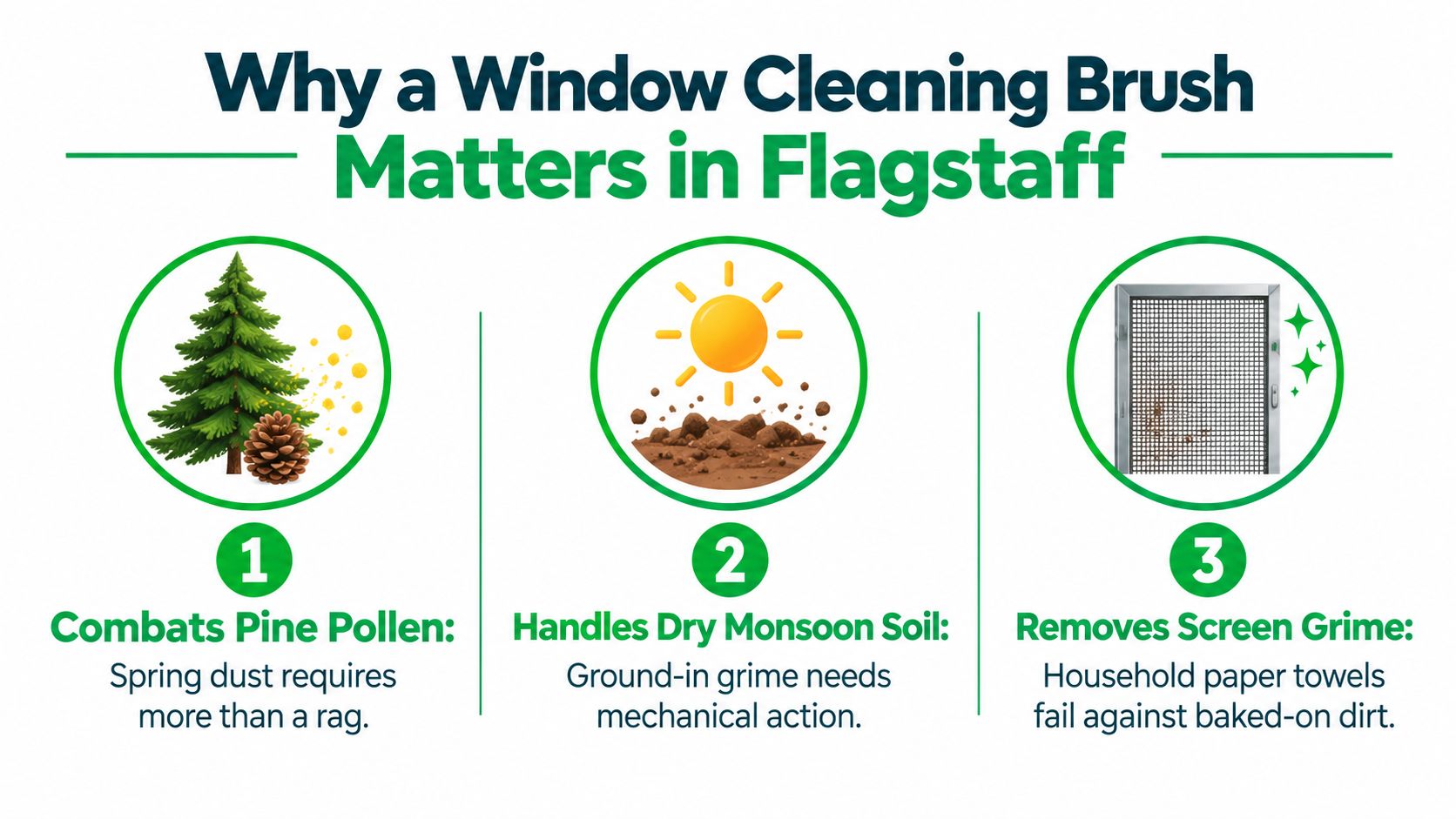
Why a Window Cleaning Brush Matters in Flagstaff
A homeowner in Flagstaff may deal with pine pollen in spring, dry soil during the monsoon season, and sun-baked grime on screens throughout the year. Those materials don't all behave the same way. Loose pollen can rinse away easily, while compacted dust around a frame or screen needs mechanical agitation before water can remove it.
Paper towels and spray bottles are poorly suited to that work. They can spread fine grit across the pane, leave lint around seals, and force a technician to keep returning to the same edge. A proper brush loosens contamination at the point of contact, then a clean rinse carries it away. That approach matters on tinted glass, coated surfaces, painted frames, and wood windows where careless abrasion or excess moisture can create a new problem.
The brush is part of a larger system
The modern trade didn't arrive at today's equipment by accident. A patent for a brush mounted on a pole to clean windows was reportedly applied for in 1895, before high-rise buildings created widespread demand for long-reach exterior systems. The squeegee was already in use for window cleaning by 1918, and Ettore Steccone patented a lighter, single-blade design in 1936, replacing an earlier arrangement that required changing two rubber blades held by 12 screws. That documented development gives the professional toolset a history of at least 108 years from early recorded use to today, as described in the history of the squeegee.
For a Flagstaff crew, the lesson is practical. The brush isn't a decorative accessory added to a pole. It is the component that makes contact with the glass, frames, edges, and screens. The pole provides reach, purified water provides the rinse, and the brush supplies the controlled agitation that turns a dirty exterior pane into a clean one.
Field rule: If the brush can't hold steady against the surface, the pole is too long, the head is wrong, or the technician needs to change position.
A professional service may use a brush on an extension pole for upper panes, a hand brush for sills and screens, and a squeegee for interior or detail work. The tool changes with the access problem, but the objective stays the same, remove soil without spreading it and protect the home while doing it.
How a Water-Fed Brush System Actually Works
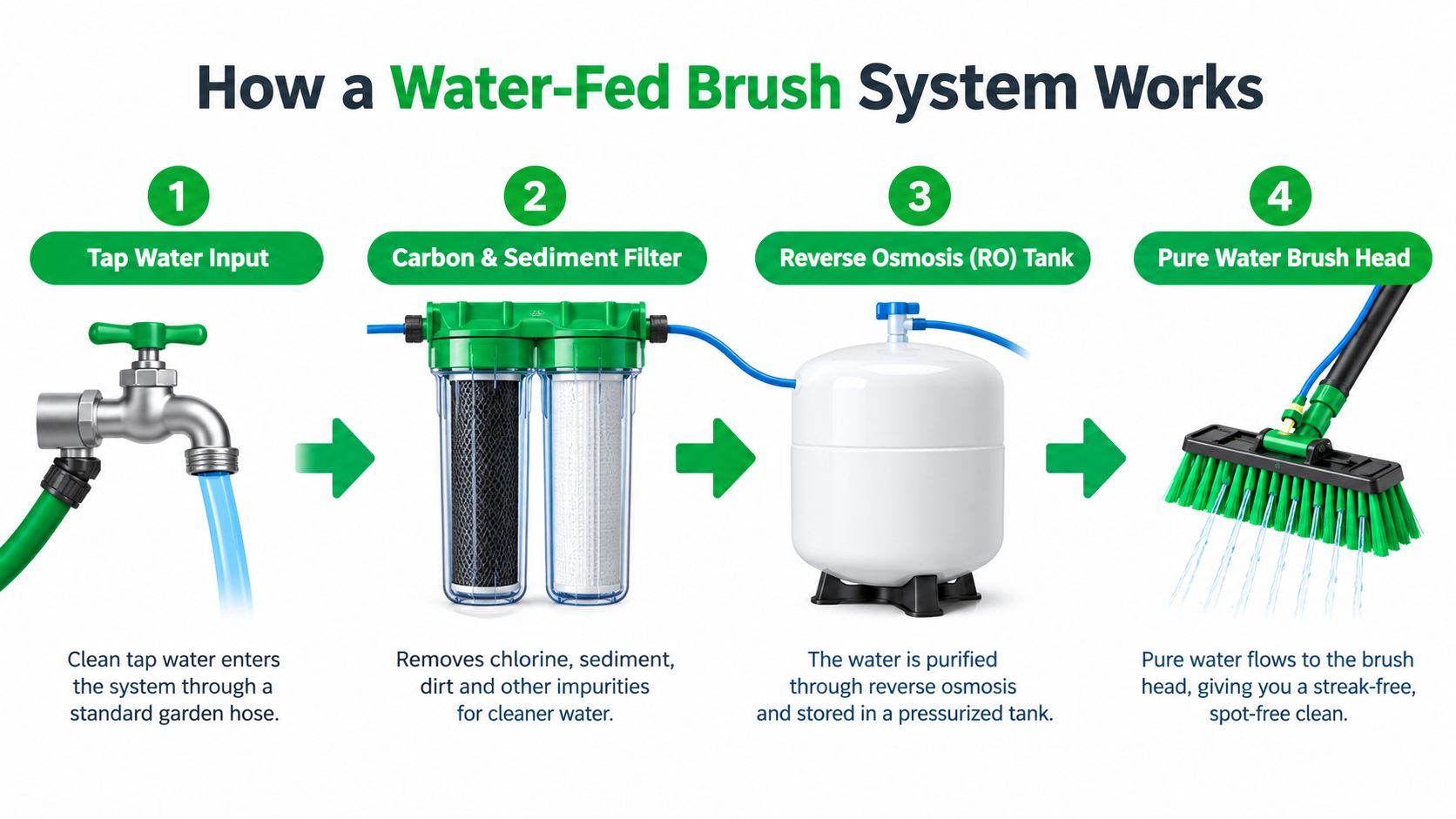
A water-fed pole is best understood as a delivery system. The brush head does the physical cleaning, while the pole carries water and lets the technician reach exterior glass from the ground or a safer working position.
The water path
In a professional setup, tap water passes through filtration stages that can include carbon and sediment filtration, reverse osmosis, and deionization resin. The final water is purified so it can dry on the glass with far less mineral residue than untreated water. Technicians monitor the water quality rather than assuming a clear stream is clean enough.
The pole sends that water through a hose to jets positioned in or near the brush head. The jets wet the glass and rinse loosened soil. Flow is more useful than increasing pressure because the brush needs enough water to carry dirt away without forcing the operator to fight a heavy or unstable pole.
The brush does the work
The operator moves the head over the glass, frames, and edges in controlled passes. Bristles reach into surface texture and corners that a flat blade cannot fully contact, while the water flushes away suspended dirt. This is especially useful on exterior glass that is high, textured, recessed, or difficult to access by hand.
The method doesn't eliminate judgment. A technician still has to recognize paint, construction debris, hard mineral deposits, failing seals, delicate coatings, and damaged glass. Pure water won't magically remove every contaminant, and a brush should never be used aggressively just because the pole can reach the pane.
The same system can support work on skylights and solar panels when the surface and manufacturer guidance allow it, but the brush material and pressure must be appropriate. Soft bristles, controlled movement, and a clean rinse matter more than forcing the head against the surface.
For a visual explanation of the equipment and sequence, this water-fed pole cleaning guide shows how purified water, a telescoping pole, and a soft brush work together.
A useful way to diagnose a poor result is to separate the system into three questions. Is the water sufficiently purified? Is the brush making even contact? Is the operator rinsing long enough to remove loosened soil? A longer pole won't correct a worn brush, and a premium brush won't overcome contaminated rinse water.
Bristle Types and Head Shapes Explained
Brush selection starts with the surface, not the product label. Lightweight, solvent-resistant synthetic bristles are common in water-fed equipment because lower weight reduces fatigue on extension poles and chemical resistance helps the head tolerate detergents or purified water. Medium-stiff polystyrene bristles can provide more scrubbing force, but stiffness has to be balanced against smooth glass, where excessive force can create poor contact or missed particles. Trade guidance on window-washing scrubbers describes this balance between dirt removal and safe, efficient contact for professional brush equipment.
Matching bristle behavior to the pane
Soft nylon is a dependable general-purpose choice for residential glass and painted frames. Natural horsehair can be useful where a gentle touch matters, although the technician still needs to inspect the glass before choosing it. Microfiber-style pads provide broad, soft contact for surfaces such as solar panels or tinted glass when the surface instructions permit that method.
Split-tip bristles act softer at the tips and increase contact with the pane, which helps with pickup and finishing. Mono-filament bristles create straighter water channels and can suit firmer scrubbing or warmer water. Triple-trim layouts engage the surface at different levels, helping the operator reach corners, edges, and frame lines without lifting the head.
Head shape changes control
Fan-shaped heads adapt well to irregular residential panes. Rectangular heads cover broad commercial glass efficiently, while round heads can follow the layout of an array or other grouped surfaces. Narrow pencil-style heads are more useful around mullions, sills, narrow frame channels, and detailed work.
| Bristle or Head Type | Best Application |
|---|---|
| Soft nylon | Everyday residential glass, frames, and general exterior washing |
| Natural horsehair | Delicate work where a softer contact point is preferred |
| Microfiber-style pad | Tinted glass and compatible solar-panel surfaces |
| Split-tip synthetic | Softer pickup and finishing on smooth glass |
| Mono-filament synthetic | Firmer scrubbing and direct rinsing on exterior glass |
| Fan head | Irregular residential panes and changing angles |
| Rectangular head | Large commercial glass and broad storefront sections |
| Narrow pencil head | Sills, mullions, edges, and frame detail |
A practical buyer should also consider screens. A screen brush needs enough softness to avoid deforming mesh while still lifting embedded dust. For a deeper equipment overview, the professional window cleaning tools guide provides useful context on how brush choices fit alongside squeegees and poles.
Choosing the Right Brush for Residential and Commercial Jobs
The best brush is the one that fits the pane, the reach, and the soil load. A large head can speed up a broad storefront, but it becomes awkward around divided lights and tight corners. A narrow head offers control, but it wastes time on uninterrupted plate glass.
For many domestic windows, a 10-inch head is a practical middle ground because it fits common household panes while still working in tighter areas, according to independent product guidance on window brush sizes and applications. That doesn't make it the right choice for every property. Cabins with divided-light muntins, deep sills, or irregular wood frames may need a smaller head, while commercial glass often benefits from a wider rectangular or fan design.
Read the job before loading the pole
A single-story ranch and a tall commercial building create different control problems. On a home, the operator may prioritize a compact brush that can wash the pane, frame, and sill without catching landscaping or trim. On a storefront, the priority is usually consistent coverage across broad glass, with enough maneuverability around doors, handles, and adjacent framing.
Pole length also affects accuracy. More reach can reduce ladder work, but a long pole becomes harder to control in wind and around rooflines. Carbon fiber helps reduce weight, while a telescoping design lets the technician shorten the setup for detail work. The correct length is the shortest one that safely reaches the glass with the brush held flat and stable.
| Job Type | Brush Width | Head Shape | Pole Length |
|---|---|---|---|
| Single-story residential windows | Compact to medium | Fan or light rectangular | Short to moderate reach |
| Divided-light cabin windows | Narrow | Pencil or compact rectangular | Short, highly controlled reach |
| Storefront plate glass | Medium to wide | Rectangular or fan | Moderate reach |
| Atrium and lobby glass | Medium | Triangular or T-bar style | Extended reach with careful control |
| Tall exterior panes | Medium, selected for low weight | Fan or rectangular | Long reach, chosen for stability |
Flow rate must match the brush and the surface. Too little water leaves loosened dirt suspended on the glass. Too much can create unnecessary runoff, poor handling, and wet areas around frames. Experienced crews adjust the sequence, use the brush to wash frames before glass when needed, and finish with a controlled rinse rather than assuming a heavier stream will produce a better result.
A bigger brush isn't automatically faster. It is faster only when the head stays flat, the operator can control it, and the pane gives it room to work.
Commercial work may still call for a hand-applied squeegee. On interior glass, narrow panes, doors, and areas where runoff must be tightly controlled, the squeegee gives the technician a precise finish that a water-fed brush may not provide.
What a Professional Service Visit Looks Like
A careful service begins before the first brush touches glass. At a Flagstaff home in Cheshire or Coconino Estates, a two-person crew can assess access, identify fragile landscaping or interior furnishings, and establish a clean route from the hose connection to the working areas. Drop cloths go beneath picture windows, and equipment stays positioned so it doesn't scrape siding, trim, or flooring.
One technician may handle ground-level details with a small natural-hair brush while the other works upper panes with a soft nylon fan head on a water-fed pole. The exact head changes with the window. A tight kitchen sash may need a compact hand brush, while an upper exterior pane may call for a broader pole-mounted brush that reaches the frame and sill in the same pass.
Screens are part of the window service
Screens come out carefully and are kept associated with the correct opening. The crew washes them separately with a soft brush, paying attention to corners and the frame without forcing the mesh. After the window is complete, each screen goes back into its original position.
That handling protects more than appearance. A screen that is bent, installed backward, or returned to the wrong opening can rattle, sit unevenly, or fail to seal as it should. Careful removal and reinstallation also show the homeowner that the crew is working on the whole window assembly, not just the visible pane.
Tracks and sills receive their own attention. Loose debris is removed before damp cleaning, hardware such as hinges and locks is brushed as appropriate, and the technician checks for remaining drips around the frame. A final pure-water rinse supports the exterior process, while a hand squeegee handles panes that need a controlled interior finish or retain isolated drips.
The company history is also part of the local context. The Flagstaff operation was founded in 1999 by Flagstaff native David Kaminski and describes itself as Flagstaff's largest window cleaning company in its commercial service history. For property managers comparing maintenance vendors, the same care principles apply whether the work involves a residence, a hotel, a campus, or a storefront. Guidance on planning adjacent exterior maintenance, such as this resource about clean commercial roofs Blacktown, is useful because roof and glass work both depend on protecting surfaces, controlling runoff, and keeping crews organized around an occupied property.
The homeowner should find the property orderly
The final check includes glass, frames, tracks, screens, and any areas beneath the windows where water or loosened debris could remain. A crew that works carefully doesn't leave the homeowner to discover a screen leaning against a wall or dirt pushed into a corner. Good window cleaning includes communication, respect for the home, and a result that looks finished from both inside and out.
Caring for Your Brush and Knowing When to Skip It
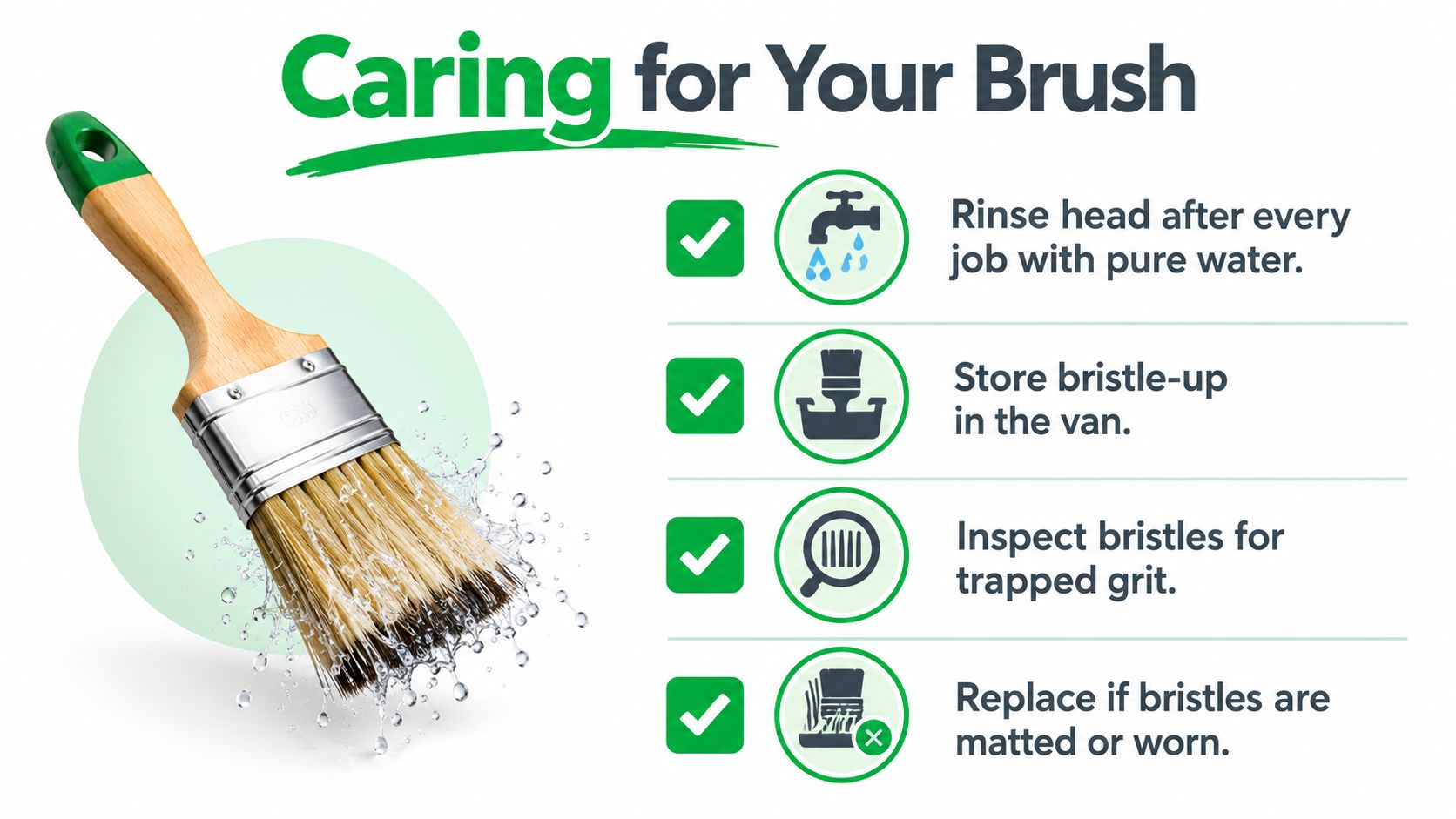
A brush doesn't need complicated maintenance, but it does need consistent care. Grit left in the tufts can scratch the next surface or create uneven contact. Mineral residue can harden around the base of the bristles, and a bent head can leave a clean pane with repeating lines or missed edges.
Rinse the brush after every job with clean, preferably purified water. Work the rinse through the tufts, inspect the ferrule, and remove trapped particles before the brush goes into the vehicle. Store it bristle-up so the fibers dry in their natural shape. Don't leave it clamped against a wall, bent under equipment, or sitting in a bucket where the head can deform.
Inspect before trusting the next pane
A quick inspection catches most problems early:
- Look for fan-out: Bristles that spread unevenly won't maintain consistent contact.
- Check the staples and ferrule: Bent fasteners or cracks can release tufts or allow the head to flex.
- Test an easy pane: If the brush leaves repeated streaks on cleanable glass, remove it from service rather than compensating with more pressure.
- Clean the pole connection: Dirt in the fitting can make the head wobble or prevent a secure attachment.
Replacement timing depends on soil, frequency, water quality, and handling. Residential heads may last through many jobs, while commercial heads exposed to heavier contamination can wear sooner. The useful test isn't a calendar date. It's whether the bristles still rinse clean, hold their shape, and produce even contact.
Know when the brush is the wrong tool
Construction debris may require a specialist scraper and careful technique. Oxidized frames need a suitable pad rather than aggressive bristles. Heavy mineral deposits may call for a compatible mild acid treatment, used only after testing the glass and surrounding materials. Soft or already scratched glass may be safer with a microfiber-style pad and a controlled rinse.
A squeegee is often the better choice for interior glass and precise storefront finishing. A pressure washer belongs on suitable exterior surfaces, not automatically on window glass, seals, screens, or delicate trim. The professional decision is not “How can I make this brush work?” It is “Which tool removes this soil without creating damage?”
Bringing It All Together for Streak-Free Results
No single piece of equipment wins every window. The brush has to match the glass and soil, the pole has to provide reach without sacrificing control, and the water has to be clean enough to dry without leaving a mineral film. On upper residential panes, a soft brush and purified water can keep the technician on the ground. On storefronts, atriums, doors, and interior glass, a hand-applied squeegee may deliver the tighter finish.
Technique determines what happens after the tool reaches the surface. The squeegee is commonly maintained at about a 45-degree angle, with overlapping strokes that control the solution and reduce residue, according to commercial window cleaning technique guidance. A brush handles agitation and rinsing. A squeegee removes water in a deliberate pass. A clean scrim or detailing cloth handles the small amount of moisture left at edges and hardware.
The customer-care details matter
A finished job includes more than bright glass. Screens should be removed, cleaned, and reinstalled with every service. Tracks and sills should be treated as part of the window, not ignored because they sit below eye level. Drop cloths, careful pole placement, and clear communication protect the home while the crew works.
For a homeowner or property manager in Flagstaff, the visible result comes from the combination of brush selection, pole reach, and water quality. It also comes from knowing when to stop using the brush and switch to a squeegee, scraper, pad, or specialty treatment. The practical guidance on cleaning windows streak-free follows the same principle, sequence the tools instead of forcing one method onto every pane.
Professional window cleaning is a system. The window cleaning brush is its starting point, but the crew's judgment, surface care, screen handling, and final inspection determine whether the system works.
For Flagstaff homes, cabins, storefronts, and commercial properties, Pine Country Window Cleaning uses squeegees, ladders, water-fed brushes, and purified-water systems to match the equipment to the glass and access conditions. Visit Pine Country Window Cleaning to request a free estimate or schedule service that includes careful screen removal, screen cleaning, and reinstallation.