
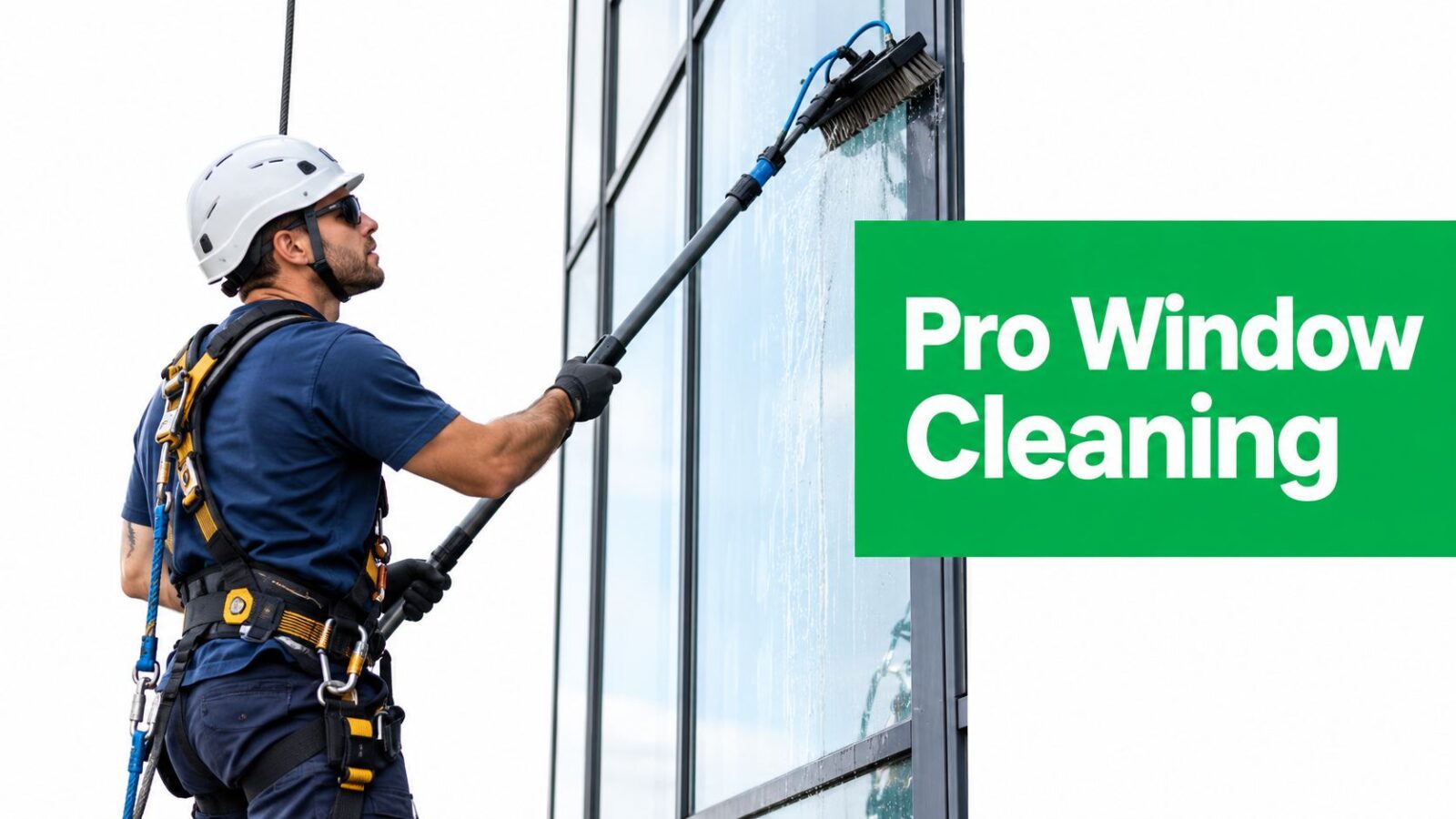
Most advice about window cleaning starts with the glass. That's the wrong place to start. A professional visit is really about safe access, mineral-free water, careful handling, and protecting the property around every pane, not just making a cloudy surface look brighter.
That distinction matters because professional window cleaning is a substantial service industry, not an occasional side task. The United States industry generated an estimated $2.9 billion in revenue in 2024, with about 35,344 businesses and roughly 89,765 workers, according to window cleaning industry data from Jobber. A trained crew brings a defined process to a job that can involve fragile glass, high elevations, screens, frames, landscaping, and liability.
What Professional Window Cleaners Actually Do
Professional window cleaners don't arrive merely to make the glass look clear for a few hours. They assess the property, select an access method, protect nearby surfaces, clean the glass with the correct tool, and inspect the result before leaving. On a residential visit, that may include interior and exterior panes, frames, tracks, sills, and screens. On a commercial property, the work can extend across storefronts, atriums, hotels, medical buildings, campuses, and upper-level façades.
The first practical difference is reach. A ground-floor pane and a second-story pane may look similar from inside the room, but they create very different safety and equipment demands outside. A professional crew chooses between ladders, extension poles, water-fed poles, lifts, and traditional squeegee work based on the building, the surface below, and the worker's ability to maintain stable access.
The work extends beyond the glass
Frames collect dust and airborne debris. Tracks trap grit that can interfere with operation. Sills often hold soil that becomes visible immediately after the glass is cleaned. A careful technician treats these areas as part of property care rather than leaving the homeowner with a bright pane surrounded by neglected edges.
Screens deserve their own step. Professional crews remove screens, clean them, and reinstall them with every service. That process reduces the debris that can migrate back onto the glass and helps keep dust from being left behind around the window opening, as described in Pine Country's screen-cleaning service information.
Practical rule: A quote should make clear whether screens, frames, tracks, and sills are included. If the scope only says “windows,” ask what the crew actually touches.
The property-care standard also includes how technicians move through the home. Shoes, ladders, hoses, brushes, and buckets need to be managed around flooring, furniture, landscaping, and outdoor fixtures. The best result isn't just a clear view. It's a clean work area, undisturbed plants, properly replaced screens, and no surprise damage to the surfaces surrounding the windows.
Why professional service is a maintenance decision
Clean glass improves appearance, but the larger value comes from regular observation and careful handling. A technician may notice failing caulk, damaged screens, deteriorating seals, paint on glass, hard-water residue, or a window that no longer operates correctly. Window cleaning doesn't replace repairs, but it gives property owners another informed set of eyes on components that are easy to ignore.
The trade has developed alongside buildings that demanded specialized access. By the 1930s, New York reportedly had about 3,000 window cleaners, evidence that dense urban construction had already created a distinct professional demand, according to the history of commercial window cleaning from Pine Country. Today, the same principle applies to homes with tall elevations, cabins surrounded by trees, and commercial properties with large expanses of glass.
The Professional Toolkit and Pure-Water Technology
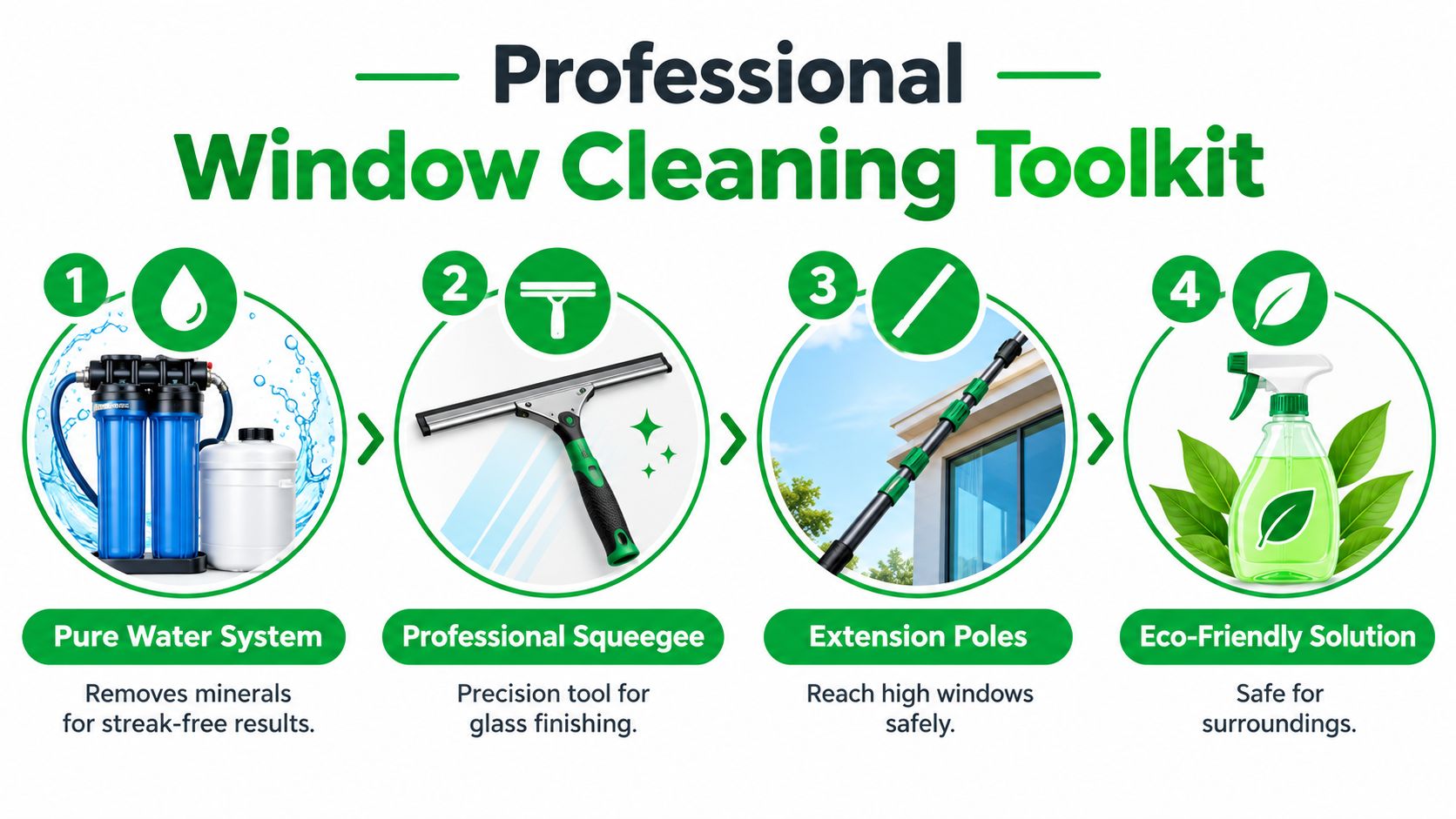
A professional result depends on matching the tool to the pane. Squeegees provide controlled removal of the cleaning solution from the glass. Extension ladders provide access where a stable setup is possible. Water-fed poles allow technicians to work on many exterior windows from the ground, while specialized brushes agitate dirt and rinse the surface.
A traditional squeegee method relies on controlled movement, a clean channel, and correct pressure. The technician wets and loosens soil, moves the squeegee across the pane in an organized pattern, and uses detailed finishing work around the edges. Technique matters because excess solution, worn rubber, poor angles, and rushed edge work can leave lines even when the glass initially appears clean.
How pure water removes the residue problem
A water-fed pole system sends tap water through multiple filtration stages that remove minerals and other impurities. The resulting pure water is applied through a brush at the end of the pole. The brush loosens surface dirt, and the glass is rinsed so the remaining water can evaporate without depositing the same mineral residue found in untreated water.
This is especially useful on large exterior panes, upper windows, and sun-exposed façades. The technician can often clean from the ground instead of placing a ladder against every opening, which improves efficiency and reduces unnecessary access changes. It doesn't eliminate the need for judgment. Screens, fragile surfaces, heavy contamination, and unusual architecture may still call for different tools.
The chemistry is simple in practical terms. Dissolved minerals, including calcium and other ions, can remain behind as water dries. Professional guidance commonly describes 0 to 10 parts per million of total dissolved solids as acceptable for most windows, while 20 parts per million or less is cited as a threshold for reducing spots and streaks. These thresholds and the relationship between dissolved solids and residue are described in the professional pure-water system manual.
Choosing equipment for the property
A crew shouldn't use a water-fed pole just because it owns one. Some glass needs close inspection. Interior work generally requires controlled hand tools and protection for nearby furnishings. Delicate frames, stubborn deposits, and certain specialty windows call for a slower approach. Equipment should serve the building, not the other way around.
For broader context on selecting products for commercial maintenance, Simply Hospitality's cleaning product guide is a useful resource. For a closer look at the tools used by professional window cleaners, see this equipment guide from Pine Country.
Safety Training and Insurance Requirements
The biggest difference between a professional crew and an informal operator often appears before the first pane is cleaned. Working at height creates a risk-management problem. A ladder, lift, roofline, balcony, atrium, or suspended access point must be evaluated before a worker commits to the task.
OSHA requires personal fall-protection systems to be used only for employee fall protection and inspected before initial use during each workshift. OSHA also requires employers to address prompt rescue planning if a fall occurs, while the anchorage point and system design affect whether the protection system functions as intended. The relevant requirements are set out in OSHA's personal fall-protection standard.
What a responsible crew should verify
A reputable company should be able to explain how it handles access, training, equipment inspection, and emergency response. You don't need to become a fall-protection specialist, but you do need enough information to distinguish a planned operation from improvisation.
Ask these questions before approving the work:
- Who performs the work? Confirm whether technicians are trained employees, subcontractors, or occasional helpers.
- How will high windows be reached? The answer should identify ladders, poles, lifts, or another defined access method.
- What happens if equipment fails? A serious provider should have an answer for rescue and emergency communication.
- What insurance applies? Ask for current proof of general liability and workers' compensation coverage where applicable.
- What is excluded? Clarify whether difficult access, lift use, screen work, or post-construction debris carries a separate charge.
Insurance protects more than the cleaning company. If an uninsured worker is injured on your property, or if equipment damages a roof, vehicle, window, or outdoor feature, the homeowner or property manager may face disruption and financial exposure. A low quote can become expensive when the vendor has not priced training, equipment, supervision, and coverage into the job.
Ladder work also requires specific setup decisions around slope, overhead hazards, electrical lines, foot traffic, and the condition of the surface supporting the ladder. A ladder safety guide for window cleaning can help homeowners understand why “just use a ladder” isn't a complete access plan.
Safety isn't an add-on to a window-cleaning quote. It is part of the service being purchased.
Evaluating and Hiring a Reputable Local Service
A useful hiring test is to ask what happens before, during, and after the glass work. Casual operators often focus on the visible center of the pane. A thorough company explains access, protects the property, handles screens, checks the finished work, and communicates what it found.
Screen handling is a revealing example. Removing a screen without bending its frame, cleaning it without damaging the mesh, and reinstalling it in the correct opening takes more care than just working around it. Screens can hold dust and debris that undermine the finished result, so a crew that includes removal, cleaning, and reinstallation demonstrates a broader service standard.
Compare the actual service, not only the quote
| Service Aspect | Professional Standard | Amateur / DIY Approach |
|---|---|---|
| Access planning | Selects poles, ladders, or lifts according to height, surface, and risk | Uses whatever equipment is immediately available |
| Glass cleaning | Uses squeegees, pure-water brushes, and controlled techniques | Relies on inconsistent tools or repeated wiping |
| Screens | Removes, cleans, inspects, and reinstalls screens | Leaves screens in place or cleans them inconsistently |
| Frames and tracks | Includes edges and surrounding components in the scope | Focuses mainly on the visible glass |
| Property protection | Plans around flooring, landscaping, furniture, and vehicles | Protects surfaces only when a problem appears |
| Safety documentation | Can explain training, insurance, access, and rescue planning | May provide little detail beyond availability |
| Final inspection | Reviews panes, edges, screens, and work areas before departure | Stops when the glass looks acceptable from a distance |
This comparison doesn't mean every homeowner needs a company for every small pane. Accessible ground-floor windows may be manageable for a careful owner who has the time and appropriate tools. The risk changes when windows are high, difficult to reach, unusually large, affected by construction residue, or part of a property where downtime matters.
Questions that expose the service standard
Request a written scope that identifies interior and exterior work, screen treatment, frames, tracks, hard-water stains, access equipment, and cleanup. Ask how the crew protects landscaping and interior surfaces. Confirm who will be on site and how the company handles damage or a missed pane.
Communication matters too. A professional operation should provide a realistic arrival window, explain changes to the scope, and leave the property in an orderly condition. For facility managers, the process should also include a site contact, access restrictions, tenant considerations, and a final inspection routine.
The strongest hiring signal is specificity. A company that can describe its tools, access plan, screen process, and insurance is easier to hold accountable than one that offers only a low total.
Understanding Pricing Drivers and Service Frequency
Window-cleaning prices reflect the physical work required to reach, clean, inspect, and leave each pane safely. Square footage matters, but it doesn't tell the whole story. A small home with steep rooflines, fragile landscaping, and difficult upper windows can demand more planning than a larger building with clear ground access.
The main cost drivers usually include:
- Window count and configuration: Divided panes, oversized glass, French doors, skylights, and specialty shapes require different handling times.
- Accessibility: A window above a porch, behind a retaining wall, or over a stairwell may need poles, ladders, or lift access.
- Building height: Upper stories increase equipment, setup, and safety requirements.
- Soil and residue: Construction debris, mineral deposits, paint, and long-neglected buildup may require specialized work beyond routine maintenance.
- Service scope: Interior glass, screens, tracks, frames, sills, and detailed cleanup add labor.
- Scheduling conditions: Occupied businesses, hotels, campuses, and short-term rentals may require work around tenants, guests, traffic, or operating hours.
Boom lifts, scissor lifts, and atrium lifts can make difficult access possible, but they also require transport, setup space, surface assessment, and trained operators. A company with in-house access equipment may provide a more coherent plan for a complex project, while a smaller provider may need to coordinate rentals. Neither approach is automatically superior. The quote should explain what the property requires.
For a homeowner comparing estimates, Pine Country's guide to residential window-cleaning cost factors provides a useful checklist of variables to discuss. For cleaning companies trying to manage scheduling and administrative workload, CS Outsource's resource on finding virtual assistants for cleaners offers context on support tasks that can affect customer communication and operations.
Setting a sensible maintenance rhythm
Service frequency should follow exposure and use rather than an arbitrary calendar. Homes near construction, unpaved roads, heavy tree cover, or mineral-rich water may need closer attention than properties with limited dust and sheltered glass. Short-term rentals, retail storefronts, and hospitality properties also have a different presentation requirement from a private cabin visited occasionally.
A practical schedule starts with the condition of the glass and the purpose of the property. Arrange a first service when buildup becomes visible, then ask the technician what recurring interval would prevent the same level of rework. Regular maintenance usually makes each visit more predictable because the crew is maintaining a surface rather than restoring one.
A quote is easier to judge when it separates routine cleaning from restoration work. Compare the access plan, included surfaces, safety provisions, and expected finish. The cheapest total may not be the lowest cost if it leaves screens dirty, misses high panes, or creates a second visit to correct avoidable problems.
The Pine Country Window Cleaning Difference
Pine Country Window Cleaning began in 1999, founded by Flagstaff native David Kaminski, and its company materials identify it as Flagstaff's largest window cleaning company. The business has served Northern Arizona since then, building its work around homes, cabins, commercial buildings, hotels, dealerships, medical facilities, campuses, and high-access properties. The company's local history is documented through David Kaminski's professional profile.

That operating history matters because Northern Arizona properties don't all present the same cleaning conditions. Cabins may combine tree debris, weather exposure, and irregular access. Commercial sites may require coordination with customers, residents, staff, vehicles, and building schedules. A local provider needs to understand both the equipment and the practical expectations of the property owner.
The company describes its technicians as background-checked and OSHA safety-trained. Its equipment includes boom lifts, scissor lifts, and a 95-foot atrium lift, allowing the team to plan for difficult interior and exterior access without treating every high pane as a ladder job. It also uses squeegees, extension poles, pure-water systems, and screen removal and cleaning as part of its service approach.
Care shows up in the small decisions
A property owner notices more than the final reflection in the glass. They notice whether a crew communicates clearly, moves carefully around furniture, protects landscaping, replaces screens correctly, and explains a stain that won't come off through ordinary maintenance. Pine Country also offers gutter and downspout cleaning, pressure washing, post-construction window cleaning, and seasonal snow removal, which supports broader exterior property care for customers who prefer coordinated maintenance.
The company states that it provides a 100% satisfaction guarantee, offers free estimates, and serves residential and commercial customers across Northern Arizona. Those claims are useful only when paired with a clear scope, responsive communication, and technicians who respect the building while they work.
This video provides a visual look at professional window-cleaning work and the type of hands-on process property owners should expect from a trained crew.
Planning Your Next Window Cleaning Service
Start with a property walk-through before requesting a quote. Identify upper windows, skylights, screens, stained areas, construction residue, delicate frames, and panes that are difficult to access from inside or outside. Clear items from window sills, move fragile objects away from the work area, and secure pets so technicians can work without interruption.
Give the company useful access information before the appointment. Mention locked gates, parking restrictions, alarm systems, tenant schedules, landscaping concerns, and any windows that should not be opened. For a rental, hotel, campus, or commercial building, assign one contact who can approve changes to the scope.
Before hiring, verify:
- Insurance: Request current documentation and ask what coverage applies to workers and property damage.
- Access planning: Confirm whether the crew will use ladders, poles, lifts, or a combination.
- Pure-water capability: Ask whether exterior work uses filtered water and how the crew checks water quality.
- Service scope: Clarify screens, frames, tracks, sills, interior panes, exterior panes, and cleanup.
- Final review: Confirm that the team inspects the work and addresses missed areas before departure.
Professional window cleaning is specialized property maintenance. Choose a crew that treats safety, equipment, mineral residue, screens, and your home as part of the same job.
Pine Country Window Cleaning provides residential and commercial window cleaning across Northern Arizona, including screen cleaning, pure-water exterior work, high-access projects, and post-construction service. For a careful crew that respects your property and can plan around difficult access, visit Pine Country Window Cleaning to request an estimate or schedule service.