
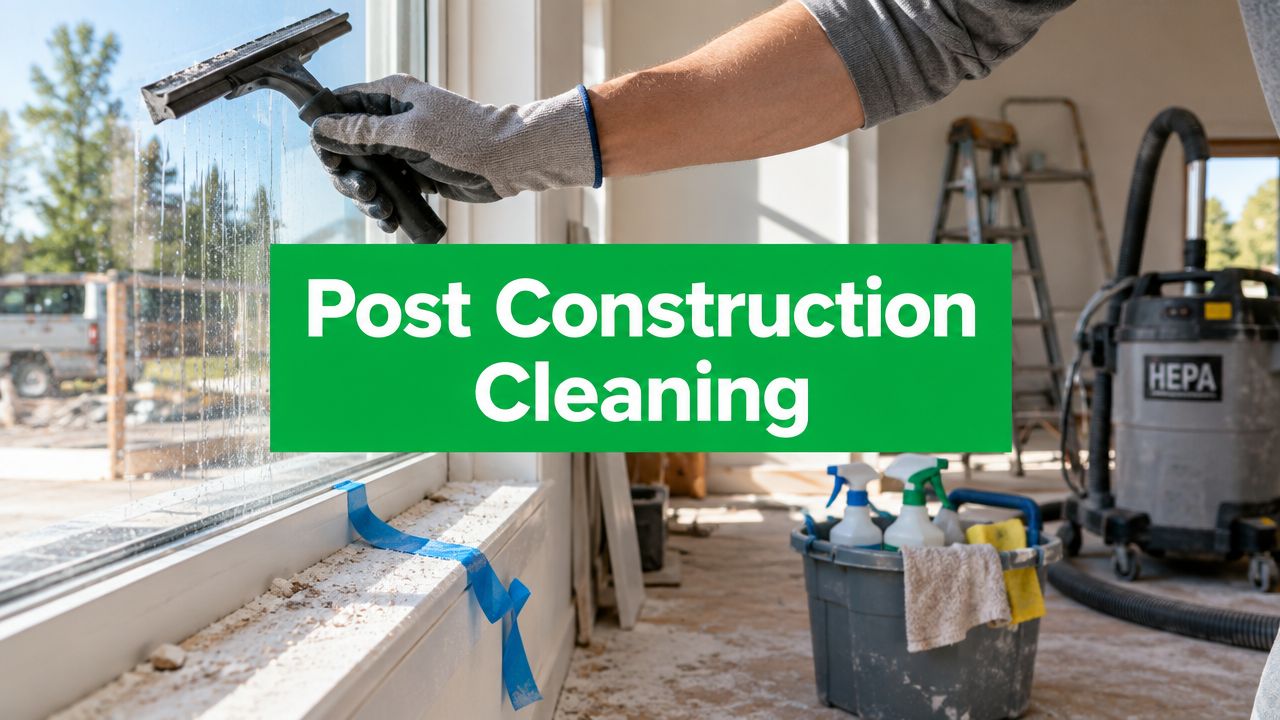
The crew has just pulled out of a new Flagstaff home. The lumber pile is gone, the drywall tools are packed, and the rooms look finished from across the threshold. Walk closer, though, and a chalky film covers the sills, fine grit sits in the tracks, stickers cling to the glass, and paint or caulk spots catch the light.
That's the point where post-construction cleaning begins. It isn't a quick pass with household spray and a towel. It's specialized work that turns a recently built or renovated property into a space ready for inspection, handoff, occupancy, or move-in, with window care and final-detail work often deciding whether the project looks complete.
What Post-Construction Cleaning Actually Means
Post-construction cleaning is the cleanup phase between the end of building work and the point when a property can be safely used. Industry guidance commonly divides it into rough cleaning, detailed final cleaning, and turnover preparation, with tasks such as debris removal, dust control, glass and floor detailing, restroom sanitization, and punch-list touch-ups. Kärcher's after-builders cleaning guidance describes the work as more than cosmetic housekeeping, because the crew is also preparing the site for inspection and use.
A routine janitorial visit assumes the building is already functioning. Post-construction work starts with mineral-heavy dust, abrasive particles, leftover packaging, protective films, adhesive, paint, plaster, and debris hidden in places regular cleaning rarely reaches. Drywall dust settles on ledges and fixtures. Concrete residue works into floor seams. Small pieces of grit can scratch a finish when someone drags a mop or wipes without first removing the loose material.
Practical rule: If a surface still carries construction residue, treat it as a specialty cleanup task, not routine maintenance.
The scope usually includes removing leftover debris, vacuuming and washing surfaces, treating adhesive and paint spots, cleaning fixtures and cabinetry, detailing floors, and polishing glass. Windows deserve particular attention because they reveal dust, scratches, mineral spotting, labels, and smears as soon as sunlight hits the room. Frames, tracks, screens, sills, and adjacent casing all need to be addressed, not just the center of the pane.
The work also protects the owner's new finishes. Sharp debris and residues can damage flooring, glass, sealants, countertops, and hardware before the building has even opened. In New York City, DSNY rules require construction and demolition debris to be source-separated and removed by authorized haulers, while DOB §3303.7 requires egress routes to remain clear. OSHA regulates silica exposure under 29 CFR 1926.1153, which reinforces the broader point: cleanup supports safety and compliance as well as appearance.
For a homeowner or builder who wants a practical overview of the sequence, the Sunset Shine post construction process offers useful background. In Northern Arizona, the same principles apply whether the project is a cabin renovation in Munds Park, a new Flagstaff home, or a commercial turnover. A window-focused crew may also be brought in specifically for construction dust cleaning when glass and frames are the surfaces holding up the handoff.
The Three Stages from Rough Clean to Final Detail
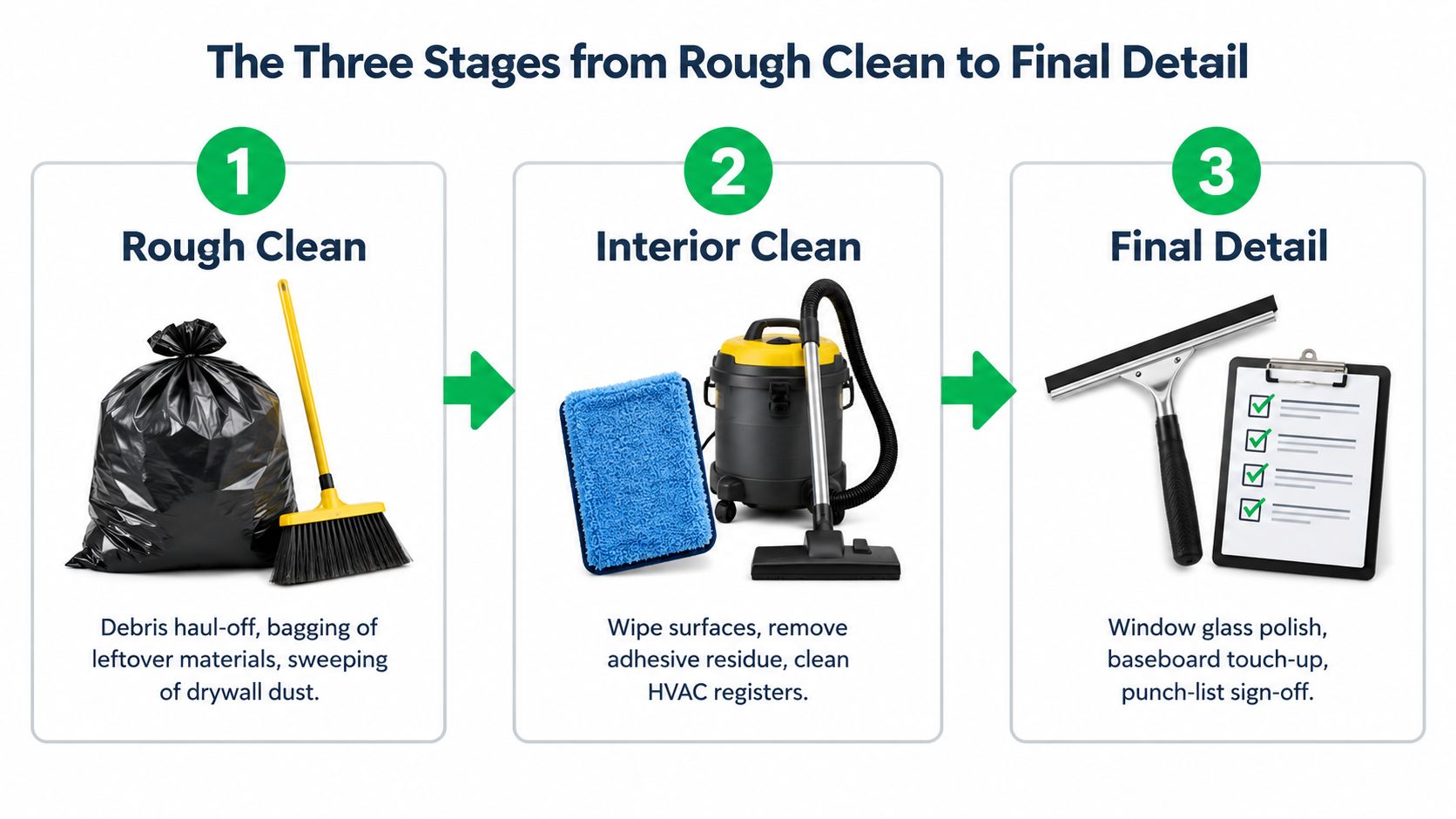
A project usually moves through three cleaning stages because each one solves a different problem. Cleaning everything once, before the trades are finished, often means paying to clean the same surfaces again.
Rough clean clears the site
The first stage handles the heavy material. Crews remove leftover packaging, loose scraps, larger debris, and bagged waste. They sweep or vacuum drywall dust and sawdust, clear corridors, and make sure inspectors and punch-list trades can move through the property without stepping over nails, screws, offcuts, or other hazards.
This stage isn't intended to make the building sparkle. It creates a workable site for detail cleaning and prevents abrasive debris from being dragged across finished floors. Egress routes need to stay clear, and the person responsible for the project should confirm which materials belong to the contractors and which items fall inside the cleaning scope.
Final cleaning reaches the finished surfaces
Once the major dust sources are controlled, the crew works through hard surfaces, fixtures, cabinetry interiors, flooring, registers, restrooms, ledges, and the first complete glass pass. Adhesive residue, paint marks, plaster, fingerprints, and settled construction dust receive individual attention at this stage.
HVAC commissioning, sanding, cutting, and installation can still introduce new particles. The cleaning team should coordinate with the general contractor so they aren't detailing a room while another trade is creating fresh contamination in it.
Touch-up follows the last disturbance
The final detail or turnover pass happens after remaining work is complete, floor protection is removed, and dust has had time to settle. A window-detail guide recommends scheduling the last glass pass 24 to 48 hours after construction ends, allowing airborne particles from cutting, sanding, and drilling to drop before the final wipe-down. Pine Country's post-construction window cleaning guidance follows the same practical logic, because glass cleaned too early can collect a new film before the walkthrough.
This timing matters for inspection readiness and certificate-of-occupancy milestones. Skipping the rough stage can grind grit into flooring, while skipping the touch-up stage leaves dust on glass, vents, baseboards, and fixtures after the last trades leave.
How Post-Construction Cleaning Differs from Regular Cleaning
Regular janitorial work maintains a building that already has stable finishes and predictable soil. Post-construction cleaning restores order after cutting, sanding, drilling, painting, and installation have introduced abrasive dust and bonded residue.
| Factor | Regular Cleaning | Post-Construction Cleaning |
|---|---|---|
| Primary soil | Light dust, fingerprints, tracked dirt, and routine spills | Drywall, gypsum, concrete, and silica-containing dust, plus paint, plaster, caulk, stickers, and adhesive |
| Surface condition | Finished and generally ready for routine products | Newly installed, vulnerable, and often covered with residue or protective film |
| Equipment | Microfiber tools, mop systems, neutral cleaners, and standard vacuums | HEPA or class-filtered vacuums, scraper blades, plastic razors, specialty solvents, squeegees, ladders, poles, and pure-water brushes |
| Window work | Maintenance wash and routine screen cleaning | Label and film removal, track and frame vacuuming, construction-spot treatment, glass restoration, and final inspection |
| Sequence | Usually one scheduled service | Rough clean, final clean, and a later touch-up when the site stabilizes |
| Main risk | Slips, routine chemical exposure, and ordinary access hazards | Respiratory exposure, sharp debris, unfinished openings, live electrical points, ladders, lifts, and damage to new finishes |
Construction dust behaves like fine sandpaper when it's wiped across glass, painted trim, or a finished floor. A professional crew first removes loose material with controlled vacuuming or damp methods, then washes the surface. Starting with a wet rag can turn dry dust into a gritty slurry that spreads rather than disappears.
The tool change is substantial. A crew may use HEPA filtration, scraper blades held in proper handles, plastic razors for labels, denatured alcohol where compatible with the finish, squeegees, extension poles, and pure-water systems. A regular mop-and-bucket kit isn't designed to remove residue from window tracks or safely manage dust generated by a build.
The labor also differs because technicians must inspect each surface rather than follow a predictable maintenance route. Access can involve unfinished decks, uneven ground, open window openings, uncovered receptacles, and surfaces that haven't fully cured. Homeowners planning remodeling for Scottsdale homeowners face the same distinction even when the project is smaller. Renovation scale changes, but the residue and finish-protection problems remain.
Window-Specific Post-Construction Cleaning and the Final Detail Pass
Windows often determine whether a new room feels finished. Sunlight exposes a missed sticker edge, a thin adhesive smear, hard-water spotting, concrete runoff, or a line of dust left in the track more quickly than it exposes a dusty closet shelf.
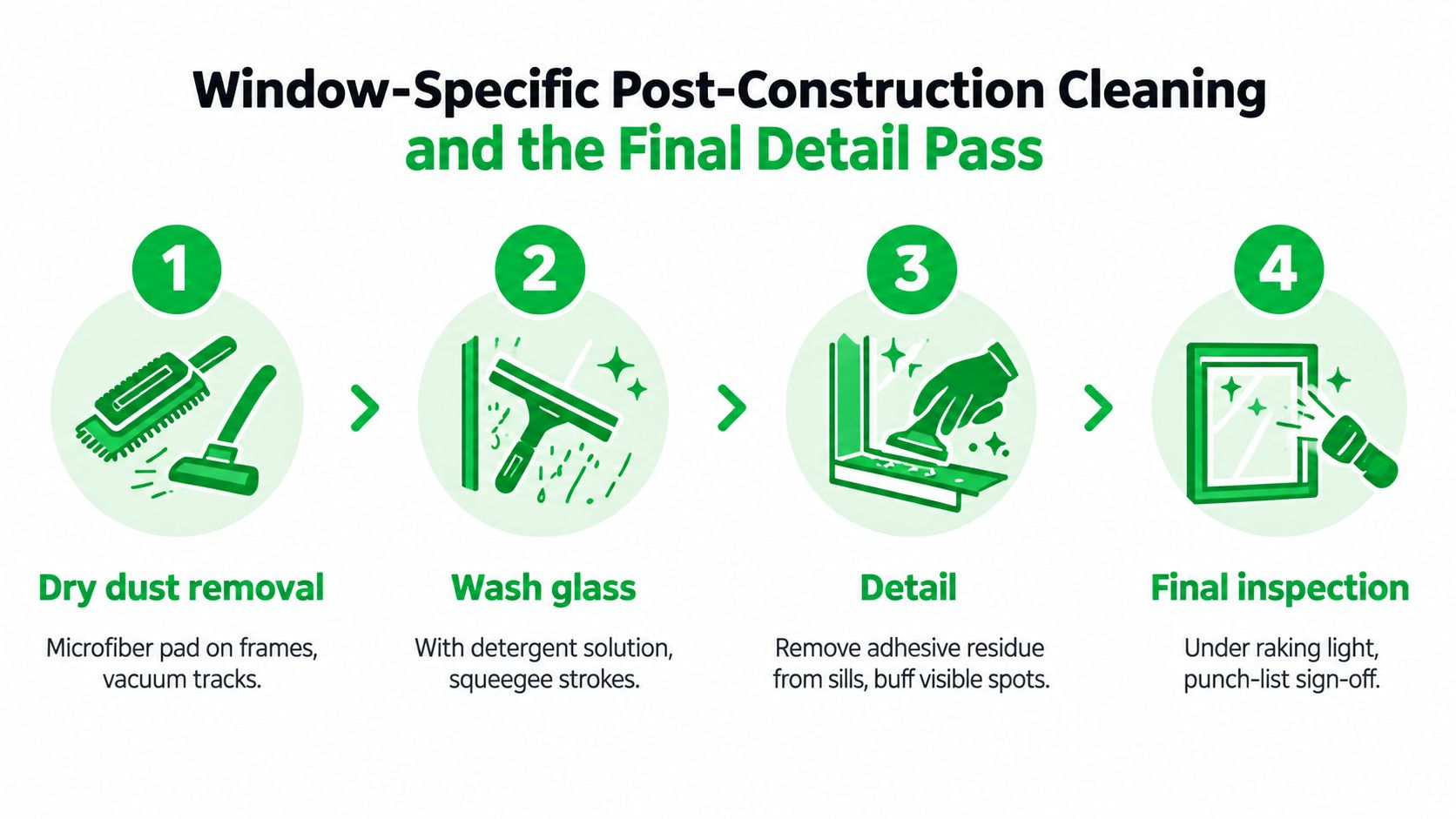
A careful crew works from the least destructive method toward targeted treatment:
- Remove dry material first. Technicians brush loose dust from frames and vacuum the tracks before introducing water. This keeps grit from becoming an abrasive paste.
- Treat labels and residue carefully. Plastic razors and appropriate holders can lift stickers and paint spots without attacking the glass. Adhesive may need a compatible solvent, and anodized frames require care because aggressive scraping or chemicals can leave marks.
- Pre-rinse construction grit. The glass gets a controlled rinse before the main wash. Lower panes deserve special inspection for stucco or concrete runoff.
- Wash and squeegee the glass. Depending on access and soil, the crew uses a traditional squeegee method or a pure-water fed pole system.
- Detail the perimeter. A microfiber pass cleans sills, frames, casing, and any visible residue left beside the pane.
Timing keeps clean glass clean
The final glass pass should follow the last major dust-producing work. A practical window-cleaning guide recommends waiting 24 to 48 hours after construction ends so suspended particles can settle before the final wipe-down. HVAC balancing, drywall sanding, and late installation work can all redeposit dust on panes that looked perfect earlier.
Exterior glass is often handled before interior glass, especially when the exterior carries runoff, masonry dust, or heavier contamination. Interior panes are commonly saved for the end, after trades have stopped moving materials through rooms and after floors, cabinetry, and trim have received their final attention.
Pure-water equipment is especially useful on exterior elevations. A purification unit feeds mineral-free water through a telescopic pole to a brush head, allowing a technician to scrub and rinse from the ground. Unger's water-fed cleaning system states that this method can reach windows up to five stories, or about 55 to 60 feet, without ladders or lifts.
The reason is simple. Purified rinse water dries without the minerals that create spots and residue. One guide describes window-use water as reaching 0 ppm total dissolved solids, while the window-cleaning reference on Wikipedia explains that mineral removal prevents streaks as the surface dries. Ladders and lifts still have a place for higher or obstructed work, but water-fed poles reduce fall exposure and setup when the building allows ground-based access.
Typical Costs Timelines and What Drives the Price
Post-construction pricing depends on what the crew must remove, how many surfaces need treatment, and whether the work happens in one visit or several. A typical residential cleanup may run $0.15 to $0.50 per square foot, while window-only work on a new build often falls between $4 and $8 per pane. Those figures are planning ranges, not a substitute for a site walkthrough, because contamination and access can change the scope quickly.
| Project Type | Per Sq Ft | Per Window Pane | Typical Total |
|---|---|---|---|
| Residential post-construction cleaning | $0.15 to $0.50 | Depends on scope | $300 to $1,200 |
| New-build window-only cleaning | Window scope varies | $4 to $8 | Depends on pane count and access |
| Commercial post-construction cleaning | Project-specific | Project-specific | Multi-thousand-dollar projects are possible as size and access increase |
A single-family project commonly lands between $300 and $1,200, while commercial work can reach the multi-thousand-dollar range as square footage, window count, story height, and coordination requirements grow. WiseGuyReports' post-construction cleaning service market overview places one estimate of the global service market at about USD 7.73 billion in 2025, with a projection of USD 12.8 billion by 2035 and a 5.2% compound annual growth rate. The same market overview also cites another estimate near USD 15 billion in 2025, projecting about USD 25 billion by 2033, and reports that commercial projects represented 52% of revenue in 2022 in a separate study. These differing estimates show that the category is commercially significant, but they shouldn't be used to price a local job.
What changes the quote
- Surface condition: Heavy drywall dust, paint spots, plaster, glue, and cement residue require more labor and more careful testing.
- Window configuration: Large panes, divided lites, deep tracks, screens, skylights, and oversized frames all affect production time.
- Access: Ground-level water-fed work differs from ladder work, boom-lift work, or restricted interior access.
- Phasing: A rough clean and a later final pass costs more than one visit, but phasing can prevent expensive rework.
- Regional labor: Flagstaff's homes, cabins, commercial buildings, and high-country access conditions can require different staffing and equipment.
A 2,000-square-foot home may need one full rough-clean day, followed by a final half-day two to four weeks later, depending on the builder's punch list and when the property becomes stable. Commercial sites typically follow coordinated turnover schedules rather than a simple residential calendar. For a more detailed discussion of labor-based estimates, see Pine Country's post-construction cleaning rates per hour.
Safety Equipment and the Real Risks on a Jobsite
Construction cleanup carries risks that ordinary house cleaning doesn't. Fine dust can become a respiratory exposure problem, sharp debris can hide under loose material, and a ladder placed against a new window can damage the frame or create an unstable setup.
Kärcher classifies construction dust by L, M, and H risk classes, with H representing the highest hazard level. HSE guidance recommends on-tool extraction and H- or M-class vacuum attachments instead of dry sweeping for finer material. Controlled vacuuming, damp suppression, and suitable respiratory protection reduce the amount of fine dust returned to the air.

A competent crew carries protection matched to the site:
- Respiratory protection: An N95 or half-mask respirator is appropriate to the employer's hazard assessment and required controls for dusty work. OSHA's silica rule is codified at 29 CFR 1926.1153.
- Eye protection: Safety glasses with side shields protect against flying fragments and splashes.
- Hand protection: Cut-resistant gloves help with glass, metal edges, blades, packaging straps, and hidden fasteners.
- Foot protection: Steel-toe boots protect against dropped materials, nails, and screws.
- Hearing and clothing: Hearing protection, long sleeves, and durable work clothing help around active framing, masonry, saws, and lifts.
Access deserves equal attention. Technicians need stable footing, three points of contact on ladders, and a clear decision about when a lift is safer than a ladder. Boom-lift work requires the appropriate harness and operating procedures. Newly installed windows shouldn't automatically be treated as ladder supports, especially before seals and surrounding finishes have been checked.
Electrical awareness matters too. Uncovered outlets, temporary circuits, and live wiring can sit near wet-cleaning operations. Floors may hide puncture hazards, adhesive can create slippery spots, and loose debris can turn a clean-looking path into a trip hazard. Professional equipment helps, but true protection comes from stopping to assess the site before beginning.
Why Hiring Professionals Pays Off and How to Choose One in Flagstaff
DIY cleanup can look economical until a homeowner scratches a pane, spreads silica-bearing dust through the HVAC system, or delays a final walkthrough by missing residue in tracks and fixtures. The cost of rework includes more than cleaning labor. It can involve replacement materials, contractor callbacks, delayed occupancy, and disputes over whether damage existed before handoff.
Professional crews also bring a process for controlling dust rather than moving it around. They know when to use HEPA or class-filtered vacuuming, when to damp-clean, when a plastic razor is safer than a metal blade, and when a spot on glass may require a specialist rather than more pressure. That judgment matters on new finishes, where an aggressive shortcut can create permanent damage.
A Flagstaff hiring checklist
Ask prospective providers for:
- Insurance documentation: Confirm current liability coverage and workers' compensation arrangements.
- Safety preparation: Ask how technicians are trained for ladders, lifts, silica exposure, electrical hazards, and unfinished surfaces.
- Window capability: Verify that the crew uses squeegees, ladders, telescopic poles, and pure-water brushes rather than treating windows as an afterthought.
- Scope clarity: Get screens, tracks, frames, sills, stickers, paint, adhesive, and final touch-ups listed in writing.
- Builder references: Request relevant references from Flagstaff or Coconino County projects with similar access and finish conditions.
- Commercial requirements: For larger work, ask whether the provider can meet bonding, scheduling, site-access, and punch-list coordination requirements.
Pine Country Window Cleaning has operated in Northern Arizona since 1999 and was started by Flagstaff native David Kaminski. The company handles residential and commercial window work, including post-construction service, and removes screens, cleans screens, and reinstalls them with every service. Its equipment includes water-fed poles and lift equipment for difficult access, while its customer approach centers on communication, careful treatment of the home or jobsite, and a 100% satisfaction guarantee.
For builders and homeowners in Flagstaff, Sedona, and the high country, the right provider should fit the project schedule rather than just arrive after the construction crew leaves. Clear scope, safe access, controlled dust removal, and a genuine final inspection are what turn a cleaning appointment into a reliable turnover service.
Pine Country Window Cleaning provides post-construction window cleaning for new homes, renovations, and commercial projects, including sticker, paint, adhesive, dust, glass, frame, track, and screen care. Visit Pine Country Window Cleaning to request a free estimate and coordinate a careful final-detail service for your Flagstaff-area property.