

A homeowner calls from a cabin near Forest Highlands after a windy week. Pine needles are packed into the front gutter, water has started spilling over one corner, and the owner wants a price before booking. The easy answer is to quote by the hour. The profitable answer is to measure the roofline, identify the access problem, and price the labor that the job will consume.
That distinction matters in Flagstaff, Munds Park, Doney Park, and the surrounding mountain communities. How to price gutter cleaning isn't about copying the lowest market rate. It's about building a quote from linear feet, height, access, debris, equipment, travel, and the time required to leave the property clean. U.S. pricing guides commonly place professional gutter cleaning around $0.80 to $2.25 per linear foot, with final totals shaped by the home's size and difficulty (Modernize's gutter cleaning cost guide, Angi's gutter cleaning pricing guide).
Why Gutter Cleaning Pricing Starts With Linear Feet
A cabin near Forest Highlands may have a modest floor plan and still require a substantial gutter-cleaning quote. Wraparound porches, detached roof sections, several valleys, and long eaves add service area that square footage cannot show. Price the roofline first. Bedrooms and listing data do not measure the channel the crew must clear.
The roofline creates the base
Measure every gutter run around the structure. Include front and rear eaves, side runs, porch sections, miters, end caps, and connected sections within the scope. Linear feet account for debris removal, ladder moves, hose staging, outlet flushing, ground protection, and cleanup.
Published pricing guides commonly place professional work between $0.95 and $2.25 per linear foot, while another guide lists many jobs between $0.80 and $2.00 per linear foot (Angi, Modernize). Those ranges can frame a starting rate, but they do not protect your margin by themselves. A Flagstaff operator still needs to cover loaded labor, travel, equipment, and the minimum charge for a small job.
Practical rule: Linear feet should form the spine of the quote. Add height, debris, access, and special handling as visible modifiers instead of burying them in a vague flat price.
For a cabin surrounded by pines, one seasonal cleaning may involve light needles, while a post-storm visit may involve packed debris and extra disposal time. A two-story home may also require more ladder repositioning than its footage suggests. Those conditions belong beside the footage on the estimate, because they consume labor even when the roofline is short.
A typical U.S. professional job averages about $168, with many homeowners paying $119 to $234, while broader market estimates often cluster around $128 to $320 (Angi's cost data). Use those figures as a reasonableness check, not as a substitute for measuring the property or calculating the crew's actual cost.
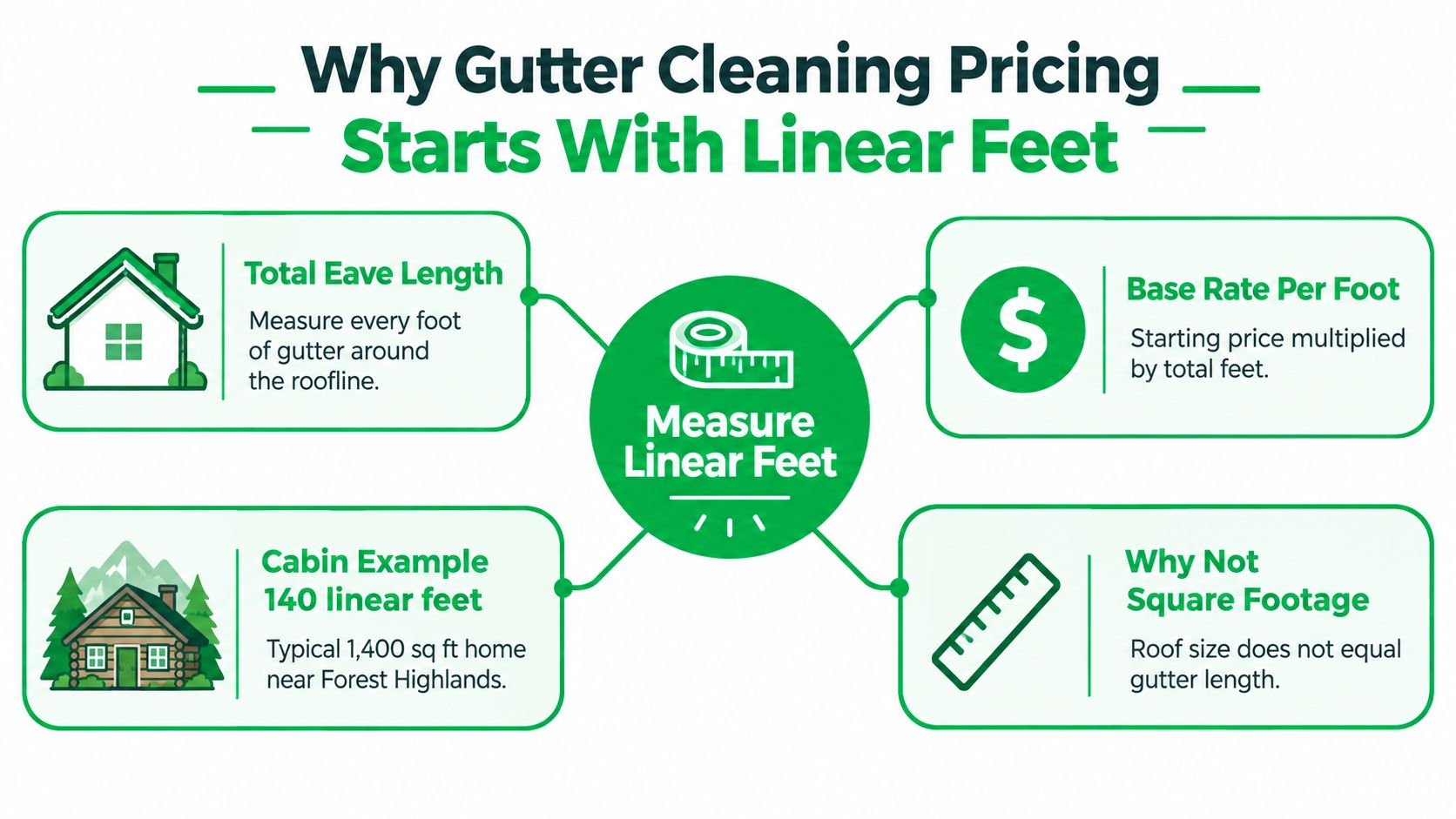
The Flagstaff gutter cleaning cost guide offers a local pricing reference. The working takeaway is direct: more gutter means more channel to clear, more debris to collect, and more ground area to protect.
Measuring the Job Before You Set the Base Rate
A defensible estimate begins with a field measurement, not a guess from satellite imagery. Walk the perimeter and record each gutter run before multiplying by a rate. A 100-foot tape works well, while a laser measure can help on accessible elevations, but neither replaces a visual inspection of corners, roof transitions, and obstacles.
Record the full service area
Use a worksheet or estimating app and log the following:
| Measurement Input | Typical Range / Method |
|---|---|
| Total gutter length | Measure every gutter run, including porch sections and miters |
| Downspouts | Count separately and note whether each outlet can be flushed |
| Story count | Record one-story, two-story, or lift-required elevations |
| Corners and miters | Inspect wraparound sections that may conceal additional trough |
| Access | Note dirt drives, fences, landscaping, parked vehicles, and slope |
| Condition | Photograph pine needles, packed muck, guards, screens, sagging, and damage |
Downspouts deserve their own line because clearing a channel doesn't prove that water can exit. Count each outlet, check whether the lower section is accessible, and record whether the scope includes flushing or only debris removal. A corner at a wraparound porch can also hide gutter length that a remote estimator misses, so photograph every elevation and label the images consistently.
Use a second measurement as a check
County property records or assessor information can provide a rough cross-check against your taped measurement. Treat that information as a reasonableness test, not the billable measurement, because roof geometry and porch additions can distort the relationship between building footprint and gutter length.
The quote should use the measured gutter footage. The cross-check helps identify an obvious omission before the crew arrives with ladders, hoses, and disposal bags. That habit is similar to the discipline used by contractors who price plumbing jobs like a pro, where the estimator separates measurable scope from assumptions.
A photo-backed measurement protects both sides. The customer sees what was priced, and the crew gets a scope that matches the property.
Don't add a story surcharge because a home has a tall front elevation. Mark the exact runs that require taller equipment, a spotter, repositioning, or a lift. That distinction makes the base rate consistent and keeps access charges tied to actual labor.
Adding Height and Story Tier Multipliers
Height changes the risk, the equipment, and the pace of the work. A one-story ranch in Cheshire may allow a technician to work from a straightforward extension ladder. A two-story home in Ponderosa Trails can require longer ladders, a second person to stabilize the setup, and more time moving equipment between elevations.
The cleanest method is to calculate the linear-foot base first, then apply a labor multiplier to the portions of the job affected by height. Travel and materials shouldn't be inflated because the upper gutter is harder to reach. The customer should be able to see that the added price follows added setup and safety requirements.
Use tiers instead of arbitrary surcharges
| Story Tier | Equipment Required | Labor Multiplier | Added Cost Range |
|---|---|---|---|
| One story | Standard extension ladder and ground access | 1.00x | Base labor only |
| Two story | Taller ladder, stabilizing equipment, or spotter | 1.25x to 1.40x | Added labor tied to elevated runs |
| Three story | Lift, scaffolding, or specialized access plan | 1.50x to 1.75x | Higher labor and access allowance |
These multipliers are a pricing framework, not a license to hide a difficult property inside a single number. A home with one short second-story section shouldn't receive the same treatment as a property where most of the roofline sits above the first floor.
A practical example shows how the math works. On a 200-linear-foot job with a $1.50 base rate, the initial calculation is $300. Applying a 1.30x labor multiplier to the labor portion adds about $60, producing a scope-adjusted price near $360 before separate condition adjustments. The arithmetic follows the pricing logic described in the Taskrabbit gutter cleaning cost guide.
Charge for access, not appearance
A two-and-a-half-story home with a walk-out basement may look like a two-story property from the street, but the rear elevation can require a different setup. Steep terrain, retaining walls, fences, landscaping, and a narrow side yard can create more difficulty than the story count suggests.
Don't promise a precise quote from a single exterior photo when the crew can't see the landing areas. Ask for images of every elevation, then confirm the equipment plan during the site visit. If a lift or scaffolding is necessary, put that requirement in writing before scheduling rather than surprising the customer on service day.
Factoring in Labor Burden and Overhead Costs
The technician's wage is only one part of the cost of a gutter visit. A business also carries payroll taxes, workers' compensation, liability insurance, fuel, vehicle maintenance, equipment wear, software, bookkeeping, and time that never appears as a clean line on the work order.
Separate wage from loaded labor
A fully loaded labor cost includes the expenses required to employ and deploy the worker. That includes ladder safety coverage, payroll obligations, insurance, paid preparation, and the portion of travel that the business can't bill directly. A billable labor rate must be high enough to recover those costs and still leave room for profit.
Industry guidance commonly estimates that labor accounts for 60% to 80% of a gutter-cleaning invoice (Gutter Cleaning Authority's cost breakdown). That range explains why a quote can look competitive and still lose money. If the estimator counts only the time spent scooping debris, the business gives away setup, ladder movement, flushing, loading, disposal, and drive time.
| Cost Component | Hourly Amount | Notes |
|---|---|---|
| Direct wage | Your payroll figure | The worker's wage before employer costs |
| Payroll burden | Calculate from payroll records | Include employer taxes and required coverage |
| Insurance | Allocate by productive hour | Include workers' compensation and liability coverage |
| Vehicle and fuel | Allocate by route and job time | Account for neighborhood-to-neighborhood travel |
| Equipment reserve | Allocate by equipment use | Cover ladders, poles, vacuums, pumps, and maintenance |
| Administration | Allocate across sellable hours | Include scheduling, software, bookkeeping, and estimating |
| Loaded labor cost | Sum the categories | Use this figure before setting the selling rate |
A useful internal test is to compare the direct wage with the total loaded figure. Many operators use a 1.4x to 1.7x relationship between direct pay and loaded labor when building internal rates, but your books should determine the actual figure. The right multiplier depends on insurance, vehicle costs, route density, equipment, and how much unpaid time the crew carries.
Track the hours customers don't see
A two-person crew may spend substantial time protecting landscaping, setting ladders, repositioning, bagging debris, and loading equipment. Those activities belong in the job costing record even if the homeowner sees only the final cleaned gutter.
For a deeper explanation of assigning direct and indirect costs to individual work, find out what job costing is. Once every job records estimated and actual labor, the owner can identify which property types produce margin and which ones consistently consume unpaid time.
Margin check: Divide the profit you need from the week by the crew's genuinely sellable hours. That result is the minimum production value each hour must generate before a gutter job earns its place on the schedule.
Modifiers That Push a Quote Up or Down
Two homes with the same gutter length can require very different prices. A clear single-story ranch with open access is not comparable to a steep cabin roof covered beneath ponderosa trees, even if both systems measure the same.
The estimator should inspect conditions in a consistent order. Start with safety and access, then assess debris and drainage, then identify components that require removal, replacement, or extra handling.
Use a field checklist
- Roof pitch: A roof above 6/12 can slow movement and require additional safety equipment. The mandatory pricing graphic identifies a 20% to 30% quote adjustment for this condition, but the final amount should reflect the actual work area and safety plan.
- Heavy pine needles: Loose needles are quick to remove. Compacted needles, roof grit, and wet muck require hand scooping, additional bags, and more disposal handling.
- Multi-story access: Taller runs require longer ladders, more repositioning, and sometimes a spotter or lift. Apply the story tier only to the affected labor.
- Gutter guards or screens: Price removal and reinstallation when the system must be opened to reach the channel. Confirm whether the product is fragile, fastened, or difficult to reseat.
- Downspout flushing: A clear gutter channel doesn't guarantee a clear outlet. List flushing separately when the scope includes testing flow through each downspout.
- Sagging or damaged gutters: Don't treat repairs as ordinary cleaning. Photograph separated seams, loose hangers, fascia damage, or sections that can't safely support access.
- Post-storm debris: Wind and monsoon conditions can leave branches, roof grit, and wet material around the property. Add a cleanup allowance only when the debris changes the labor or disposal scope.

Discounts should also come from measurable efficiencies. A recently serviced home, an accessible ranch, a bundled exterior visit, or an off-season booking can reduce setup and route waste. Don't discount a difficult job merely because the customer asks for the same price as a neighboring property.
The gutter cleaning frequency guide can help frame recurring service around the property's tree cover and seasonal debris. The right frequency may reduce future buildup, but it doesn't erase the labor required for the current visit.
A short video can help crews and homeowners recognize the difference between a simple cleanout and a scope that needs closer inspection.
Three Sample Quotes From Base Rate to Final Price
Sample quotes are useful only when the assumptions are visible. The following examples show how an estimator can move from measured footage to a final price without pretending that every property behaves like a standard house. They use the stated job conditions and rounded totals, so the line items should be adjusted to match actual labor, access, and local tax requirements.
Job one, an accessible cabin
The Doney Park cabin measures 120 linear feet and has one story, light debris, open truck access, and no downspout flushing. At a base rate of $1.50 per foot, the cleaning base is $180. A modest route or minimum-trip adjustment can bring the quoted total to roughly $175 only if the operator's actual route and cost structure support that figure. If the minimum trip charge is higher, the quote must be higher.
Job two, a two-story home
The Flagstaff home measures 200 linear feet. Moderate debris, two downspout flushes, and removal and reinstallation of gutter screens add handling time. The base at $1.50 per foot is $300. Applying the example 1.30x labor multiplier to the work produces an added allowance of about $60, bringing the working total near $360 before any tax treatment or unusually difficult access.
Job three, a steep cabin
The pine-covered cabin has 160 linear feet, an 8/12 roof pitch, packed needles, full downspout flushing, and a second technician for safety. A base at $1.50 per foot is $240, but the height, steep pitch, heavy debris, safety staffing, and flushing scope push the final price near $475. That difference is precisely why a flat price based only on footage fails on mountain properties.
| Line Item | Job 1: 120 ft Cabin | Job 2: 200 ft Two-Story | Job 3: 160 ft Steep Cabin |
|---|---|---|---|
| Linear-foot base | $180 | $300 | $240 |
| Height allowance | Included in one-story base | About $60 example allowance | Elevated access and safety allowance |
| Condition work | Light debris | Moderate cleanup and screen handling | Packed pine needles and steep-pitch work |
| Downspout scope | Not included | Two flushes | Full flushing |
| Travel or minimum trip | Confirm route policy | Confirm route policy | Confirm route and equipment policy |
| Tax handling | Apply local requirements | Apply local requirements | Apply local requirements |
| Illustrative total | Roughly $175 | Around $360 | Near $475 |
The table isn't a promise to charge those exact amounts. It's a way to expose the formula so an estimator can replace each assumption with measured footage, actual labor, equipment requirements, and the company's minimum acceptable price. A simple quoting calculator, such as the Ace Aviation Aerospace Academy tools, can help organize inputs, but the calculator can't inspect a roof or identify packed debris.
Writing Proposals and Repeat Customer Discounts
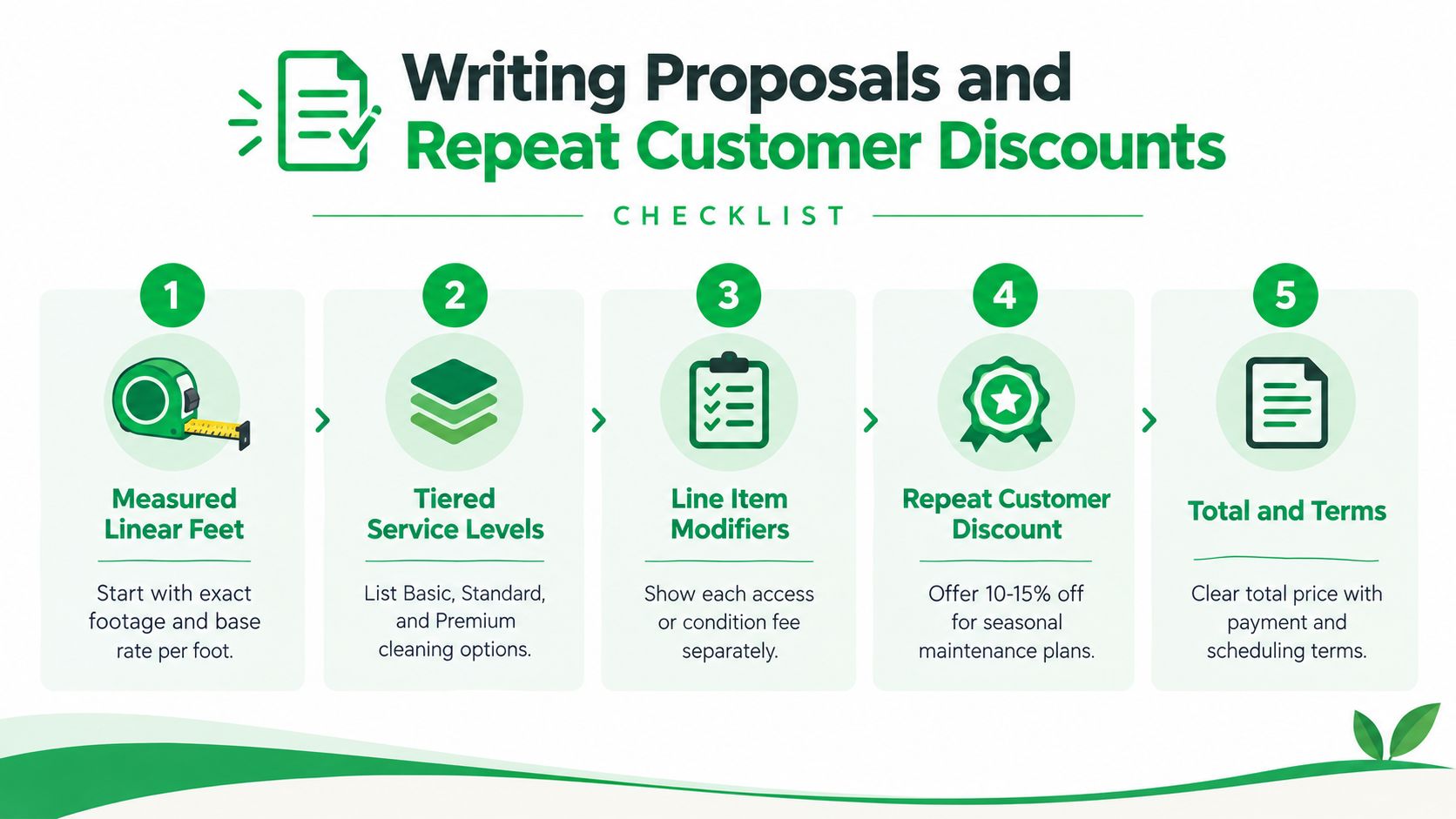
Homeowners accept higher prices more readily when the proposal explains the scope in ordinary language. Start with the measured footage, show the base rate, then identify each reason the job differs from an accessible maintenance visit.
Build the proposal around visible decisions
A clear proposal can include:
- Measured scope: State the total linear feet and list the elevations or structures included.
- Base service: Describe debris removal, ground cleanup, and any included water-flow check.
- Access tier: Identify one-story, two-story, lift-required, or restricted-access work.
- Condition modifiers: List pine needles, packed muck, steep pitch, screens, guards, or post-storm debris separately.
- Payment terms: State the total, tax treatment, scheduling window, deposit requirement, and what isn't included.
The customer should know whether downspout flushing, screen removal, repairs, disposal, and gutter guard handling are included. That level of detail prevents a low initial quote from becoming a disputed invoice when the crew finds conditions that were visible but never discussed.
Give the customer a short phone explanation
A concise script can sound like this:
“Your gutters measure [measured footage], and the base cleaning is [base price]. The quote adds [height, debris, flushing, or screen-handling item], bringing the total to [total]. We can also schedule the next seasonal visit under the maintenance option so the system is checked before the next heavy debris cycle.”
Use actual figures from the signed estimate. Don't promise a recurring discount until the customer understands the service frequency and cancellation terms.
Reward predictable work without destroying margin
A repeat customer discount should pay for a real efficiency. If the second visit is booked within ten months, a 10% discount can be reasonable when the property is expected to require less setup or buildup. An annual contract paid upfront can offer 15% off when it locks in fall and spring cleaning and improves route planning. Those figures should be applied only after confirming that the discounted price still covers loaded labor and disposal.
Seasonal add-ons can increase the ticket without distorting the gutter base. Offer gutter guard installation after a fall cleaning, downspout extensions where runoff is washing out soil, or roof-blown debris removal bundled with a spring visit. For broader scope and proposal expectations, use the gutter cleaning quote guide.
First-time jobs over $500 can require a 50% deposit, while repeat commercial accounts may use net seven terms if their payment history supports it. Pine Country Window Cleaning has served Northern Arizona since 1999 and also handles window cleaning with squeegees, ladders, poles, and pure-water brushes, including screen removal, screen cleaning, and reinstallation with every service. The company was started by Flagstaff native David Kaminski, and its exterior-service proposals can be evaluated using the same scope-first pricing discipline described above.
Pine Country Window Cleaning provides gutter and downspout cleaning for Flagstaff homes, cabins, commercial properties, and challenging-access buildings, with quotes based on footage, height, access, debris, and drainage scope. Visit Pine Country Window Cleaning to request an estimate and schedule service from a local team that also cares for windows, screens, and the surrounding home.