A facility manager can face six different glass problems before lunch. A street-facing storefront needs frequent touch-point cleaning, a dealership depends on clear display glass, an atrium demands specialized lift access, and a campus or medical building may require phased scheduling around occupants. A high-rise adds anchors, rescue planning, suspended access, and stricter documentation.
The best commercial window cleaning provider isn't just the most recognizable brand. It's the company that can document appropriate safety practices, insurance, trained technicians, suitable equipment, relevant references, a clear scope, dependable scheduling, and responsive communication. The right choice also depends on whether you need a local full-service partner, a recurring low-rise route, specialty high-access work, or national portfolio coordination.
This comparison evaluates seven providers through that facility-manager lens. It also considers the practical details that influence service quality, from pure-water systems and squeegees to boom lifts, scissor lifts, atrium equipment, screens, post-construction residue, and follow-up communication. For broader ideas about attracting and evaluating window-cleaning customers, Pipeline On's guide to window cleaners provides useful marketing context.
Verify the crew, not just the logo: Ask which local technicians, equipment, supervisors, and subcontractors will perform the work at your property.
1. Pine Country Window Cleaning
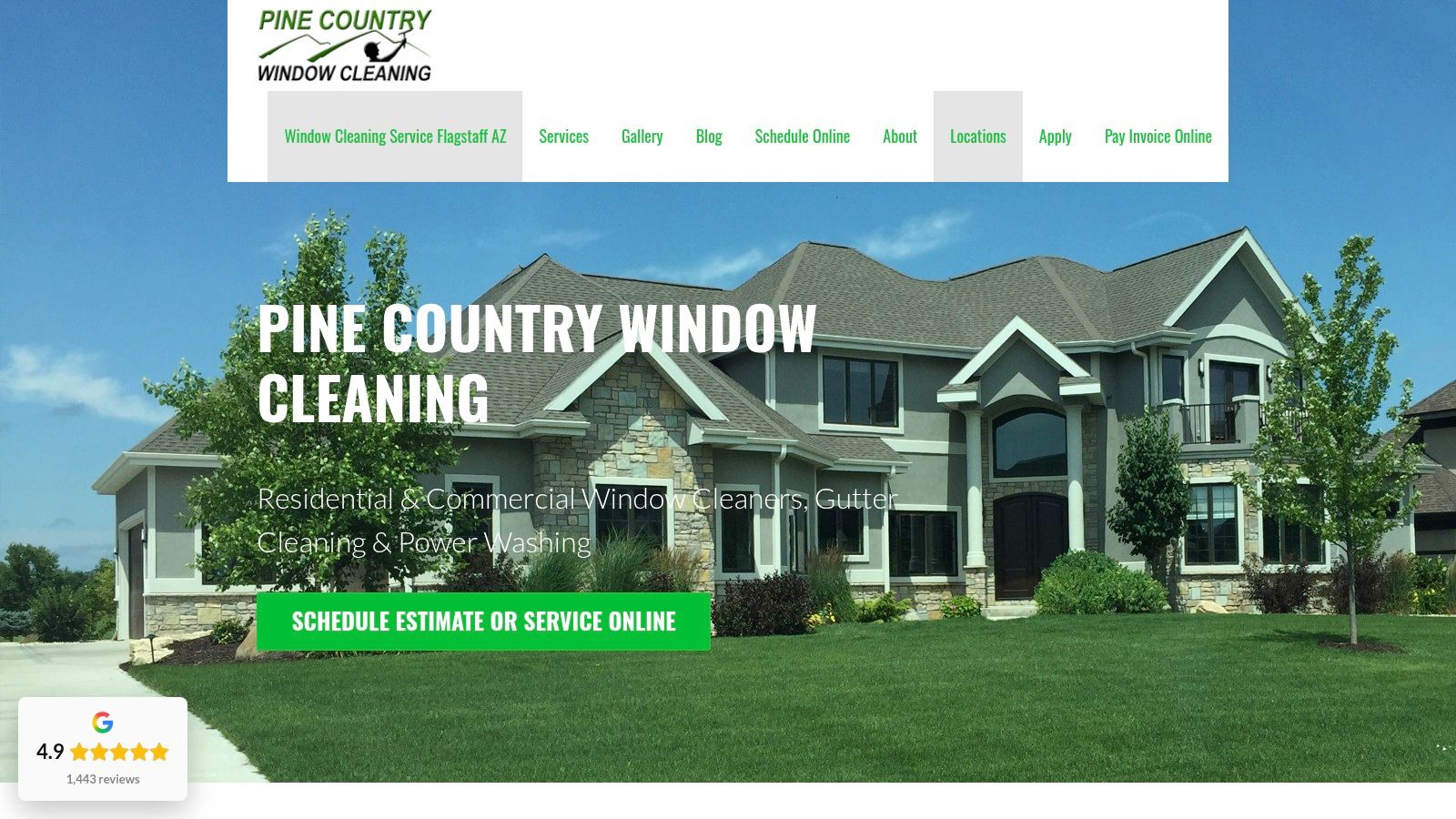
For properties in Flagstaff and Northern Arizona, Pine Country Window Cleaning offers the strongest combination of local execution, commercial reach, and service breadth. The company was founded in 1999 by Flagstaff native David Kaminski and is described as Flagstaff's largest window cleaning company. Its work covers homes, cabins, hotels, NAU facilities, car dealerships, medical buildings, and high-rise properties, so a facility manager can discuss very different building types with one local team.
Pine Country uses professional squeegees, extension poles, and specialized pure-water brushes. Purified water is useful for many standard exterior cleans because it removes dirt without added chemicals and dries without the limescale or hard-water staining that ordinary water can leave behind, as explained in Kärcher's commercial window-cleaning guidance. The company also removes, cleans, and reinstalls screens with every service, an important scope detail for homes, cabins, offices, and buildings where neglected screens can undermine an otherwise clean result.
Its in-house access fleet includes boom lifts, scissor lifts, and a 95-foot atrium lift. That matters when a building has glass above stairwells, lobby voids, dealership showrooms, hotel atriums, or other areas where a basic pole setup won't provide the right combination of reach and control. The company also provides gutter and downspout cleaning, pressure washing, post-construction window cleaning, and seasonal snow shoveling and removal.
Where Pine Country fits best
Pine Country is a practical candidate when a property manager wants one Northern Arizona provider for routine maintenance and occasional complex work. Fast scheduling, responsive communication, clear pricing practices, free estimates, online booking, and a 100% satisfaction guarantee support a service model built around local accountability. Technicians are background-checked and OSHA safety-trained, and the company is recognized by the International Window Cleaning Association and is a member of the Flagstaff Chamber of Commerce.
The trade-off is geographic. Pine Country focuses on Flagstaff and Northern Arizona rather than serving as a regional or national portfolio vendor. Pricing isn't published as a flat online rate, so most commercial work requires a project-specific estimate, and peak-season availability may require advance scheduling.
For building-specific scope and access details, review Pine Country's commercial building window cleaning service. The company is also known for its 1999 founding by David Kaminski and its Flagstaff-based operation, which can be valuable when a manager needs a reachable local contact rather than a distant account desk.
2. Fish Window Cleaning
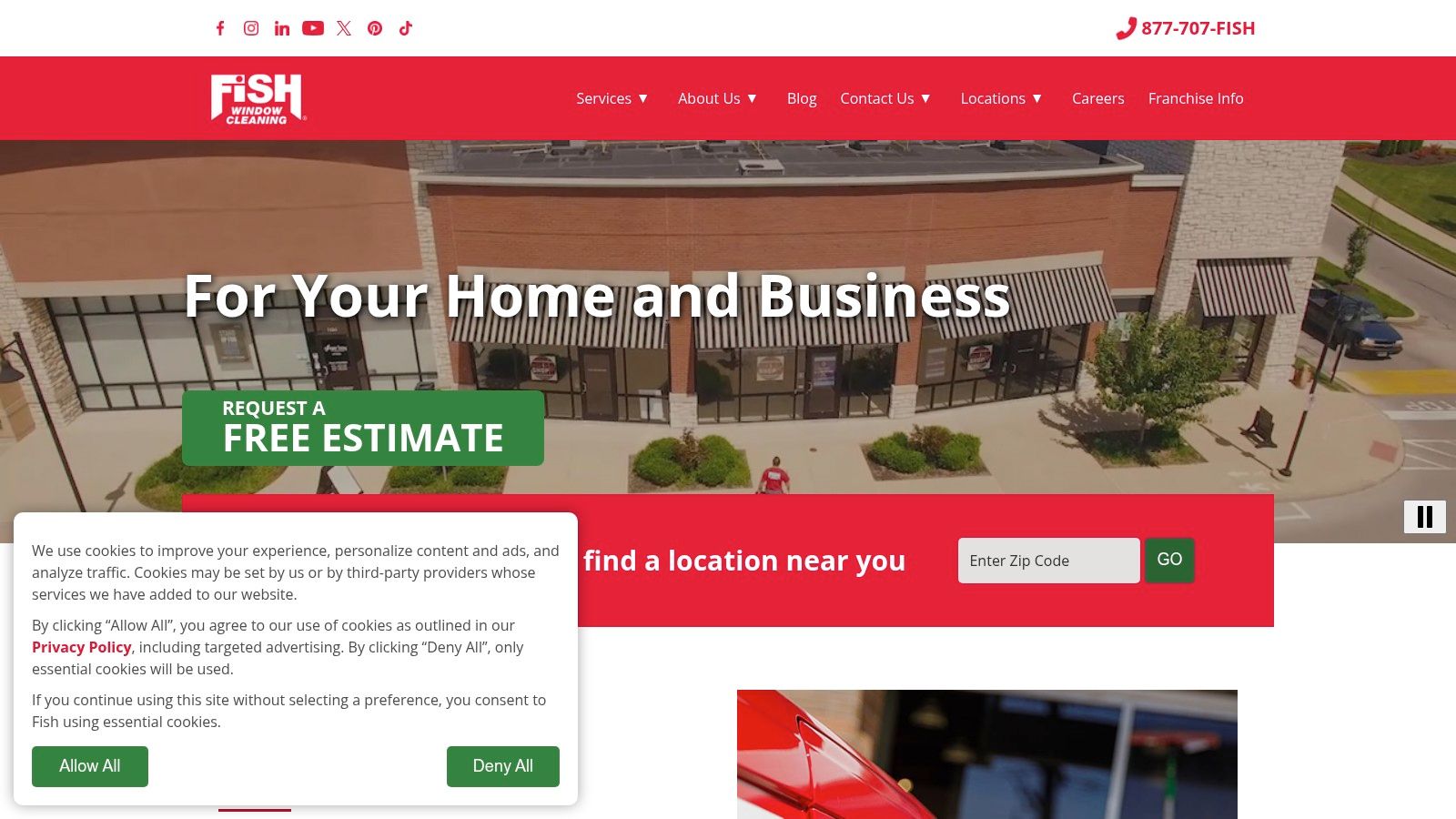
Fish Window Cleaning is a sensible option for recurring storefront and low-rise maintenance, particularly when a property manager needs a recognizable franchise network and a nearby branch. Its commercial focus generally centers on storefronts and low-rise buildings up to three stories, making it a better fit for retail strips, restaurants, small offices, branch locations, and similar properties than for tower façades or complicated atriums.
The practical advantage is route-based service. A local branch can often build a repeat schedule around entrances, display glass, interior partitions, mirrors, skylights, light fixtures, and other exterior-maintenance needs. That structure can help a retailer or franchise operator keep visible glass on a predictable maintenance cycle instead of repeatedly sourcing one-off jobs.
Fish has 270+ locally owned locations, according to the company's commercial positioning, which can make it easier to identify nearby operators and coordinate work across multiple sites. The number is tied to the provider's stated footprint and should be confirmed for the exact markets included in a portfolio before contracting.
What to verify locally
The main limitation is access. Many Fish branches concentrate on buildings of three stories or less, so a high-rise, large atrium, or façade requiring suspended access may fall outside the local crew's normal equipment and training. A manager should ask about water-fed poles, lift operation, interior access controls, traffic protection, and any subcontracted high-access work.
Franchise consistency also deserves attention. The brand may simplify initial vendor discovery, but the actual experience depends on the local owner, crew, scheduling capacity, insurance documents, and references. Ask for a written scope that separates exterior glass, interior glass, frames, tracks, screens, skylights, and add-on surfaces.
Fish's route model can work well when a portfolio contains many modest-height buildings with similar service requirements. It isn't automatically the best commercial window cleaning choice for a campus with mixed heights or a high-rise program that requires a dedicated access plan.
For a closer look at the equipment decisions behind different commercial jobs, see this commercial window-cleaning equipment resource.
3. Squeegee Squad
Squeegee Squad is positioned for commercial properties that need more than routine storefront work. Its service mix includes interior and exterior window cleaning, post-construction cleaning, pressure and soft washing, restoration, roof and solar cleaning, high dusting, and high-access work. That makes it a candidate for campuses, commercial developments, mixed-use properties, and buildings where exterior cleaning needs extend beyond the glass.
The company's local crews operate across many U.S. markets through a combination of franchise and company-run locations. For a facility manager, that creates potential coverage without requiring a completely new vendor search in every market. It doesn't remove the need for local vetting, especially when the work involves roof edges, suspended access, anchors, or complicated pedestrian controls.
Best use case
Squeegee Squad makes the most sense when a project includes mid-rise or high-rise glass, post-construction residue, or bundled exterior services. A building manager may value the ability to combine window cleaning with pressure washing, restoration, or high dusting, particularly when separate contractors would create conflicting schedules and additional site coordination.
High-access work needs more than a brand promise. Ask the local branch to identify the access method, crew qualifications, equipment inspection process, anchor documentation, exclusion zones, rescue planning, and insurance limits. A commercial window-cleaning safety procedure identifies slips and falls, falling objects, loss of control, overhead obstacles, and electric shock among the hazards requiring controls, PPE, trained staff, and a clean work area after completion. Review this documented window-cleaning safety procedure when comparing contractor submittals.
The main trade-off is variation between markets. One branch may have strong high-access capacity while another focuses on low-rise routes. Confirm who will perform the work and whether any portion will be subcontracted before awarding a complex project.
4. Valcourt Group
Valcourt Group, including Valcourt Building Services and partner brands, is aimed at owners and managers who want a broad exterior-building-services platform rather than a window-only contractor. Its capabilities include window cleaning, façade restoration, waterproofing, pressure washing, fall-protection solutions, and related building-envelope work.
That integrated model is especially useful for complex portfolios. A healthcare system, stadium operator, university campus, or high-rise owner may need glass maintenance alongside façade repairs, waterproofing, rooftop anchor work, or inspection support. One vendor can reduce coordination between separate contractors, but only if the scope, operating company, and site responsibilities are clearly documented.
Valcourt's platform covers 30+ states, according to the company's stated operating footprint. That scale can support multi-market procurement, although managers should confirm service availability for each address rather than assume that every partner brand serves every region.
Where the model earns its place
Valcourt is strongest when a property's needs extend beyond routine glass cleaning. Its experience with complex and high-rise buildings, campuses, healthcare facilities, and stadiums suggests a useful fit for owners who need formal project management and safety systems around façade work. The platform emphasizes OSHA and ANSI practices, but the local operating company still needs to provide the documents that apply to the specific job.
The risk is vendor complexity. A national platform with multiple brands can leave a manager asking which company holds the contract, which crew arrives on site, who supplies lifts, and who owns correction work. Put those answers in writing.
Access method should drive the award. A scissor lift may suit a level exterior, while a boom lift, rope descent system, or specialized atrium equipment may be necessary elsewhere. Minnesota rules require safe cleaning methods aligned with ANSI/IWCA I-14.1, and California maintains formal window-cleaning requirements. Local rules and building-specific fall-protection conditions should be reviewed before work begins, not after a crew arrives.
5. American National Skyline
American National Skyline, commonly known as ANSI, is built around commercial and high-rise window cleaning with a strong fall-protection component. The company has operated since 1970, giving it a long-established position in commercial exterior maintenance. Its services include low-rise and high-rise window cleaning, pressure washing, glass restoration, and SafeSite fall-protection work involving rooftop anchor inspection, testing, and certification.
That combination is valuable for owners who don't want to treat glass cleaning and rooftop safety infrastructure as unrelated concerns. A high-rise program depends on the building's available anchors, roof layout, façade geometry, access restrictions, rescue procedures, and inspection records. A contractor that can discuss those factors directly may be better suited than a general cleaning company that only prices the visible glass.
Regional strength, geographic limitation
ANSI reports 10 locations across the Midwest and adjacent regions, with coverage including Illinois, Indiana, Ohio, Pennsylvania, Tennessee, and Missouri. This regional density can be useful for property managers with buildings in those areas, especially when several sites require similar high-rise or fall-protection services.
The limitation is clear for Western portfolios. A manager operating in Arizona or across a nationwide collection of properties may need another provider for locations outside ANSI's operating footprint. Even within its service region, confirm the local crew's equipment, staffing, insurance, references, and ability to work around tenants and public areas.
For any high-rise contract, the manager should request a written access and rescue plan, equipment inspection records, anchor documentation, and a description of who supervises the work. This high-rise window-cleaning guide for owners explains why building owners need to evaluate access and safety planning alongside the cleaning result.
ANSI is a compelling specialist for Midwest high-rise programs. It isn't a universal answer for low-rise route work, remote Western locations, or portfolios seeking one national vendor.
6. Shine Window Cleaning
Shine Window Cleaning combines commercial window cleaning with pressure washing, gutter cleaning, and seasonal holiday lighting. Its Shine+ commercial subscription program is the main differentiator for managers who want recurring exterior care organized around a continuing service relationship rather than separate work orders.
That model can fit retail, medical, and education properties where appearance needs to remain consistent through the year. A subscription structure can simplify scheduling and budgeting, especially when the local branch can bundle windows with other exterior tasks. It can also reduce administrative friction for sites that repeatedly need gutters or pressure washing alongside glass maintenance.
Subscription convenience versus local capacity
Shine's expanding U.S. location map may help organizations with operations in multiple markets. Still, a franchise network doesn't guarantee identical staffing or equipment at every address. Before selecting the provider, confirm the local branch's commercial references, insurance, lift access, pure-water capability, interior-work procedures, and response process for missed or incomplete work.
The best commercial window cleaning arrangement for a medical clinic may differ from the right plan for a school or retail center. Entry doors and high-touch glass may need more attention than upper exterior panes, while a campus may require work during breaks or in carefully sequenced zones. A provider should translate those conditions into a written schedule instead of offering the same cadence to every building.
Tool choice also matters. For standard exterior maintenance, pure-water systems can reduce chemical use and help cleaners work from the ground where conditions allow. For interior glass, technicians may need controlled water application, squeegees, poles, and protective procedures that prevent runoff near flooring, equipment, and occupied areas.
Shine is worth considering when a manager values programmatic service and bundled exterior care. The decision should rest on the local crew's actual execution, not only on the subscription's convenience or the parent brand's growth.
7. Window Gang
Window Gang is an established branded option for commercial window washing and related exterior services. The company has operated since 1986 and offers pressure washing, gutter cleaning, and dryer-vent services alongside window cleaning. It is now part of Premium Service Brands and promotes expansion across 50+ locations, making it particularly recognizable in the Southeastern United States.
The appeal is bundling. A retail center, office property, or multi-tenant building may prefer one service relationship for windows, gutters, pressure washing, and other exterior tasks. Window Gang also promotes its branded “Window Gang Blue” cleaning chemistry and an “All Shine, No Shakedown” guarantee, which can make the offer easy for a property manager to explain internally.
Questions to ask before a larger award
Window Gang can work well for multi-service exterior packages, but local capacity should determine whether it fits a specific building. Ask whether the branch handles high-access work directly, what lifts or poles it owns, whether it uses pure-water brushes, how it protects landscaping and pedestrian areas, and which technicians will be assigned.
Franchise quality and scheduling can vary by location. A recognizable brand doesn't replace proof of insurance, safety training, references from comparable properties, or a clearly defined correction process. For standard storefronts and lower buildings, the model may be straightforward. For atriums, high-rises, post-construction glass, or large campuses, the local branch needs to demonstrate the equipment and planning required.
A written proposal should identify interior and exterior glass, frames, tracks, screens, hard-water stain treatment, access equipment, traffic control, and disposal responsibilities. Construction glass also requires careful technique. A construction-cleaning specification calls for soaking glass with clean water and soap solution, using a mild non-abrasive commercial solution, removing it immediately with a squeegee, keeping metal parts from touching glass, and drying residue from gaskets, sealants, and frames. See this construction-window-cleaning specification for the level of detail a post-construction scope may require.
Top 7 Commercial Window Cleaning Comparison
| Provider | Implementation complexity | Resource requirements | Expected outcomes | Ideal use cases | Key advantages |
|---|---|---|---|---|---|
| Pine Country Window Cleaning | Medium, turnkey local provider able to handle complex high‑reach jobs | In‑house heavy equipment (boom/scissor/95-ft lift), OSHA‑trained crews | High‑quality, safety‑compliant cleans with satisfaction guarantee | Flagstaff/Northern AZ homes, property managers, hotels, high‑reach jobs | Local expertise, full‑service offerings, fast scheduling |
| Fish Window Cleaning | Low, route‑based, predictable recurring service | Nationwide franchise locations and route crews (focus ≤3 stories) | Consistent, regular storefront/low‑rise maintenance | Multi‑site storefronts, retail chains, low‑rise commercial buildings | Large footprint, quick estimates, franchise consistency |
| Squeegee Squad | Medium‑High, supports mid/high‑rise and specialized access projects | High‑access crews, anchor certification, safety credentials | Safe execution of mid/high‑rise and post‑construction work | Mid/high‑rise properties, specialty access projects, campuses | High‑rise capability, safety/access expertise |
| Valcourt Group | High, integrated, multi‑trade façade and restoration programs | National platform with multiple operating companies and specialized trades | Integrated façade restoration, waterproofing, fall‑protection solutions | Large portfolios needing façade work across markets, complex/high‑rise sites | Single‑vendor for façade + safety systems, national scale |
| American National Skyline (ANSI) | Medium‑High, safety‑driven high‑rise programs | Regional high‑rise crews, fall‑protection systems, anchor inspection/testing | Robust, safety‑focused high‑rise cleaning and anchor services | Midwest high‑rises, campuses, healthcare facilities | 50+ years experience, in‑house fall‑protection expertise |
| Shine Window Cleaning | Low‑Medium, franchise model with subscription option | Expanding franchise network, Shine+ subscription program | Predictable, budgetable recurring maintenance with discounts | Retail, medical, education sites seeking scheduled upkeep | Shine+ subscription, bundled exterior services |
| Window Gang | Low‑Medium, branded franchise offering bundled exterior services | Franchise locations backed by parent company, branded cleaning chemistry | Branded, guaranteed service and bundled exterior cleaning | Residential + light commercial, Southeastern markets, multi‑service needs | Recognizable brand, service guarantee, multi‑service packages |
Turn the Shortlist Into a Safer Service Decision
A shortlist becomes useful only after it is tested against the actual property. Start by defining the buildings in practical terms: storefront, dealership, hotel, medical facility, campus, atrium, low-rise office, or high-rise. Record the glass locations, interior access restrictions, surrounding landscaping, tenant hours, parking constraints, pedestrian traffic, and any areas that require lift staging or roof access.
Then request documentation before comparing price. A responsible commercial contractor should be able to provide proof of insurance, relevant safety training, equipment information, references from comparable buildings, and a clear explanation of who will perform the work. For high-access jobs, ask specifically about lifts, rope descent systems, rooftop anchors, inspections, rescue planning, overhead hazards, electric exposure, and exclusion zones.
The access method should match the building, not the contractor's favorite tool. Water-fed poles can be efficient for suitable low- to mid-rise exterior glass, while squeegees and poles remain valuable for controlled detail work. Boom lifts and scissor lifts can address different reach and positioning problems, and a specialized atrium lift may be necessary inside a large open lobby. Purified water is commonly used for standard exterior cleaning because it can dry without mineral deposits, but a contractor still needs to explain how it will handle frames, seals, screens, interior surfaces, and residue.
Procurement rule: The cheapest proposal is not the lowest-cost option if it leaves missed glass, creates access delays, or requires a second vendor to solve the difficult areas.
Ask each bidder for a written scope and schedule. The proposal should state whether it includes interior and exterior glass, frames, tracks, screens, screen removal and reinstallation, skylights, hard-water treatment, post-construction residue, lift rental, traffic control, and cleanup. It should also explain the pricing basis, weather policy, cancellation terms, escalation process, inspection procedure, and response time for corrections.
Frequency should follow exposure and use rather than a generic calendar. Storefront doors and visible lower glass collect fingerprints and traffic residue quickly. High-pollution or high-visibility areas may need service at 4- to 12-week intervals, while independent guidance identifies quarterly service for commercial towers and monthly service for hotels, as summarized in this commercial property frequency guidance. The useful decision rule is to prevent visible buildup at the lowest total cost, not to clean more often simply because a standard schedule says so.
Scale still matters, but it isn't the only measure. The U.S. window-washing market had 35,344 businesses in 2024, indicating a fragmented field where local execution can differ sharply between providers, as reported in this window-cleaning industry analysis. For Northern Arizona properties, Pine Country Window Cleaning is a practical candidate when one local provider needs to coordinate routine windows, screen care, high-access work, post-construction cleaning, gutters, pressure washing, or seasonal services.
Facility managers comparing vendors can also use this resource on SEO for cleaning services to understand how service providers present their capabilities online. Still, the award should be based on verified field capacity, documented safety practices, communication, and the crew assigned to the property.
Pine Country Window Cleaning provides commercial window cleaning for Flagstaff and Northern Arizona businesses, hotels, NAU facilities, medical buildings, dealerships, campuses, and high-rise properties, using squeegees, poles, pure-water brushes, boom lifts, scissor lifts, and a 95-foot atrium lift. Visit Pine Country Window Cleaning to request a free estimate for window, screen, gutter, pressure-washing, post-construction, or seasonal property care.