
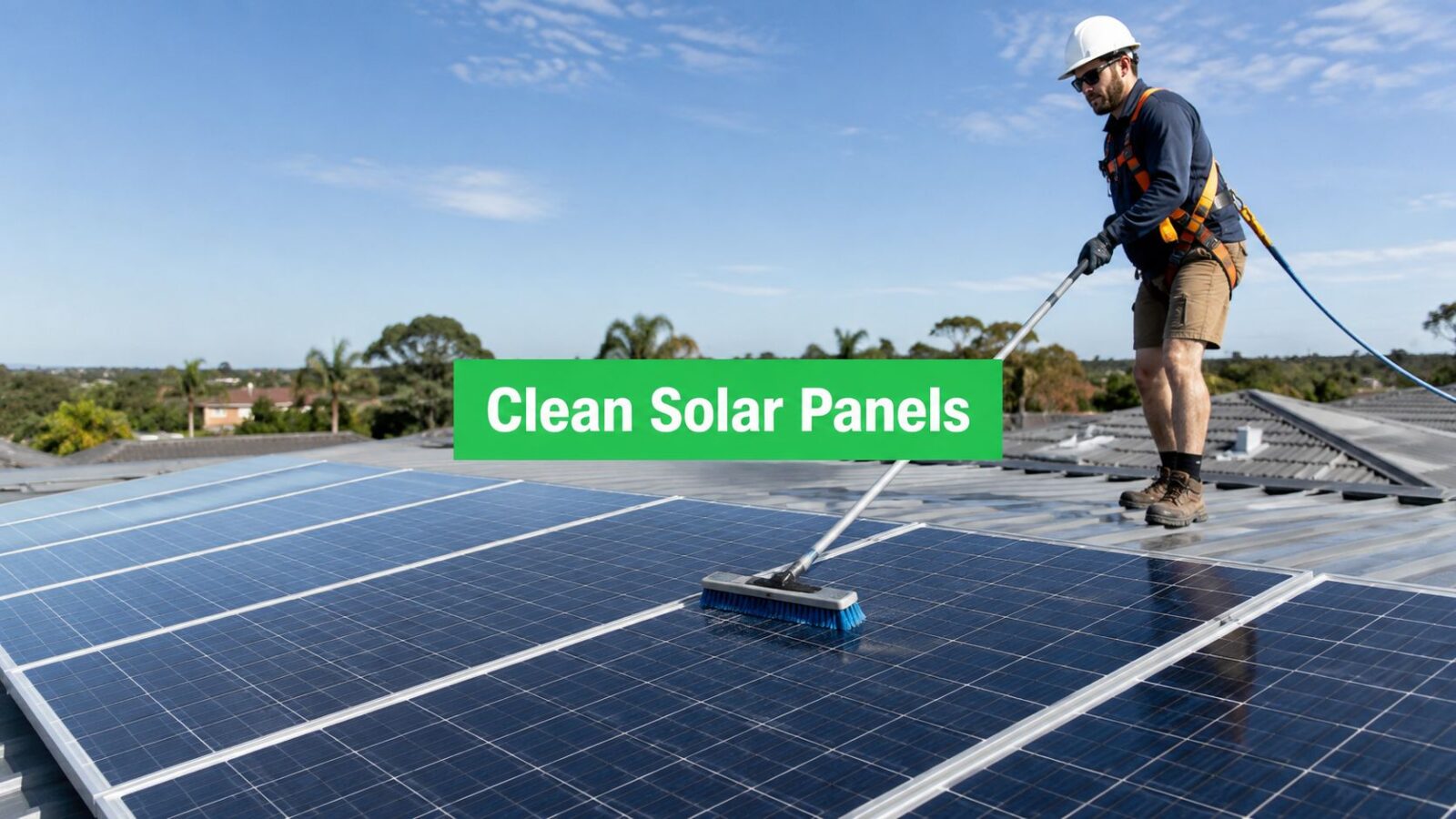
You check your Flagstaff inverter app after a summer storm and notice that the roof isn't producing what it did on clear days earlier in the season. The panels look mostly clean from the driveway, but a closer look reveals a dull film, yellow pollen, and a few stubborn spots that rain didn't remove. That's a common situation in Northern Arizona, where solar glass faces dust, pine debris, intense sun, and winter weather year after year.
Learning how to clean solar panels safely means more than spraying water across the roof. The right method protects the glass, coatings, seals, wiring, and your own footing while removing the residue that blocks sunlight. The practical approach is similar to professional window care: use the right water, a soft tool, controlled strokes, and a careful inspection instead of aggressive scrubbing.
Why Solar Panels in Flagstaff Need Real Cleaning
Flagstaff's panels deal with a distinctive mix of conditions. Dry road dust can settle across an array, late-spring pine pollen can form a sticky film, and winter snow can remain on low-tilt panels long after it has disappeared from the surrounding ground. Rain helps with loose dust, but it often won't remove pollen or mineral deposits after they bond to the glass.
The problem becomes more noticeable because Flagstaff has many bright, productive days. When soiling covers the photovoltaic surface, the system has fewer opportunities to convert available sunlight into electricity. A roof may still look attractive from the street while producing less energy than its owner expects.
Dust, pollen, and snow behave differently
Loose dust can often be rinsed away. Caked dust requires soaking and gentle agitation, because wiping a dry surface drags abrasive particles across the glass. Pine pollen is more troublesome once moisture and minerals help it adhere. A simple rainstorm may leave behind a thin yellow-green coating rather than a clean surface.
Snow presents a different decision. A steep array may shed it naturally, while a flatter installation can hold snow for an extended period. Scraping frozen material across the glass can damage the surface, and pouring hot water over cold modules creates a thermal-shock risk.
Practical rule: Treat solar-panel cleaning as preventive maintenance, not a cosmetic detail. The goal is to restore light transmission without creating a new problem.
The research supports that approach. A review of field and laboratory studies found that rising dust loading was associated with nearly linear performance declines, with reported losses ranging from 0% to about 26% as dust loading increased from 0 to 22 g/m². The same review summarizes broader real-world losses commonly reported from 5% to 40%, with harsh dusty environments sometimes reaching 50% or more (review of photovoltaic soiling research). In Flagstaff, that makes a professional, roof-safe cleaning plan part of protecting energy yield.
What Soiling Costs You in Output
A panel can look only moderately dusty while producing less electricity. Dust blocks incoming light, pollen leaves a persistent film, and bird droppings can shade one part of a module more heavily than another. A field and laboratory soiling review reports module-efficiency reductions of 15% to 35% in one test involving 20 g/m² of dust. Under the same loading, another cited test found short-circuit current reductions of 15% to 21% (field and laboratory soiling review).
Those results do not transfer directly to every Flagstaff roof. Soil composition, rainfall, array angle, wind exposure, and deposit type all affect the outcome. They do show why a visual inspection alone can miss a meaningful production loss. Check system output before assuming a dirty array has an electrical fault.
Typical Soiling Losses by Climate and Season
| Climate / Season | Average Output Loss | Notes |
|---|---|---|
| Lightly soiled, rainy conditions | Qualitatively low | Rain may remove loose dust, but bonded pollen or bird deposits can remain. |
| Dry, dusty periods | About 4% to 25% reported in PV systems | Results vary with dust loading, site exposure, and cleaning practices (PV soiling review). |
| Three months of dust in a UAE study | Up to 13% | That study identified a 15-day cleaning interval as optimal for its specific setting (PV soiling review). |
| Harsh dusty environments | 50% or more in some reports | These conditions are severe and should not be treated as a universal expectation. |
Compare clear-day production with similar clear days instead of judging the system from one cloudy reading. A gradual decline, with weather and shading staying consistent, makes soiling a reasonable maintenance suspect. A sudden drop needs a broader system check, since cleaning will not correct an inverter, wiring, or monitoring problem.
The financial decision depends on recovered production, service labor, roof access, and water use. The discussion of is solar panel cleaning worthwhile provides context for weighing those factors. Cleaning pays for itself only when the value of protected energy exceeds the service and safety costs. For Flagstaff property owners, that calculation should include whether dry dust, pine pollen, or a long-lasting deposit is limiting light across the array.
The Right Way to Clean Panels Without Damage
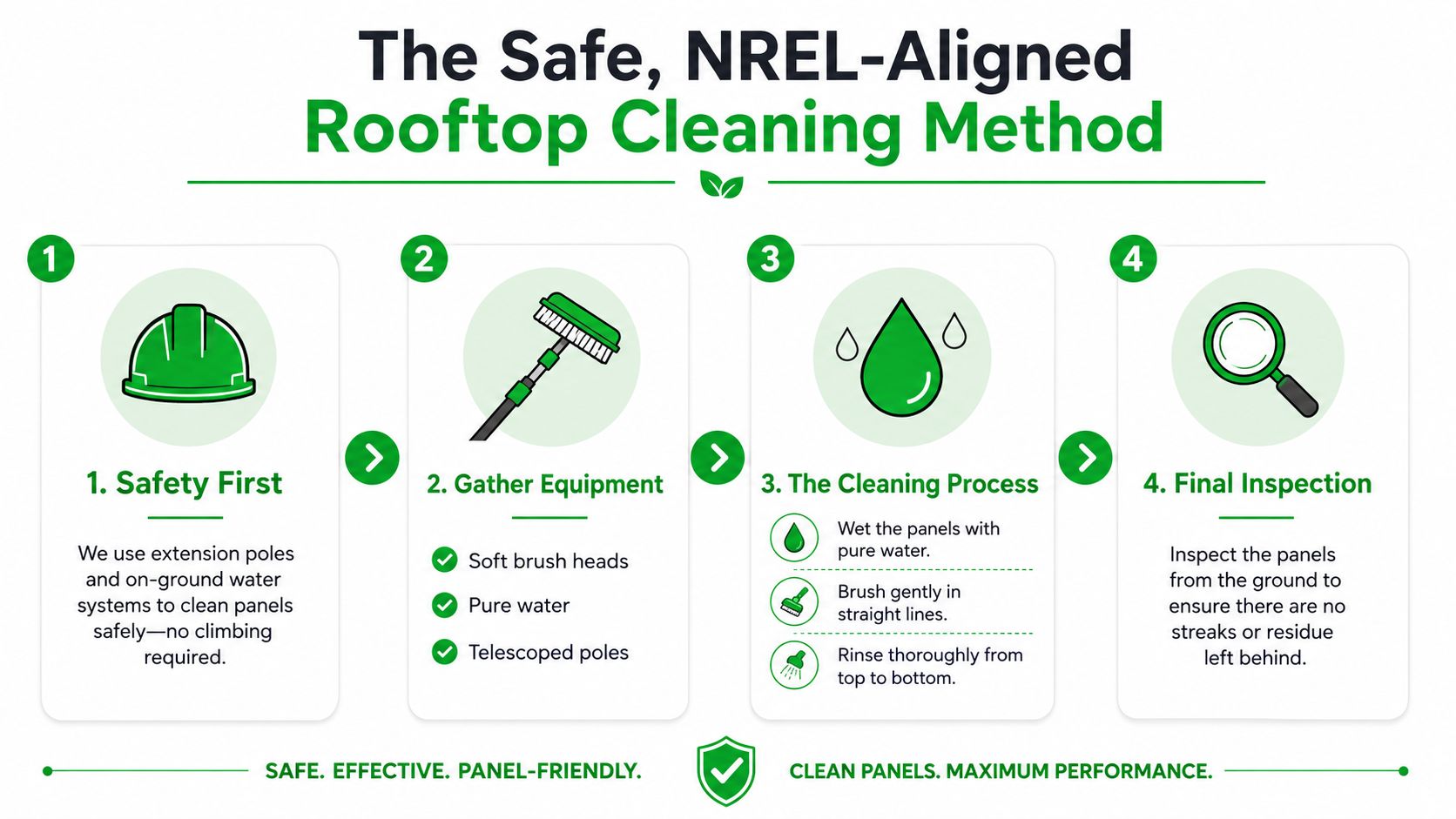
Start from the ground whenever the array and equipment permit it. A telescoping pole with a soft solar brush and an on-ground water-fed system reduces roof exposure while keeping tools away from fragile glass. If roof access is unavoidable, use appropriate fall protection, place the ladder securely, and plan a route that avoids stepping on the modules. Review the ladder safety requirements before setting up.
Check the module manufacturer's maintenance instructions before adding water or detergent. NREL solar-panel cleaning guidance recommends plain demineralized water, with mild detergent only when needed. It warns against high-pressure water, abrasive tools, solvents, harsh detergents, and unsuitable brushes, which can damage components or leave uneven deposits that contribute to hot spots.
Equipment and water quality
Use a soft brush made for photovoltaic glass, a clean bucket for manual work, a strip washer or similar soft applicator, and a rubber squeegee. Pure, deionized, distilled, or reverse-osmosis water is preferable because ordinary hard water can dry into mineral spots. A PV panel water-quality requirements guide notes that water below roughly 10 ppm TDS can dry without visible residue, while harder water may leave spotting and buildup.
If detergent is necessary, choose a manufacturer-approved, non-abrasive product and dilute it as directed. Avoid ammonia, bleach, acetone, scouring powders, solvents, and products that leave a slick or waxy film. In Flagstaff, pure water and gentle agitation usually handle dust and pollen without adding soap automatically.
A controlled cleaning sequence
- Choose cool conditions. Early morning or a cool, shaded period slows evaporation. Keep the water close to module temperature. The IEA PVPS soiling-loss report warns that temperature differences can create thermal shock.
- Rinse loose grit first. Wet the panel from the top down and let the rinse carry away loose dust. Dragging dry grit across the glass can create fine scratches.
- Brush in straight, overlapping strokes. Use light pressure, keep the brush clean, and work vertically. Follow the frame channels so water is not forced beneath seals.
- Rinse and squeegee. Pull a clean rubber squeegee from top to bottom, overlapping each pass. Check the lower frame and panel edges for residue.
Never use a pressure washer, abrasive pad, scraper, scouring powder, bleach, acetone, or unapproved solvent. One manufacturer-style instruction sheet limits nozzle pressure to 35 bar because excessive force can damage modules (solar-panel cleaning instructions). Lower force, purified water, a soft brush, and dry edges are the safer combination.
DIY Versus Hiring a Pro for Your Array
A homeowner may reasonably handle a ground-level rinse when the panels are reachable without climbing and the soiling is light. A two-story array on a steep Flagstaff roof is a different job. The decision turns less on willingness than on access, footing, equipment, and the condition of the deposits.
Where DIY can make sense
A single-story installation with a safe ground position may be suitable for a gentle seasonal inspection and rinse. The homeowner still needs a soft brush, purified rinse water, manufacturer approval for any detergent, and a way to avoid leaning a ladder against the modules or walking on the glass.
DIY becomes less attractive when pollen has bonded to the surface or construction dust has cemented into the frame edges. A dry cloth can scratch the coating by moving grit around, while a hard brush can leave fine marks that are difficult to see from the ground.
Where professional service earns its place
A trained crew brings more than a longer pole. The useful advantages include:
- Pure-water delivery: Deionized or RO-treated water dries with far less residue than ordinary hard water.
- Soft telescoping brushes: Non-abrasive heads can reach across an array without forcing a technician to step on modules.
- Safety equipment: Tie-offs, harnesses, proper ladder footing, and lift equipment reduce exposure on pitched or raised roofs.
- Condition awareness: A careful technician can identify cracked glass, damaged seals, bird deposits, and debris before cleaning makes the condition harder to see.
- Documentation: Before-and-after photographs and output observations can help separate soiling from an electrical or shading issue.
A clean panel isn't a successful result if the person cleaning it slips, scratches the coating, or pushes water into a damaged seal.
The same reasoning applies when evaluating specialized roof products and access constraints. Homeowners comparing integrated solar roofing can use finding affordable solar tiles in California as a separate resource for understanding how roof design affects maintenance access.

If your array is reachable from the ground, lightly soiled, and safe to rinse, DIY may be reasonable. If it's above one story, steep, heavily soiled, difficult to inspect, or surrounded by fragile roofing, hire a qualified crew. For homeowners who want equipment but not a full service visit, a water-fed pole system rental can be an option, provided the user understands safe operation and the array's manufacturer requirements.
Flagstaff-Specific Care for Dust, Pollen, and Snow
Flagstaff's seasonal pattern calls for different responses rather than one universal cleaning routine. Dust after a monsoon event, pine pollen in late spring, and accumulated winter snow each require a different level of intervention.
Dust and construction grit
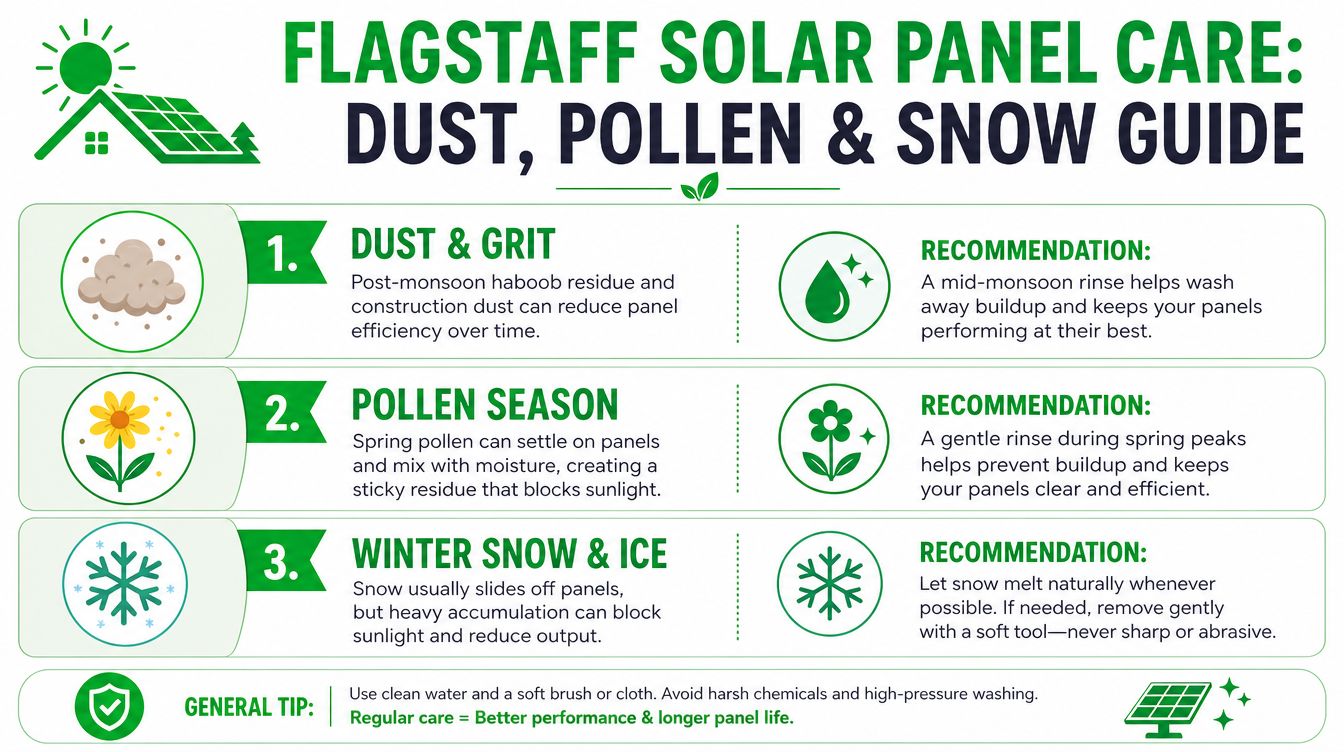
After a dry, windy stretch or nearby construction, inspect the array from the ground. If the surface has loose dust, rinse first and then brush gently. Never start by wiping a dry panel, because the brush or cloth can move grit across the glass and coating.
A post-monsoon rinse can be useful when rain has deposited muddy or mineral-rich residue instead of washing the surface clean. Use cool, low-force water, then a soft brush and purified final rinse. If the film remains after a normal wash, don't escalate to a scraper or pressure washer. Bonded material may need a trained technician and a manufacturer-compatible cleaning method.
Pine pollen and needles
Ponderosa pollen can settle as a fine yellow-green blanket. Once it mixes with dew, it may cling tightly enough that later rain leaves a visible film. A gentle rinse during the spring peak, followed by soft brushing with clean water, is safer than waiting until the residue hardens.
Pine needles and small twigs create shade and can collect along the lower frame. Remove loose debris from the ground when possible, but don't reach beyond a stable position or use a rigid tool that could strike the glass.
Snow and ice
Snow often deserves patience. If the array is safely visible and the snow can slide or melt without creating a hazard below, natural melt is usually the least invasive option. When light removal is necessary, use a soft roof rake designed for solar or delicate roofing, and pull gently without scraping frozen material across the module.
Don't pour hot water on cold glass. Don't chip ice with a shovel, scraper, or metal edge. High-elevation ultraviolet exposure and repeated temperature swings already place stress on exterior materials, so aggressive winter treatment adds avoidable risk. Forested lots also deserve an inspection for bird droppings, nesting material, and branches that may have fallen near the array.
For adjacent roof and property work during winter, a specialized winter snow removal service can address access and ground hazards without turning a solar-panel check into an improvised roof climb.
How Often to Clean for Your Roof and Site
A Flagstaff array beside an unpaved road may need attention far sooner than one on a sheltered, steep roof. There is no single calendar interval for every system. Industry guidance supports periodic water cleaning, often once or twice a year, while the right schedule also depends on rainfall, dust type, cleaning cost, and the amount of soiling at the site. A desert study recommended cleaning about every three weeks in its own setting, showing how sharply local conditions can change the answer (solar-soiling operations research).
NREL's cost-benefit example gives the useful decision framework. At a site with 1.91% annual soiling loss, one cleaning reduced modeled loss to 1.52%, two cleanings to 1.32%, and three cleanings to 1.20% (NREL operations and maintenance guidance). Those figures are not a schedule to copy. Compare recovered production with labor, water, access, and fall-protection costs, then clean when the expected gain justifies the work.
Sample Cleaning Cadence for a Flagstaff Roof
| Site Condition | Recommended Cadence | Best Window | Trigger to Clean Sooner |
|---|---|---|---|
| Sheltered, steep array with light dust | Periodic inspection with cleaning as needed | After visible residue or seasonal buildup | Output declines on otherwise comparable clear days |
| Typical Flagstaff roof near trees | Seasonal review and targeted cleaning | Spring pollen period and late-summer dust check | Pollen film, needles, or bird deposits remain visible |
| Low-tilt array near an unpaved road | More frequent condition-based cleaning | After dusty weather and before high-production periods | Caked grit, persistent film, or measurable soiling decline |
| Array with recurring bird activity | Clean localized deposits promptly | When deposits appear and conditions are cool | Uneven spots remain after rain or output changes unexpectedly |
Use the inverter monitoring app to compare production on clear days before and after a wash. If monitoring is limited, a qualified technician can take consistent readings. A single reading proves little because weather, shade, snow cover, and equipment faults also affect output.
For a typical Flagstaff roof, inspect after spring pollen and check for dust after monsoon activity. Review the array again before winter weather. Shorten the interval for a flat or low-tilted roof, an unpaved-road location, heavy pollen exposure, or a regular bird-perching area. Schedule cleaning when residue remains after rain, not because a calendar reminder appears.
A Year-Round Maintenance Playbook and Local Help
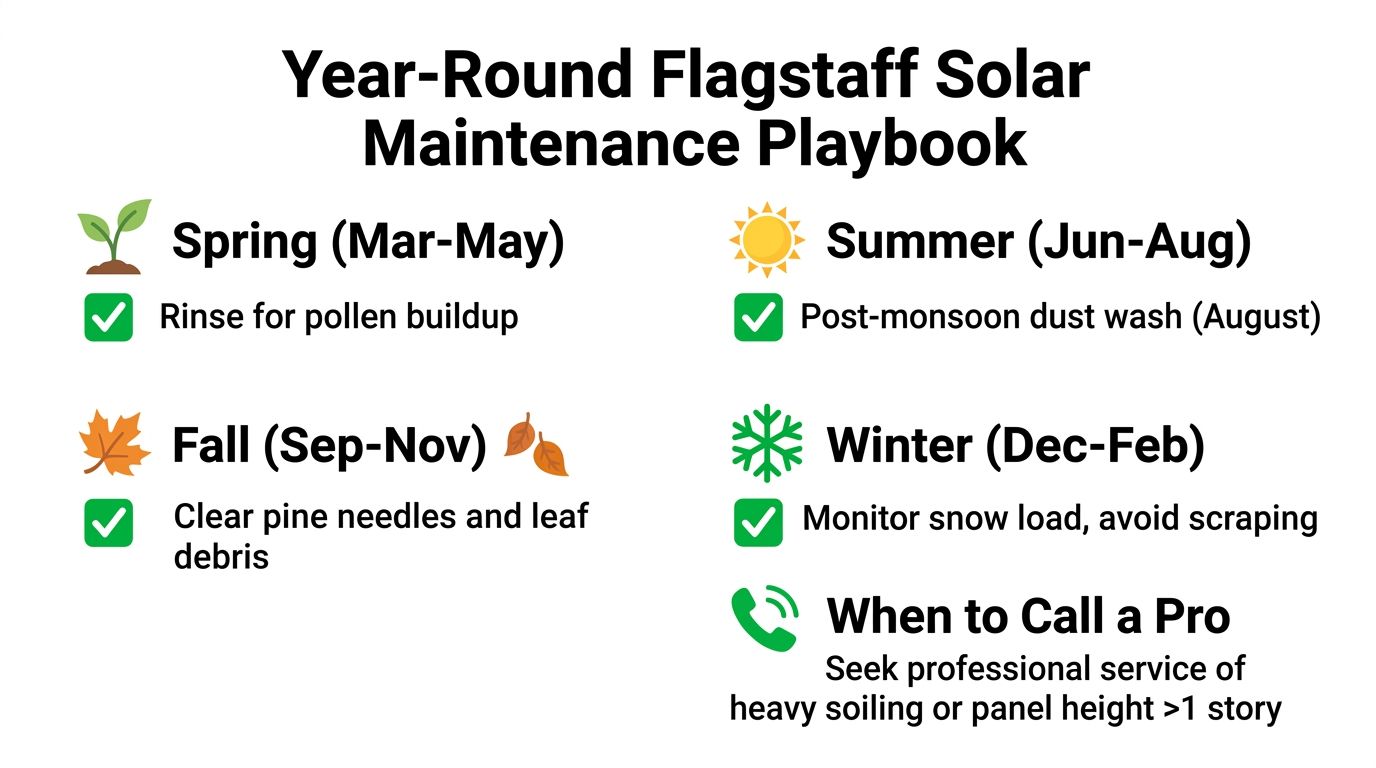
A practical Flagstaff routine follows the seasons instead of forcing every panel into the same schedule.
- Spring: Inspect for pollen, rinse bonded film before it hardens, and check frame channels for needles.
- Summer: Review production after dusty weather and schedule a wash if monsoon residue remains.
- Fall: Remove loose needles and leaves safely, then check whether gutters or roof debris can affect panel runoff.
- Winter: Monitor snow load from the ground, let snow melt naturally when possible, and avoid scraping ice.
The safest professional approach uses the same pure-water, scratch-conscious mindset required for high-end glass. A qualified crew surveys the array first, chooses ground-based poles or appropriate access equipment when possible, protects the home and landscaping, and uses tie-offs, harnesses, and secure ladder footing where roof work is unavoidable. Documented before-and-after photographs and output observations give the owner a clearer record than appearance alone.
Pine Country Window Cleaning has served Flagstaff and Northern Arizona since 1999. Founded by Flagstaff native David Kaminski, the company removes, cleans, and reinstalls screens with every window service, and its technicians bring that same care for the customer's home to solar-panel cleaning. Request a quote, schedule a seasonal cleaning, or ask for a free soiling assessment before the next dusty stretch.
Schedule a solar-panel inspection with Pine Country Window Cleaning for pure-water, soft-brush cleaning that respects your glass, roof, and landscaping. The Flagstaff team can help you choose a sensible seasonal schedule, document the result, and keep your array safer and cleaner through pollen, monsoon dust, and snow.