You're probably looking for a pressure washing service agreement template because you don't want a simple cleaning job to turn into an awkward phone call later.
That usually happens in predictable ways. A homeowner thinks the price included the patio furniture area. The contractor thought it didn't. A property manager expected the siding to be soft washed, but the crew arrived planning standard pressure washing for harder surfaces only. Or the work goes well, then somebody notices an old crack, a faded patch, or peeling stain and asks when it happened.
A solid agreement fixes most of that before the truck pulls up. It gives both sides the same written understanding of the work, the method, the schedule, and the limits. In Northern Arizona, where you're dealing with cabins, exposed wood, dusty commercial exteriors, snow season wear, and sudden weather changes, that kind of clarity matters even more.
Your Guide to a Rock-Solid Pressure Washing Contract
A lot of service problems don't come from bad intentions. They come from vague language.
A verbal agreement sounds easy until the details get fuzzy. “Wash the house and patio” can mean one thing to the customer and something completely different to the company. On wood siding, stone patios, stained decks, and high-country exterior finishes, those missing details can create real friction.
That's why a professional agreement should never feel like a sign of distrust. It's a care document. It shows the client you've thought through the property, the process, and the outcome. It also gives the company a fair way to price the work, schedule it properly, and document what's included.
Why local experience changes the contract
Northern Arizona properties aren't one-size-fits-all. A pressure washing service agreement template for a stucco home in town shouldn't read exactly like one for a pine-shaded cabin with cedar siding or a retail storefront with heavy foot traffic.
A well-written agreement accounts for:
- Surface differences like concrete, flagstone, painted siding, cedar, and composite decking
- Method differences between higher-pressure cleaning for durable hardscape and soft washing for delicate materials
- Access concerns such as tight driveways, screen removal, landscaping, and multi-story elevations
- Weather realities including wind, snow, and monsoon interruptions
That kind of detail doesn't happen by accident. It comes from seeing how jobs succeed and how misunderstandings start.
Founded by Flagstaff native David Kaminski in 1999, with over 26 years serving Northern Arizona and recognized as the largest window cleaning service in Flagstaff, AZ, the business perspective behind this approach is simple. Protect the customer's property first. Put expectations in writing. Then do the work the right way.
Practical rule: The best contract doesn't sound aggressive. It sounds clear.
If you want to build an agreement that helps prevent fee disputes, the strongest move isn't legal jargon. It's plain language that states exactly what will happen, what won't happen, and how changes get approved.
A free template is useful. A useful template with the right reasoning behind each clause is what actually keeps jobs smooth.
Anatomy of a Professional Pressure Washing Agreement
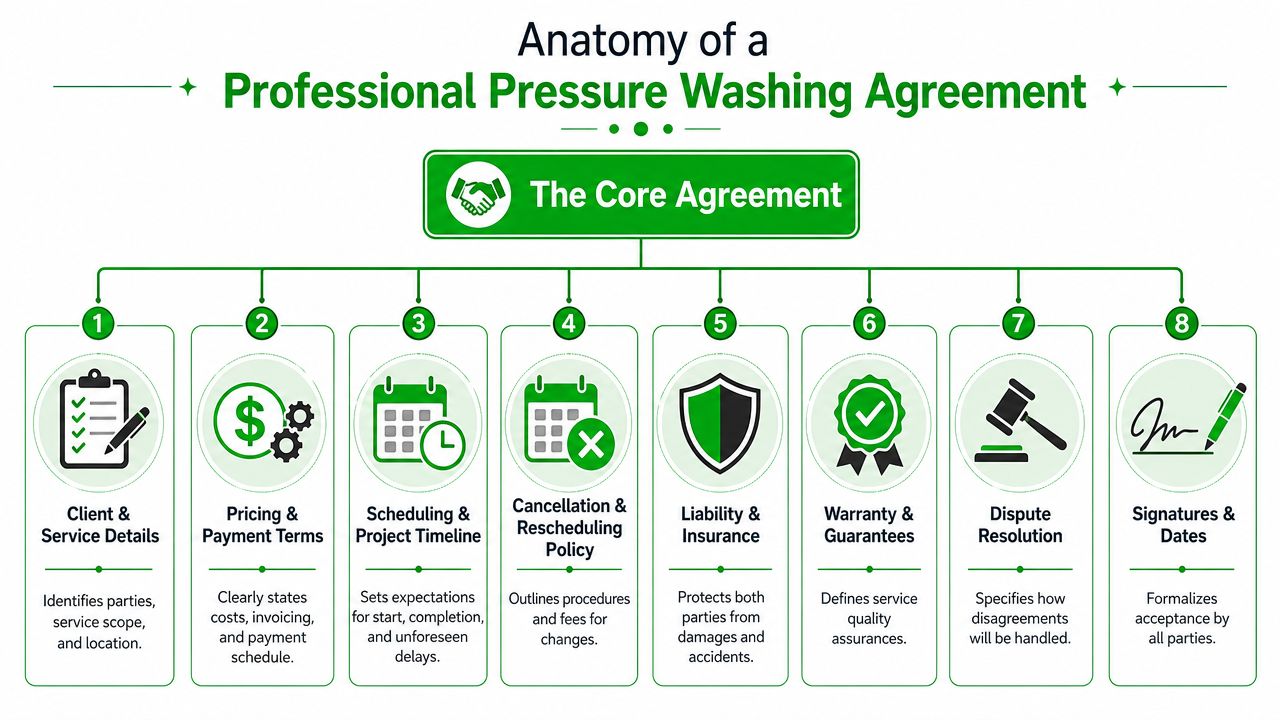
The strongest pressure washing service agreement template is built like a work order and a protection document at the same time. It should be easy for a homeowner to read, and detailed enough that a commercial manager can hand it to accounting or facilities without extra explanation.
Here's the visual structure most professionals aim for.
Start with identities and job location
Every agreement needs the basics. Client name. Company name. Service address. Contact details. Date of service or service window.
That sounds obvious, but this section prevents a lot of confusion on second homes, rentals, HOA-managed properties, and multi-building commercial sites. If the property has a detached garage, guest house, rear patio, or side yard access issue, note it here or in the scope.
Good version: “Soft wash exterior siding of main residence only at listed address. Detached garage excluded unless added in writing.”
Weak version: “Wash house exterior.”
Scope of work needs real detail
This is the heart of the agreement. Industry best practice is to use a written agreement on every job, even when residential work may not legally require one, and the clauses that reduce liability most effectively include itemized pricing, detailed scope definitions that specify methods like soft washing, and pre-existing condition clauses tied to photographic documentation according to TaskTag's guide to pressure washing contracts.
That means your scope shouldn't just name surfaces. It should name the method.
Use language like this:
- Concrete driveway cleaned with pressure washing
- Painted wood siding cleaned with soft washing
- Stone patio cleaned with lower-pressure surface-appropriate method
- Chemical treatment disclosed when used on organic staining or buildup
- Excluded items listed clearly, such as outdoor furniture, interior courtyards, roofs, or oxidized surfaces needing specialty restoration
Cleaning method belongs in writing because the customer hears “pressure washing” and may assume every surface gets the same treatment. A professional agreement corrects that assumption before work begins.
For homeowners comparing pricing, this is also where transparent estimates help. A detailed breakdown is easier to understand when paired with a clear pressure washing service cost guide.
Later in the process, seeing method and price side by side makes approval much easier.
Itemized pricing works better than a lump sum
Lump-sum bids create questions. Itemized pricing answers them before they're asked.
If a job includes a front walkway, siding, patio, and garage apron, list those as separate line items. That makes approvals cleaner and change requests simpler. It also helps when a client wants to postpone one area without rewriting the whole job from scratch.
A short comparison makes the difference clear:
| Pricing style | What happens |
|---|---|
| Lump sum | Client doesn't know which area drove the cost |
| Line item pricing | Client can see exactly what each surface or service includes |
Liability, photos, and property protection
The best liability clause isn't the one that sounds toughest. It's the one that matches how the crew works on site.
Before cleaning begins, document visible wear. That can include cracked concrete, failing stain, peeling paint, deteriorated caulk, oxidized metal, loose mortar, or fragile wood fibers. Then reference that photo record in the agreement. This protects the company from false claims and protects the client from uncertainty.
A useful property protection section often includes:
- Pre-existing conditions documented before work starts
- Access and utilities clarified in advance
- Chemical disclosure stated plainly
- Safety expectations noted for occupied properties, pets, and restricted areas
For companies that work around ladders, poles, hoses, reels, pumps, surface cleaners, and pure-water brush systems for related exterior cleaning, the agreement should also reflect a broader professional standard of property care. That includes careful setup, controlled hose routing, and attention to screens, frames, and surrounding finishes. On window service work, professional crews remove screens, clean screens, and reinstall them as part of taking care of the home. That mindset carries over to exterior washing too.
Tailoring Your Agreement for Homes and Businesses
A good template becomes useful when you can picture it attached to a real property.
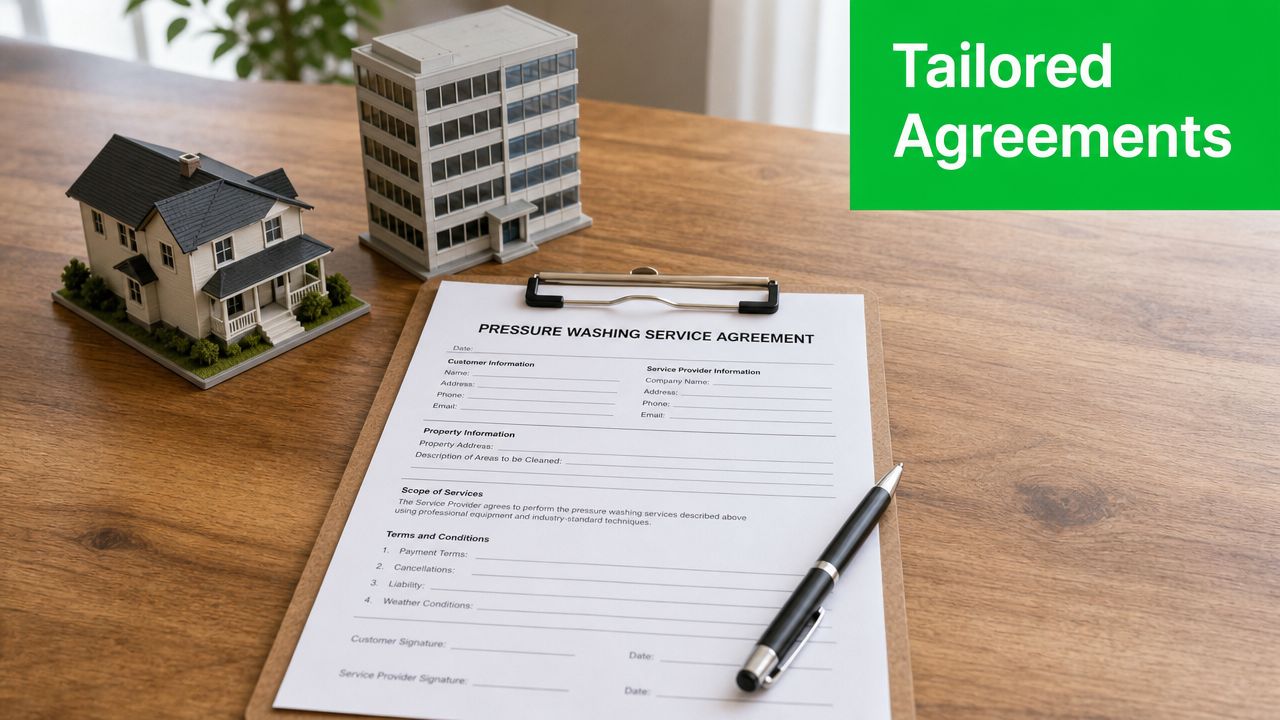
In Flagstaff, the same pressure washing service agreement template won't fit a pine-shaded cabin and a busy commercial building without changes. The structure can stay the same, but the scope, scheduling language, and client responsibilities need to match the property.
Residential example for a cabin property
Take a cabin in Pine Canyon or a similar high-country neighborhood. The owner wants the cedar siding cleaned, the flagstone patio washed, and the entry walkway freshened up before guests arrive.
The agreement should sound specific and calm, not overly legal. A residential scope might read more like a guided work order than a formal facilities contract.
Sample scope language:
Soft wash exterior cedar siding on main cabin structure using a low-pressure process appropriate for wood surfaces. Pressure wash flagstone patio and front entry walkway using surface-appropriate settings. Avoid direct impact on delicate trim, light fixtures, and planted beds adjacent to patio edge.
That wording matters because cabins often have mixed materials close together. You might have wood siding beside natural stone, decorative iron, screened porches, and landscaping that can't be treated casually.
What else belongs in the home version
Residential agreements should also spell out the “small” details that clients care about most.
Include items like:
- Furniture and access whether the homeowner or company is moving light items, and what must be cleared in advance
- Window area care whether nearby screens will be removed, cleaned, and reinstalled when window cleaning is part of the visit
- Water access which outdoor spigot will be used, if needed
- Surface limitations faded stain, loose paint, weathered wood, and cracked mortar may look different after cleaning because soil is removed and defects become more visible
For homeowners wanting a better sense of how this scope translates to actual exterior service, a typical house pressure washing service page is often a helpful reference point before signing.
If the property is a second home or short-term rental, the agreement should say who approves changes when the owner isn't on site. That avoids delays and last-minute confusion.
Commercial example for a hotel or retail property
Now switch to a hotel, storefront, or mixed-use building near campus. The property manager usually has different concerns. They care about access windows, tenant disruption, recurring service terms, and documentation.
A commercial scope should read tighter. It may include service zones, approved work hours, staging areas, and invoicing instructions.
Here's a practical contrast:
| Contract area | Residential cabin | Commercial property |
|---|---|---|
| Scheduling | Flexible around owner availability | Often outside business hours or low-traffic windows |
| Scope detail | Focus on home materials and appearance | Focus on traffic areas, entrances, façades, and safety |
| Approvals | Usually one homeowner | Property manager, facilities contact, or ownership group |
| Billing | Simple completion payment terms | Often invoicing procedures and recurring service language |
For a commercial example, the agreement might state that sidewalks at public entrances will be cleaned before opening hours, rear loading areas are excluded unless listed, and service frequency is recurring rather than one-time.
Commercial versions also benefit from recurring language that states service frequency, renewal terms, and how annual pricing adjustments will be handled. That makes routine maintenance far easier to manage than repeated one-off approvals.
Advanced Clauses for Scheduling and Changes
The clauses that save a job usually aren't the glamorous ones. They're the parts that deal with interruptions, extra requests, and surprises found on site.
In Northern Arizona, those clauses matter because exterior cleaning depends on conditions you can't fully control. A schedule that looks simple on paper can shift fast when wind picks up, snow lingers in shaded areas, or a client decides they want the retaining wall cleaned after the crew is already there.
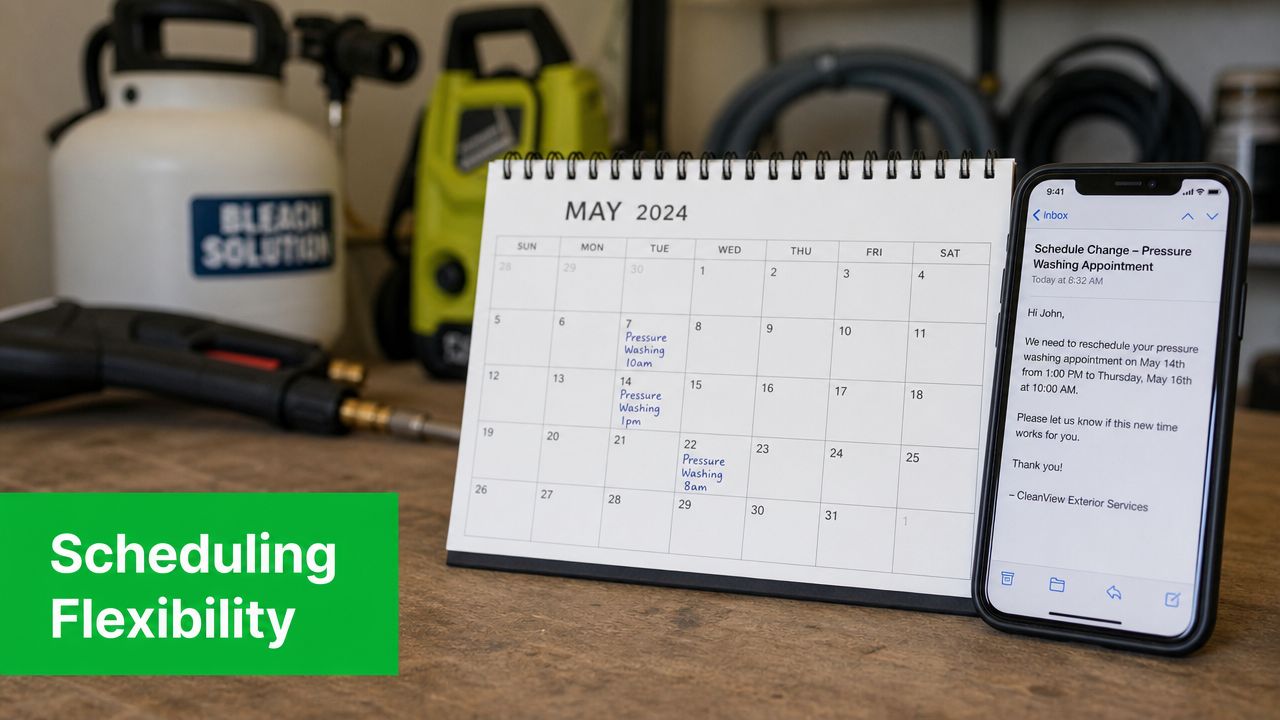
Weather contingency language that actually works
A vague weather clause doesn't help much. “Work may be rescheduled due to weather” leaves too much room for argument.
A better version identifies the kinds of conditions that make the work unsafe or impractical. In this region, that can include high winds, active precipitation, freezing temperatures, snow buildup, and monsoon conditions that affect footing, runoff control, or dry time.
A useful clause can say:
Service may be delayed or rescheduled when weather conditions create safety concerns, interfere with cleaning performance, or prevent proper access to the work area. The company will coordinate a revised service date with the client as soon as conditions allow.
That wording gives enough protection without sounding evasive.
Change orders stop scope creep politely
Most scope creep doesn't begin as conflict. It starts as a casual question.
“Since you're here, can you do the side fence too?”
“Can you also clean the back retaining wall?”
“Would it be possible to add the dumpster pad?”
If the agreement has no change-order language, crews end up making judgment calls in the field. That's where billing problems begin. The simple fix is to require written approval for added work before it starts.
Use a short clause like this:
- Additional work request must be described in writing
- Revised price must be approved before the work is performed
- Schedule impact should be acknowledged if the added work extends the visit
That approval can be formal on a commercial property or as simple as an email or text confirmation on a residential job, as long as the agreement allows for it.
Added work isn't a favor if it changes labor, chemicals, equipment time, or risk. Put it in writing while everyone is still smiling.
Pre-existing damage and fair termination terms
The pre-existing damage clause is where professionalism shows up in practice, not just in paperwork.
Before work begins, do a walkthrough. Look at cracked concrete, loose stone, weathered stain, oxidized metal, peeling paint, brittle seals, and old wood fibers. Take clear photos. Then make sure the agreement says the cleaning process won't be responsible for defects that already existed.
This clause should never be used to dodge responsibility. It should be used to identify the true condition of the property before cleaning reveals it more clearly.
A fair termination clause matters too. Either party may need to stop the project because of access issues, safety concerns, nonpayment, or a major change in conditions. Keep the language balanced. State how notice is given, what work completed to that point will be billed, and how unused future work is handled if the project ends early.
That gives both sides a clean exit path instead of a messy argument.
Client Communication and Enforcing Your Agreement
A signed agreement doesn't build trust by itself. The conversation around it does.
Clients usually respond well when you present the contract as part of a professional process. They get uneasy when it feels like a trap. The difference is in how you explain it. If you move too fast, they assume the document protects only the company. If you walk through the key parts plainly, they see that it protects their property and their expectations too.
How to introduce the agreement without sounding defensive
Keep your language simple. You don't need a speech.
Try something like this:
“This agreement puts the scope, method, price, and scheduling in writing so we both know exactly what's included before the job starts.”
Or this:
“I like to spell out which areas are being pressure washed, which are being soft washed, and anything that's excluded. That keeps the project clean on paper before we start cleaning on site.”
That approach lowers tension because it centers clarity, not conflict.
What to review with the client before signing
Don't read every line aloud. Focus on the clauses people care about most.
Use a short checklist:
- Scope and method confirm the exact surfaces and whether each will be pressure washed or soft washed
- Pricing and payment make sure line items and due dates are easy to understand
- Scheduling confirm access windows, gate codes, pets, parked vehicles, and weather rescheduling
- Pre-existing conditions explain that photos document current surface condition before work begins
If you run a service business and want a smoother front-end process for calls, follow-up, and appointment flow, systems for handling leads for power washing services can support the agreement process by making sure details are captured early and consistently.
How to enforce the agreement professionally
If a question comes up during the job, don't jump straight to “it's in the contract.” That phrase usually escalates things.
Instead, bring the document back into the conversation calmly:
- “Let's look at the written scope together.”
- “I want to make sure we're following what we both approved.”
- “That area wasn't included in the original agreement, but I can write up an addition for you.”
The agreement should feel like a reference point, not a weapon. When clients feel heard, they're usually fine with boundaries. What they resist is surprise.
Protect Your Business and Delight Your Clients
The pressure washing service agreement template that works best isn't the longest one. It's the one that makes the job easier to understand, easier to perform, and easier to close out without friction.
That's the core benefit. A professional agreement doesn't just reduce disputes. It improves the customer experience because people know what's happening on their property. They know the cleaning method, the service areas, the timing, the limits, and the process for any changes. That kind of clarity feels professional because it is professional.
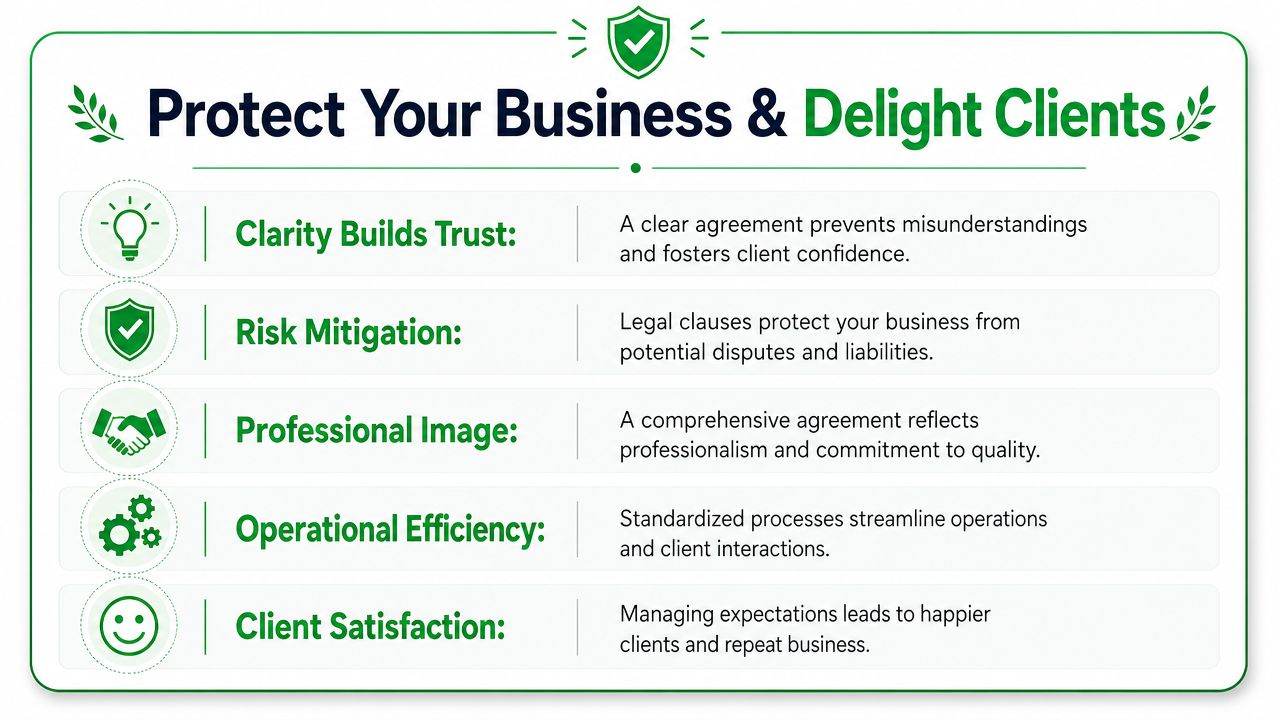
What separates a fair contract from a bad one
A bad agreement tries to shield the company from everything. A fair agreement creates a clear job for both sides.
That means it should:
- Protect the property by matching the method to the surface
- Protect the budget by listing prices in a way the client can follow
- Protect the schedule by addressing weather and access in advance
- Protect the relationship by creating a written process for changes and concerns
For owners reviewing risk beyond the contract itself, a practical guide to cleaning business insurance is worth reading alongside your service agreement language.
Commercial operators should also think about how this plays out across multiple visits and multiple stakeholders. A well-built agreement becomes even more valuable when attached to recurring exterior maintenance such as commercial pressure washing services, where consistency matters just as much as the initial scope.
The takeaway
If you're building your own template, keep it readable. Use plain English. Name the surfaces. Name the method. State what's excluded. Document the condition before work begins. Give weather and changes a written process. Then review it with the client like a professional who cares about the result and the property.
That's how experienced companies avoid preventable problems. This is also how clients feel taken care of from the first signature to the final walkthrough.
Download the free template, customize it for your property type, and use it as a working document, not just paperwork.
Pine Country Window Cleaning provides pressure washing, professional window cleaning, and gutter cleaning across Northern Arizona with the kind of care local property owners expect. We use professional tools like squeegees, ladders, poles, and pure-water brushes, not household shortcuts, and we remove screens, clean screens, and reinstall them with every window cleaning service. Started by Flagstaff native David Kaminski in 1999, we've grown into Flagstaff's largest window cleaning company by focusing on dependable communication, careful workmanship, and respect for every home and business we service. If you'd rather skip the paperwork and get a clear, hassle-free estimate, contact us for pressure washing, window cleaning, or gutter cleaning.