

A dark film is spreading across the siding of your Flagstaff cabin. Pine pollen has settled into the trim, the north-facing walls look green after a wet season, and the roofline has picked up organic staining. You may be tempted to rent a pressure washer and solve everything in an afternoon. On a Forest Highlands home, a Munds Park cabin, or a mixed-material commercial building, that approach can create more problems than it removes.
Soft wash exterior cleaning uses cleaning chemistry, controlled dwell time, careful rinsing, and low pressure. The method protects surfaces by matching the treatment to the material, the contamination, the landscaping, and the property's drainage. In Northern Arizona, that last part matters as much as the spray itself.
What a Soft Wash Visit Looks Like on a Flagstaff Home
On a typical cabin in Forest Highlands or Munds Park, the visit begins unobtrusively. A technician walks the perimeter, checks the siding, roof edges, windows, decks, gutters, and landscaping, then identifies where runoff could travel. Instead of immediately opening a loud pressure-washing wand, the crew sets up a hose-fed applicator and a low-pressure pump designed to distribute solution evenly.
Plants receive attention before the first application. Crews pre-wet vegetation, move vulnerable furniture, protect sensitive fixtures, and account for wind that can carry mist toward a garden bed or window assembly. The work is slower than blasting a wall with water, because the solution needs time to loosen algae, mildew, pollen residue, and other organic staining.
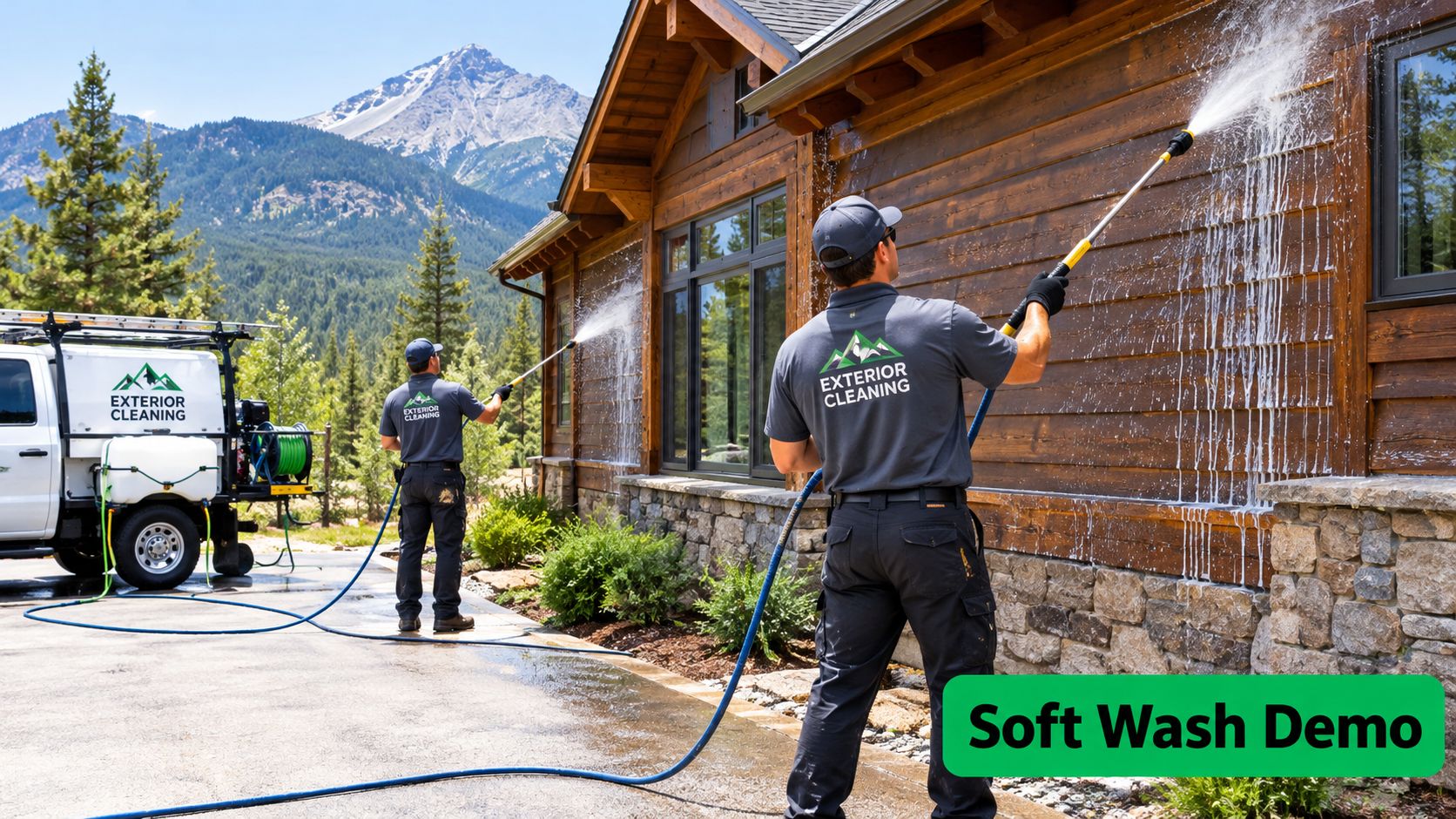
What the crew watches during application
The technician doesn't treat every exterior as one large surface. Painted wood, log siding, stucco, decorative masonry, window trim, and metal details absorb or shed water differently. A shaded stucco wall may need a different application strategy from sun-baked painted trim, while older mortar requires restraint.
Practical rule: The lowest pressure that achieves the cleaning objective is usually the right pressure.
The same purpose-built mindset applies to windows. Professional window cleaning relies on squeegees, ladders, extension poles, and pure-water brushes, not rags, Windex, or newspaper. Pure water allows exterior glass to be brushed and rinsed without the mineral residue commonly left by ordinary tap water, when site conditions support that method.
Screens are part of the window assembly, not an afterthought. A careful crew removes them, cleans them, allows them to dry as needed, cleans the glass, and reinstalls the screens so dirty runoff doesn't compromise freshly cleaned windows during later rain. That sequence reflects the broader principle behind soft washing: protect the home while cleaning it.
By the end of the visit, the exterior should look cleaner without the telltale signs of aggressive work, such as damaged paint, disturbed mortar, forced water behind seams, or overspray on nearby plants. The method is chemistry-led from start to finish.
The Chemistry and Pressure Behind the Method
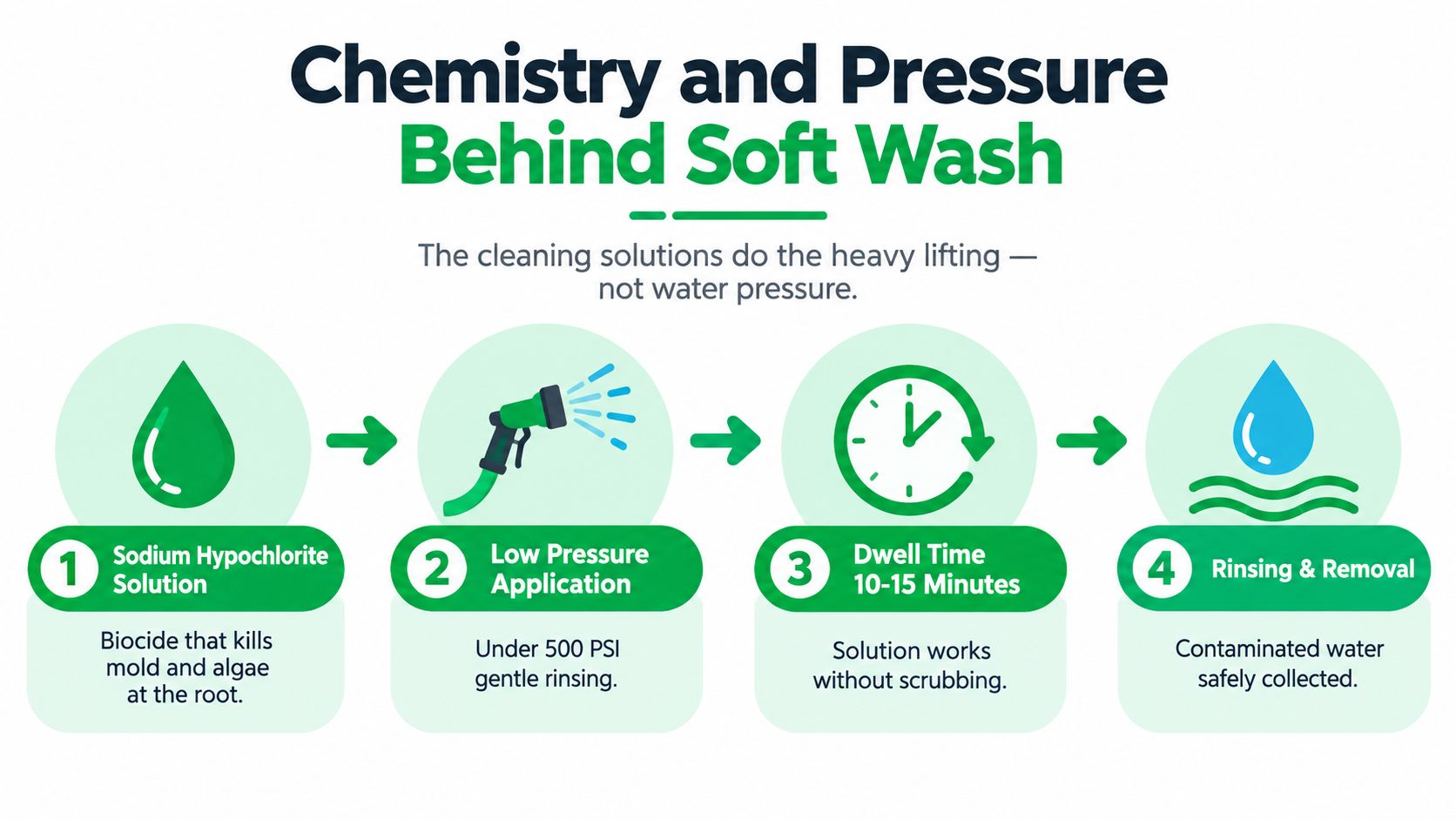
Soft washing works because the cleaning solution does most of the work. Water carries and rinses the solution, but abrasive impact isn't the primary tool against algae, mildew, and organic staining.
Sodium hypochlorite is commonly used because it can oxidize biological growth. Household or general-purpose bleach commonly ranges from 3% to 8%, while commercial products range from approximately 10% to 15%, according to the OSHA interpretation on sodium hypochlorite use and dilution. Those figures describe product strength, not a universal spray recipe. A technician should calculate dilution from the actual product label.
Why dwell time matters
Think about a pan with dried-on food. Dish soap works better when it sits on the surface than when you immediately attack the pan with a sharp object. Soft washing follows the same logic. The solution is applied, allowed to work, and then rinsed gently.
Pressure washing is closer to attacking that pan with force. It may remove visible residue quickly, but the impact can damage the surface beneath it. On a Flagstaff property exposed to freeze-thaw cycles, intense sun, and dry air, painted wood, older log siding, window seals, and mortar already have environmental stresses to manage.
The National Park Service recommends beginning masonry cleaning at 100 psi or below, increasing pressure only as needed, and generally remaining no higher than 300 to 400 psi. Its masonry-cleaning guidance also identifies low-pressure water, potentially combined with a non-ionic detergent and natural- or synthetic-bristle brushing, as an approach for biological growth.
That guidance supports the central distinction:
- Chemistry: Breaks down or treats organic contamination.
- Dwell time: Gives the solution a chance to work.
- Low pressure: Rinses without relying on aggressive impact.
- Surface testing: Confirms that the treatment suits the material.
Higher concentration isn't automatically better. It increases oxidation capacity, but it also raises the possibility of vegetation injury, color loss, corrosion, and worker exposure. Chemical-resistant gloves, splash goggles, vegetation protection, and a test area are basic controls, especially around painted siding, metal fixtures, roof-adjacent surfaces, and delicate finishes.
For homeowners planning broader property care, this 2026 guide to organic lawn care offers useful context on protecting outdoor areas while selecting exterior maintenance practices. The same principle applies here: a clean surface isn't a successful result if the surrounding yard suffers.
Lower PSI plus compatible chemistry creates a safer cleaning process. Neither part works responsibly on its own.
Soft Washing vs Pressure Washing Side by Side
Soft washing and pressure washing aren't competing religions. They are different tools for different substrates and contaminants. A concrete dumpster pad with embedded oil may need mechanical force, while painted siding or a roof usually calls for chemical treatment and controlled rinsing.
| Criterion | Soft Washing | Pressure Washing |
|---|---|---|
| Primary cleaning action | Cleaning solution treats organic growth, followed by a gentle rinse | Water impact removes surface debris and embedded contamination |
| Pressure approach | Low pressure, beginning at 100 psi or below for sensitive masonry guidance | Higher pressure selected for durable surfaces |
| Typical surface fit | Siding, roofs, painted finishes, wood, stucco, and decorative masonry | Concrete, dumpster pads, some hardscape, and stubborn oil on concrete |
| Main stain profile | Algae, mildew, biological growth, pollen film, and organic staining | Oil, tire marks, embedded dirt, and loose surface residue |
| Main risk | Chemistry can harm plants, metals, finishes, and waterways if unmanaged | Impact can erode surfaces, damage mortar, strip finishes, or force water behind seams |
| Runoff concern | Treated water and loosened contamination still require containment planning | Larger water volume can carry paint, debris, detergent, and other pollutants |
| Best decision factor | Match solution strength and dwell time to the substrate | Match impact and nozzle technique to a durable material |
Where each method belongs
A crew may use both methods on one property. Soft washing can address a cabin's siding, roofline, gutters, soffits, and painted trim. Pressure washing may be appropriate for a concrete entry, loading area, or dumpster pad after the surrounding surfaces have been protected.
Pressure washing a house isn't automatically wrong, but the operator must understand where the water goes and what the substrate can tolerate. A practical overview of that service distinction appears in Pine Country Window Cleaning's pressure-washing guidance.
The wrong choice is usually driven by equipment rather than by diagnosis. A loud engine doesn't prove that a surface needs force, and a low-pressure pump doesn't prove that the job is environmentally controlled. The right method is the one matched to the stain, material, access conditions, and runoff pathway.
Surfaces Safe for Soft Wash Exterior Cleaning
Many Flagstaff properties combine materials that respond differently to water and chemistry. A single cabin may have painted wood siding, stone or brick accents, metal roof trim, glass, screens, gutters, and a weathered deck. Treating all of it with one nozzle or one mixture is poor practice.
Materials that often respond well
Soft washing is commonly suited to:
- Painted wood and log siding: Low impact reduces the chance of driving water into seams or lifting fragile coatings.
- Stucco and EIFS: Controlled application helps avoid unnecessary erosion and water intrusion.
- Vinyl siding: Chemical treatment can address organic staining without relying on force against panel joints.
- Asphalt shingle and tile roofs: Roof cleaning generally depends on chemistry and careful rinsing rather than aggressive water impact.
- Brick and decorative masonry: The National Park Service recommends testing first and beginning with very low pressure.
- Gutters, soffits, window frames, and outdoor furniture: These areas often need a measured application because finishes and seals vary.
The roof-cleaning service information from Pine Country Window Cleaning illustrates why roof surfaces deserve their own treatment plan rather than a generic house-washing pass.

Materials that demand caution
Anodized aluminum trim, weathered sealants, solar panels, painted murals, and lead-painted historic features require closer inspection. A technician may need a weaker mixture, shorter dwell time, more frequent rinsing, or a different method altogether.
Lead-painted surfaces deserve special care because wash water can carry lead and solids. UNC guidance calls for collection, removal of lead and solids, pH control between 6 and 10, and discharge to a sanitary sewer for surfaces containing lead paint, as explained in the University of North Carolina pressure-washing guidelines.
Every job should begin with an inconspicuous test area. The crew should also identify landscaping, water features, fabrics, electrical fixtures, and nearby drains before applying anything. Surface compatibility isn't a promise printed on a bottle. It is a decision made at the property.
Inside a Professional Soft Wash Job
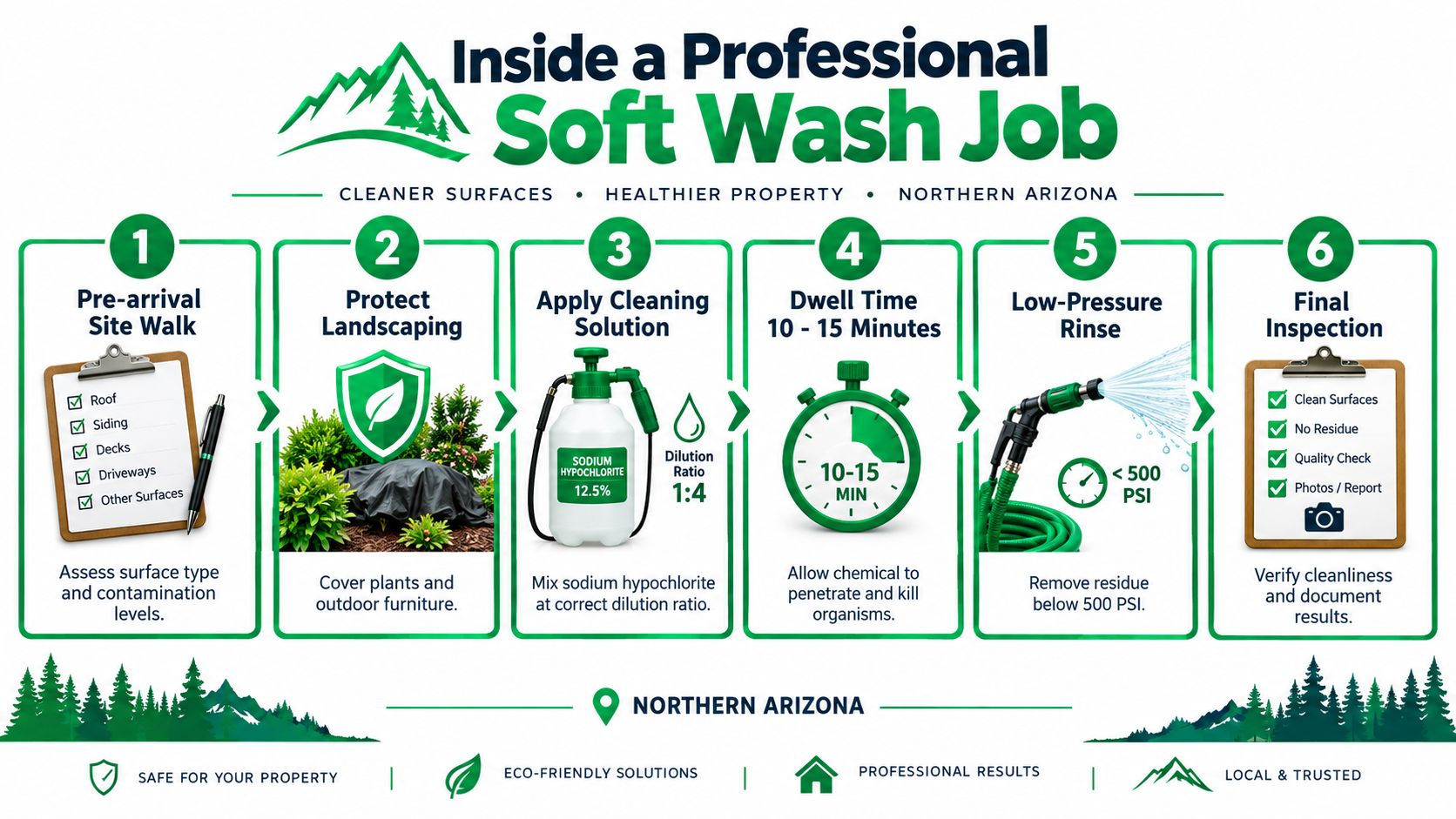
A reliable soft wash job follows an order. Skipping one phase can undermine the next, even if the final rinse looks clean.
The sequence that protects the property
- Pre-arrival site walk: The crew assesses surface type, contamination, height, access, wind, landscaping, and drainage routes.
- Protective preparation: Plants are pre-rinsed, sensitive items are moved or covered, and storm drains are identified.
- Mix and meter: The technician verifies the actual product concentration and adjusts the working solution to the surface.
- Controlled application: A dedicated low-pressure pump applies the solution without using a narrow, aggressive jet.
- Dwell and agitation: The solution works on the surface. A natural- or synthetic-bristle brush may assist stubborn areas where appropriate.
- Rinse and inspect: The crew removes residue with controlled water, checks runoff, handles screens, and walks the property with the owner.
Equipment choices depend on access. A low roofline may be reachable from the ground with extension equipment, while a commercial building, atrium, or steep section may require a boom lift, scissor lift, or atrium lift. The equipment isn't there to make the job look bigger. It keeps technicians positioned safely and helps them control application distance and overspray.
Window care follows its own sequence. Screens come out before glass cleaning, screens are cleaned separately, and they're reinstalled only after the work is complete and the screen material won't send dirty water across finished glass. Squeegees, extension poles, and pure-water brushes serve different parts of the process.
For deck surfaces and algae concerns, TimberSol Ltd's decking advice provides useful material-specific context. Deck boards, fasteners, coatings, and surrounding landscaping all influence how the cleaning should proceed.
A quality service leaves more than a clean wall. You should see protected plants, controlled overspray, a tidy rinse, attention to salt deposits, properly replaced screens, and a final discussion of areas that need repair rather than more cleaning. Soft washing is a process, not a product.
Why Low Pressure Does Not Mean Low Responsibility
A low-pressure application can still cause environmental damage. The pressure number says little about what happens when the solution reaches a plant, flows across a walkway, enters a storm drain, or collects at the property's low point.
Chemistry needs controls
Sodium hypochlorite strength varies by product, so technicians should read the label and calculate dilution rather than pour an assumed amount into a tank. Stronger solution increases the chance of vegetation injury, discoloration, corrosion, and worker exposure. Crews should use chemical-resistant gloves and splash goggles, avoid mixing hypochlorite with acids or ammonia, and test an inconspicuous area.
Plant protection starts before application. Pre-wetting vegetation can reduce contact with the working solution, while post-rinsing helps remove residue. Wind complicates the job, particularly on dry Flagstaff afternoons, because overspray can travel farther than expected.
Low pressure protects the substrate. It doesn't excuse poor chemical handling.
Runoff is part of the job plan
Fairfax County warns that pressure washing can dislodge oil, paint, sealants, debris, detergents, and other chemicals. Its pressure-washing pollution-prevention guidance recommends minimizing water volume, preventing runoff from entering storm drains, and using cleaners sparingly. Paint or concrete residue can also raise stream-water pH and harm aquatic life.
EPA guidance recommends capturing wastewater when cleaning waste could be generated, minimizing detergent use, and preventing contaminated water from entering storm-sewer systems. On a commercial property, that may mean mapping drains, blocking or covering inlets, controlling overspray, and routing collected water through an approved pathway.
Seattle stormwater guidance calls for polluted wash water to be isolated and conveyed to sanitary sewer, treatment, or a dead-end sump, depending on local requirements. Stanford maintenance guidance similarly says outdoor wash water shouldn't enter storm drains or soak into the ground. Local rules control the final disposal route, so a responsible crew should explain the plan before turning on the hose.
Ask for plain answers:
- What product is being used, and how is dilution calculated?
- Which plants, surfaces, and fixtures need protection?
- Where will wash water travel?
- How will nearby storm drains be isolated?
- What happens to collected wastewater?
- What protective equipment will technicians wear?
If the answer is only “the pressure is low,” the plan is incomplete.
Frequency, Pricing, and Flagstaff Climate Fit
Northern Arizona properties don't follow one cleaning calendar. Altitude, intense sun, pine pollen, monsoon dust, shade, occupancy, and freeze-thaw cycles all affect the timing. A cabin in Munds Park may need a different plan from a Pine Canyon second home, an NAU-area rental, a hotel, dealership, or retail storefront.
Short-term rental owners often schedule around turnover and guest access. Commercial managers may coordinate work with loading areas, tenant hours, landscaping, and public walkways. A property that sits vacant for part of the year may need inspection before the owner arrives, especially if winter weather has affected sealants, trim, or drainage.
A responsible quote considers:
- Surface mix: Wood, stucco, masonry, roofing, glass, and concrete require different methods.
- Access: Height, slope, lifts, ladders, and equipment staging affect labor.
- Soil load: Pollen, dust, organic growth, and staining change application needs.
- Property protection: Landscaping, drains, water features, and occupied areas add preparation.
- Service combination: Gutters, screens, exterior glass, and soft washing may be coordinated.
Pricing should follow the actual scope rather than a generic pressure-washing label. Bundling soft wash exterior cleaning with window and screen service can reduce duplicated setup and travel compared with booking separate visits. The window portion should still use professional tools, including squeegees, poles, pure-water brushes, screen removal, screen cleaning, and reinstallation.
Choosing the Right Crew for Your Property
Choose a crew that can explain the entire chain, from surface diagnosis and dilution to plant protection, storm-drain control, rinsing, and screen handling. A homeowner, cabin owner, hotel manager, NAU facility operator, dealership, or short-term rental host should receive a plan that reflects the property, not a one-size-fits-all pressure setting.
Pine Country Window Cleaning was started in Flagstaff in 1999 by Flagstaff native David Kaminski and identifies itself as Flagstaff's largest window-cleaning company. Its published approach distinguishes professional work from improvised household methods through the use of squeegees, extension poles, and pure-water brushes, with screens removed, cleaned, and reinstalled as part of the service. Those are useful benchmarks when comparing contractors.
For commercial properties, facility managers can also use these RFP tips for landscaping services to structure questions about scope, site protection, scheduling, and documentation. The same discipline applies when requesting an exterior cleaning proposal. Ask what will be soft-washed, what may be pressure-washed, how chemistry will be diluted, how plants and drains will be protected, and how screens will be handled. Review the available pressure-washing services only as part of a broader surface-by-surface plan.
Pine Country Window Cleaning provides soft washing, professional window cleaning, screen removal and cleaning, gutter care, and pressure washing for Flagstaff and Northern Arizona properties. Visit Pine Country Window Cleaning to request a service conversation built around your home, cabin, commercial site, or seasonal cleaning schedule.