

You look through the picture window after a Northern Arizona storm and wonder why the backyard seems permanently out of focus. The glass looked fine before the monsoon, but now it carries a milky film. A sprinkler may be reaching the lower pane, pine pollen may be clinging to the wet surface, or a cabin that sat closed through August may have collected several rounds of evaporation.
That haze usually isn't ordinary dirt. Mineral deposits on glass can be a loose surface film, alkaline construction residue, silica-rich buildup, or actual etching of the glass. Each problem calls for a different response, and reaching for the strongest acid or a razor blade first can turn a manageable cleaning job into permanent damage.
Why Your Northern Arizona Windows Look Cloudy After Every Monsoon
A Flagstaff homeowner may notice the problem the morning after the first major summer storm. Water has blown against the picture windows, sprinklers have run at dawn, and the cool night has slowed evaporation. By breakfast, the glass looks gray-white instead of clear. In Munds Park, the same pattern can affect a cabin that stays empty while humidity swings, pollen, and irrigation water repeatedly settle on the panes.

The first question isn't "What cleaner should I buy?" It's what is on, or in, the glass? A film that changes when wet may still be sitting on the surface. A haze that stays visible under water may indicate etching, alkaline damage, or another condition that ordinary window cleaning can't reverse.
Northern Arizona windows also face more than one source of residue. Hard well water can leave calcium and magnesium salts. Irrigation overspray creates repeated drying cycles. Monsoon moisture keeps deposits active longer, while pine pollen gives minerals and grime something to cling to. Construction runoff adds another concern, especially when cement or other alkaline materials reach new glazing.
A 2004 field-exposure study tested potash-lime-silica glasses at 26 locations across Europe and North America for 3 to 6 years and found weathering relationships involving temperature, relative humidity, nitrogen oxides, sulfur dioxide, and ozone. The crystalline products included gypsum, arcanite, and syngenite, which shows that environmental deposits aren't dust sitting on a pane. (The multi-site glass-weathering study documents that broader interaction between moisture, pollutants, and glass chemistry.)
Practical rule: Treat the window like a technician would. Look at the dry glass, wet a small test area, check the location of the spots, and only then decide whether cleaning, restoration, or replacement makes sense.
The rest of the diagnosis comes down to that sequence. The safest route may involve a squeegee, pure-water brush, and controlled chemical test. It may also mean leaving the surface alone until someone can identify the glass and the deposit.
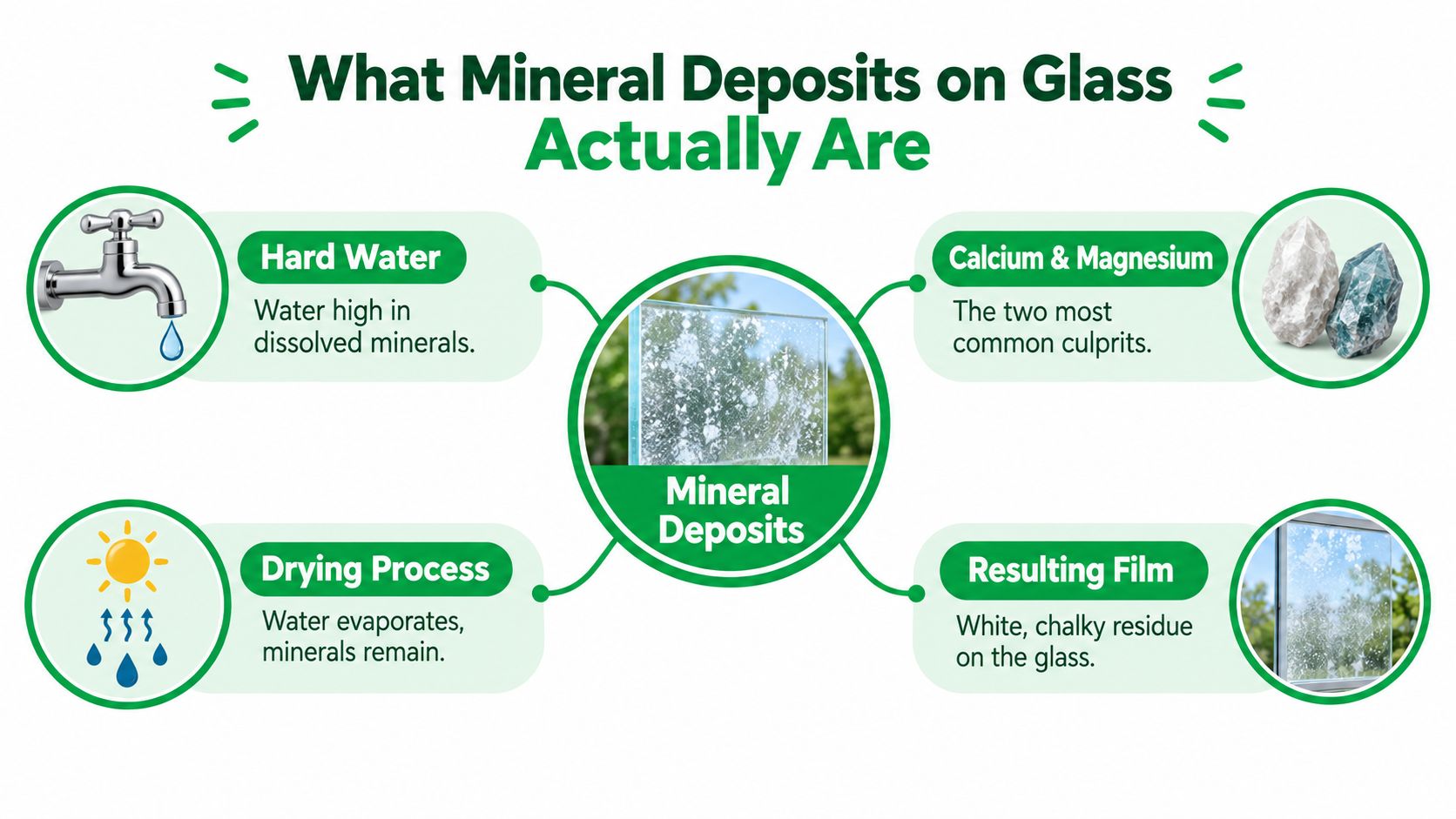
What Mineral Deposits on Glass Actually Are
Hard-water residue is the familiar starting point. Water carrying dissolved calcium and magnesium reaches the pane, spreads into a thin layer, and evaporates. The water leaves, but the minerals remain as a chalky, white, or milky film. Because some calcium and magnesium compounds don't dissolve readily in plain water, another rinse can leave the window looking clean for a moment and then cloudy again when the rinse dries.
Silica creates a different kind of problem. A municipal technical review of white spotting found that deposits consisted largely of silica, along with smaller quantities of calcium carbonate and other minerals. The review describes formation through amorphous silica precipitation, metal silicate precipitation, and silica co-precipitating with metal salts. (The silica white-spotting review explains why a stubborn film may not behave like ordinary calcium scale.)
A useful way to picture the surface
Think of a painted wall. Most dust rests on top and wipes away. A splatter may stick more firmly and require a solvent. A chemical burn changes the paint underneath, so wiping harder won't restore the original finish.
Glass has a similar range of conditions:
- Loose residue sits on the surface and may respond to water, soap, or gentle chemical treatment.
- Mineral scale adheres more strongly as water dries repeatedly, often near sprinkler arcs, downspouts, shower doors, and wash areas.
- Reaction products can form when moisture, pollutants, and glass components interact.
- Etching changes the glass surface itself, so removal isn't the same as cleaning.
A glass-weathering process called dealkalinization helps explain the last category. Hydrogen ions from water can exchange with alkaline ions such as sodium and potassium in the glass. With more advanced degradation, alkaline-earth ions can also leach out, and new deposits may develop over the altered layer. That doesn't mean every white spot represents glass corrosion, but it does mean prolonged moisture exposure can become a substrate problem rather than a housekeeping problem.
The deposit's appearance matters, but its behavior matters more. A technician needs to know whether the haze lifts, dissolves, scratches, or remains after the surface is wet.
That distinction is especially important on older windows, shower glass, commercial façades, and panes exposed to years of irrigation. A contractor who calls everything “hard-water spots” may miss alkaline residue or permanent damage. A contractor who calls every haze “etched glass” may recommend replacement when careful cleaning would have worked.
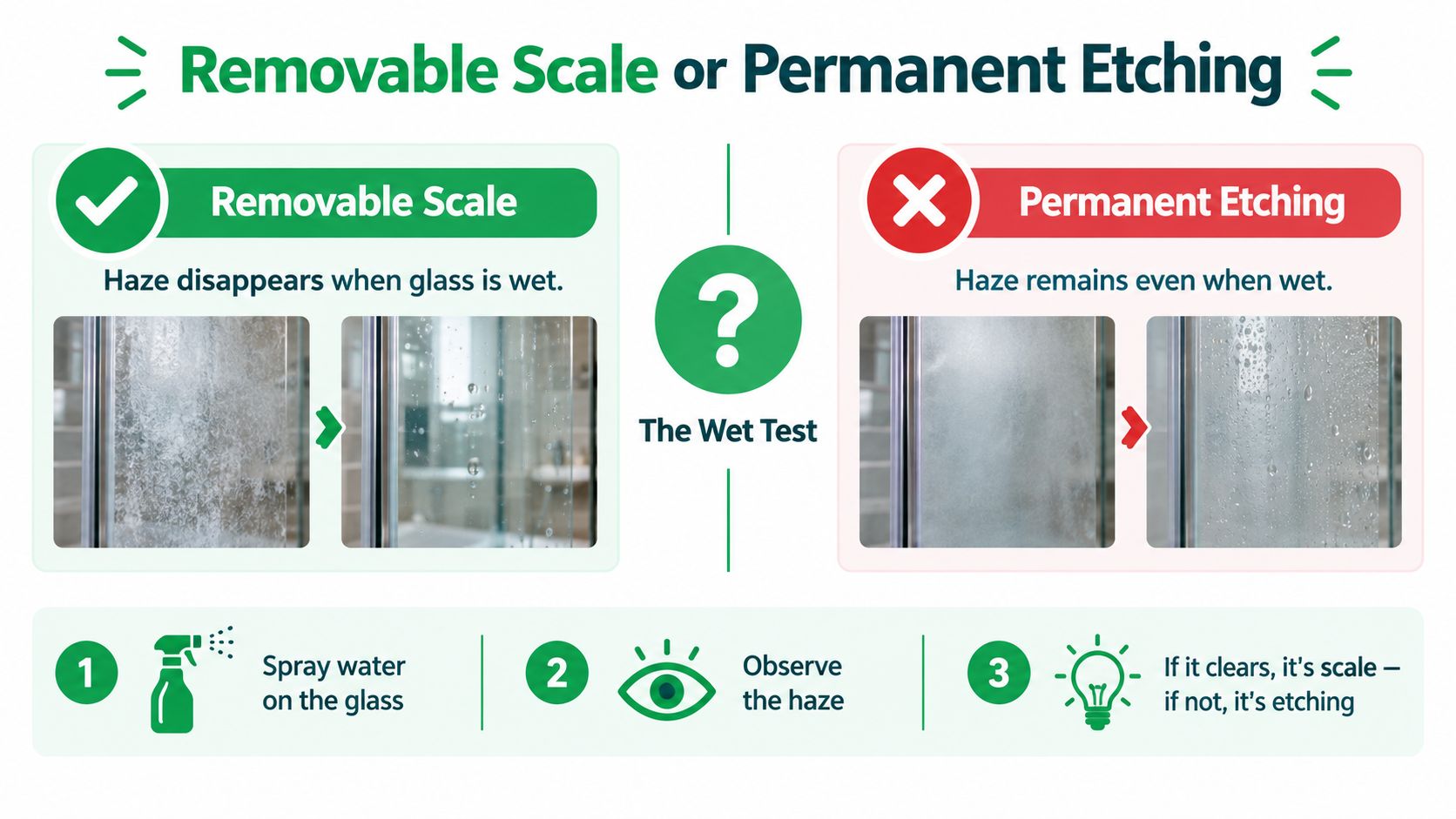
Removable Scale or Permanent Etching
The most useful homeowner test is simple. Wet a small, clean section of glass and compare it with the dry area beside it.
If the haze changes substantially or disappears while wet, the material is likely sitting on the surface. That doesn't guarantee easy removal, but it suggests that a controlled cleaning approach may improve the pane. If the haze remains visible when fully wet, the glass may be etched, chemically altered, or affected by a problem that isn't on the exterior surface at all.
Four clues before you treat the pane
Location gives you a history. Deposits concentrated beneath sprinklers, beside downspouts, or around a shower's splash zone point toward repeated water exposure. A broad haze near construction work may indicate cement or alkaline residue. A uniform cloudiness between panes suggests a different window condition and shouldn't be treated like exterior scale.
Texture adds another clue. A rough-feeling surface may carry adhered deposits, but don't drag a fingernail, blade, or abrasive pad across it to find out. Coated shower glass and delicate finishes can be damaged by an exploratory scratch.
Age changes the risk. Glass that has endured years of wetting, drying, heat, and cleaning has had more opportunity to develop strongly bonded deposits or surface alteration. That history matters even when the window looks as though it only became cloudy recently.
Chemistry can be the culprit. Research on glass degradation reports that alkaline contact above approximately pH 9 favors dissolution of the silica network. Separate work on high-disilicate automatic dishwashing detergents found serious clouding and iridescence after 50 wash cycles. (The glass-degradation discussion shows why the wrong alkaline product can create damage that homeowners later blame on hard water.)
A useful comparison is a glossy countertop. Lemon juice may leave a removable stain or residue. Oven cleaner can chemically burn the finish. Scrubbing the burned area harder doesn't restore the gloss, and a more aggressive product may expand the damage. Glass behaves similarly when etching has replaced a simple deposit.
What the wet test can't prove
A wet test is a screening tool, not a laboratory diagnosis. A heavy deposit may still look cloudy when wet, and a subtle etched surface may seem better because water temporarily fills microscopic irregularities. Insulated windows can also develop haze between panes after seal failure, which no exterior chemical will remove.
That is why a professional assessment starts with a small test patch and a clear explanation of the likely result. The goal isn't to use the strongest treatment. It's to identify the least aggressive method that can remove the actual soil without sacrificing the glass.
DIY Removal Methods Ranked From Safest to Strongest
Start with the method least likely to damage an unknown surface. Work on a small area, keep the surrounding materials protected, and stop if the glass changes appearance.
The measured ladder
Warm water, mild dish soap, and a clean microfiber. This is appropriate for loose pollen, ordinary grime, and a light film. It won't dissolve established mineral scale, but it helps remove surface contamination before a more specific test.
White vinegar. A mild acid can help with early calcium-based residue. Apply it carefully rather than flooding nearby stone, metal finishes, or sealants. Rinse the test area thoroughly and inspect it after drying.
Citric acid. This can be useful when vinegar doesn't do enough, but concentration, dwell time, and surrounding materials matter. Use a small test patch and don't assume a food-grade acid is harmless to every coating or frame.
Commercial mineral removers. Select a product made for glass and verify whether the pane has a protective coating. Follow the label, ventilate the area, protect adjacent surfaces, and test before treating the whole window.
Oxalic acid or cerium oxide. These belong at the specialist end of the scale. They can involve chemical or mechanical action that affects the substrate, so they aren't sensible first choices for unknown residential glass.
The hard-water removal tips from Water Filter Advisor can help with general mineral-residue thinking, but sink materials and window glass aren't interchangeable. A product that works on one surface may damage a coating, frame, seal, or stone surround.
| Method | Best For | Typical Time | Risk Level |
|---|---|---|---|
| Warm water, mild soap, microfiber | Loose grime and pollen | Short | Low |
| White vinegar | Early mineral residue | Moderate | Low to moderate |
| Citric acid | More persistent scale after testing | Moderate | Moderate |
| Glass-safe commercial remover | Established deposits with known glass condition | Moderate to longer | Moderate to high |
| Oxalic acid or cerium oxide | Serious deposits handled with specialist control | Longer | High |
Rinse like the final step matters
Vitro's architectural guidance recommends choosing acid treatment according to the deposit and the glass condition, not assuming that acid is universally safe. It also emphasizes rinsing with demineralized water before drying because residual salts can remain on the surface and undo the cleaning. (Vitro's technical guidance explains that clean-water rinsing is part of the treatment, not an optional finish.)
For a homeowner, that means don't let the cleaned solution evaporate in place. Use a controlled rinse, remove the water with a squeegee, and inspect the dry glass under natural light. Filtered or demineralized water is especially useful where local water leaves its own mineral load.
Skip razor blades on unknown glass, magic erasers on coated panes, abrasive pads, and alkaline cleaners above pH 9 unless the glass and product instructions specifically support them. A blade can catch a particle and score the surface. An abrasive can create a haze that looks like the original deposit. Strong chemistry can remove scale while worsening etched glass.
For a local assessment of stubborn buildup, see Pine Country Window Cleaning's mineral deposit removal service. The practical advantage of a professional test is knowing when to stop, not just having access to stronger chemicals.
When a Professional Crew Earns the Invoice
DIY makes sense for a small, reachable pane with a light film and a clear diagnosis. The calculation changes when the deposits cover many windows, sit above a sloping yard, or have returned after several cleaning attempts.
A crew brings the equipment and process needed to separate routine cleaning from restoration. That can include squeegees, ladders, water-fed poles, and pure-water brushes. Tall atriums and commercial façades may require boom lifts, scissor lifts, or a 95-foot atrium lift, equipment that keeps the work planned instead of improvised.

The real trade-offs
Time: A homeowner may spend a weekend testing products, moving furniture, rinsing panes, and discovering that the haze is etched. A trained technician can usually identify the likely category quickly and focus effort where cleaning can help.
Risk: Reaching a second-story picture window from a sloped lot is not the same as cleaning a kitchen pane. Roof edges, wet decks, ladders, and chemical handling add hazards that don't disappear because the job is residential.
Results: Pure-water systems remove dissolved contaminants from the rinse water, reducing the chance that the cleaning itself leaves a fresh mineral film. They don't reverse etched glass, but they provide a cleaner baseline for judging what remains.
Property care: Screens, frames, sills, deck furniture, flower beds, and pets all need consideration. A responsible crew protects the work area and communicates before moving equipment or using a chemical treatment.
OSHA identifies ANSI/IWCA 1-14.1 as a consensus standard addressing window-cleaning safety and access equipment. OSHA also requires personal fall-arrest systems to be rigged so a worker cannot free-fall more than 6 feet, which is why high-access work should be planned around fall protection rather than treated as ordinary cleaning. (OSHA's fall-protection guidance provides the safety framework.)
A Flagstaff cabin with mineral buildup on upper picture windows is a good example. If the crew can reach the panes with poles or a lift, the owner avoids repeated ladder setup and gets a clearer answer about whether the remaining haze is removable. On an NAU-area commercial property, a planned access system also reduces disruption compared with having staff improvise around entrances and walkways.
What Professional Service Actually Looks Like
A well-run visit begins before anyone touches the glass. The crew confirms access points, discusses fragile items, and notes irrigation, construction residue, coated glass, or areas where a test patch is appropriate. Screens are removed carefully, kept organized, and cleaned rather than left to shed dust back onto freshly washed windows.
Glass work then follows a controlled sequence. Technicians brush or scrub the pane with pure water or an appropriate solution, squeegee manageable sections, and detail the edges. Frames, tracks, and sills receive attention because a clean pane won't stay clean if dirty water continues to migrate from the surrounding assembly.
Safety that protects the property too
OSHA ladder guidance requires portable ladders to support at least four times the maximum intended load, with non-self-supporting ladders positioned so the base sits about one-quarter of the working length from the upper support. Rungs must be level and spaced 10 to 14 inches apart, and the areas around the top and bottom need to stay clear. (OSHA's ladder-safety guidance explains why a professional setup can look slower at first but creates a safer work zone.)
Those details affect the homeowner's property. A deliberate setup helps protect flower beds, deck furniture, siding, pets, and people walking through the area. For taller work, poles and lifts can keep technicians off fragile roofs and reduce the need to lean ladders against finished surfaces.
Screens should be part of the service, not an afterthought. Pine Country Window Cleaning removes, cleans, and reinstalls screens with every service, which gives technicians a chance to inspect the window assembly and prevents loose pollen and debris from immediately returning to the glass.
A homeowner who wants broader property-maintenance context can review this complete car detailing overview for a useful reminder that professional exterior care involves preparation, surface-specific methods, and finishing checks. The same principle applies to windows: the visible pane is only one part of the job.
For local service details, professional window cleaners in Flagstaff should be able to explain the access plan, glass condition, screen handling, and expected result before work begins. A free estimate, responsive communication, and a 100 percent satisfaction guarantee give the customer a clearer standard than a vague promise that every haze will disappear.
Preventing Mineral Deposits in Northern Arizona Conditions
Prevention starts with the water source. Aim sprinklers away from glass, use drip lines near windows where practical, and avoid late-evening watering that leaves panes damp through cool nights. If a sprinkler arc repeatedly reaches the same lower sash, no cleaning product will solve the pattern for long.
After a monsoon storm, remove loose pollen and residue before it dries into a bonded film. A clean-water rinse followed by a squeegee is safer than rubbing grit across the pane. Shower glass benefits from the same habit, because water left to evaporate carries minerals into the next layer of buildup.
Match the routine to the property
- Homeowners: Inspect exposed windows after storms and address sprinkler overspray before spotting becomes widespread.
- Short-term rental hosts: Check picture windows and shower glass monthly, especially before guest turnover. A clean pane supports the whole presentation of the property.
- Cabin owners: Schedule an inspection after long periods of vacancy and again before heavy seasonal use. Closed windows can collect residue unnoticed.
- Facility managers: Track irrigation, wash-down areas, construction activity, and access needs instead of waiting for every pane to show the same level of haze.
Screens belong in that routine. A Los Angeles County public-health cleaning guide recommends washing screens with soapy water, rinsing them thoroughly, drying them, and reinstalling them. (The screen-cleaning guidance supports a clean, rinse, dry, reinstall sequence that keeps damp debris from cycling back onto the window.)
Pine Country Window Cleaning includes screen removal, cleaning, and reinstallation with every service. That small step matters in Flagstaff and Munds Park, where pollen and dust can sit against a wet screen and transfer back to the glass.
For a property-specific schedule, use this guide to how often windows should be cleaned. The right interval depends on exposure, access, water sources, and whether the property is occupied continuously or only during selected seasons.
When to Call Pine Country Window Cleaning
Don't keep scrubbing just because the glass still looks cloudy. A small panel that responds to vinegar may be a reasonable DIY project, while widespread haze, multi-story access, post-construction residue, or suspected etching calls for an assessment. Pine Country Window Cleaning has served Northern Arizona since 1999, was started by Flagstaff native David Kaminski, and handles homes, cabins, campuses, dealerships, medical buildings, hotels, and high-rise properties with trained crews, lifts, gutter cleaning, pressure washing, post-construction cleaning, seasonal snow removal, and a 100 percent satisfaction guarantee.
Pine Country Window Cleaning can evaluate mineral deposits on glass, clean screens, use pure-water tools, and plan safe access for Flagstaff and Munds Park homes or commercial properties. Request a free estimate, schedule before the next monsoon, and visit Pine Country Window Cleaning to put the ladders, screens, and chemistry in experienced local hands.