
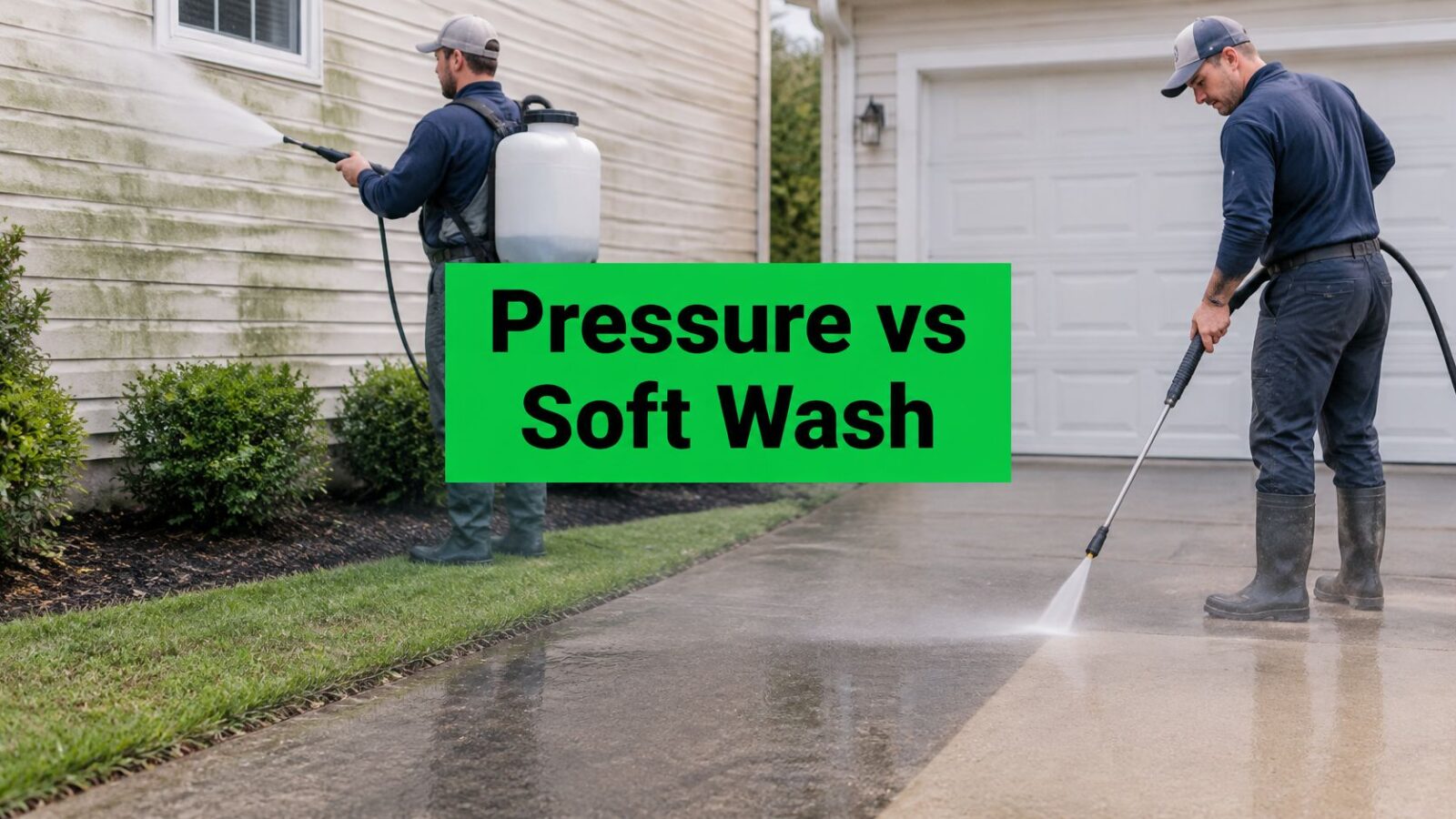
Most advice about pressure washing vs soft washing comes down to a single dial. Turn the pressure down for the delicate stuff, the reasoning goes, and any machine becomes a safe machine.
That advice mistakes a setting for a method. Real soft washing isn't a pressure washer on its lowest notch. A detergent or biocide goes on at low pressure, sits on the surface long enough to kill and loosen the growth, and then gets rinsed away. The nozzle on the end of the wand isn't what makes it soft. The chemistry and the dwell time are.
The distinction that decides the job: soft washing is a chemical process with a rinse, not a pressure setting with a lower number on it.
The same shortcut runs through the safety advice. Low pressure gets presented as the safe choice, as if the pump were the only hazard on the truck. Soft-wash mix drifts onto landscaping, cars and open windows. It leaves a walkway slick enough to drop someone. It stings skin and eyes. High pressure brings a different set of problems, and at height most of them come down to the operator's footing.
So the useful comparison isn't a PSI contest. It's four decisions: what the substrate can survive, whether chemistry can do the work without force, where the dirty water goes when it leaves the surface, and who is standing on the ladder when the hose kicks. Get those right and the method picks itself. Get them wrong and the stain returns next season, the paint peels, or the runoff finds a storm drain.
Working at 7,000 feet adds one more variable. Porous material that soaks up rinse water holds that moisture, and the first hard freeze of the year turns it into spalling and cracked mortar. That's a Flagstaff detail, but the reasoning behind it travels.
Pressure Washing vs Soft Washing at a Glance
Pressure washing and soft washing aren't two strengths of the same tool. One removes contamination with mechanical impact, the other with chemistry and time. Their failure modes differ, their hazards differ, and plenty of properties need both methods on the same visit.
The short answer before the detail: soft washing for siding, roofs, painted surfaces and anything growing algae or mildew; pressure washing for sound concrete, brick and durable hardscape that can take the impact without giving up material.
| Criterion | Pressure Washing | Soft Washing |
|---|---|---|
| How it cleans | High-pressure water blasts deposits off the surface | Low-pressure detergent or biocide is applied, left to dwell, then rinsed |
| Best for | Sound concrete, brick, durable hardscape | Siding, roofs, painted surfaces, algae and mildew |
| Typical pressure | High, with tip size and stand-off set by the substrate | Low, delivered as a chemical spray and rinsed without impact |
| Main damage risk | Etching, stripped coatings, water forced behind siding | Chemical injury to plants if they aren't protected |
| Chemical use | Little or none | Detergents and biocides at controlled dilution |
| Wastewater concern | Higher water volume and sediment | Chemical-laden runoff |
| Typical price | Priced by the square foot on flatwork, by the job on a house wash | Quoted per job |
| Worker fall risk | Hose recoil and sudden pressure changes at height | Slippery walkways and chemical exposure |
In one line: if the surface is coated or alive with growth, use chemistry; if it's dense, mineral and stained with oil or tire marks, use force.
Read the table from the top. The first rows explain how each method does the work, the middle rows show where each one goes wrong on a real building, and the bottom rows cover price and runoff, which usually decide a commercial job once the surface question is settled.
Pricing follows the same split. Pressure washing is normally quoted by the square foot on flatwork and by the job on a house wash, while soft washing is quoted per job, because the cost sits in the chemical mix, the protection of landscaping and the dwell time the product needs. A per-square-foot bid and a per-job bid tell you nothing sitting side by side. Put both quotes in a line-by-line comparison by method.
If you already know what your walls and your driveway are made of, the surface-by-surface guide further down answers your question faster than this table does.
How Each Method Actually Removes Grime
It helps to see the two mechanisms before the mixing ratios and the nozzle charts.
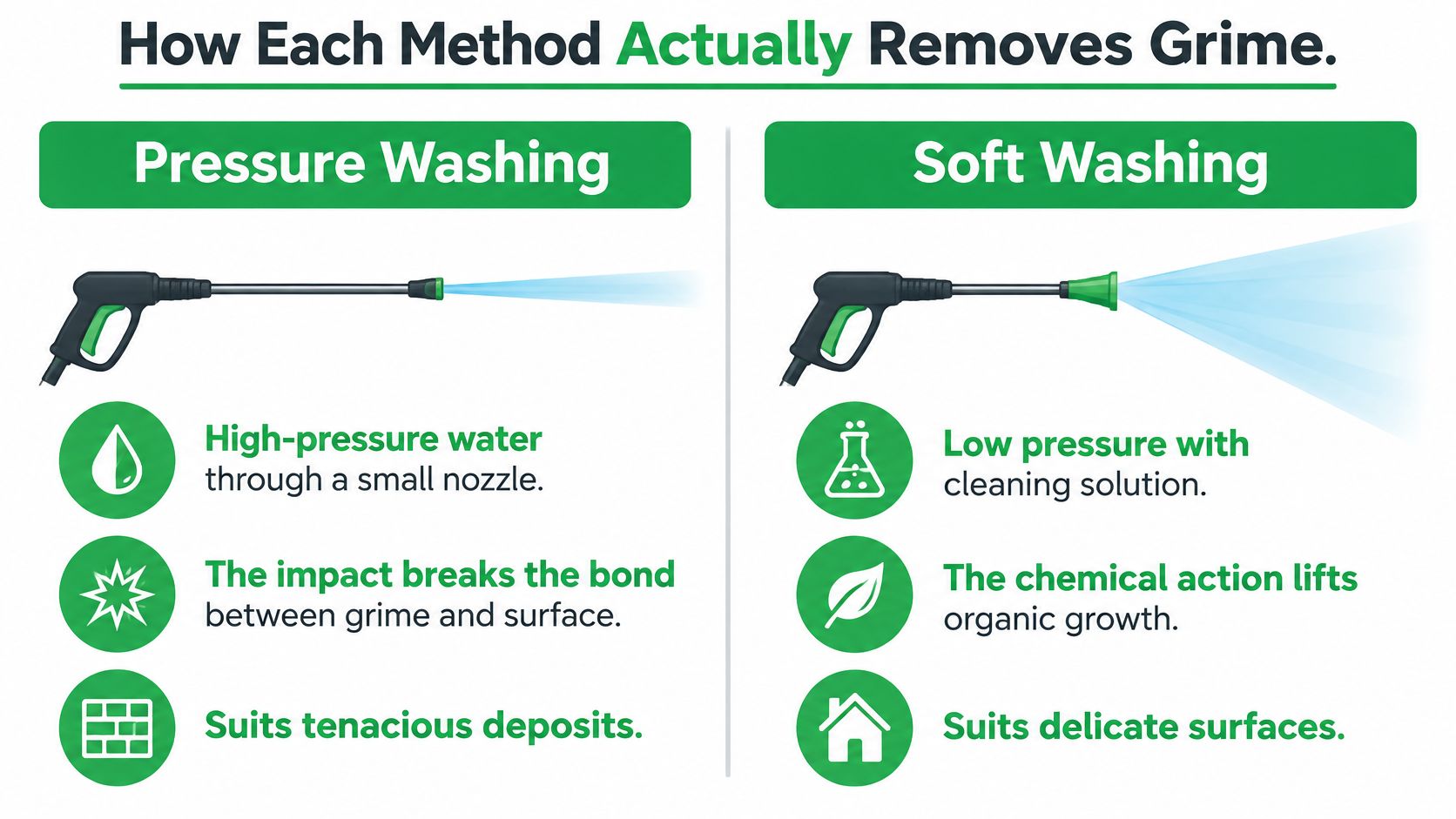
Pressure washing concentrates mechanical force through a small orifice. The impact itself breaks the bond between grime and the material underneath, which is why it earns its place on tenacious deposits: oil baked into sound concrete, mineral staining on masonry, gum on a sidewalk. The EPA guidance on exterior cleaning and washwater frames the variable correctly. There's no universal PSI threshold that separates safe from unsafe. What matters is the relationship between impact energy, substrate strength, coating condition and dwell time.
Soft washing moves the work to chemistry. A detergent or biocide goes on at low pressure and breaks down algae, mildew or lichen while it sits. The rinse exists to carry away what the chemical already loosened, not to blast it off. For painted trim, stucco, roofing and wood siding, that means soft washing the exterior surfaces rather than turning a pressure washer down and calling it gentle.
The specification a careful operator writes down
The difference between a professional pass and an expensive experiment is documentation. A written spec for each surface covers:
- Nozzle type. A wide fan at a distance behaves nothing like a narrow pencil tip held close, even at the same machine setting.
- Stand-off distance. The gap between tip and surface controls impact more than the pump does.
- Rinse pressure. Enough to move loosened residue, not enough to drive water into a joint.
- Chemical concentration and dwell time. Weak mix with long dwell protects the material; strong mix sprayed and immediately rinsed wastes product and kills nothing.
- A test patch. One hidden corner, checked after it dries, before anyone commits to the whole wall.
The question isn't how hard the water hits. It's whether the chemistry can sit on the surface long enough to do the work without force.
Green algae on vinyl siding shows the fork in the road clearly. A close, high-pressure pass cuts a visible stripe through the growth and etches the panel at the same time, and it pushes water behind a lap that has no way to drain. The growth looks gone for a few weeks. A soft wash kills it, rinses it off, and the panel comes back uniform because nothing was abraded. The same logic applies to fiber-cement, painted wood and any surface with a coating you intend to keep.
Here's the same decision walked through in practice.
How to tell the method worked
Judge the result a day later, not while the surface is still wet. The stain should be gone after the dwell time rather than merely faded, and the wall should dry evenly with no streaks or fresh tide lines where rinse water pooled. Most important, the test patch should match the surrounding material. If the patch is brighter, duller or slightly textured compared with the rest of the wall, the pass was too aggressive and the rest of the surface shouldn't get the same treatment.
Matching Surfaces and Properties to the Right Method
Start with a rule you can apply without a gauge: durable, nonfriable surfaces tolerate pressure, while anything coated, fibrous, aged or sealed needs the low-pressure route. Friable means the material gives up particles under a fingernail. If it does, it will give up particles under a wand.
| Surface | Pressure Washing | Soft Washing | Main Reason |
|---|---|---|---|
| Concrete driveway or sidewalk | Suitable | Suitable for algae | Dense, nonfriable; pressure lifts oil and tire marks |
| Brick or stone masonry | Low setting only | Suitable | Aged mortar can erode under force |
| Vinyl siding | Avoid high pressure | Preferred | Pressure can drive water behind panels |
| Painted wood or fiber-cement siding | Avoid | Preferred | Force strips paint and damages fibers |
| Asphalt shingle roof | Avoid | Preferred | Granules loosen and shorten roof life |
| Wood deck or fence | Low setting only | Suitable | Force raises fibers and grain |
| Stucco | Avoid | Preferred | Force can erode the finish |
| Painted or sealed metal | Avoid | Suitable | Force strips coatings |
| Glass windows and frames | Not recommended | Gentle brush or pure-water pole | Glass and frames need gentle contact |
Two rows deserve a longer look than a table cell allows. Vinyl siding is the classic mistake because it looks tough and isn't: a fan tip held at the wrong angle lifts the lap and injects water into the wall cavity, and the damage shows up months later as a soft spot or a paint blister indoors. Our crews treat pressure washing vinyl siding as a low-pressure job with a chemical assist, not a blasting job. Stucco is the other one. It's porous, so force both erodes the finish and pushes moisture into the assembly, where it stays.
Glass gets its own answer. Windows take a soft brush or a pure-water pole rather than a pressure tip, and we filter the water to strip contaminants and minerals before it reaches the glass, then deliver it through a pole fitted with a soft brush.
Property types change the mix
A single-family home usually needs the whole board. Roofs and siding want the chemical process; driveways, sidewalks and garage floors want pressure. Cabins in the ponderosa belt lean harder toward soft washing, because pine needle staining and the organic film that grows on shaded north walls respond to chemistry and barely budge under force. That shaded wall is also the one most likely to stay damp, which is where the freeze risk lives.
Commercial properties shift the balance again. Hotels, medical buildings and a campus like NAU need low-drift methods and off-hours scheduling, because the constraint is the people thirty feet away rather than the concrete. Dealerships and retail lots can take pressure on asphalt and hardscape, provided someone captures the runoff. Our pressure washing covers driveways, sidewalks, garages, roof shingles, roof eaves and siding, and the method and setting on each of those are chosen by the material rather than by habit.
Avoid saturating porous surfaces late in the season. A wall that holds rinse water into the first hard freeze is a wall that spalls. In the high country, that argues for cleaning earlier in the year or for using a mix and a rinse volume that leave the substrate drier.
For price context, contractor-network data covering more than 1,200 verified jobs, published by HomeFixx, puts typical pressure washing at $0.15 to $0.75 per square foot, with standard house washes running $250 to $650. Read those as a sanity check on a written quote, not as a substitute for one.
Most properties don't choose a side. They split the job by surface, and the estimate should show that split line by line.
Safety Risks for Workers, Occupants and Plants
Soft washing is the safer method. That's true for the siding and false for the person applying it, the plants below the eave, and anyone who walks across the wet walkway afterward.
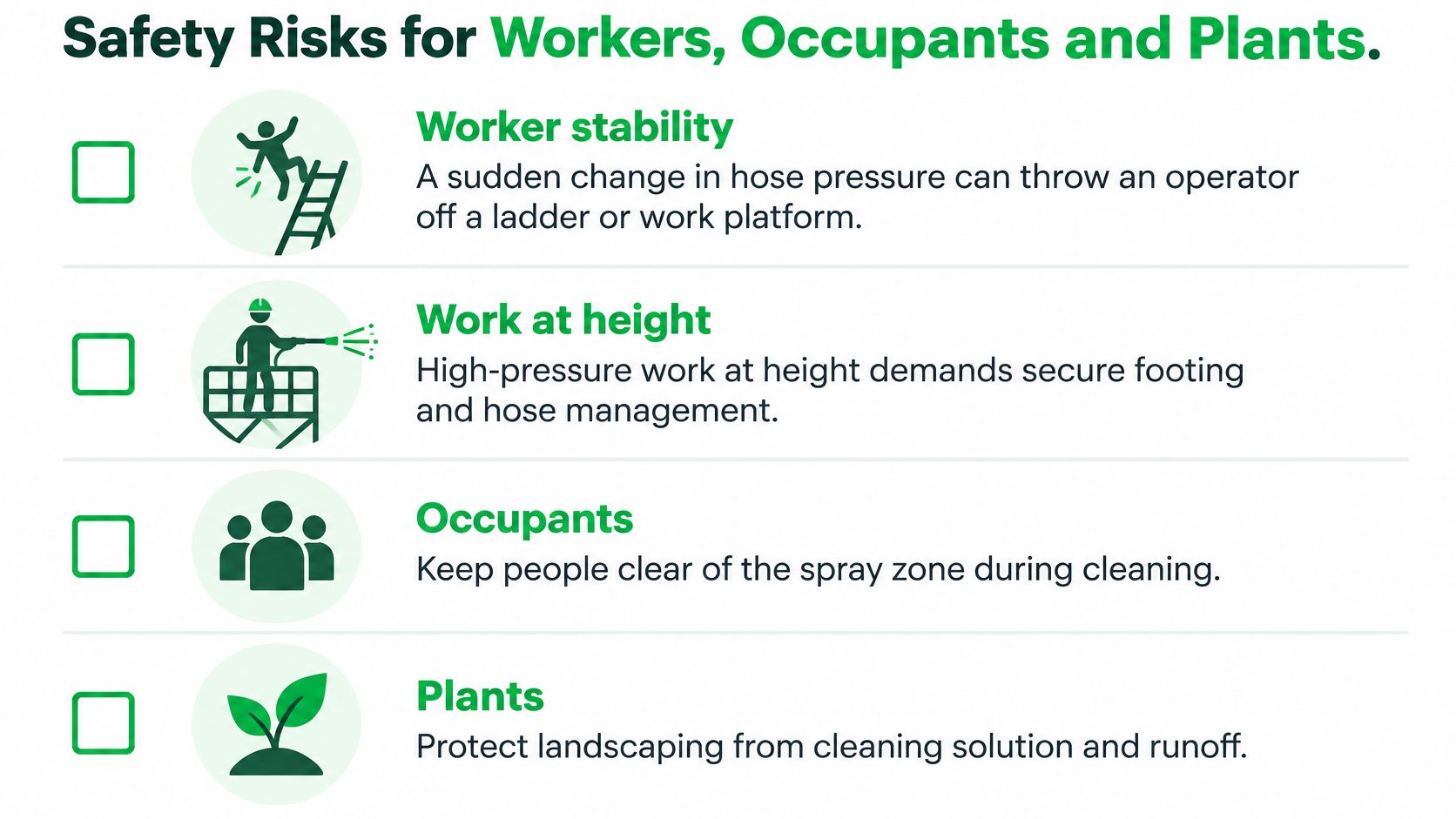
Start with the operator. High-pressure equipment can destabilize the person holding it: OSHA's surface preparation safety guidance notes that a sudden change in hose pressure can throw a worker from a work surface, which makes fall protection and a stable stance part of the method choice, not an afterthought. The hazard record bears that out. OSHA's accident search database returns 54 recorded incidents matching "Pressure Wash," including fatal falls, electrocution, suspected carbon monoxide poisoning from gas-powered equipment, and chemical burns. Those records don't give an injury rate per job. They do map the ways this work goes wrong.
Soft washing swaps one exposure for another. The chemical is the hazard: skin and eye contact, inhalation in a confined breezeway, detergent-slick concrete, and drift onto landscaping, parked cars and pets. Low pressure doesn't remove any of that.
Worth repeating: a low-pressure pump doesn't make the mix harmless, and a strong mix doesn't make a ladder safe.
A five-point check before the first drop of water
- Clear the zone. Move occupants, pets, grills and planters out of the spray path and off the walkway that will get wet.
- Read the wind before the mix. Direction and speed decide whether chemical lands on the wall or on the neighbor's car. If it's gusting, reschedule.
- Pre-wet and cover what grows. Soak plants with plain water first, cover sensitive metals and glass, and rinse the beds again when the work is done.
- Confirm the access setup. Ladder angle and footing, lift placement, harness and tie-off, and a second person where the site calls for one.
- Respect the electrical. Keep the spray clear of service drops, meters, exterior outlets and fixture boxes.
On a hotel, a medical building or a campus, these aren't housekeeping details. Occupants are close to the work, schedules are fixed, and a drift complaint travels faster than any cleaning result. That's why method selection there starts with access and drift, then moves to the surface.
Wastewater, Runoff and Local Rules
Water leaves the property whether or not anyone planned for it, and that's where the regulatory line sits. It isn't drawn at a pressure number.
Ohio EPA's power washing fact sheet classifies wastewater generated by power washing as industrial wastewater, and states that discharging it to waters of the state, including ditches and storm sewers, may require authorization under the Clean Water Act, with direct discharge to a creek or river requiring an NPDES permit. Indiana's environmental agency makes the same point from the other direction: wash water travels streets, curbs, gutters, inlets and open channels to waters of the state, and operators shouldn't assume a storm sewer connection is authorized. The practical translation is that a curb inlet is a pipe to the river, not a drain.
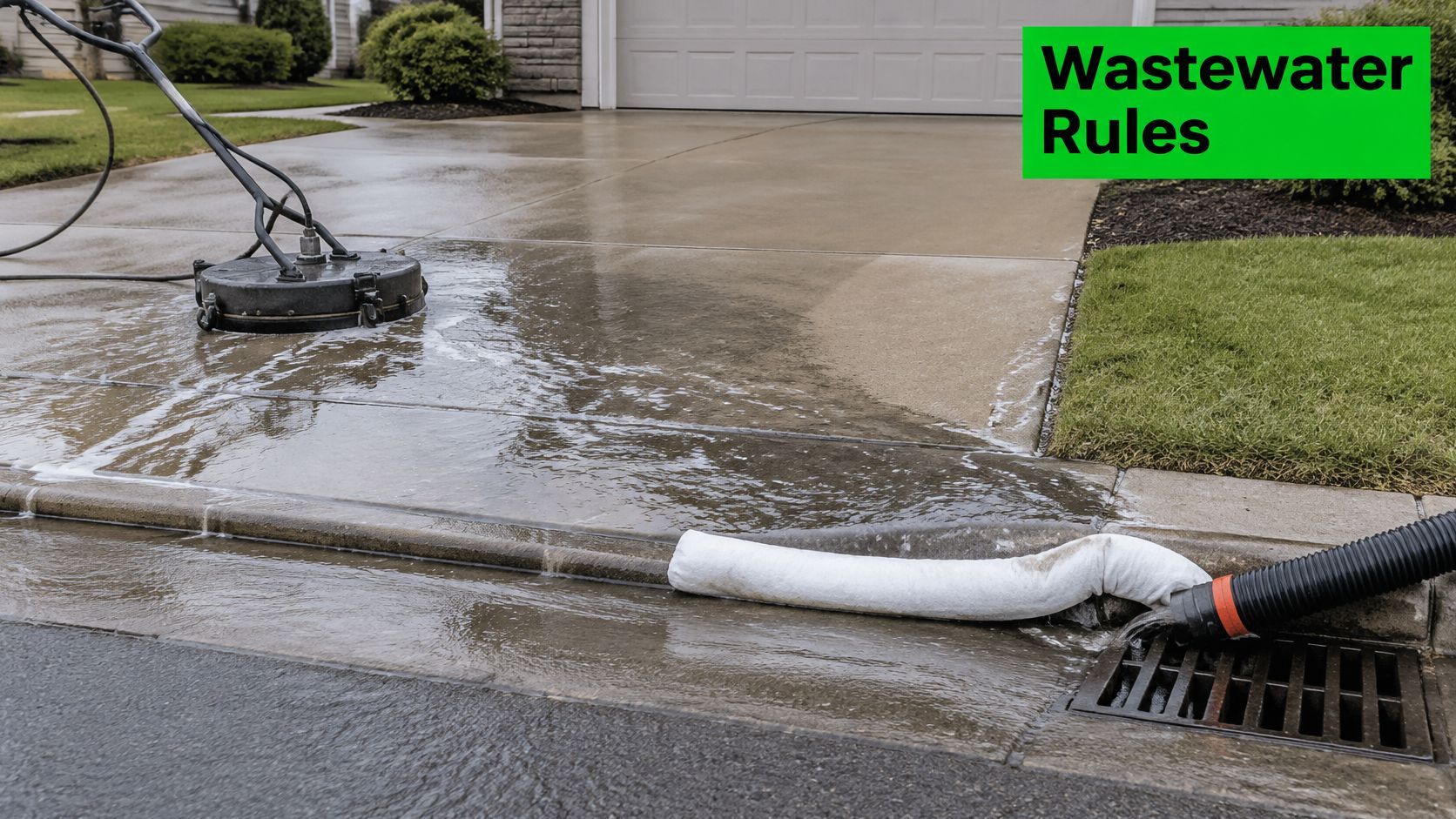
The volume argument surprises people. A pressure washer runs at roughly 2 to 3 gallons per minute, against about 8 gallons per minute for a garden hose, according to RapidEye Inspections' pressure washing cost statistics. So the concern was never flow rate. It's total washwater and what's suspended in it. Pressure washing lifts more sediment and grime per pass. Soft washing uses less mechanical force but still puts detergent, biocide, surfactant and loosened organic growth into the runoff. Both methods carry the same obligation: contain, divert, recover, dispose.
Take a sloped driveway with a soap mix running toward a curb inlet at the low corner. A containment berm, a vacuum recovery unit or a drain sock at the inlet keeps that water out of the storm system and puts it in a tank for the sanitary sewer where permitted, for treatment, or for a licensed disposal service.
Three questions worth asking in writing
- Where does the wash water go? The answer should name a destination, not a drain.
- Which products, at what dilution? Product name and mix strength tell you what's landing on the beds.
- How are nearby drains and landscaping protected? Berms, socks, pre-wetting and covers are the concrete answers.
Local stormwater and sewer rules vary by city, so confirm the requirement with your local authority before a large flatwork job. Our pressure washing services are scheduled with that containment step built into the job rather than added after a complaint.
Confirm the Method Before You Book
A short routine at the estimate stage removes most of the risk from this decision. Work through it before anyone schedules a wash day.
- Walk the property and list every surface by material. Siding, roof, deck, driveway, walks, garage floor, fence. The list is the scope.
- Ask for the method on each line. Pressure or soft wash, plus the reason. A quote that just says "house wash" hides the choice.
- Request a test patch on a hidden area. Check it after it dries, not while it's wet.
- Get the runoff plan in writing. Where the water goes, what's in it, and how drains and beds are protected.
- Confirm training and access equipment. Who's coming, what they're trained on, and what they'll be standing on.
That last point matters more as the building gets taller. OSHA's interpretation on window cleaning access notes that rope-descent systems for exterior cleaning generally shouldn't be used above 300 feet unless another access method is infeasible or creates a greater hazard, and it points to ANSI/IWCA 1-14.1, Window Cleaning Safety, as the industry guideline covering suspension scaffolds and powered platforms. Ask whether the provider follows that guideline for high-rise work and whether the answer is documented.
When you call Pine Country Window Cleaning, a staff member comes out to look at the home, building or project, and the estimate is free when you schedule. Book online or by phone at (928) 527-0671. For window service we remove each screen, clean it and reinstall it in its original opening, so dust and pollen don't stay in the frames after the glass is clean. Our technicians are background-checked and OSHA safety-trained, and they pick squeegees, ladders, poles or pure-water brush systems according to the access on the day, not according to what's easiest to unload.
Pine Country Window Cleaning has served Northern Arizona since 1999 and backs the work with a 100% satisfaction guarantee. Approve the scope when the surfaces, the drains and the safety plan are all on paper, and not before.
Windows, siding, roofs and flatwork on the same property rarely want the same treatment, and matching the method to each surface is the work we do across Flagstaff and Munds Park every week. Pine Country Window Cleaning will walk your property, quote pressure washing or soft washing surface by surface, and put the containment and safety plan in writing before anything gets wet. Call (928) 527-0671 or book your free estimate with Pine Country Window Cleaning to get started.