
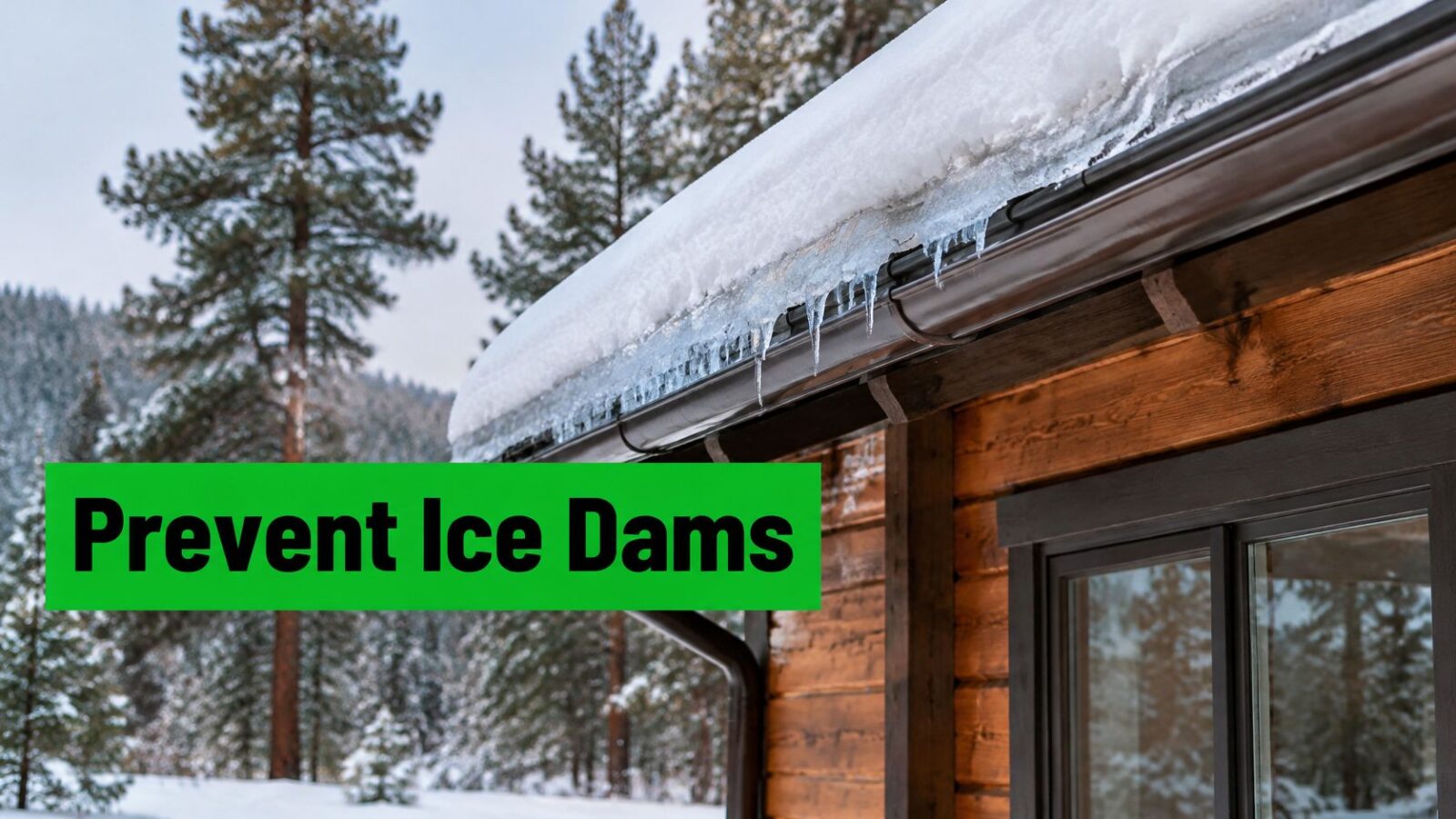
A clean gutter is the most popular answer to ice dams, and it's the answer that leaves people standing in the driveway confused. If a clog were the whole story, why does a cabin above Munds Park build a thick ice ridge at the eave every January with a trough you could eat out of? Why does the ice come back a week after somebody scooped it clean?
Because the water isn't coming from the gutter. It's coming off the roof.
Snow sits on the deck. Warm air leaks from the living space into the attic and warms part of that deck, so the snow above it melts on a bright, cold afternoon. The meltwater runs downhill until it hits the overhang, which hangs out past the insulated wall and stays close to outdoor temperature. It freezes there. Run that cycle for a week and you've built a dam, and the water stacked behind it goes under the shingles instead of down the spout.
So there are two different problems wearing the same costume: a drainage failure and a heat-loss failure. One is maintenance, the other is a building-science repair. Fix the wrong one and the ice returns with the next storm. Learning how to prevent ice dams in gutters starts with admitting the gutter is usually the messenger, not the cause.
Why Clean Gutters Still Form Ice Dams
Picture a Munds Park cabin after a clear night. The sun clears the ponderosas around ten, hits the south slope, and by four there's an ice shelf along the eave while the trough below it sits empty. The homeowner did the responsible thing in October. It didn't matter, because the ice formed on the roof, not in the channel.
An empty gutter tells you the drainage hardware works. It tells you nothing about the temperature of the roof deck a few feet above it.
The tell: ice that runs in a horizontal band along the eave, with a clear trough beneath it, is a roof-temperature problem. Water pooling in one sagging section under a mat of needles is a drainage problem.
That distinction is the whole diagnosis. The Massachusetts ice dam guidance pushes owners toward a home energy assessment rather than repeated ice removal, and it names the same three controls that Pacific Northwest National Laboratory does: a fully air-sealed ceiling plane, adequate insulation, and roof ventilation. Ice removal treats the symptom. Those three treat the mechanism.
Read the last storm, not the calendar
Don't guess from the season. Look at what happened during the last snow and match it to a row below. Every row has one first action, and doing that action this week beats a weekend of chipping.
| What you see | Likely cause | First action |
|---|---|---|
| Icicles and an eave ice ridge with gutters already clear | Attic heat melting snow that refreezes at the cold eave | Air-seal the ceiling, then check insulation and soffit-to-ridge vents |
| Water backs up only where pine needles or leaves fill the trough | Drainage blockage | Clear gutters and downspouts before the next freeze |
| Downspout frozen solid while roof snow stays even | Frozen outlet, not whole-roof heat loss | Open the outlet and send discharge away from the foundation |
| Melt stripe only above a bath fan, dryer, or recessed lights | Local heat or moisture dumped into the attic | Vent that fan outdoors and seal the penetration |
| Ice returns on a cabin left empty for weeks | Hidden ceiling leaks the owner does not see day to day | Do a cold-weather attic check before the next stay |
The second row is the cheap one. The fourth is the one people misdiagnose for years, because a single bath fan venting into an attic will melt a stripe down one rafter bay and nowhere else, and the rest of the roof looks innocent.
If both a clog and a heat stripe are present, and they often are on an older cabin, handle them in order. Clear the drainage now so the next thaw has somewhere to go, then book the attic work before the next snow load arrives. Doing the attic first and leaving a packed trough in place just moves the water to a different problem.
Mark the row that matches your last storm and do only that first action this week. Everything else can wait until the pattern is fixed.
How to Stop Roof Heat Before Ice Forms
Clean gutters give meltwater a path out, but they do not stop snow from melting on a warm roof. Building America identifies control of outward air leakage as the most effective way to prevent ice dams, and pairs it with well-insulated roof areas to limit the melt-freeze cycle, according to its research summary. The aim is a cooler, better-sealed roof.
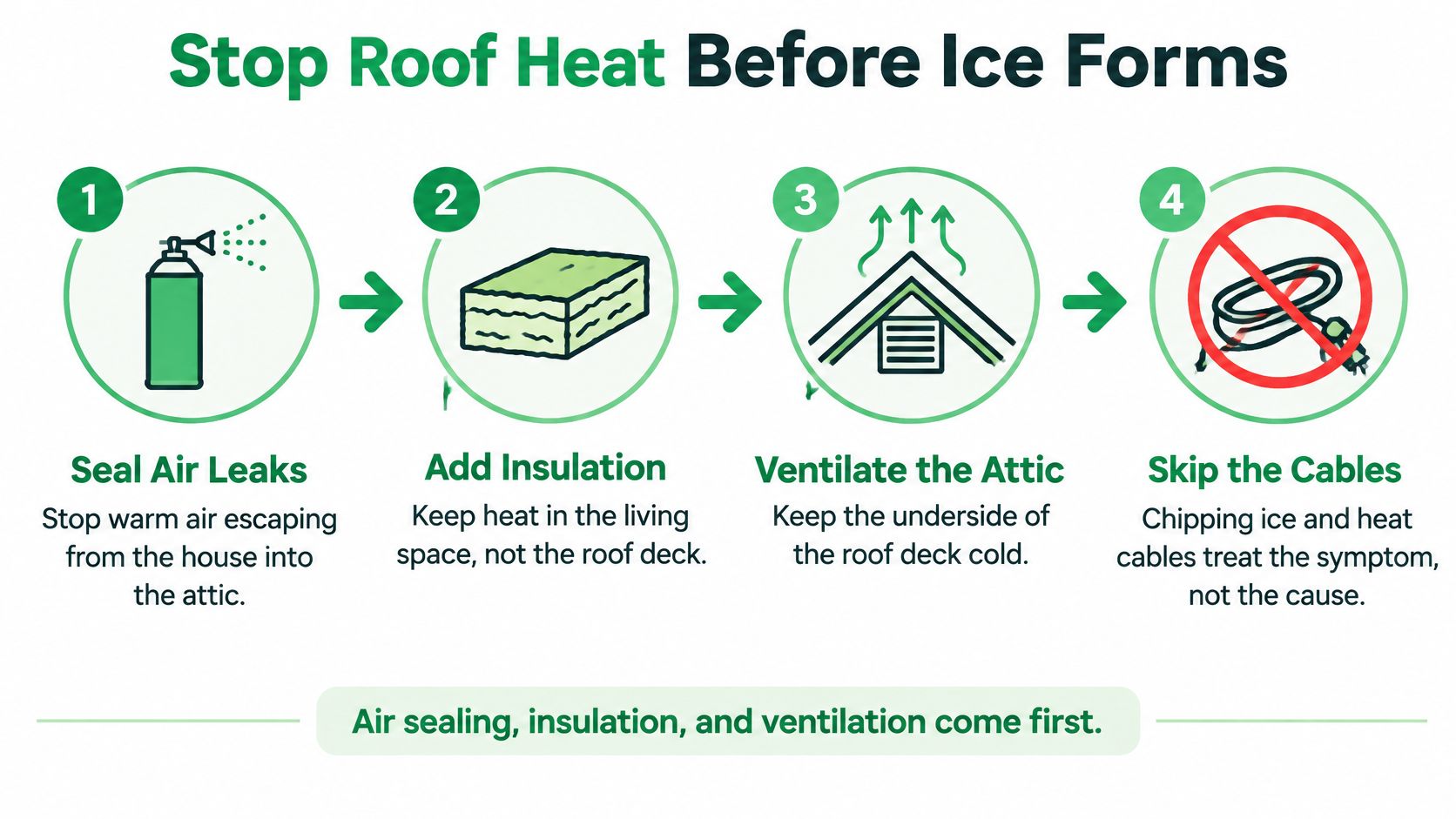
Here is the whole job in seven steps, then the detail.
A cold-day attic walk in order
- Inspect the attic on a cold day. Check for warm sheathing and missing or compressed insulation at the exterior top plates. Then inspect recessed lights, plumbing stacks, duct runs, and the attic hatch. An unsealed hatch can let warm indoor air into the attic.
- Seal openings in the ceiling plane. Use a compatible fire-rated sealant or a listed gasket. Check product requirements before sealing around recessed fixtures, and make sure plumbing-stack gaps are closed.
- Continue insulation over the ceiling edge. Insulation often thins at the perimeter, leaving the eaves more exposed to heat loss and uneven roof temperatures. Follow the depth guidance in the insulation section below.
- Keep soffit intakes open and connect them to each rafter bay with baffles. Paint or insulation can block an intake and disrupt airflow.
- Pair soffit intakes with high-point exhaust, commonly a ridge vent. A powered attic fan without adequate sealing can draw conditioned air through ceiling leaks.
- Keep at least 2 inches of clear airspace beneath the sheathing in every bay. The Building Science Education guidance on sealed eaves in cold climates recommends a continuous ventilation channel at every rafter or truss bay in cold, snowy climates.
- Record blocked bays and measure insulation depth. Infrared imaging can help identify areas to inspect, but confirm suspected leaks visually or with a smoke pencil before cutting into anything.
Three failures that undo the job
Blocked soffits are a common problem. Blown insulation can cover intake vents, leaving the attic with inadequate airflow. Baffles installed in only some bays also create uneven ventilation, while new insulation placed over an unsealed ceiling can allow warm, moist indoor air to reach cold sheathing and form frost.
Complete the attic checks before spending money on gutter hardware. Drainage problems need clear outlets; roof heat needs air-sealing, insulation, and ventilation work. The right repair depends on which problem the last storm revealed.
Gutter Pitch and Downspout Distances That Work
None of these numbers cool the roof. They keep meltwater moving once the attic work is done, and they limit how much of it ends up against the foundation when a thaw hits a Flagstaff eave in the afternoon and refreezes after dark.
A Department of Energy weatherization field guide sets the working figures: pitch gutters toward the downspout at 1 inch for every 16 feet of run, keep uninterrupted gutter lengths to no more than 40 feet without a downspout, and send discharge at least 3 feet from homes with crawl spaces and 5 feet from homes with basements, per the Midwest weatherization best practices field guide.
| Gutter run | Pitch toward the outlet | Downspout rule | Discharge distance |
|---|---|---|---|
| Up to 16 ft | About 1 inch of drop | One clear downspout | 3 ft from crawl-space homes; 5 ft from basements |
| 16 to 40 ft | 1 inch for every 16 ft | Stay at or under 40 ft without another outlet | 3 ft from crawl spaces; 5 ft from basements |
| Longer than 40 ft | Keep 1 inch per 16 ft on each segment | Add a downspout so no stretch exceeds 40 ft | 3 ft from crawl spaces; 5 ft from basements |
| Pine-needle roofs in Northern Arizona | Pitch does not replace a clear trough | Clear needles and outlets before the first hard freeze | Keep discharge off walkways that ice overnight |
A 16-foot stretch needs about an inch of drop toward its outlet. A 50-foot ranch eave does not get one heroic slope. It gets a second downspout, because no stretch should travel more than 40 feet without one. Splitting the run keeps the drop at an inch per 16 feet instead of stacking three inches at one end and starving the far half.
One 32-foot eave worked out
Take a 32-foot front gutter on a basement house. That's two 16-foot segments, so the whole run should fall 2 inches end to end, and the downspout should land 5 feet off the wall. If the same house sat on a crawl space, 3 feet would be the target. Set the far hanger at the high mark, snap a chalk line down to the outlet, and hang to the line rather than eyeballing from the ladder.
On ponderosa lots, pitch changes nothing about a trough packed solid with needles. Slope cannot drain a mat, so the fall cleanup has to happen before the first hard freeze, and the outlets need a clear path to grade. Extensions that dump onto a walkway just move the problem: that water refreezes overnight into a slip lane. For the drainage side of the job in town, the crew at gutter cleaning in Flagstaff flushes downspouts rather than only scooping the channel.
Practical rule: measure pitch with a 4-foot level and a tape before you add a single hanger. Fix low spots that hold water in July, because they'll hold ice in January no matter how well the attic is sealed.
Insulation and Airflow Targets for Snowy Roofs
The cold-climate target for attic insulation is R-49 to R-60, the range a 2026 ice-dam prevention guide attributes to U.S. Department of Energy guidance, as summarized by Eaves and Acres on preventing ice dams. That range is the number to hold onto when a contractor quotes a depth in inches instead.
Loose fiberglass runs about R-3 per inch, so a ruler showing 16 inches of settled depth is roughly R-49, and 20 inches is closer to R-60. Measure in several spots, and measure where nobody walks, because a walked-flat path across the joists reads several inches shallow and tells you nothing useful.
The ruler check at the eave
The eave is usually where the job falls short. Insulation gets stuffed into the overhang to keep it out of the way, and both the R-value and the intake air disappear in the same move. Kneel at the perimeter, push the tape down to the ceiling plane, and read the depth at the last three bays before the wall line. If the perimeter reads 8 inches while the middle of the attic reads 18, you've found the weak spot that feeds the ice.
That single check decides pass or fail better than any thermal scan.
What the airflow is actually for
Airflow isn't there to make the attic windy. Soffit vents let outdoor air in under the overhang, a ridge vent gives it a high exit, and baffles hold the channel open so insulation can't plug it. The Department of Energy's attic guidance notes that pairing soffit ventilation with a ridge vent improves effectiveness and that baffles preserve the open channel between soffit and attic, and it warns that poor ventilation lets moisture accumulate and damage insulation and wood while contributing to mold, per the Department of Energy durable attics guidance.
That moisture damage is what shows up in cabins that sit closed through January. Wet insulation loses R-value, sheathing softens, and the first sign is often a stain on a ceiling the owner sees in March.
A pass-fail you can run in ten minutes: depth at the perimeter meets the target range, every bay still has an open intake you can feel, and no bath or kitchen fan dumps into the attic. Fail any one and the roof will run warm.
Safe Winter Habits for Flagstaff Roofs
Owners ask the same question after one bad storm: cables or ventilation first? Ventilation, air sealing, and insulation come first, every time. Heat cables can open a drainage channel during a thaw so the trough empties, but they don't fix heat loss, a buried soffit, or a sloppy electrical hookup, and the National Weather Service guidance on roof ice dams is blunt about that limit while noting the goal is keeping the underside of the roof deck below freezing when outdoor air sits around 22°F (−5.6°C), not maximizing air movement.
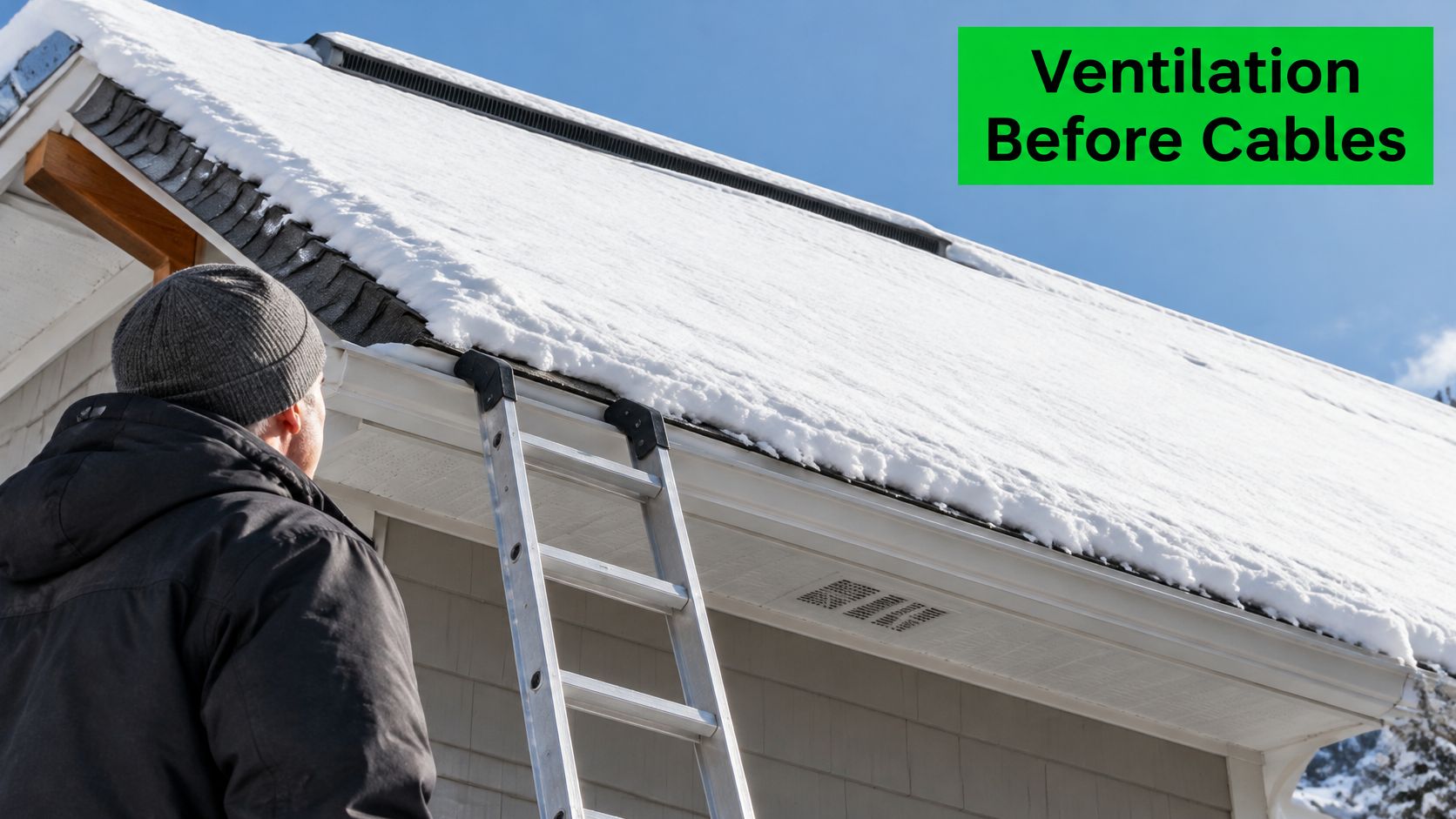
More vents are not automatically better. Add a ridge vent without open soffit intake and the new exhaust pulls conditioned air through ceiling leaks, which is the same warm, moist air you were trying to keep out of the attic. Intake and exhaust have to balance, or the assembly works against itself.
Cables or ventilation first
Treat a heat cable as a drainage tool, not a cure. It belongs on a roof that has already been sealed and insulated, installed by a qualified electrician to the manufacturer's instructions, and run only when needed. Buying cable first is buying the symptom.
Exhaust routing is the neglected one. Bathroom fans, kitchen fans, and dryer vents must discharge outdoors, never into the attic, because that air carries heat and moisture straight to the deck and feeds both ice and mold.
Some roofs need a designer rather than a baffle kit. Cathedral ceilings, unvented attics, deep valleys, and houses with no gutters at all don't follow the standard recipe. Where dropping the gutters is realistic, roofing guidance treats removal as the most effective preventive measure available, and otherwise recommends positive slope, clear downspouts, and an eave ice-barrier membrane as layers of protection rather than a promise.
The do-not list for an icy eave
- No chipping from a ladder. A hatchet or a shovel blade cracks shingles, tears flashing, and puts you on ice with a swinging tool.
- No salt on the roof or in the gutter. It corrodes the metal, stains the fascia, and kills the plantings below.
- No attic fan as the only fix. It moves air without sealing the leaks that made the attic warm.
- No dryer exhaust in the attic. Route it outside, full stop.
- No pressure washing or hot water on the dam. Forcing water under the shingles creates the leak you're trying to avoid.
- Roof rake from the ground only. Pull snow off the lower few feet of the eave and stay off the roof.
Pine needles get pulled in fall for two reasons that meet on the same roof. A clear trough drains the first thaw instead of freezing into a block, and needles kept off the property and out of the gutters matter for fire safety in the dry summer months. The same rake work serves both seasons. If you're the one on the ladder, read these snow removal safety tips before the first storm rather than after.
Schedule Gutter Care Before the Next Freeze
Turn the diagnosis into a calendar entry. If the last storm left a packed gutter and a frozen downspout, book gutter and downspout cleaning before the next one arrives, and get the pine needles off the roof and away from the house so summer fire risk doesn't stack on top of winter ice. If it left an ice ridge over a clean trough, the cause sits in the attic: finish the air sealing and the insulation depth check first, then clear the gutter so the new drainage path has somewhere to send water.
That order matters. Cleaning a trough on a roof that still runs warm buys a short reprieve and a second invoice.
Pine Country Window Cleaning has served Northern Arizona since 1999 and stays locally owned, with David Kaminski, who also owns Professional Window Cleaning in Tempe, behind it. The technicians are background-checked, the work carries a guarantee, and a standard window visit covers screens removed, cleaned, and reinstalled plus frames and sills wiped. For ice-dam season the useful add-ons are gutter cleaning and pine needle cleanup, with the tools and equipment to finish the job fast, plus driveway and sidewalk shoveling in Flagstaff and Munds Park when the same storm buries the discharge path. Calls get answered and scheduling moves quickly. Reach them at (928) 527-0671 or book online for a free estimate, and ask for a walk of the eaves while the crew is already on site so a blocked downspout isn't a January surprise. Late-fall timing for all of it is laid out in this guide to seasonal gutter maintenance.
An ice ridge over a clean trough points to the attic. A packed gutter and a frozen downspout point to drainage that needs a thorough clearing before the next freeze. Pine Country Window Cleaning handles the drainage half of that work with gutter cleaning, downspout flushing, and pine needle cleanup across Flagstaff and Munds Park, and the crew can walk your eaves while they're on site so you know which problem you have. Visit Pine Country Window Cleaning for a free estimate and get the trough clear before the next hard freeze sets it in place.