

You're standing outside your Flagstaff home, looking at pine needles packed into an upper gutter, with a pressure washer ready in the driveway. Before you turn it on, check what you're trying to remove and where it will go. Breaking up a visible pile isn't much help if you push it into a hidden downspout blockage.
The best gutter cleaning tools match the debris, the gutter design, and the access conditions. A scoop can outperform a powered attachment on wet sludge, while a ground-operated vacuum can make loose debris easier to collect. Neither is the right answer if reaching the gutter puts you or the building at risk.
Which Gutter Cleaning Tool Fits Your Situation
Start with these questions before buying an attachment or setting up a ladder:
- What's in the gutter? Loose, dry leaves behave differently from wet needles knitted into a compacted mat.
- How high is the run? A reachable single-story gutter is a different job from an upper run above a sloping driveway.
- Is there a guard? A cleaning head that fits an open trough might snag or damage a covered system.
Gutter Cleaning Tool by Situation
| Situation | Best tool | Reach | Avoid |
|---|---|---|---|
| Dry leaves in open gutter, one story | Plastic gutter scoop or handheld vacuum | Ground for low runs or suitable short-ladder access | Pressure washer |
| Wet, packed sludge at any height | Gutter trowel or scoop, then hose | Usually ladder needed, with professional access for upper runs | Leaf blower alone |
| Dry debris, reachable single-story run | Telescoping pole with curved head | Up to pole length, within controllable working reach | Poles near power lines |
| Dry debris, two-story or sagging run | Professional with lift access | Lift-based access | DIY ladder climb |
| Pine needles before dry summer months | Gutter vacuum or scoop | Ground to low runs | Rinsing needles into downspouts |
| Clogged downspout | Flush hose with controlled nozzle | Ground at outlet | High-pressure jet |
Treat the reach column as a limit, not an invitation to stretch. A handheld vacuum only works where its nozzle can reach safely; it doesn't become an overhead cleaning system without a compatible extension kit. Likewise, the length printed on a pole doesn't guarantee that you can control its head against packed material.
Choose Removal Before Rinsing
For pine-covered properties, collect needles rather than washing them toward the outlet. Keeping pine needles away from the property and out of gutters is important for fire safety during the dry summer months. A vacuum or scoop takes that material out of the system instead of relocating it inside the drainage path.
Say your cabin has a low porch gutter and an upper roofline above a deck. You might collect loose porch debris with a ground-operated attachment, then leave the upper section for professional access. There's no benefit in forcing the same tool to handle both.
Practical rule: Choose the tool you can control at the gutter, not the longest tool you can buy.
Before starting, identify where you'll collect debris, where rinse water will discharge, and whether guards restrict access. Those checks often matter more than motor power. Tool performance and ladder setup deserve separate attention because a suitable cleaning head can still be attached to an unsafe access arrangement.
What Each Gutter Cleaning Tool Does and Where It Fails
Removal and rinsing are different jobs. Start with equipment that lifts or collects the bulk material, then use water to clear residue and check drainage.
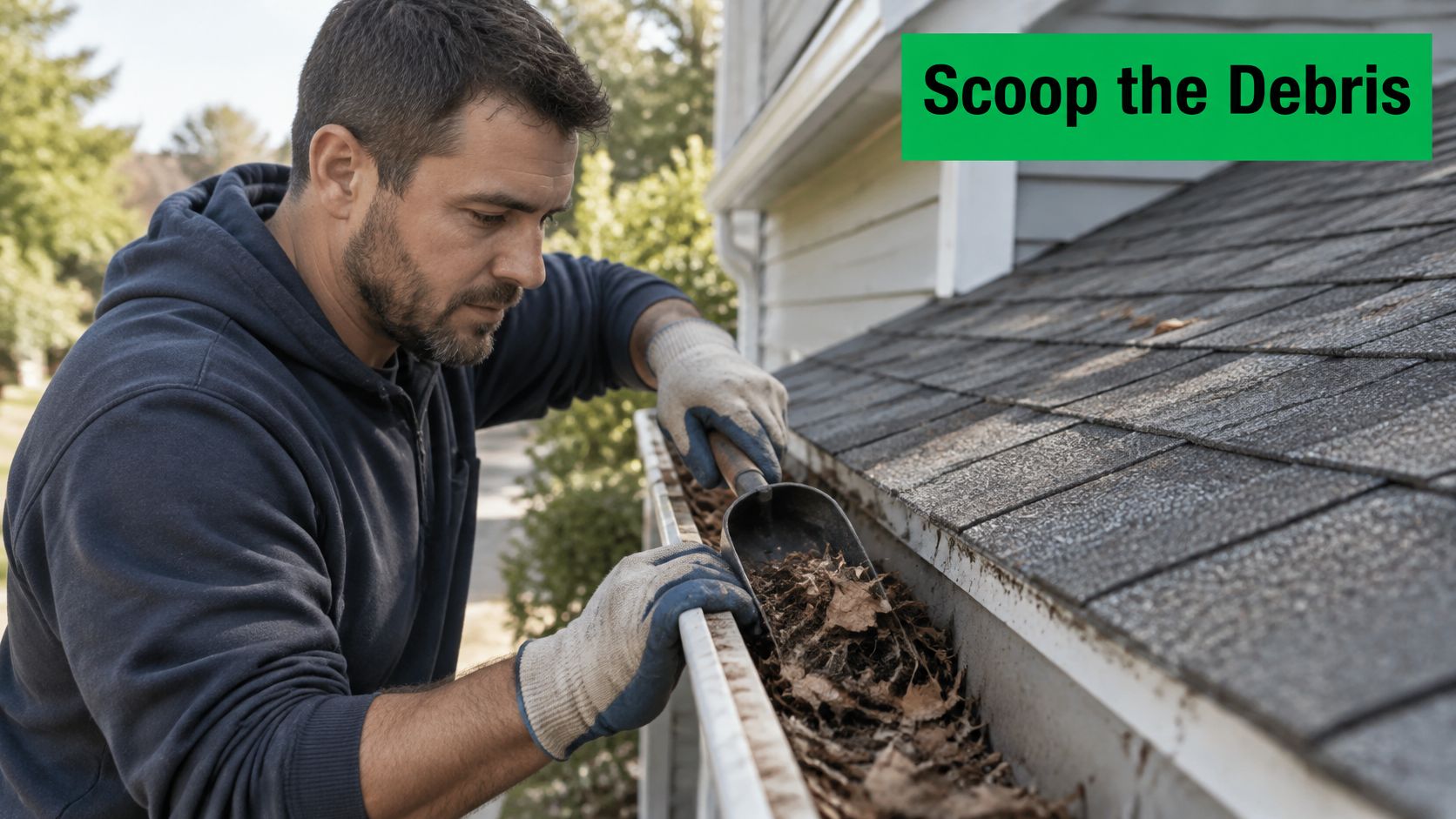
A scoop is particularly useful when wet debris needs to be lifted out intact.
Tools That Collect Debris
Hand scoops and plastic gutter scoops remove wet leaves, sludge, and packed needles directly. They work well on short, accessible sections, but hangers and shingle overhang can restrict the scoop's movement. Don't force a metal trowel against sealant or lean across the trough to reach another handful; collect into a secured bucket and reposition your access equipment.
Telescoping poles with curved attachments let you lift, drag, or grab loose material while standing below the gutter. At full extension, flex makes precise movements harder, and you can't reliably inspect the far side of the trough. A head dragged blindly across the run can catch a hanger, disturb a guard, or pull against a weak joint.
Gutter vacuums draw debris through an extension and hose into a collection container or bag. They're useful when you want to keep dry material off a deck or planting bed, but wet clumps can bridge inside bends and block the hose. Use a machine rated for the material you're collecting, and don't press the nozzle into fragile gutter components to compensate for poor suction.
Tools That Move Debris or Water
Leaf-blower gutter attachments shift dry, loose leaves well when the trough is open and accessible. They're poor tools for wet mats, and they scatter material onto landscaping, cars, and outdoor furniture. Blown grit can also mark nearby finishes, so clear the work area rather than treating the lawn as an unrestricted landing zone.
Hose wands rinse fine silt after the bulk debris is gone. They don't reliably lift compacted mats, and spraying harder can send dirty water over the edge. Keep the stream directed into the trough, not beneath roofing edges or toward electrical fixtures.
Pressure-washer attachments are the option I'd leave out of a routine homeowner kit. The Consumers Guide's gutter-tool comparison warns that high pressure can drive debris deeper into downspouts and damage seams, shingle edges, or fasteners. Pressure may break apart a stubborn deposit, but it also gives you less margin for error around aging components.
A clean gutter has an empty trough, collected debris, and freely draining water. Debris pushed out of sight doesn't meet that standard.
Check attachment compatibility before using equipment you already own. Hose diameter, locking connections, collection capacity, and the manufacturer's wet-material rating matter more than whether a product is advertised as a gutter-cleaning kit.
How Gutter Guards Change the Cleaning Method
Gutter guards don't mean maintenance-free gutters. They change where debris collects and how you reach it. A clean-looking cover can still conceal an obstructed outlet or a trough holding sediment.
Capital Pro's gutter-guard cleaning guidance describes guards as reducing rather than eliminating maintenance, with cleaning methods matched to mesh, brush inserts, and helmet-style designs. Start by identifying the cover before choosing a brush or attempting removal.
Match the Method to the Guard
- Mesh screens: Use a soft brush to loosen surface needles, followed by a gentle rinse. Avoid scraping with a sharp scoop, which can tear the mesh or catch an edge.
- Brush-style inserts: Remove surface debris without grinding it deeper into the bristles. Where the design allows, periodically lift the insert to inspect and clean the trough underneath.
- Helmet or reverse-curve guards: Clean accessible surfaces gently, but recognize that the covered trough may require removal for inspection. Don't pry apart unfamiliar seams just to make a cleaning head fit.
Pressure washing can deform screens or dislodge inserts. Guards also aren't load-bearing surfaces, so don't stand on them or use them to support access equipment.
For needle-heavy properties, our guide to gutter guards for pine needles can help you think through the maintenance implications before choosing a system. The useful question isn't whether a cover excludes leaves, but whether its surfaces and outlets remain accessible for inspection.
Inspect Beyond the Surface
Begin from the ground. Look for lifted edges, visible debris ridges, separated sections, and staining beneath joints before disturbing anything.
After cleaning, introduce controlled water at the far end of the run and observe what happens at the outlet. Water disappearing through the screen doesn't prove that it travels through the downspout. Stop if the trough backs up underneath an apparently clean cover.
Inspection priority: A tidy guard surface is only part of the job. The concealed drainage path still has to work.
After storms, check seams, edges, outlets, and signs of overflow. This matters especially for seasonal cabins left unattended and commercial properties where water can spill onto façades, entrances, or landscaping without anyone noticing immediately. Photograph questionable areas from a safe position so they can be assessed without repeated climbing.
Ladder Safety Rules Before Any Gutter Job
A ladder-free tool can reduce climbing, but it does not make the job automatically safe or complete. Before choosing access equipment, check the ground, building height, overhead lines, and whether the cleaning head can reach without forcing you to lean sideways.
OSHA's ladder safety guidance says an extension ladder used to access a raised surface must extend at least 3 feet above the landing, sit approximately 1 foot out for every 4 feet of working height, and be secured against movement. Keep three-point contact while climbing. The extension rule applies when accessing a raised surface; it does not authorize stepping onto a roof to clean gutters.
Ladder Setup Requirements for Gutter Work
| Check | Requirement | Why it matters |
|---|---|---|
| Extension height | At least 3 ft above the landing | Gives a handhold when stepping off |
| Base placement | About 1 ft out for every 4 ft of working height | Keeps the ladder angle stable |
| Contact while climbing | Three points at all times | Helps prevent slips on the way up |
| Tool carrying | Belt, backpack or hoist line | Keeps both hands free |
| Overhead power lines | At least 10 ft clearance | Pole or ladder contact can be fatal |
Maintain electrical clearance around the full ladder or pole while carrying, raising, and repositioning it. If the work area cannot provide that clearance, stop. Do not try to thread equipment past a line.
Use this visual checklist before setting up.
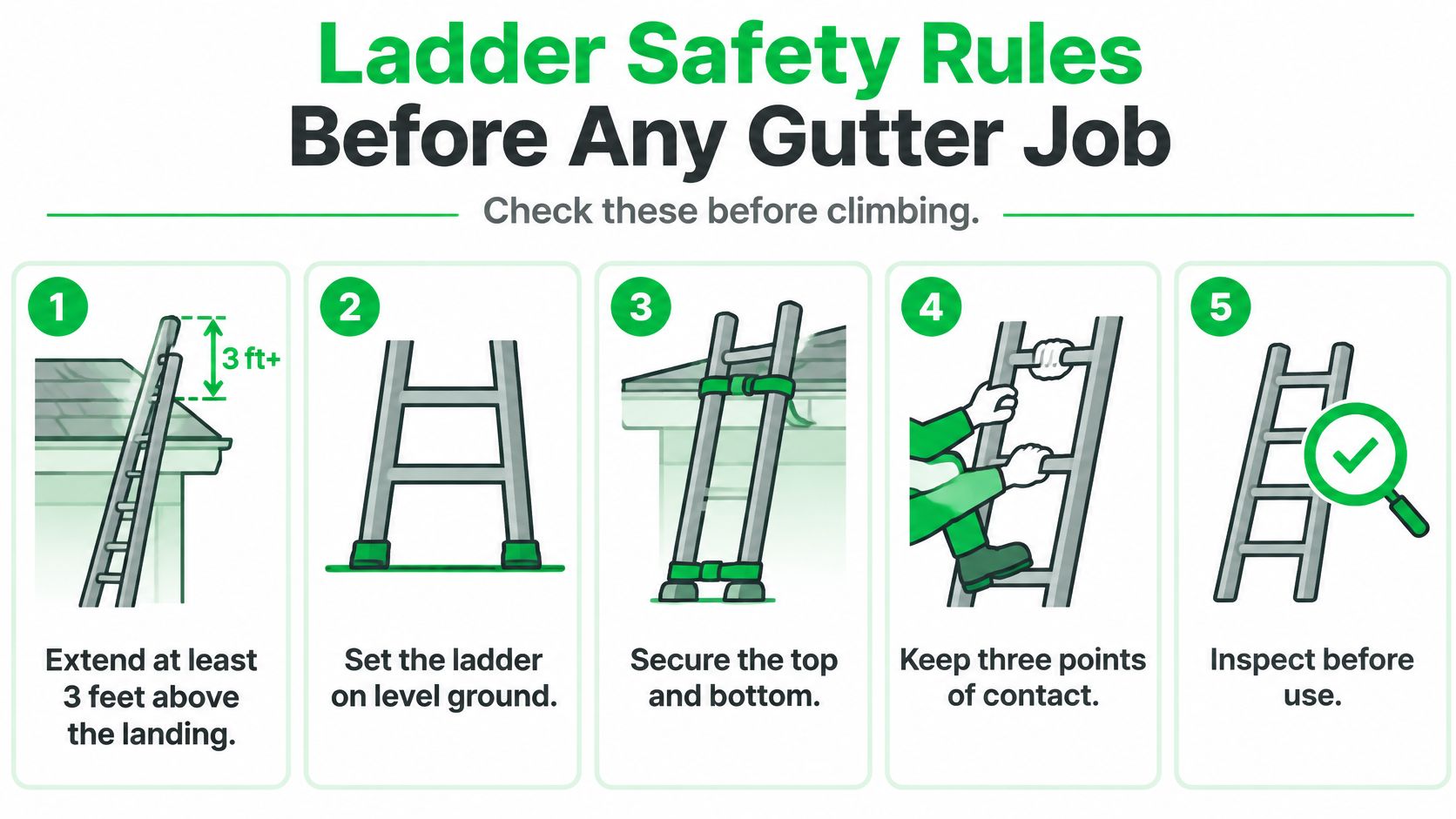
Check the Equipment and the Ground
Inspect the rails, feet, rungs, locks, and extension components before use. When comparing ladders, Ladder ratings and verified pricing can help with shopping; check the duty rating and instructions on the ladder's own manufacturer label.
Review these ladder safety requirements before setup. Never rest a ladder against a gutter. A helper cannot make unstable placement safe.
Check the surface before climbing:
- Firm, level support: Avoid sinking feet, improvised blocks, and slippery ground.
- Engaged locks and secure placement: Check the extension mechanism and prevent movement.
- Clear hands: Carry tools in a belt or backpack, or raise them in a secured container.
- Suitable assistance: A helper can support the base where appropriate, but that does not replace securing the ladder.
- Dry, calm conditions: Do not climb in wind, ice, or wet conditions.
Stop if the ladder shifts, the ground gives way, or the cleaning head cannot reach the work without leaning beyond the rails. Descend and reposition instead. If safe footing, electrical clearance, or stable placement cannot be maintained, leave the job for a professional.
How to Test Downspouts After Cleaning
A gutter can look clean and still fail because the outlet or downspout remains blocked. EPA inspection guidance treats gutters, downspouts, and pipes as a connected collection-and-conveyance system and calls for keeping gutters, downspouts, and leaf screens clear.
Use this sequence to check the whole drainage path, not just the visible trough.
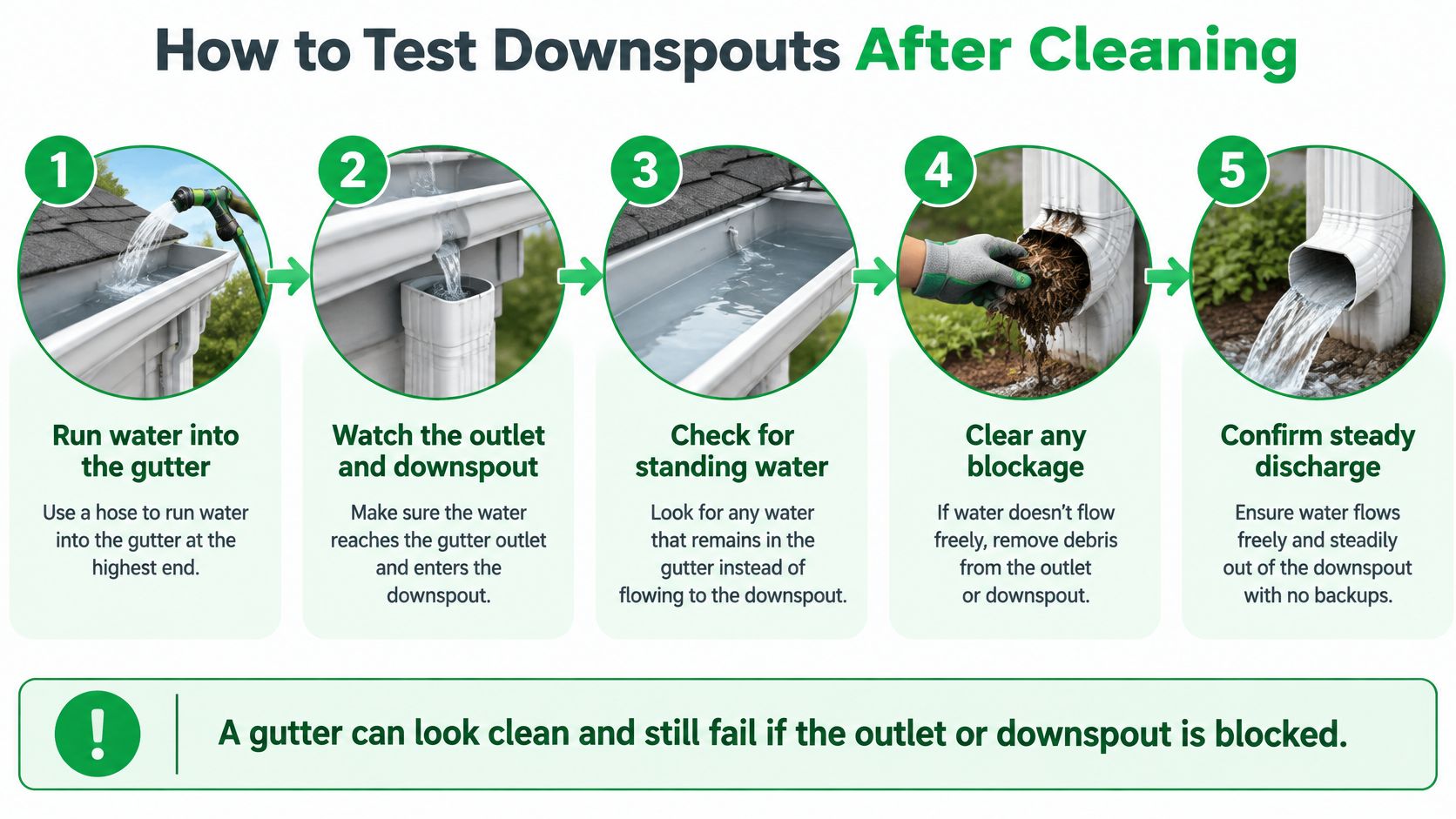
Follow the Water
- Remove loose debris and inspect the outlet opening. Lift remaining leaves and needles out so the test doesn't carry a fresh obstruction into the pipe.
- Run a hose into the far end of the trough. Watch water travel toward the outlet, allowing for the run's length and the flow you're supplying.
- Flush from the top with a controlled nozzle where safe access permits. Confirm that water exits cleanly at the bottom, and stop if the gutter starts filling faster than it drains.
- Look for front-edge overflow or pooling. A partial blockage can restrict discharge, while persistent standing water in an otherwise clear trough may indicate a sag or pitch problem.
- Clean leaf screens and inspect connected collection components. Rainwater cistern screens and first-flush components need attention too, because a clear downspout doesn't prove those parts are functioning.
Don't respond to backing-up water by increasing pressure. Shut off the hose, identify the restriction, and leave inaccessible elbows or buried connections for further assessment. Restricted drainage can send water toward fascia, soffits, foundations, and garden areas.
Our guide to how to clean gutter downspouts explains the cleaning task in more detail. Keep the distinction clear: flushing checks performance, but it doesn't repair a separated joint or correct a sagging run.
The video offers another visual reference for the cleaning process.
The pass condition is steady discharge at the outlet, with no overshoot, overflow, or standing water. Check joints during the test as well, rather than judging success solely by water reaching the bottom.
When Gutter Cleaning Calls for a Professional
A ladder-free tool doesn't automatically make a gutter job safe or complete. If you can reach the trough but cannot control the tool head or see whether debris is coming free, the access problem remains. A longer pole does not fix poor visibility or give you a way to inspect a hidden blockage.
Stop if the upper run requires roof-edge access, the ground is sloped or icy, or compacted debris will not lift without force. If a downspout stays blocked after controlled flushing, do not keep forcing water into it. The restriction needs investigation.
Stop-Work Signs and Who Should Do the Job
| Situation | DIY with pole or scoop | Hire a professional |
|---|---|---|
| Loose debris, reachable single-story run | Yes | Only if access is unsafe |
| Two-story or multi-story gutter | No | Yes, with lift access |
| Sagging, pulling-away or damaged section | No | Yes |
| Downspout still blocked after flushing | Limited | Yes |
| Guarded gutter needing inspection of seams and outlets | Visual check from ground only | Yes, for full inspection |
| Sloped, icy or wet roof-edge access | No | Yes, with a safe access plan and suitable conditions |
From the ground, check for a dip between hangers or a gutter pulling away from the fascia. Either condition warrants inspection before you apply force. A pole can loosen debris, but it cannot tell you whether a weak section will hold.
Professional access still depends on safe conditions. The right equipment and timing should match the building, the ground below it, and the gutter's condition. If those conditions cannot be managed safely, stop the work.
Access Equipment and Care for Your Home
Pine Country Window Cleaning has served Northern Arizona since 1999 and offers gutter cleaning and pine needle cleanup, with tools and equipment to finish the job fast. Its boom lifts, scissor lifts, and 95 ft. atrium lift provide access for challenging heights without relying on a long pole from the ground. Lift access is useful where a gutter is beyond safe ladder reach, but the equipment must suit the site and conditions.
The company's window cleaners are background-checked and industry safety-trained. Its window-cleaning service uses pure water filtered to remove contaminants and minerals, delivered to the top of a pole fitted with a soft brush. For in-home service, bug screens are removed, cleaned, and reinstalled. Other extras, including cleaning and reinstalling items outside the standard service, are available for an additional charge.
Pine needles deserve attention as well as ordinary leaves. Keeping them away from the property and out of gutters matters for fire safety during dry summer months. Packed needles, inaccessible runs, unstable gutters, and downspouts that remain blocked after flushing are good reasons to leave the job to a professional rather than keep working from the ground.
Walk the property from the ground and note which runs are reachable and which need safer access. Recheck after heavy storms and at the end of autumn, and arrange difficult work before a blockage becomes urgent.
Pine Country Window Cleaning provides gutter cleaning and pine needle cleanup. To schedule an assessment of packed debris, a blocked downspout, or a gutter section you cannot safely reach, visit Pine Country Window Cleaning.