
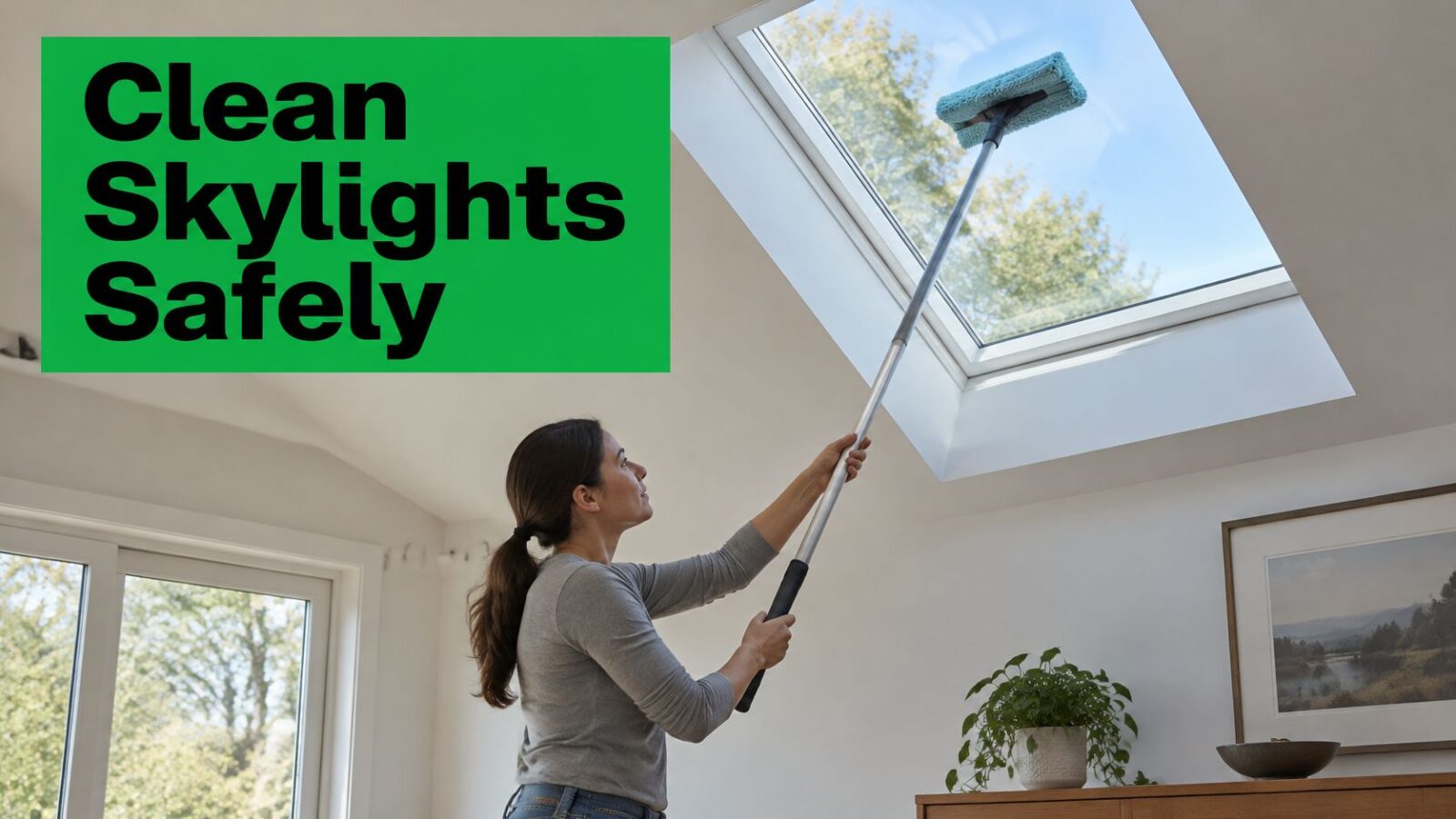
You're standing in the hallway of a cabin in Munds Park in February, looking up at a skylight that used to throw a clean rectangle of light onto the floor. Now it looks like a gray dinner plate. Somewhere between last spring's pine pollen and January's snowmelt, the glass went dull, and you're already eyeing the ladder in the garage.
The dirt is the easy part. Access is what gets people hurt. A skylight sits in a hole in your roof, the glazing isn't a walking surface, and the same weather that soils the glass leaves the roof around it slick.
Ask ten people how to clean skylights and nine will describe soap, water and a squeegee. That's the last third of the job. What comes first is deciding how you'll reach the pane without loading it, and what comes last is reading the glass and frame well enough to know whether what you're seeing is residue or a unit that's failing. Here's the order that keeps you off the roof and out of the emergency room.
Check Access and Fall Risk Before You Climb
A homeowner leans an extension ladder against the curb of a skylight on a roof still wet from overnight snowmelt. Shingle grit shifts under the ladder feet. On the first step up, the aluminum frame flexes a quarter inch as the rails take weight. That flex is the whole problem in miniature. A skylight is a hole in the roof with a lid on it, and the lid was engineered for snow load, not for people.
Never Treat the Glazing as a Step
Nothing you own should rest on skylight glazing. Not your knees, not a bucket, not a tool bag, not a ladder. Panels that look solid from six feet away are thin, and acrylic domes get brittle with age and ultraviolet exposure, which means the pane that held a contractor ten years ago may not hold you today.
The numbers behind that rule aren't abstract. The U.S. Occupational Safety and Health Administration recorded 1,034 construction fatalities in 2024, including 389 fatal falls to a lower level, roughly 37.6 percent of construction deaths that year. Its prevention framework rests on three controls: plan the work, supply the right protective systems, and train people before they go up. OSHA requires fall protection where a worker could fall through a skylight more than 6 ft (1.8 m) to a lower level, and the controls it accepts include guardrails, rated covers, safety nets and a personal fall-arrest system.
The rule that settles every argument: if reaching the glass means standing on the roof, on the frame or on the glazing, the job has moved past what a homeowner should take on.
Five Ways to Reach a Skylight
Start at the top of the table and work down. Most homes never need to go past row two.
| Access method | Best for | Main limit |
|---|---|---|
| Interior glass reached from a stable floor | Skylights within arm or pole reach from a room you can stand in safely | Cannot reach exterior glazing |
| Ground-level extension pole | Low-set or easily reached glazing where you can see the whole pane | Limited to pane reach; no body weight on glass |
| Boom or scissor lift on level ground | Multi-story, sloped or hard-to-reach skylights | Needs firm level ground and a trained operator |
| Roof access with guardrails or fall-arrest gear | Low-pitch roofs with a planned route and a secure anchor point | Needs training and a competent site assessment |
| Professional crew | Snow, ice, steep pitches, cracked or aging glazing | Costs more than a DIY job |
Answer three questions before you carry a single item outside. How steep is the roof? If you can't stand with both feet planted and a hand free, it's a professional job. Is there snow or ice on it? Even a thin crust changes every calculation, and a snow-covered panel reads as solid deck from a distance. Can you reach every pane without standing on the roof? If the answer is no for even one skylight, that one gets a different plan. For a sense of how ladder placement should be set up, this guide to window cleaning ladder work covers the setup side in detail.
Gear and Cleaners Matched to Your Glazing
Match the product to the glazing before you match it to the dirt. A detergent that's harmless on tempered glass can craze a polycarbonate dome, and that clouding doesn't come off. Identify what you have before you open a bottle.
| Glazing | Tools and cleaner | Avoid |
|---|---|---|
| Annealed or tempered glass | Mild pH-neutral detergent, soft microfiber, rubber squeegee | Razor blades, abrasive pads, strong solvents |
| Acrylic (plastic glazing) | Mild soap solution, soft microfiber, plenty of clean water | Dry wiping, ammonia-based sprays, scouring pads |
| Polycarbonate | Mild detergent, soft brush, clean-water rinse | Abrasive cleaners, solvents, high-pressure spray near seals |
| Low-E or coated glass | Mild detergent, soft applicator, no abrasives | Harsh chemicals that can attack the coating |
| Any glazing near gaskets or flashing | Hand washing with a soft applicator | Pressure washing close to seals unless the maker permits it |
The kit for a homeowner is short: one bucket for wash solution and a second for rinse water, a mild pH-neutral detergent, soft non-scratch applicators, a soft-bristled brush for the frame and screen, a rubber squeegee with a fresh blade, a telescopic pole with a soft head for anything above shoulder height, and clean water for the final rinse. Keep the squeegee blade wiped, because it picks up grit on the first pass and drags it across everything after that.
Leave the razor blades, scouring pads, strong solvents, fiber-shedding paper products and pressure sprayers in the garage. A pressure washer aimed anywhere near gaskets or flashing turns a cleaning job into a leak repair. On higher panes, a water-fed pole running purified water does the work from the ground and dries without the mineral spotting that Flagstaff tap water leaves behind. More on that kit sits in this guide to home window cleaning tools.
Test first: put any new cleaner on a hidden corner of acrylic or plastic glazing, wait a few minutes, then wipe. If the surface dulls or hazes, the bottle stays closed.
How to Clean Skylight Glass Step by Step
Once access is settled and the right tools are out, the cleaning itself is a controlled sequence rather than a scrubbing contest. The order below is the one we run on residential skylights.
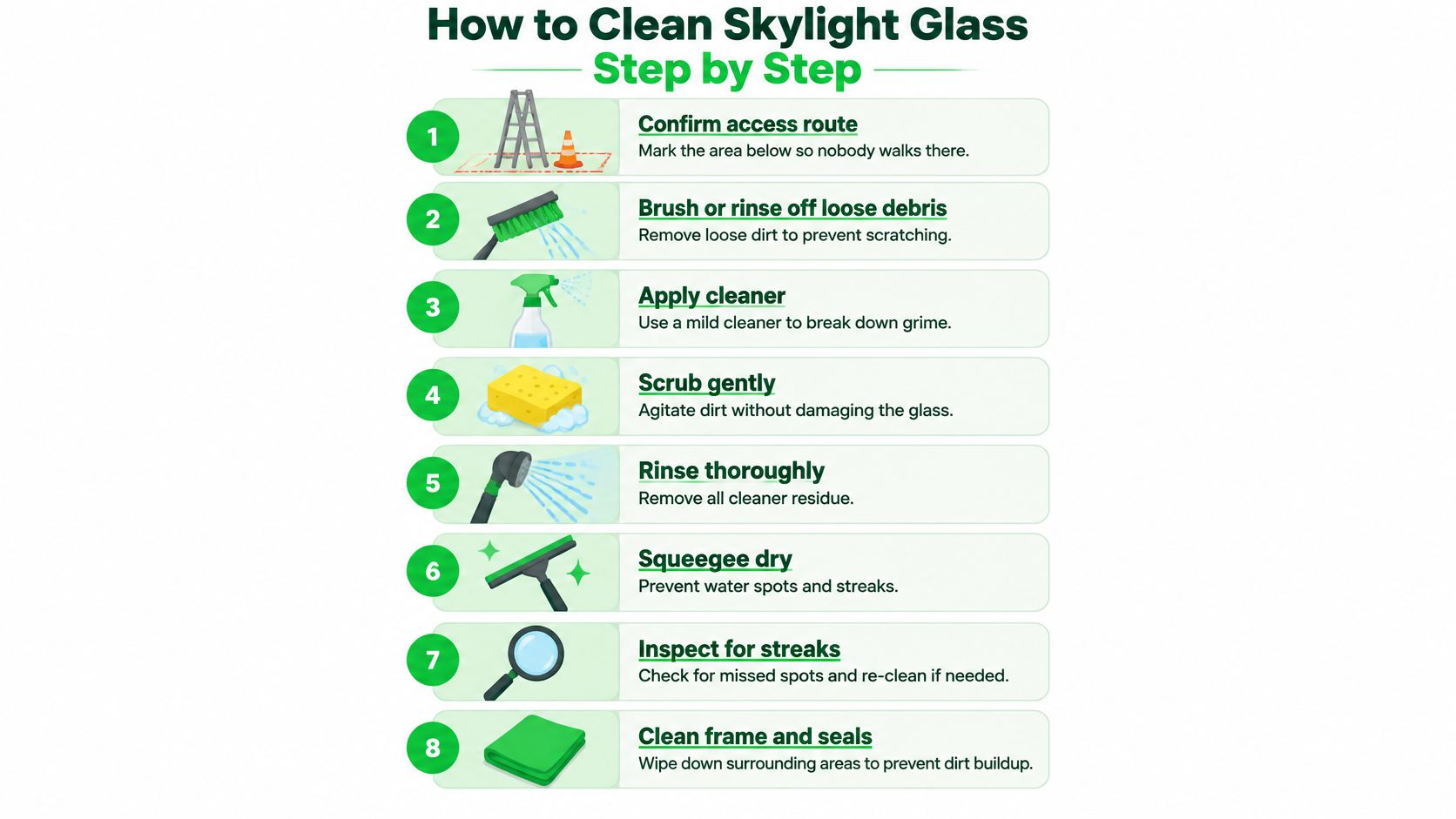
The Eight-Step Sequence
- Confirm your access route and mark the area below. Tape or cone the floor and ground underneath before anything gets wet, so nobody walks into a drip line, a dropped squeegee or a moving ladder.
- Brush or rinse off loose grit before any wet work. Dry dust dragged across acrylic or coated glass leaves fine scratches that scatter light permanently, and no product polishes them out afterward.
- Mix mild detergent in clean water at room temperature, and keep a second bucket for rinse water. Two buckets stop the wash solution from turning into grit soup halfway through the job.
- Work from the top edge downward in sections about the width of your applicator. Overlapping passes keep the solution from drying on the pane, and a drying edge is what leaves a line you'll chase for ten minutes.
- Clean in shade or early morning. Sun heats the glass and flashes the detergent off before you can pull it, which bakes streaks into the surface.
- Rinse fully with clean water until no soap film remains on glass or frame. Detergent trapped in a gasket or frame joint pulls a gray bead line along the edge and attracts fresh dust.
- Pull the squeegee top to bottom in overlapping strokes, wiping the blade after every pass. A clean blade is the difference between a clear pane and a scratched one.
- Check the pane in good light from two angles, then photograph it. A photo from the same spot next season tells you whether new haze is dirt or something changing in the assembly.
What a Good Result Looks Like
Success is clear light through the pane, no film when you sight along it, no drip lines down the frame, and no wet residue sitting at the edges where the glass meets the seal. Judge the frame and seals too, not only the glass.
Recurring moisture deserves a diagnosis rather than another wash. ENERGY STAR rates skylight condensation resistance from 0 to 100, with higher values meaning less water buildup, but a good rating doesn't stop condensation caused by indoor humidity, blocked drainage or a failed seal.
Set your next clean by how much light you're losing and what the glass looks like, not by a date on the calendar. There's no universal interval that fits every roof. Keep the before and after photos as your benchmark.
Inspect Seals and Diagnose What Comes Back
You wiped the glass, the light came back, and a week later a gray line sits on the gasket again. That return is the diagnosis. Dirt blocks daylight, which is why the skylight is there, but a film you can rinse off is a different problem from water that keeps showing up after the pane is clean. Glazing, orientation, shading, climate, and whether the seals and drains stay clear all change whether the opening helps or adds cooling load. A clean pane does not repair a failed edge.
The checklist below is the one worth running after every wash.
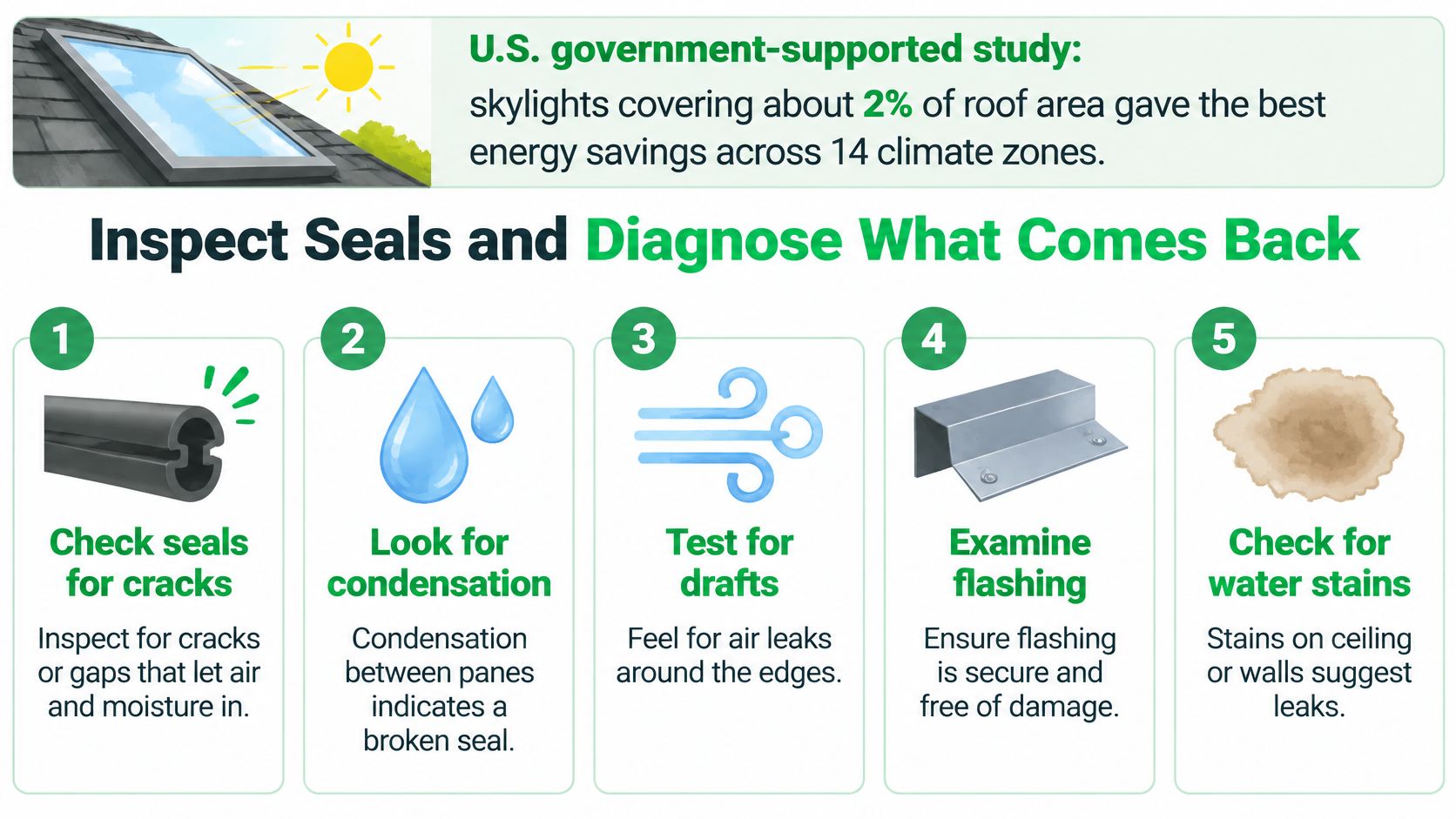
Sort the Symptom Before You Wash Again
Walk the perimeter with a dry cloth and a flashlight. Press the cloth along the seal where glass meets frame, then the frame joints, weep holes, and drainage channels. Check flashing edges, the curb, and any gutter or valley that can hold needles and debris. Finish on the ceiling below. Staining or bubbling paint means water has already left the roof assembly.
| Symptom | Likely cause | Fix |
|---|---|---|
| Streaks or film after drying | Detergent residue or a dirty squeegee blade | Rinse with clean water and wipe the blade after each pass |
| Cloudy or hazy acrylic | Dust scratches or the wrong cleaner | Stop abrasive work and test a plastic-safe cleaner; ask the maker before polishing |
| Fine scratches on the glazing | Dry dust rubbed across the surface | Pre-rinse next time; a professional can assess whether the pane needs replacing |
| Fog between panes | Failed seal | Schedule an inspection; cleaning will not fix it |
| Moisture on the inside surface | High indoor humidity or a cold surface | Run bath fans and check ventilation; cleaning alone will not fix it |
| Water staining at the frame or curb | Blocked drainage or failed flashing | Clear debris from drainage paths; call a roofer or pro if staining returns |
If the same symptom returns within two weeks of a clean, stop cleaning and book an inspection. That rule alone separates a maintenance habit from a repair bill you're postponing.
I treat that two-week line as the cutoff. Residue from a dirty blade or leftover detergent shows up as streaks a dry cloth can lift. Fog trapped between panes, a wet curb, or paint bubbling downstairs does not wipe off. Another wash only hides it until the next rain.
Water reaching a ceiling needs prompt attention. Leave a cracked or sagging pane alone until someone qualified looks at it. In Northern Arizona, dust, pollen, intense sun, snowmelt, and freeze-thaw cycles all work on seals and drainage paths, so run this check after each seasonal change rather than once a year.
What you can see from the floor is only the stain. The seal, weep, and flashing checks happen at the unit.
When to Call a Professional Instead of Doing It Yourself
Call a trained crew the moment any of these conditions is true. None of them is about pride; each one is about exposure.

- The roof is steep enough that you can't stand with both feet planted and keep a clear route. A pitch you have to shuffle across is a pitch you can slide off.
- Snow, ice or frost covers the skylight. Covered panels read as solid roof from a distance, and that misread is how people step onto a hole.
- The skylight sits over a stairwell, cathedral ceiling or multi-story space. Interior work there means a ladder on a finished floor with nothing behind you if it kicks.
- The glazing is cracked, sagging or already leaking. Cleaning a compromised unit can finish it off.
- The job needs a boom lift or roof-level fall protection. Renting equipment you've never operated is its own hazard.
- You manage a commercial property. Liability, documentation and access control change the math completely.
What a professional brings is mostly access discipline. Squeegees and extension poles handle reachable panes, while water-fed pole systems use pure water and soft brushes on higher glass, which cuts ladder exposure because the technician can work from the ground. Inside, you should see shoe covers, towels and drop cloths catching drips, and soft protective covers on ladder ends so siding and walls don't get scuffed, as Pine Country Window Cleaning's service description sets out.
Cost is the honest trade-off. In 2025, Fixr.com priced skylight window cleaning at $25 to $35 per window, with inside and outside cleaning included in some cases, and that figure moves with access difficulty and pane size.
Ask for the plan: any provider should put the access method in writing before the crew arrives, including which equipment they'll use and where it will sit.
Go back to the three questions from the start of this job. If you can't answer every one of them safely, hiring the work out isn't the expensive option. It's the cheap one. For the broader technique of reaching glass well above grade, this walkthrough on how to clean high windows is a good next read.
Schedule a Skylight Check Before the Next Storm Season
A spring storm hits a roof still coated in winter dust, and the first drip often shows up under a skylight you stopped looking at in January. Walk the house and mark every opening before you book: hallway, bath, the pane over the stairwell. Note whether each one is glass or plastic. Then write the access story in plain terms. Roof pitch, a spot where a ladder can sit, where snow drifts pile, and every stain or leak you have seen, including the one you assumed was old.
Pine Country Window Cleaning has served Northern Arizona since 1999 as a locally owned window cleaning company. Crews reach high and difficult glass from ladders and high-reach poles, and with boom lifts, scissor lifts, and a 95-foot atrium lift, as the company's Flagstaff page describes. That gear is how a crew gets to a cabin roof or a tall atrium without standing on the glazing. I would not walk a pitched, snow-loaded roof to wipe one pane when a pole or a lift can do the reach from a stable base.
A residential visit covers outside and inside glass, wiping inside and outside frames and inside sills, and pulling bug screens so they can be cleaned and put back. Cleaners are background checked and industry safety trained. Call (928) 527-0671 for a free estimate, or schedule online.
Pollen, dust, and bird residue on a skylight are part of that routine residential cleaning. Panes over a stairwell, a vaulted ceiling, or a roof you would rather not walk are the ones where fall risk should pick the method before anyone climbs. Book through Pine Country Window Cleaning and pass along the access notes you already wrote, so the visit matches the glass ahead of the next storm cycle.