
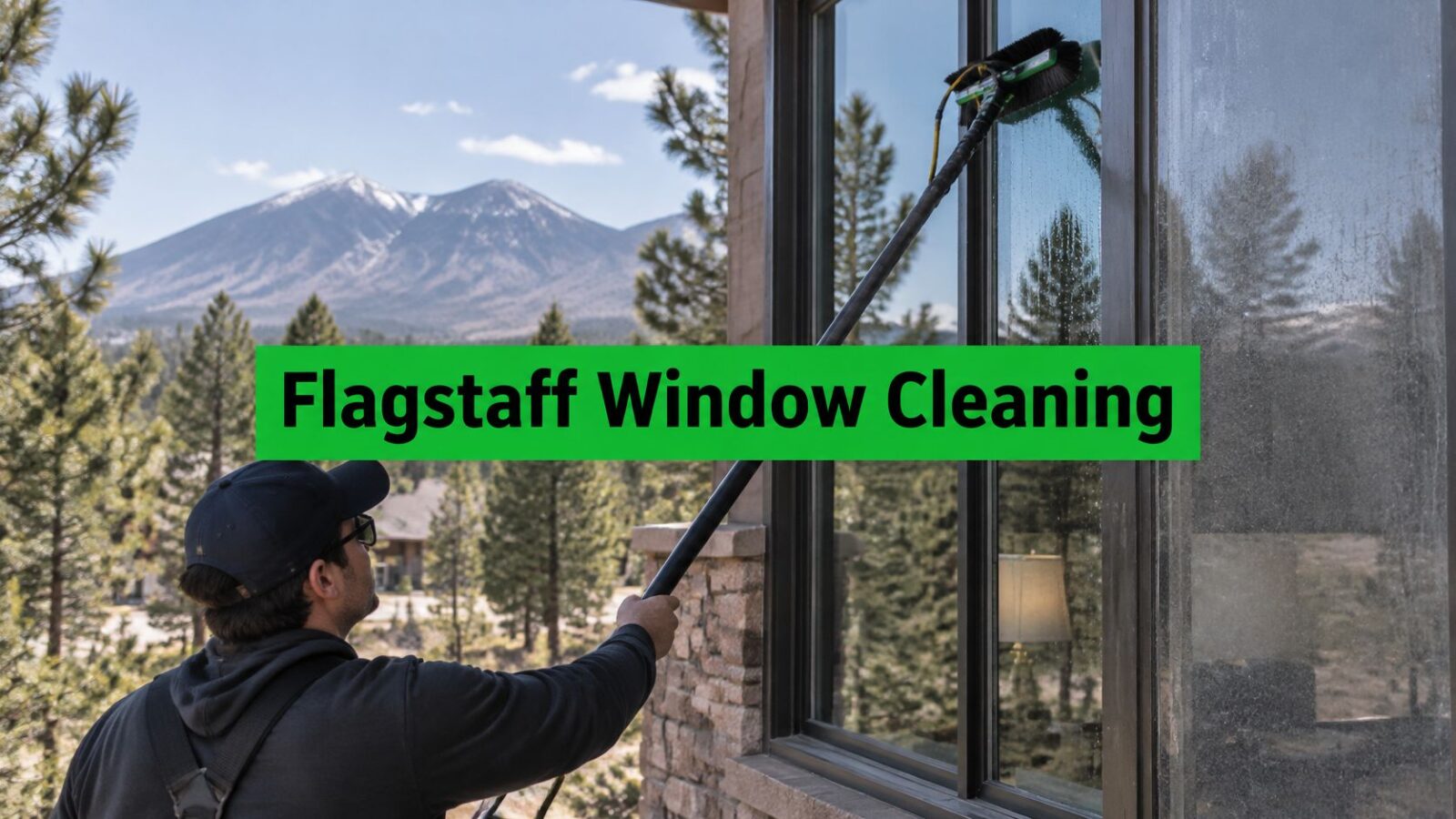
You're looking out at the pines on a bright Flagstaff morning, and the view is there, but it's hazy. Dust sits on the outside glass, pollen has settled into the screens, and the second story panes haven't been touched since winter because there's no safe way to reach them from your sloped yard. That's the point where an outside window cleaning service stops being a cosmetic extra and becomes practical maintenance. Done properly, it clears the glass, cleans the screens, wipes the frames, and leaves your home cared for without you climbing, leaning, or guessing what's included.
What an Outside Window Cleaning Service Covers
Start by checking scope against your own windows, because pricing follows scope, not a flat rate. Our standard visit for a home covers the items in the left column below. Add-ons are quoted separately because each one needs different tools, products, or time.
| Item | Standard Service | Add-On |
|---|---|---|
| Outside windows | Included | Not applicable |
| Inside windows | Included | Not applicable |
| Bug screens removed, cleaned and reinstalled | Included | Not applicable |
| Outside and inside window frames | Included | Not applicable |
| Inside window sills | Included | Not applicable |
| Window tracks | Not included | Extra charge |
| Paint or stain removal from glass | Not included | Extra charge |
| Hard water removal | Not included | Extra charge |
| Sunscreen removal | Not included | Extra charge |
| Ceiling fans | Not included | Extra charge |
| Mirrors | Not included | Extra charge |
What's Included in a Standard Visit
When we come to your home, we clean outside windows and inside windows, remove, clean, and reinstall bug screens, wipe inside and outside window frames, and wipe inside window sills. That's the complete standard package. You don't need to take screens down yourself or wipe frames after we leave.
Residential window cleaning is our most popular service, so this scope fits most houses, cabins, and second homes. Commercial and post-construction jobs work differently. We scope those to the building, elevation by elevation, rather than applying a standard house package to a hotel, campus, or newly built property.
Why Add-Ons Are Priced Separately
Window tracks hold compacted dirt, pine needles, and dead insects that need detail work beyond wiping a sill. Paint or stain removal and hard water removal call for careful methods that protect the glass surface while breaking down deposits a normal wash won't shift. Sunscreen removal, ceiling fans, and mirrors each add handling time outside the window itself.
Practical rule: List every add-on you want before the estimate visit, so the quote matches the job you actually want done.
A quote depends on four things, the number and height of panes, the access method needed, the add-ons you request, and whether the job is residential, commercial, or post-construction. We don't publish exact dollar figures in a guide like this because a single story ranch and a steep lot cabin with tall picture windows aren't the same job. Your free estimate sets the price for your property, with standard items and add-ons named separately so you can compare line by line.
Tools and Access Methods for Every Height
The right tool depends on height and access, not habit. A ground floor pane beside a flat patio is a different job from a second story window over a roofline or a hotel atrium, and we plan each elevation accordingly.
| Building Type | Primary Access | Tool for Each Pane |
|---|---|---|
| Single-storey home | Ground-level pole and ladder | Squeegee and pure-water brush |
| Two-storey home | Extension pole and ladder | Squeegee and pure-water brush |
| Sloped or landscaped lot | Water-fed brush on pole | Pure-water brush, fewer ladders |
| Hotel, campus or dealership | Boom lift or scissor lift | Squeegee and brush from platform |
| Atrium or multistory facade | 95-foot atrium lift | Squeegee and brush from lift |
Squeegees, Poles, and Pure Water
Our professional window washing process uses traditional squeegees for controlled water removal, ladders and extension poles for access, and water-fed brushes supplied by a pure-water system for high or difficult-to-reach panes. A squeegee pulls water off in a controlled pass and leaves an edge that dries clean, which is why it's still the right finish on glass a technician can reach directly.
The pure water comes from multi-stage filtration that removes dissolved minerals and other impurities from tap water. Because that water carries no mineral residue, the final rinse dries without the spotting hard water deposits leave behind. If you want the technical detail on how that system reaches upper panes from the ground, our guide to water-fed pole window cleaning explains the setup.
Water-fed brushes matter most on sloped lots and around landscaping. They reduce the need to place a ladder beside every pane, so we're not setting ladder feet in planting beds or leaning equipment against your siding just to reach one awkward window.
Powered Access for Large Buildings
For large or high work we use in-house boom lifts, scissor lifts, and a 95-foot atrium lift. Those suit hotels, campuses, dealerships, and multistory facades where pole reach runs out and a stable platform is the safer choice.
I would ask any crew one simple question before booking. Which method do you plan to use for each part of my building? A clear answer, elevation by elevation, shows the access was planned rather than improvised on arrival.
How a Crew Cleans Outside Glass Step by Step
Order matters on exterior glass. Wash before grit is loosened and you drag abrasive particles across the pane. Leave screens in place and the edges stay blocked. A crew works in a fixed sequence for those reasons, from the first walk-through to the final check.
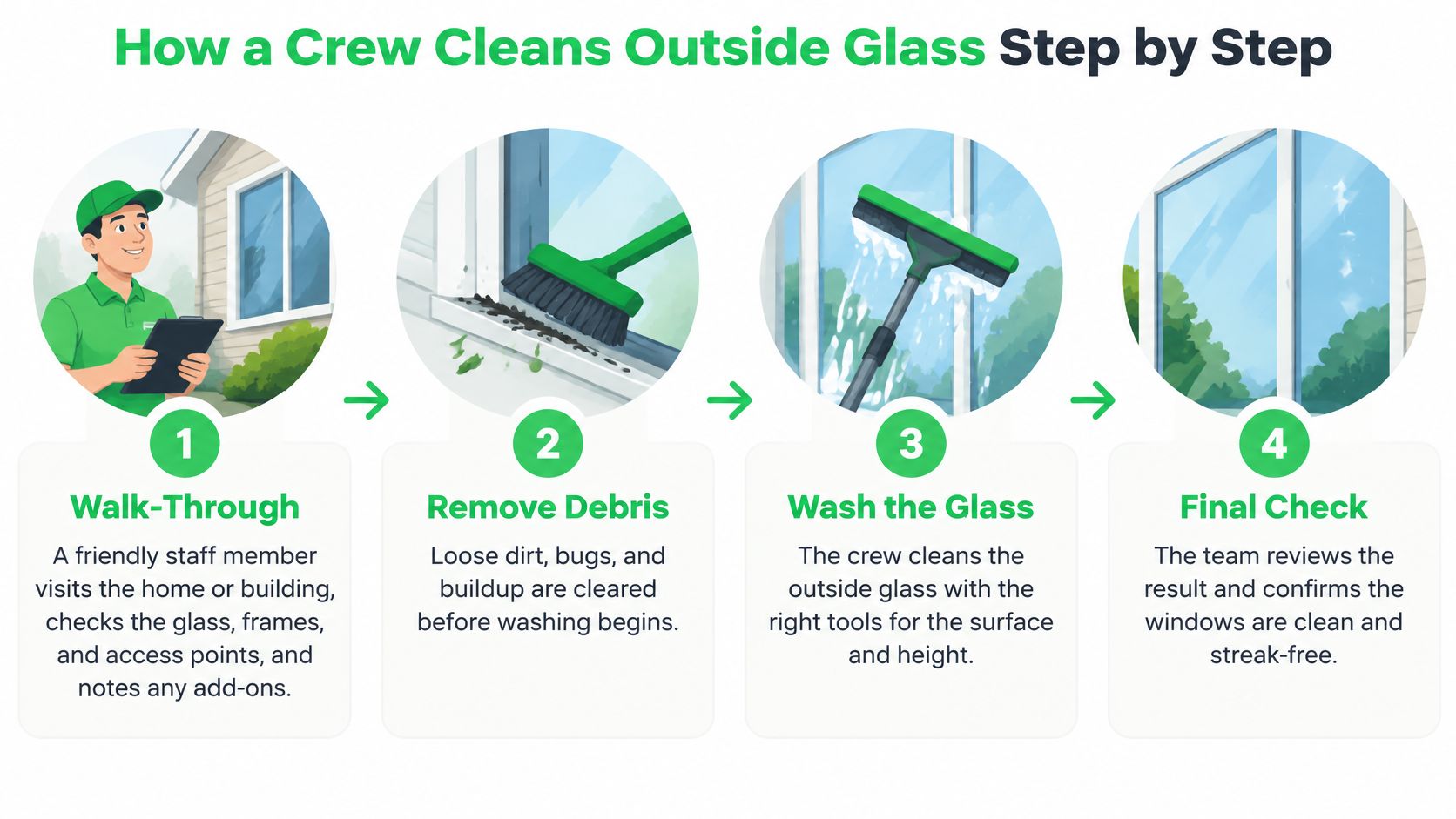
Walk-through first. When you call or schedule online, a staff member comes out to look at your home, building, or project. The crew checks the glass, frames, and access points, and notes any add-ons before work is booked. That conversation settles height and scope before cleaning day, not after the ladders are up.
Remove the bug screens. Screens come out before any glass is cleaned and are set aside in order so each one returns to its own window. Removal and reinstallation are part of the standard service, not an extra you have to remember to request.
Loosen dust, pollen, and grit. Loose buildup is cleared from frames and glass first. Skipping this step is how scratches happen: grit trapped under a squeegee or brush gets dragged across the surface. A dry pass over the frames and a pre-rinse on the glass keep the abrasive material moving off the pane instead of into it.
Clean the glass at the right height. Reachable panes get a squeegee finish from a ladder. High or awkward panes get pure water delivered to the top of a pole fitted with a soft brush, using water filtered to remove contaminants and minerals. The brush scrubs while the water rinses, so dirt comes off and runs clear. The trade-off is water volume: the pole method uses more water than a bucket and squeegee, but it keeps ladders off fragile planting beds and steep slopes.
The short video below shows that washing stage in action, so you can see the pace and control involved rather than picturing a quick spray and wipe.
Wash each screen separately. Our screen removal, cleaning, and reinstallation procedure washes screens independently to remove accumulated dust, pollen, and grime, then rinses them completely so no cleaning residue remains. A dirty screen reinstalled over clean glass puts the haze right back. Screen washing is slow, unglamorous work, and it is the difference between glass that stays clear and glass that looks dirty again in a week.
Final rinse and edge work. A last pure-water rinse clears the pane, then the squeegee pulls along the edges where water collects. Edges are where streaks start, so they get deliberate attention rather than a hopeful glance. The final pass has to overlap the previous one; a gap between strokes leaves a line that shows up as soon as the glass dries.
Reinstall screens once dry. Screens go back only after both glass and screens are dry. Taking them out first gives clear access to the glass edges, so the crew is not working around a frame that blocks the squeegee.
Wipe frames and sills, then check. The crew wipes inside and outside frames and inside sills, then reviews the glass from inside and out. You are left with glass that is clear from the street and from your couch, screens back in place, and frames and sills wiped clean. Window tracks are not part of the standard visit; ask for them as a separate add-on if you want them cleaned.
Caring for your home runs through every step. Screens are set aside carefully. Ladders and poles stay out of planting beds where access allows. Frames and sills are treated as parts of the house, not obstacles to work around.
Safety Standards for Work at Height
Working at height is an occupational hazard, and the record is plain about it. The U.S. Occupational Safety and Health Administration accident database records a fatal incident on November 7, 2019, involving an employee who fell from the roof of a 12-story high-rise while performing window-washing work. A separate OSHA investigation reported an East Boston window cleaner died after a 29-story fall in October 2023, and investigators determined the employer had failed to ensure personal fall-protection equipment and a rope-descent system were properly inspected and maintained.
The visual below summarizes the controls that should be in place before anyone leaves the ground at your property.
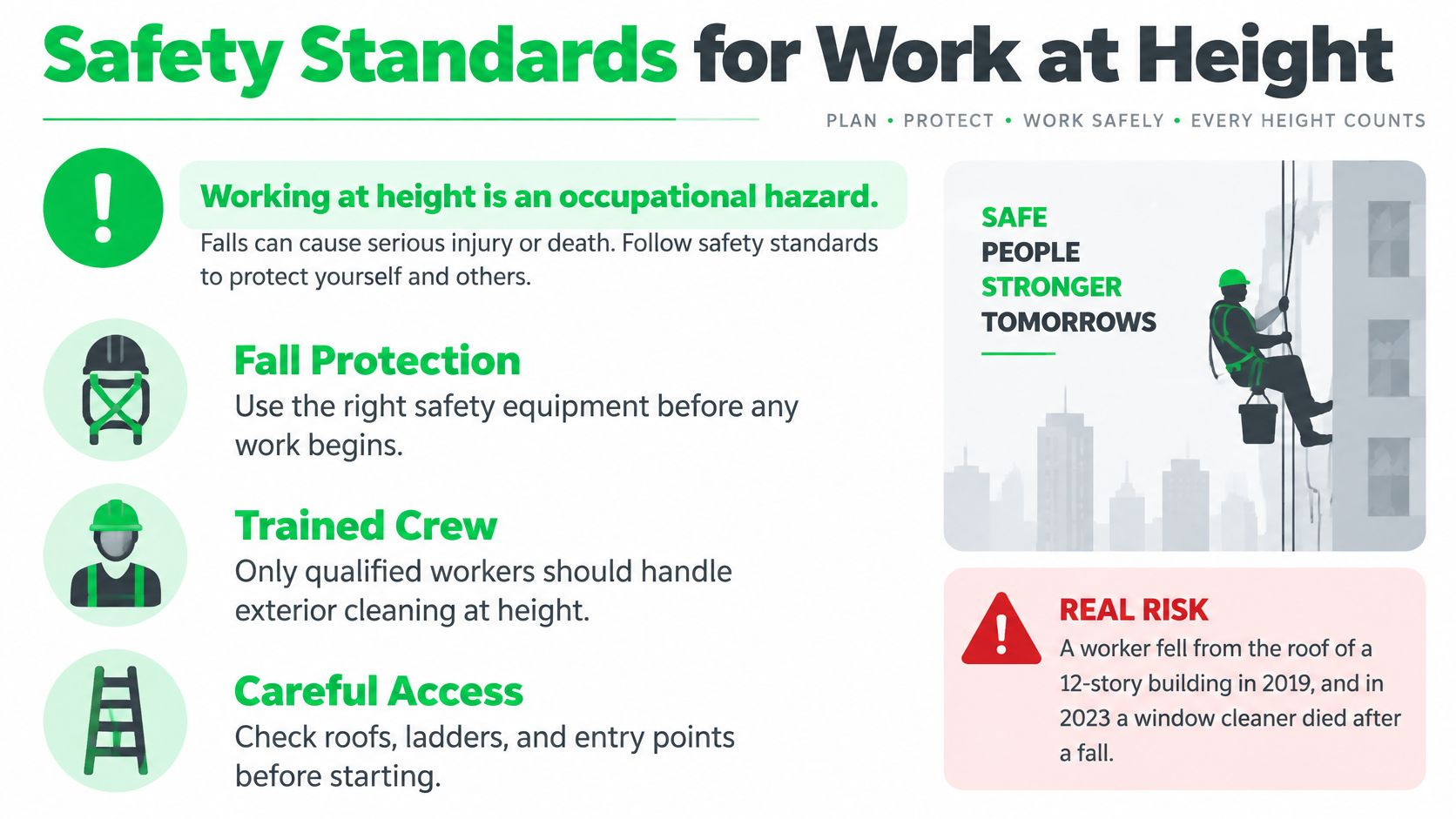
Six Controls to Expect on Any Job
- Trained operators only. OSHA aerial lift guidance states only trained and authorized workers may operate aerial lifts, and the work zone must be inspected for hazards before use. Our window cleaners have all been background checked and industry safety trained.
- Platform discipline. Workers keep access gates closed, stand firmly on the platform floor, and never use ladders or planks to increase reach. Our page on ladder safety requirements covers the same discipline for ladder work.
- Correct harness attachment. A body harness or restraint belt with a lanyard attaches to the boom or basket, not to an adjacent structure.
- Inspected fall protection. OSHA fall-protection guidance says personal systems must be inspected before initial use during each work shift, defective components must be removed from service, and fall-arrest systems must be rigged so a worker cannot free-fall more than 6 feet (1.8 m).
- A rescue plan. Employers must provide prompt rescue after a fall, so the plan exists before work starts, not after an incident.
- A weather plan. Wind, snow, and ice change what's safe in Northern Arizona. Stable, level setup surfaces and protection against runoff freezing on walkways belong in the plan.
Ask us to describe these controls for your property before work starts. A crew that can't explain its access and rescue plan hasn't finished planning your job.
When Smoke and Dust Call for a Cleaning
More frequent cleaning isn't automatically better. During active smoke or a stretch of dusty wind, a fresh wash can be spoiled within hours, and poor air quality is the wrong time to put a crew on ladders or a lift. Waiting for the event to pass gets more out of one visit than two bookings made while the air is still thick.
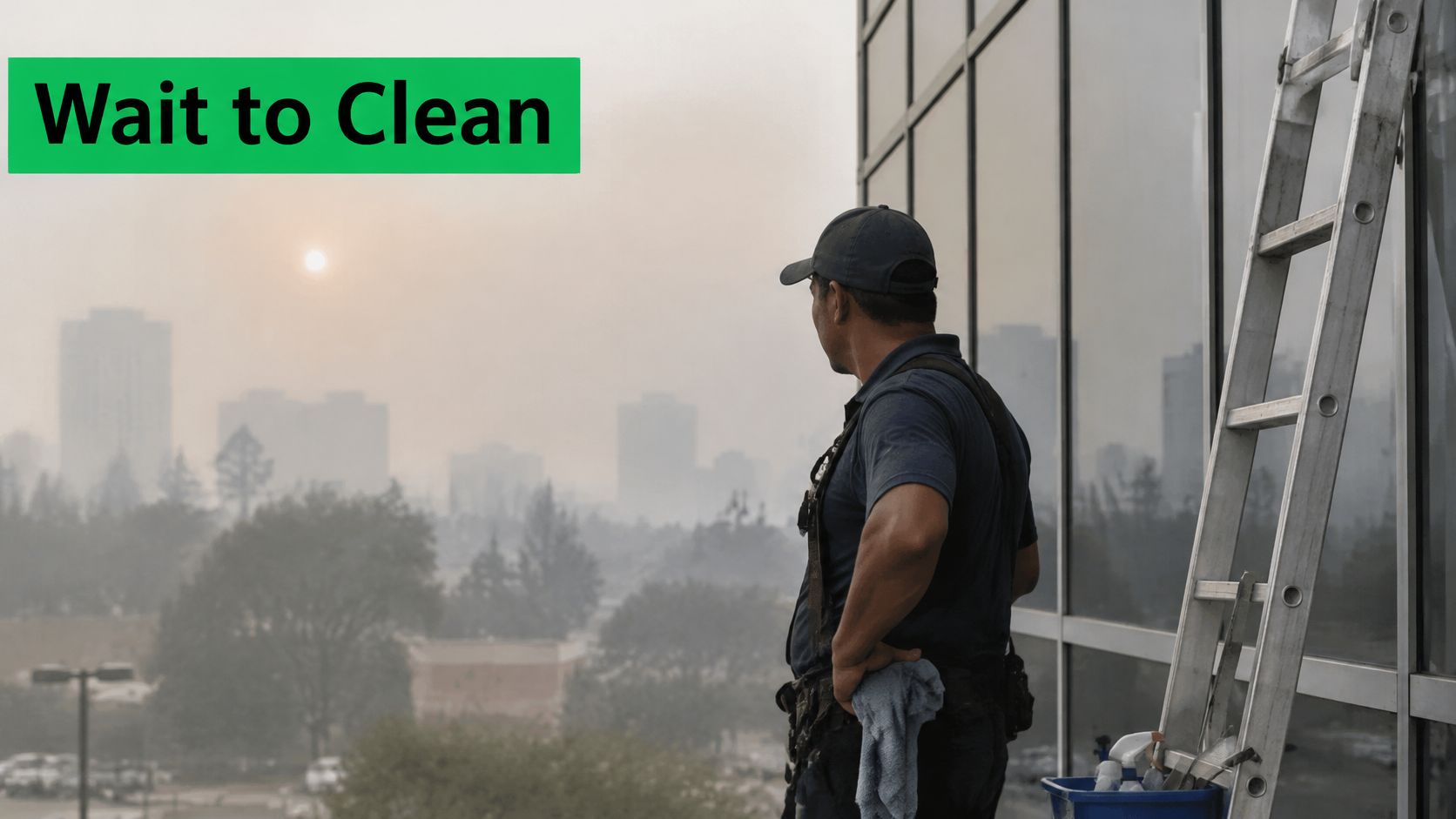
Dust and smoke residue behave differently on glass. Wind-borne dust sits loose on the surface and rinses away with the first pass of a wet brush. Ash and fine particulate are a different job: they settle into screen mesh, frame corners, and tracks, and wiping them dry grinds the grit across the pane. Flagstaff sits downwind of wildfire smoke and prescribed burns often enough that this pattern repeats most seasons.
| Trigger | When to Schedule | What to Check |
|---|---|---|
| Visible ash deposit on glass | After the air clears and winds calm | Glass, screens, sills and tracks |
| Prolonged dusty winds | Once winds have settled for several days | Exterior frames and screens |
| Nearby prescribed burn | After the burn ends and smoke has dispersed | Glass edges and tracks |
| Guest complaints about hazy views | Within a week of the complaint | Full exterior glass |
| Seasonal dust and pollen | Routine spring and fall service | All exterior glass and screens |
Acting on Each Trigger
After any smoke or dust event, inspect glass, screens, sills, tracks, and exterior frames, not just the center of the pane. Ash lodges in screen mesh and along the edges, so a glass-only wash leaves residue that works its way back onto the surface with the next breeze through an open window. Screens come off, get rinsed, and go back on as part of a standard residential visit. Tracks are quoted separately, because digging packed ash and grit out of a channel is slow work that a routine wash doesn't cover.
Second-home and short-term-rental owners run into a different problem. You may be away from Flagstaff, Munds Park, or Forest Highlands when smoke settles, and the first signal is a guest message about a hazy view. Have a neighbor or property manager report visible residue after an event, then book once the air has cleared, rather than stacking cleanings on a fixed calendar. I'd rather quote a job for the first clear day than send anyone up a ladder into a smoke plume, and our schedule moves fast enough that waiting a day or two costs you nothing.
Use the calendar for routine spring and fall service, and use the triggers for everything else.
Budget follows the same logic. One well-timed post-event cleaning does more than two visits squeezed in while ash is still falling, and it keeps your listing photos honest about the view guests are paying for.
Benefits and Written Scope for Commercial Glass
For homeowners, the payoff is straightforward, clear views, better daylight in the rooms you live in, and a house that looks cared for from the street. For businesses, glass is part of the first impression. Clean storefront and lobby windows match the standard tenants, guests, and customers expect, and routine service gives technicians a close look at frames and seals while they're already at the glass.
An Honest Limit on Energy Claims
Cleaning doesn't replace a glazing upgrade, and we won't claim it does. Lawrence Berkeley National Laboratory reported in 2025 that commercial-building windows influence loads representing more than 6% of annual U.S. primary energy use, while typical nationwide window upgrades were estimated to save about 4% to 6% of site energy. Washing glass can't produce savings of that kind.
What cleaning does is support inspection. Clean glass and maintenance records help managers identify failed seals, damaged frames, obstructed daylight, and access problems before they become capital projects. That documentation habit sits naturally inside a broader commercial cleaning contract rather than a series of one-off callouts.
What to Request in Writing
We offer commercial window cleaning for homes, businesses, hotels, NAU facilities, car dealerships, high rise buildings, and medical buildings. For any of those properties, I'd put these items in writing before the first visit.
- Written scope. Which facades, entrances, and interior glass are included on each visit.
- Access method per facade. Pole, ladder, boom lift, scissor lift, or atrium lift, named building face by building face.
- Equipment plan. Where lifts will set up, how ground surfaces are protected, and how overhead obstructions are handled.
- Technician training. Confirmation of documented safety training for the crew assigned to your site.
- Insurance. Current coverage on file with your facilities team before work begins.
- Exclusion zones. Pedestrian and vehicle areas kept clear below overhead work, with signage where needed.
- Recurring documentation. Visit records noting glass and frame condition, so trends are visible across the year.
Send that list with your first inquiry. You'll get comparable answers, and the recurring schedule that follows will run on an agreed scope instead of assumptions.
Book a Free Estimate for Your Flagstaff Windows
A free estimate is only useful if it matches the glass you really have. Before the walk-through, know who is coming out and what the visit covers.
Pine Country Window Cleaning has been locally owned and operated since 1999. Our published company history dates the business to that year and covers the Flagstaff work since. That local tenure matters when a home has older glass, painted frames, or hard-water film that needs a different approach from a standard wash.
We clean windows in Flagstaff and have worked in Munds Park for more than 20 years. The crew handles homes, cabins, hotels, NAU facilities, car dealerships, medical buildings, and high-rise properties across Northern Arizona. In-house boom lifts, scissor lifts, and a 95-foot atrium lift let the same team move from a cabin pole-and-brush job to a multistory facade. We guarantee our work, so if something does not look right, call us back to it.
How Booking Works
- Call or schedule online. Reach us at (928) 527-0671 or book through the website. If you run a trade or property business and miss calls while you are on a job, a contractor answering service from SkipCalls is worth a look, since a missed estimate request usually goes to whoever answers first.
- We visit and look. A staff member comes out to check your glass, frames, screens, and access points in person.
- You get a free estimate. We offer a free estimate when you call to schedule, and it lists standard items separately from add-ons. Compare it against your own scope list, and confirm every add-on you want before work begins.
- We schedule around conditions. Cleaning is booked around your access plan, the weather, and any smoke or dust event, so the result lasts instead of being undone the same afternoon.
Book before the next visit is overdue, not after a guest, tenant, or buyer points at the glass.
Bring your scope list to that first call. Outside glass, inside glass, screens, frames, sills, plus any tracks, hard water, or paint removal you have noticed. The clearer that list is, the more exact your estimate will be, and the easier cleaning day runs for everyone.
If your Flagstaff windows are due, we would be glad to look at them in person and give you a free, itemized estimate for exactly the scope you want. Our crew cleans outside and inside glass, removes, cleans, and reinstalls your screens, and wipes frames and sills as part of every standard visit. Visit Pine Country Window Cleaning to schedule online or call, and we will set up your walk-through.