

You're probably reading this because something already overflowed, stained, iced over, or drew a complaint. A gutter spilled onto a deck during a storm, a storefront looked dull on a busy weekend, or a cabin sat closed all winter and nobody can say what was checked. That's how most owners meet building maintenance services, as an emergency call. In Northern Arizona, I'd treat them differently, as an asset-protection schedule tied to snow load, pine needle drop, dust, and monsoon runoff.
What Building Maintenance Services Include
Say you own a Flagstaff cabin and you only call when the gutters overflow onto the deck. By then water has already run where it shouldn't, and the visit is cleanup plus damage control. A scheduled program flips that order. The crew clears drainage before storms, cleans glass before grit bakes on, and notes small defects while they're still cheap to fix.
Core Building Maintenance Services at a Glance
| Service | What It Covers | Typical Frequency | Property Types |
|---|---|---|---|
| Window cleaning, inside and outside | Glass, frames and sills; screens removed, cleaned and reinstalled | Residential: 2 to 4 times a year; commercial: monthly to quarterly | Homes, cabins, offices, hotels |
| Gutter and downspout cleaning | Debris, pine needles and downspout flow checks | Spring and fall in pine-heavy areas | Homes, cabins, commercial roofs |
| Pressure washing | Driveways, sidewalks, garages, roof shingles, eaves and siding | 1 to 2 times a year | Homes, storefronts, campuses |
| Post-construction window cleaning | Glass and frames after a build or remodel | Once, before occupancy or listing | New builds, remodels, pre-listing |
| Roof and exterior inspection | Flashing, sealant, drainage and visible damage | Once a year, plus after major storms | All property types |
| Snow removal and shoveling | Driveways and sidewalks; large lots referred to specialists | After each significant snowfall | Homes, cabins, commercial sites |
| HVAC filter and ventilation checks | Filters, outdoor-air pathways and vents | Filters quarterly; full service annually | Offices, hotels, medical buildings |
Read that table as a scope to keep on a calendar, not a menu you order from after a failure. Window cleaning protects glass and frames, gutter cleaning protects siding, fascia, and foundations, and inspections connect the two. If a service only happens when someone notices a problem, you're paying late.
The cost frame backs this up. The Association of Physical Plant Administrators reports that, over a 40-year building life span, design and construction represent approximately 14% of total costs, while operations and maintenance account for the remaining 86%. In other words, what you spend running and preserving the building dwarfs what you spent building it. That same source identifies the building sector as responsible for 36% of total energy use in the United States, so upkeep also shapes energy performance, not just appearance.
The HVAC Note Most Owners Skip
Filter and ventilation checks matter most in offices, hotels, and medical buildings because indoor air is a performance issue. The U.S. EPA Building Assessment Survey and Evaluation study examined 100 randomly selected public and commercial buildings across 37 cities in 25 states, collecting data on pollutant concentrations, occupant symptoms, ventilation, and HVAC maintenance and operation. Inspect air-handling units and outdoor-air pathways, verify ventilation runs as designed, control moisture, and record every filter change.
Do a quick self-test before you read further. Mark which services your property already gets on a schedule, and which ones you've never booked. If gutters, inspections, or filters fall in the second column, that's your starting list.
Preventive vs Reactive Maintenance Compared
Say a Flagstaff hotel finds a brown stain spreading across its ballroom ceiling on a Friday afternoon. A roof drain clogged weeks earlier, nobody logged it, and now the room closes for a weekend of repairs and drying. Guests get moved, staff improvise, and the bill arrives at emergency rates.
Contrast that with a hotel that clears drains on a calendar. A technician finds the same partial blockage during a routine visit, clears it in an hour, and photographs the drain flowing freely. The ballroom never closes. Same building system, completely different outcome, because one property paid for timing and the other paid for urgency.
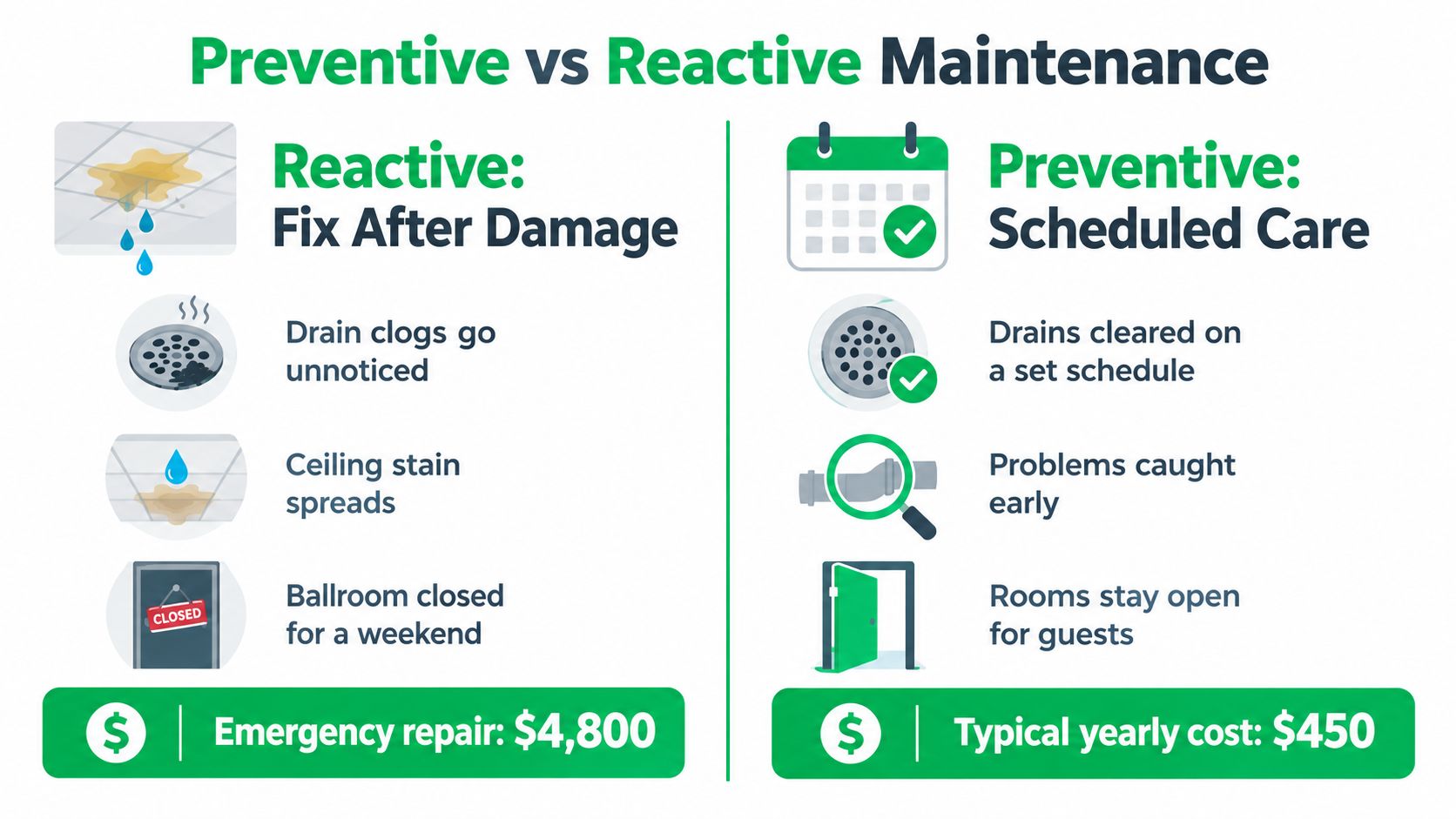
Preventive vs Reactive Maintenance by Decision Factor
| Factor | Preventive Maintenance | Reactive Maintenance |
|---|---|---|
| Trigger | Calendar date or manufacturer interval | Failure, leak or complaint |
| Budget pattern | Planned and spread across the year | Irregular, often urgent pricing |
| Disruption | Scheduled around guests, tenants or occupancy | Unplanned closures and emergency access |
| Effect on asset life | Slows deterioration; NIST model cites about 1% a year from year 11 | Deterioration accelerates to 3% a year; expected life falls to 16 years |
| Best for | Windows, gutters, drainage, HVAC, roofs | Active leaks, failed equipment, safety hazards |
Preventive work buys you choice about timing. Reactive work takes that choice away.
The asset-life row deserves a closer look. A NIST life-cycle-cost model assumes equipment receiving manufacturer-specified preventive maintenance deteriorates at approximately 1% annually beginning in year 11, whereas deferred maintenance accelerates deterioration to 3% annually and reduces expected service life to 16 years. The model also indicates deferred maintenance increases operation-and-maintenance costs and produces more frequent, more expensive repair and replacement events. Treat maintenance schedules as asset-preservation controls, not discretionary cleaning expenses.
For exterior work, translate that penalty into consequences. A missed gutter cleaning on a single-story home might cost you an overflow stain. A missed roof-drain check on a flat commercial roof can put water inside occupied rooms. I would prioritize high-consequence assets first, document manufacturer intervals, assign a named owner for each task, and track missed tasks as financial risk. If you want more detail on preventive maintenance versus run-to-failure, Facility Management Insights lays out that trade-off clearly.
My Verdict by Situation
- Active leaks, failed equipment, and safety hazards: Respond reactively first, stabilize the problem, then move the asset onto a schedule.
- Windows, gutters, drainage, and roofs: Keep these preventive, because failure shows up as water damage or closures.
- Second homes empty most of winter: Skip fixed monthly visits and use documented checks after major storms instead.
- Cosmetic-only work: Schedule it last, but don't confuse dirty glass with harmless glass if grit and hard water are building up.
Seasonal Maintenance Schedule for Northern Arizona
Flagstaff doesn't reward a generic national calendar. Snow load, freeze-thaw cycles, spring dust, pine needle drop, and summer monsoon runoff each change which task matters most in a given month. Use the windows below and adjust the exact weeks to your elevation and tree cover.
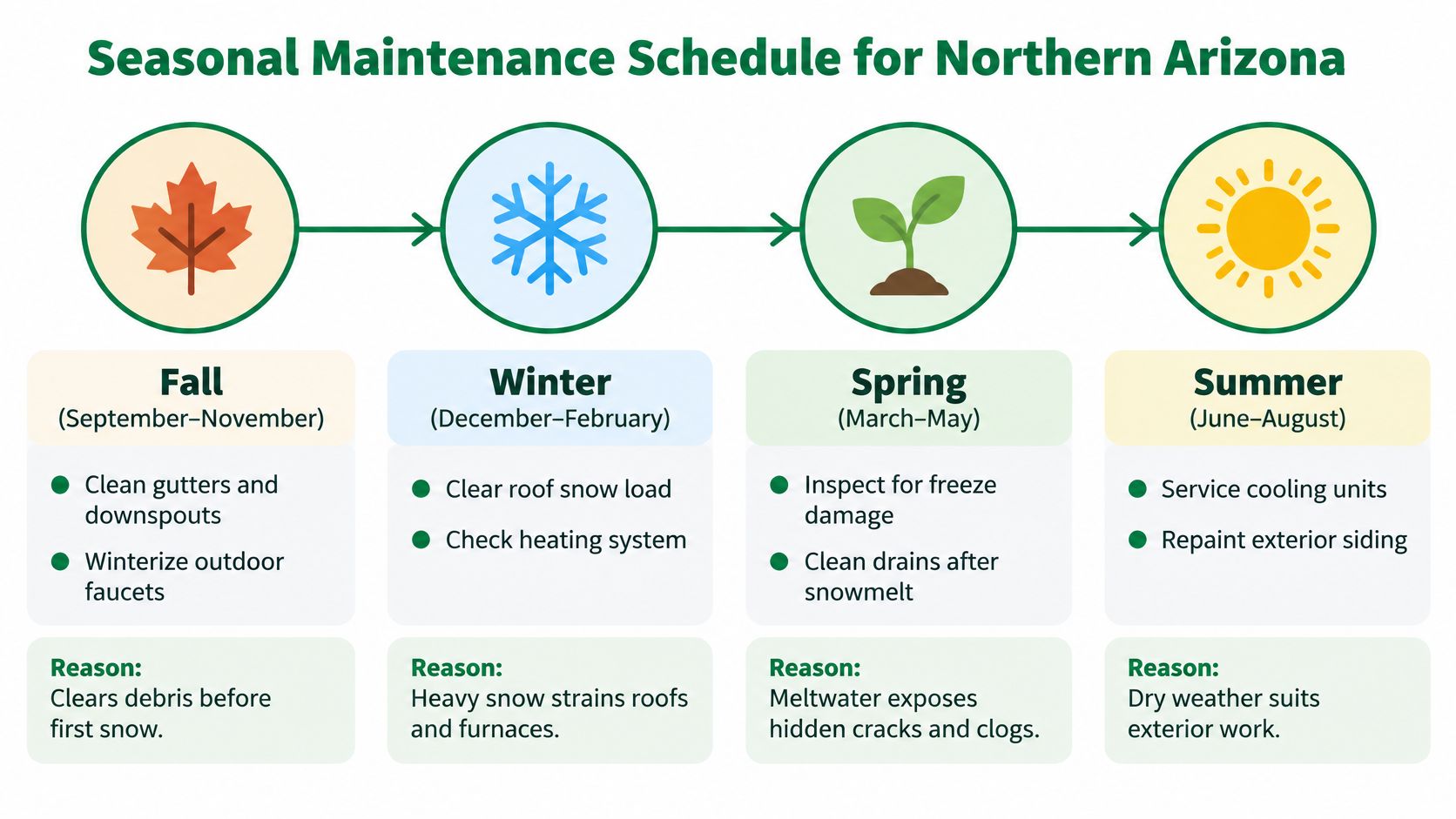
Seasonal Maintenance Calendar for Northern Arizona Properties
| Season | Priority Tasks | Why This Timing |
|---|---|---|
| Spring (March to May) | Window cleaning after winter dust; pressure washing; gutter clearing after snowmelt debris | Dust and grit build up over winter; warm, dry days make washing practical |
| Summer (June to August) | Roof and flashing check; sealant review; drainage clearing before monsoon | Monsoon storms bring fast runoff and debris |
| Early fall (September to November) | Gutter and downspout clearing after pine needle drop; eave inspection; snow equipment check | Drainage must be clear before freezing and snow load arrive |
| Winter (December to February) | Snow and ice removal; check for ice damage and blocked drains after storms | Snow load and freeze-thaw cycles stress surfaces; no pressure washing below freezing |
Say you manage a Munds Park second home that's closed from November to April. Book the gutter clear in late October, after pine needle drop but before the first hard freeze, so channels don't hold water that turns to ice. Then set a snow check after every significant storm, with photos of the driveway, roof edges, and downspout outlets sent to you. In April, open with window cleaning, a gutter flush for snowmelt debris, and a walk around the siding and foundation.
That example shows the cadence rules. Residential exteriors usually run a spring and fall package, while commercial glass runs monthly or quarterly depending on foot traffic and visibility. A vacant property doesn't need less frequent checks. It needs documented checks, because nobody is on site to spot a stain or an overflow early. Our guide to seasonal property maintenance shows how we sequence these visits for Northern Arizona properties.
Two cautions save real money. Don't pressure wash below freezing, because water left in cracks and joints can freeze and widen them. Don't schedule roof work during an active storm, because wet, windy surfaces turn a routine inspection into a fall risk.
Practical rule: If a task protects drainage, book it before the season that stresses drainage, not after.
Finish by writing each season's dates into a shared calendar with your vendor. Put the task, the asset, and the person who confirms completion on each entry. A calendar invite that just says maintenance helps nobody in October.
Window Cleaning and Screen Service Explained
A finished visit should be obvious without anyone explaining it. The pane is streak-free, the screen sits back in its frame, the sill is wiped clean, and the room looks brighter because light isn't fighting a layer of dust. Getting there takes professional equipment and a set sequence, not improvisation at each window.
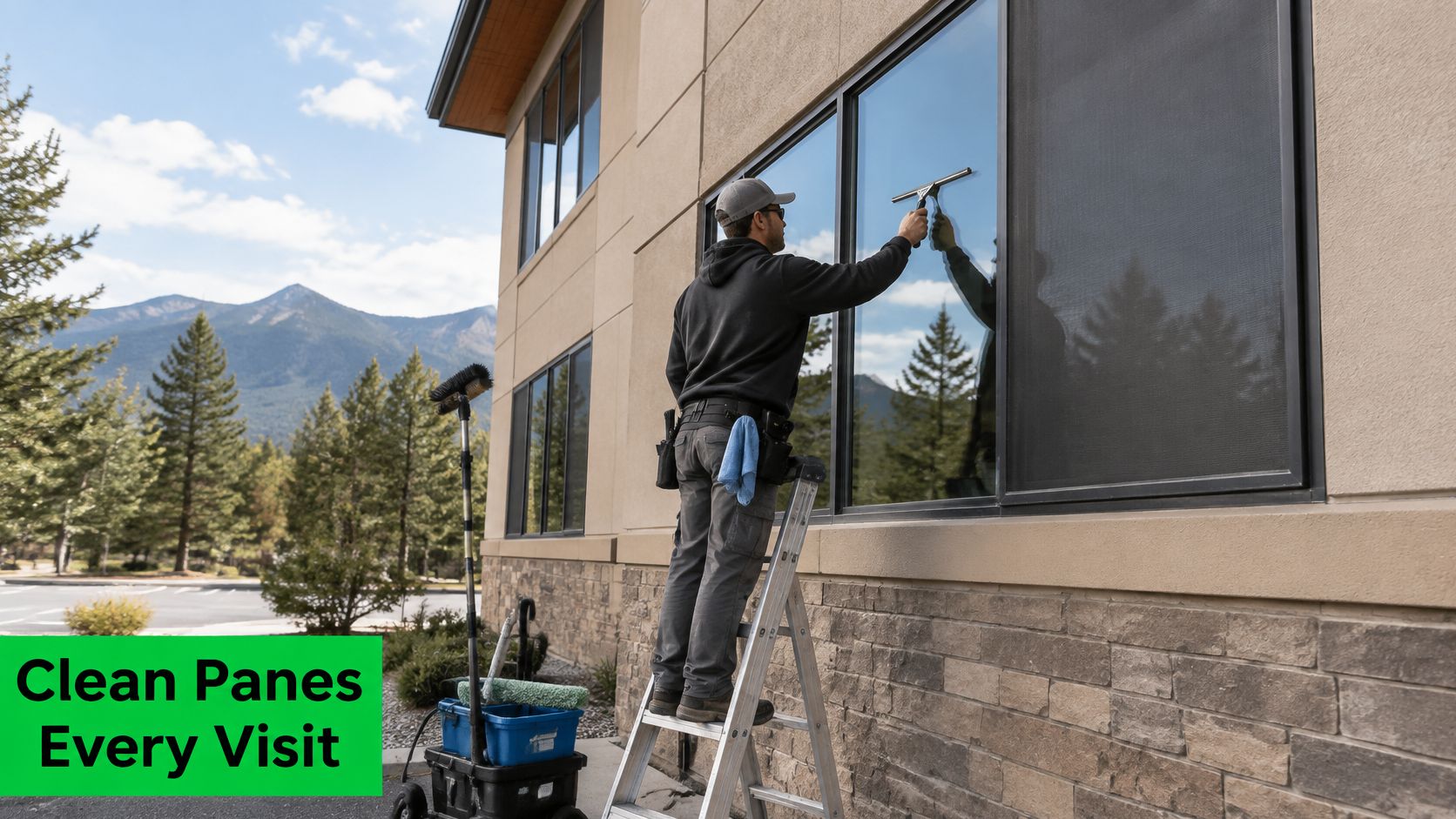
Our crews work with squeegees, ladders, poles, and pure-water brushes, and we bring lifts for height. We own boom lifts, scissor lifts, and a 95 ft. atrium lift to reach tall glass safely and efficiently. The right tool depends on access, ground surface, and how close we can position equipment to the building.
The photo below shows the kind of controlled ladder work a typical exterior visit involves.
What a Standard Visit Includes
When we come to your home, we follow the same order every time so nothing gets missed.
- Clean outside glass using squeegees, poles, or pure-water brushes matched to the height.
- Remove screens and clean them away from the opening so dirt doesn't wash back onto the glass.
- Clean inside glass with care for floors, furnishings, and window treatments.
- Reinstall screens in their original frames and check the fit.
- Wipe inside and outside window frames to remove dust and debris loosened during cleaning.
- Wipe inside window sills so the finished opening looks complete, not just the pane.
We remove, clean, and reinstall screens with every service because the screen is part of the window opening. Screens collect outdoor dust, pollen, insects, and debris while sitting in the path of incoming air. The U.S. Environmental Protection Agency guide to indoor air quality identifies dust and other indoor pollutants as contributors to indoor-air-quality concerns and recommends controlling pollutants and keeping indoor areas clean and dry. Cleaning the screen, frame, and surrounding sill supports a cleaner opening and cleaner air moving through it.
How We Care for Your Home
Technique matters, but so does how a crew treats the property. We protect interior surfaces, move carefully around landscaping, and check that screens seat properly before we leave. If we spot a damaged seal, cracked pane, or clogged track area, we tell you rather than cleaning over it and saying nothing.
The short video below shows our approach on a real service visit.
Extras Billed Separately
Some work sits outside standard window cleaning, and customers pay extra for it. Knowing the list upfront prevents surprise line items.
- Window tracks: Deep cleaning beyond wiping frames and sills.
- Paint or stain on glass: Careful removal that takes extra time and care.
- Hard water removal: Mineral deposits that regular cleaning won't lift.
- Sunscreen removal, cleaning, and re-installing: Separate handling from standard bug screens.
- Ceiling fans and mirrors: Interior items outside the window scope.
Before you book, list your actual problems window by window. Then ask which ones fall in the standard scope and which are extras. You'll get a cleaner quote, and we can bring the right equipment the first time.
Gutter, Downspout and Pressure Washing Work
Say a clogged gutter overflows during a spring storm at a pine-shaded home. Water sheets down the siding instead of draining away, leaves a dark stain, and keeps the wood at the base damp until it starts to soften. The gutter didn't fail dramatically. It just filled with needles until water found another path.
Gutter and Downspout Cleaning
Good gutter service has three parts. First, clear debris and pine needles from the channels, including the packed material that sits at outlets. Second, check that each downspout flows freely from top to bottom, because a clean gutter feeding a blocked downspout still overflows. Third, confirm the outlet discharges away from the foundation, not into a planting bed against the wall.
We provide gutter cleaning and pine needle cleanup, and our equipment lets crews finish the job quickly without scattering debris across decks and walkways. For commercial roofs, the same logic applies to scuppers and internal drains. Our commercial building exterior cleaning service covers how we handle larger rooflines and drainage runs.
Pressure Washing by Surface
We offer pressure washing for driveways, sidewalks, garages, roof shingles, roof eaves, and siding, but one pressure setting doesn't fit all of those surfaces. Match the method to the material.
Concrete driveways and sidewalks tolerate higher pressure. A rotating surface cleaner or a fan tip held at a consistent distance lifts tire marks, algae, and winter grit without striping the slab. Work in overlapping passes and rinse toward drainage, not toward the garage door seal.
Vinyl siding and painted surfaces need a gentler approach. Use a wide tip, lower pressure, and detergent doing more of the work, and spray downward at an angle so water doesn't drive behind laps. Eaves get the same treatment, because forcing water up under the roof edge creates the moisture problem you're trying to prevent.
Roof shingles are the surface owners damage most often. Clean them at low pressure or with a soft-wash approach, because high pressure strips protective granules and lifts tabs. If a contractor points a tight, high-pressure stream at your roof, stop the job. Granules in the gutter afterward are your roof's surface leaving early.
Three Checks After Service
- Downspouts drain freely: Run water and watch each outlet discharge without backing up.
- No pooling at the foundation: Walk the perimeter and confirm water moves away from walls.
- Shingles intact: Check that no tabs are lifted and granules aren't collecting in the gutters.
If any check fails, fix it while the crew and equipment are still on site. It's far cheaper than booking a return visit after the next storm.
What Building Maintenance Costs and Why
Owners often ask why two quotes for the same building differ by a wide margin. Usually the buildings match but the scopes don't. One bid includes screens, frames, and lift time, while the other prices glass only and adds the rest later.
Cost Drivers for Building Maintenance Services
| Cost Driver | What Raises the Price | What Keeps It Lower |
|---|---|---|
| Height and access | Multi-story exteriors, atrium glass, boom or scissor lift work | Single-story homes reachable by ladder and pole |
| Scope | Window tracks, paint removal, hard water, mirrors, ceiling fans | Standard glass, frames, sills and screens only |
| Frequency | One-off visits or long gaps between services | Recurring schedule that prevents heavy buildup |
| Property size | Large floor area, many panes, multiple buildings | Single building with a defined scope |
| Site condition | Heavy pine needle load, construction residue, hard water | Regular upkeep keeps debris light |
| Timing | Emergency or same-week callouts | Work booked into the seasonal calendar |
Height and access move price more than anything else. Tall glass and atrium work needs boom lifts, scissor lifts, or our 95 ft. atrium lift, plus setup time and ground protection. A single-story home we can reach with ladders and poles costs less because the crew spends its time cleaning, not positioning equipment.
Scope is the second driver, and it's where comparisons break down. Extras such as window tracks, hard water removal, and mirrors are priced separately, so compare quotes line by line. If you manage several vendors, clear line items help here too, and the handyman invoicing examples from GetBill show how itemized invoices make scope differences visible. We don't beat or match written prices from other companies, which makes scope comparison more important than price matching. A cheaper quote that excludes screens or lift time isn't cheaper for the same job.
A Benchmark for the Budget Conversation
Use published benchmarks to justify preventive budgets, not as price promises. The U.S. Environmental Protection Agency ENERGY STAR business case reports high-performing buildings save approximately $0.60 per square foot annually in operations and maintenance expenses compared with typical buildings, plus $0.50 per square foot in janitorial expenses and $0.53 per square foot in utility expenses. Combined, that's $1.63 per square foot in potential annual savings. For a 100,000-square-foot commercial property, those averages imply about $163,000 in annual savings, although actual results depend on building type, climate, occupancy, and equipment.
I would treat that benchmark as a reason to fund scheduled service and track your own costs per visit. Your building's numbers will differ, but the direction is consistent. Small per-square-foot improvements multiply across large floor areas.
Vetting Vendors and Safety Duties
After a near miss, owners ask one question first. Who's responsible when a worker falls? The answer involves both the vendor's safety practices and your duties as the building owner, so sort it out before anyone climbs.
OSHA identifies ladders as regulated walking-working surfaces under 29 CFR 1910.23 and recognizes ANSI/IWCA 1-14.1 as the window-cleaning safety standard covering access equipment and related building-owner responsibilities, according to OSHA fall protection standards. Properly selected ladders, poles, and access systems, inspected by trained technicians, are part of a controlled professional process.
If work requires a ladder, a lift, or roof access, get the safety documents in writing before the crew arrives.
What to Verify and What You Owe
Check the vendor for OSHA training and background checks for technicians, a current insurance certificate, a clear method for inspecting ladders and lifts, and a commitment that crews won't work near power lines. Ask who supervises the job and how defects get reported back to you. Vague answers on any of these points should slow you down.
Your duties as owner are practical. Share roof access points, mark anchor locations, warn tenants or guests about work zones, and log known hazards in writing. If a walkway ices over or a roof hatch sticks, tell the crew before they discover it at height.
Seven Vetting Steps That Work
- Photograph and list exterior assets, including windows, gutters, downspouts, and access points.
- Set service intervals from your seasonal calendar, not from memory.
- Get a written scope of included and excluded items before quoting.
- Verify insurance and safety documents before the first visit.
- Require photos or notes after each visit showing what was done.
- Escalate active leaks and safety hazards the same day they're found.
- Review cost per visit against scope every quarter and adjust frequency where buildup is light or heavy.
We're Flagstaff's largest window cleaning company, founded in 1999 by Flagstaff native David Kaminski, and we've served Northern Arizona for more than two decades. Our staff come out to look at your home, building, or project after you call or schedule online, before we quote. For bigger snow jobs such as parking lots and commercial buildings, we refer customers to Flagstaff Snow Removal, and if you're not satisfied with our work, we'll return to remedy it. You can see how we approach dependable scheduling on our page about reliable cleaning services.
Bring your asset list and seasonal calendar when you request a free estimate by phone or online. We'll walk the property, confirm scope in writing, and agree on intervals before the first visit.
If your Flagstaff or Northern Arizona property needs scheduled window cleaning with screens removed, cleaned, and reinstalled, plus gutter cleaning, pressure washing, post-construction cleaning, or snow shoveling, we can build that into one seasonal plan. Visit Pine Country Window Cleaning to request a free estimate, and we'll come out to look at your home or building and put the scope in writing.