

Make Clean Windows Part of the Operating Plan
Clean commercial windows do more than improve a façade. They shape first impressions, support a brighter occupant experience, help staff spot visible maintenance issues, and show customers that the property is being cared for. The strongest plan combines professional squeegees and pure-water brushes with screen removal and reinstallation, safe ladder or lift decisions, coordinated scheduling, quality checks, clear vendor expectations, and seasonal maintenance.
That approach matters across Northern Arizona. A hotel, car dealership, medical building, university facility, retail storefront, and cabin portfolio all face different access, occupancy, weather, and presentation demands. Window cleaning should fit those operating realities instead of forcing every property into the same routine.
These commercial window cleaning tips focus on eight practical checkpoints, from squeegee control and high-reach equipment to screen care, safety planning, vendor communication, post-construction work, and seasonal scheduling. For additional context on keeping glass clear of mineral buildup, see this guide to spotless windows.
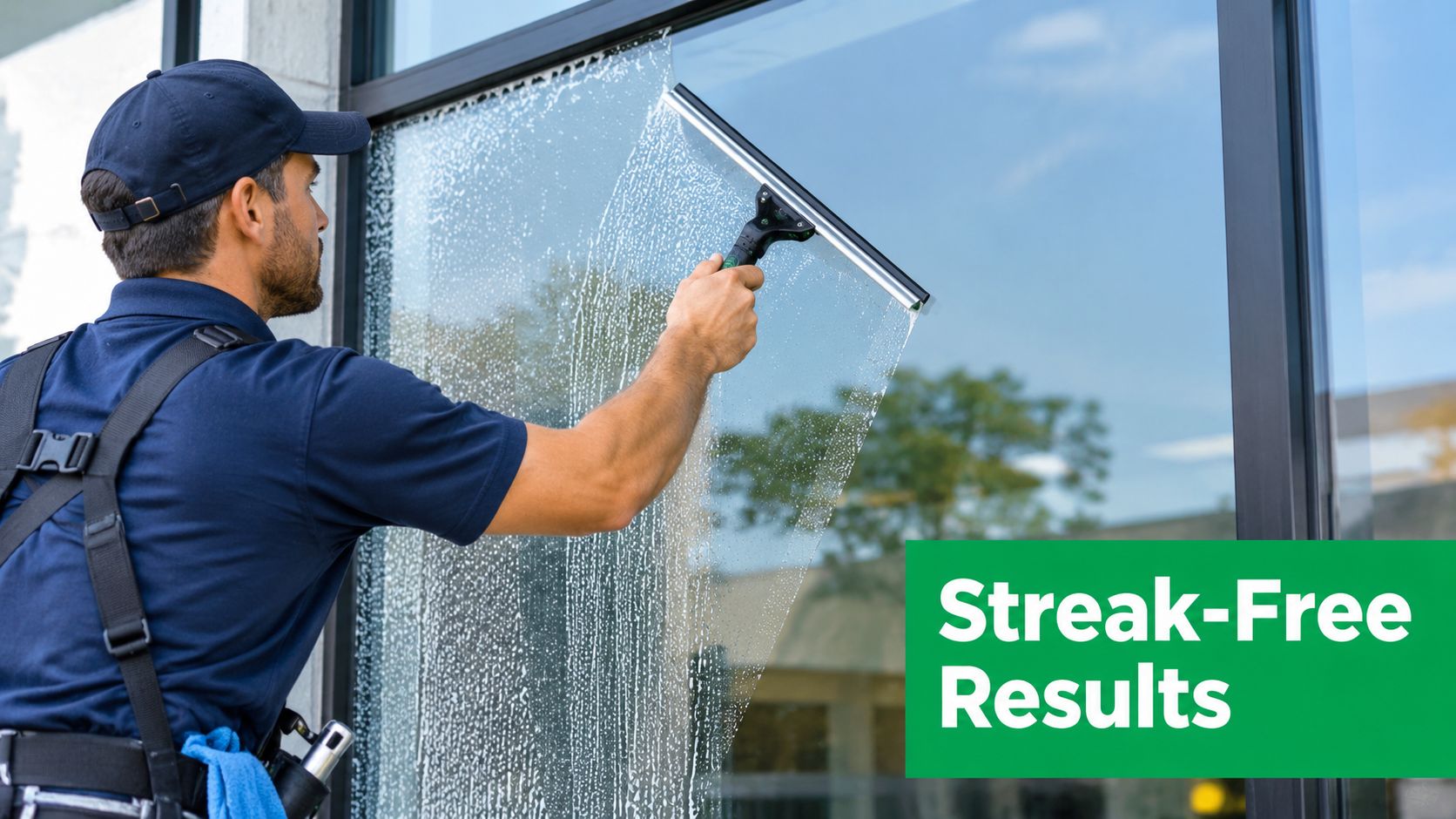
1. Mastering Squeegee Technique for Streak-Free Results
A professional squeegee does one job exceptionally well. It removes water and cleaning solution in a controlled pass, reducing residue and producing the clear finish customers expect from commercial glass. The result depends less on speed than on blade condition, pressure, angle, and coverage.
Technicians should keep the blade at a consistent working angle, commonly around 45 degrees, and use smooth, overlapping strokes. Slight overlap prevents narrow wet lines from remaining between passes. Consistent pressure matters too. Too little pressure leaves water behind, while too much pressure can make the blade chatter across uneven glass.
Use a professional-grade channel suited to the pane, and inspect the rubber before starting. A nicked, hardened, or uneven blade can create repeating streaks across an otherwise clean window. The blade should also be wiped or rinsed between passes so loosened grit doesn't transfer back to the glass.
Build consistency before increasing speed
A reliable commercial process looks like this:
- Inspect the glass first: Identify damaged seals, contamination, stickers, hard-water deposits, and coatings before applying pressure or scraping.
- Mix the solution carefully: Water temperature and solution concentration affect glide, soil removal, and residue. More detergent isn't automatically better.
- Overlap every pass: Small, controlled overlaps produce more uniform coverage than wide, rushed movements.
- Replace worn blades: A fresh blade is cheaper than repeatedly correcting streaks after the crew has finished.
This method is more dependable than cloth or paper-based cleaning because it limits lint and uncontrolled residue. Teams that need a refresher on channel selection, movement, and professional handling can review this commercial window cleaning squeegee guidance. Practice should happen on manageable jobs before a crew takes on a large glass-heavy property, where a small technique problem can multiply across many panes.
2. Professional Water-Fed Brush Systems for Safe High-Reach Cleaning
Pure-water pole systems change the access decision for reachable exterior glass. A purification system removes dissolved minerals from the water, then sends it through a telescopic pole to a soft-bristled brush. After agitation and rinsing, the purified water can dry without the mineral spots left by ordinary tap water. Professional window-cleaning guidance explains why this method is useful for higher and harder-to-reach exterior surfaces.
The main advantage is not just a spotless finish. It can reduce dependence on ladders for second- and third-story glass, skylights, and architectural features where ground-level work is practical. A hotel can maintain guest-facing windows with less disruption, while a dealership can keep showroom glass clear without arranging lift access for every routine visit. Medical offices and university facilities also benefit when crews can work efficiently without placing ladders through busy interior areas.
Practical rule: Use pure-water systems as the primary method where reach, surface condition, and site layout make them appropriate. Reserve ladders for detail work and locations the pole can't safely or effectively address.
Protect the equipment and the budget
A water-fed system only performs well when the purification stages, hoses, brushes, and poles receive regular attention. Mineral breakthrough can leave spotting, while damaged fittings can create downtime in the middle of a route. Technicians need training on pole handling, brush pressure, water flow, and hose placement so the equipment doesn't contact fragile trim or create a trip hazard.
Managers should also ask how the contractor controls water use. Efficient routing, sound fittings, and maintained filters support predictable operating costs without sacrificing rinsing quality. Automation and technology-enabled cleaning are gaining commercial attention. The door and window cleaning service market overview identifies automated methods as the fastest-growing segment, with 27.9% market share in 2025 and a projected 8.2% CAGR through 2034. Those figures are market projections, not a reason to automate every building, but they reinforce the value of evaluating tools that reduce repetitive labor on recurring glass routes.
3. Comprehensive Screen Removal, Cleaning, and Reinstallation
Glass isn't fully maintained when a dirty screen remains in front of it. Screens collect dust, pollen, and debris, reducing the clean appearance of the opening and potentially sending accumulated material indoors when windows are operated. A complete service removes the screen carefully, cleans it, checks the frame and mesh, and reinstalls it correctly.
Screen handling requires more care than brushing the surface in place. Technicians should identify the correct removal points, support the frame evenly, and avoid bending corners or tearing mesh. Both sides need attention, and the surrounding sill should be cleaned before the screen goes back. If a frame is damaged, the crew should document it instead of forcing it into an opening where it may not seat securely.
Pine Country Window Cleaning describes screen removal, cleaning, and reinstallation as part of its professional process, alongside professional squeegees, poles, ladders, and pure-water brushes. Its window screen cleaning guidance also provides a useful reference for keeping the work systematic rather than treating screens as an afterthought.
Put screen service into the scope
A property manager should decide in advance whether screen work is included in every visit, selected elevations, or seasonal service. Including it in the contract creates consistency and prevents a common handoff problem where the glass is cleaned but screens remain dusty.
Useful operating practices include:
- Record condition before removal: Note torn mesh, bent frames, missing tabs, and screens that don't fit properly.
- Protect the opening: Keep removed screens organized and off finished floors, landscaping, and walkways.
- Use seasonal timing: Spring and fall transitions are sensible points for screen attention in Northern Arizona, especially where pollen, dust, and seasonal occupancy affect the property.
- Reinstall and verify: Confirm that each screen is seated, latched, and returned to the correct opening.
This process applies to hotels, medical buildings, university residences, short-term rentals, and homes in Flagstaff or Munds Park. It also gives managers a clear maintenance record and reduces the chance that a small screen issue becomes a guest, tenant, or homeowner complaint.
4. Safe Ladder and Lift Operation for Multi-Story Commercial Properties
Access equipment should be selected before the crew arrives, not improvised after someone sees the building. A ladder may suit a low, unobstructed window, while a pole, scissor lift, boom lift, suspended platform, or atrium lift may be safer and more efficient for a larger elevation. The right choice depends on height, ground conditions, façade geometry, pedestrian traffic, weather, anchors, and rescue planning.
OSHA guidance states that powered platforms and swinging scaffolds are preferred where windows can't be cleaned safely and practically by other means. The same guidance says boatswain's chairs should be used only when necessary and points employers to the applicable scaffold requirements under 29 CFR 1910.28(j). OSHA has also clarified that there isn't one federal safety standard devoted only to window cleaners. Employers must follow the relevant scaffold and powered-platform rules. Read the OSHA window-cleaning interpretation when evaluating a contractor's safety framework.

Make the site safe for people and property
The contractor should inspect the work area, establish exclusion zones, protect nearby surfaces, and coordinate equipment placement with the property manager. Washington rules provide a useful example of how prescriptive commercial access planning can become. They require a pre-job inspection, rope with a minimum 5,000-pound breaking strength for suspended equipment, and barricades directly under or next to the work zone. The same rules set a 10-foot minimum safe distance from unprotected energized lines and limit ladder-supported cleaning to windows no more than 45 feet above the floor or ground. These requirements appear in the Washington commercial window-cleaning rules.
A qualified provider should explain equipment maintenance, insurance, training, parking, access routes, and traffic control before scheduling. Pine Country Window Cleaning uses in-house boom lifts, scissor lifts, and a 95-foot atrium lift, which can help address challenging commercial properties without treating ladder work as the default.
This video illustrates the type of aerial work platform planning that matters on high-rise projects.
5. Strategic Scheduling and Communication for Commercial Properties
The best cleaning appointment is the one that leaves the property looking better without interfering with the people using it. A retail storefront may need service before opening, while a hotel may prefer a carefully planned night shift. A medical office requires coordination around patients, staff, sensitive areas, and indoor air-quality expectations. A university route may need several buildings handled around academic and event calendars.
Start by giving the contractor useful site information. Include parking instructions, loading areas, security procedures, restricted rooms, elevator access, water availability, tenant contacts, and any times when lifts or hoses can't be used. The cleaner should return a confirmed arrival window and identify what building staff need to do before the crew arrives.
A schedule is part of the service. If tenants don't know where crews will work or when access equipment will arrive, even excellent glass cleaning can feel disruptive.
Match frequency to visibility and exposure
Industry guidance gives property managers a practical starting point. Standard office buildings are commonly serviced quarterly, high-visibility retail may need monthly or bi-weekly cleaning, healthcare properties often fall between monthly and quarterly, and high-rise exterior glass is typically cleaned one to two times per year. One commercial reference recommends at least four exterior cleanings per year for Class A office towers, weekly to bi-weekly service for retail storefronts, and 2–4 cleanings per year for schools. These intervals are starting points, not automatic rules. Review the commercial window-cleaning frequency guidance and adjust for traffic, pollen, dust, weather, and the visibility of the glass.
For Northern Arizona properties, discuss spring pollen, winter precipitation, short-term rental turnovers, and seasonal cabin occupancy early. A standing weekly, bi-weekly, monthly, quarterly, or seasonal pattern is easier to manage than repeated emergency requests. Online scheduling can help, but dependable confirmation and responsive follow-up matter more than the software itself.
6. Tailored Solutions for Unique Property Types and Challenges
A hotel, dealership, medical building, campus, and vacation cabin don't have the same definition of a successful visit. A hotel needs quiet coordination around guest occupancy and a consistently clean lobby. A dealership needs clear showroom glass between customer visits. A medical office needs low-disruption work and careful product selection. A university facility may involve different façades, access restrictions, and building contacts across campus.
Start with a site assessment rather than a generic quote based only on pane count. The provider should examine glass type, frames, screens, coatings, film, sills, ladders, lift access, landscaping, pedestrian routes, and interior furnishings. That inspection helps the team determine whether squeegees, pure-water brushes, poles, or powered access equipment should lead the work.
Glass compatibility deserves particular attention. Technical guidance from Kärcher's commercial window-cleaning resource notes that purified water is common for standard cleaning, while scrapers shouldn't be used on tempered or film-coated glass. Manufacturer instructions should control the method where coatings, tint, low-emission surfaces, or applied films are present.
Ask questions specific to the property
- For hotels: How will the crew work around guest rooms, lobbies, entrances, and event periods?
- For medical buildings: Which products and methods minimize smell, fumes, and disruption in occupied areas?
- For campuses: Can the contractor coordinate multiple buildings and academic calendar constraints?
- For dealerships: How will the team protect display vehicles, polished floors, and tinted or coated glass?
- For Flagstaff cabins and rentals: How will the plan account for altitude, weather, access, and guest turnover?
A one-size-fits-all price can hide a one-size-fits-all method. A specific plan may change the access equipment, chemistry, work hours, screen scope, and quality checks, but that flexibility is what protects the property and makes the service practical.
7. Post-Construction Window Cleaning and Property Care
Post-construction glass needs more than a routine maintenance pass. Concrete dust, paint overspray, adhesive, labels, joint material, and other debris can remain on the glass and frames after a renovation or build. Removing those materials requires identification first. A technician must know what can be safely loosened, what needs a compatible solvent, and what should never be scraped because the surface is coated, tempered, filmed, or newly installed.
The cleaning crew should also protect the surrounding property. Before work begins, they should use drop cloths, shoe covers, careful ladder placement, and suitable protection for floors, walls, landscaping, finished millwork, and fixtures. This property-care workflow is part of professional service, not an optional courtesy. Commercial property-maintenance guidance also describes screen removal, cleaning, and reinstallation as a useful component of a complete building service.
Put the work on the project timeline
Builders, developers, agents, and facility managers should treat window cleaning as a critical path item before occupancy, listing photography, or a grand opening. Cleaning too early can allow later trades to recontaminate the glass, while rushing the final visit can leave residue, missed edges, or unreported defects.
A strong handoff includes:
- A pre-cleaning inspection: Identify construction residue, scratches, chips, seal issues, and damaged screens before the crew disturbs the surface.
- A documented scope: Define interior and exterior glass, frames, sills, screens, labels, adhesive, and surrounding property protection.
- A final quality review: Walk the site in suitable light and record areas needing correction.
- Before-and-after records: Keep photographs and notes with the project documentation.
This is valuable for a renovated NAU facility, a new medical or retail building, a Northern Arizona office, a hotel refresh, or a residential development being prepared for sale. The cleaner's inspection may also reveal a construction defect while the builder can still address it.
8. Seasonal and Routine Maintenance Planning for Long-Term Property Value
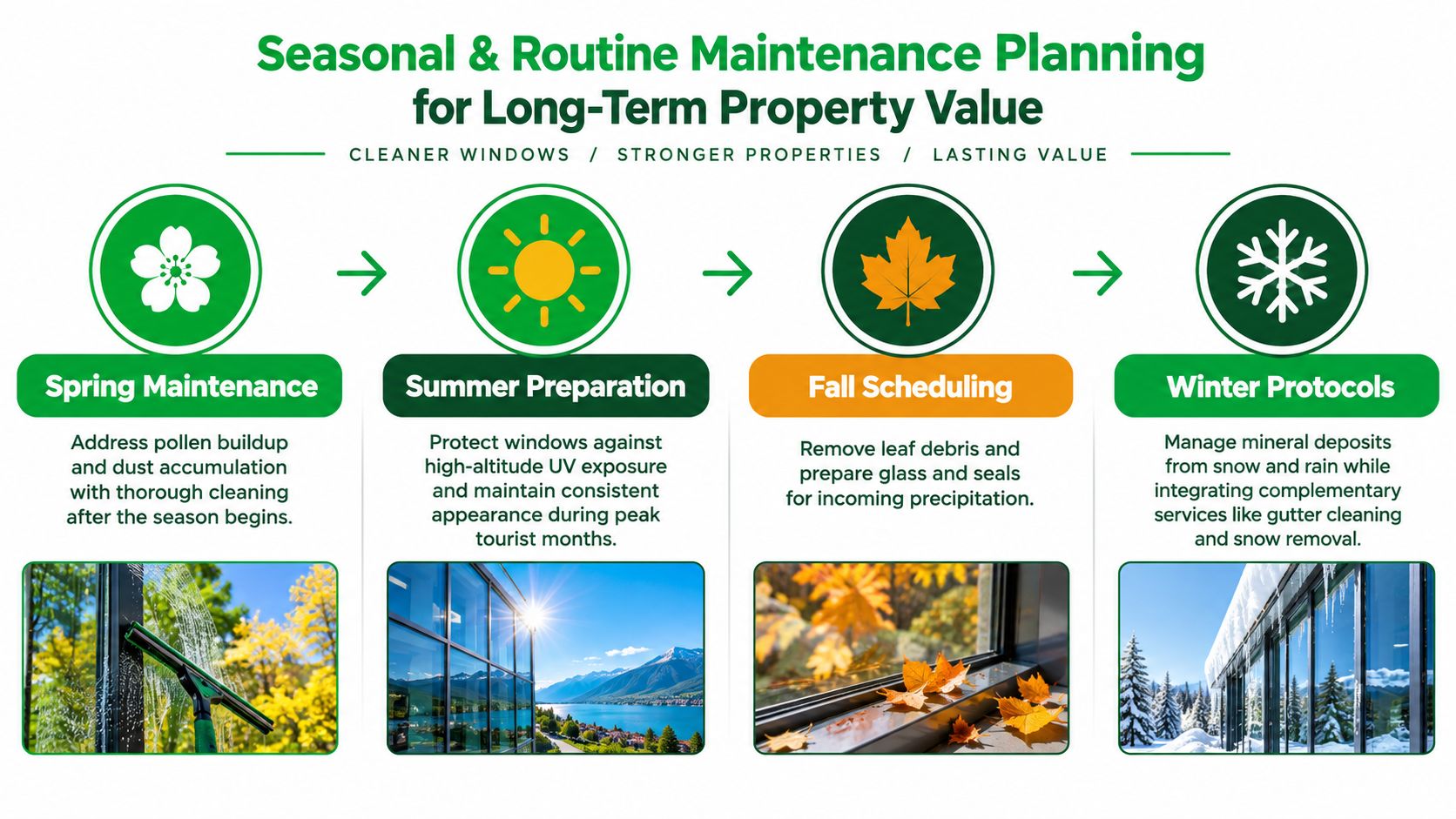
Northern Arizona windows face changing conditions throughout the year. Spring can bring pollen and dust, summer brings strong high-altitude sun exposure, fall adds leaf debris, and winter can leave precipitation and mineral deposits behind. A property that waits until the glass looks neglected usually needs more intensive work than one that follows a planned route.
Maintenance frequency should reflect the building's visibility, occupancy, exposure, and access cost. A hotel lobby, retail entrance, and dealership showroom may need more frequent attention than a lightly used office elevation. A medical office may need a dependable recurring route to maintain a consistent professional environment. A cabin or short-term rental may need service timed around spring and fall use, guest turnover, or listing photography.
Build a seasonal service calendar
- Spring: Address pollen and settled dust, then inspect screens, sills, frames, and drainage paths.
- Summer: Check how sun exposure and weather affect coatings, residue, and visible water spotting.
- Fall: Remove leaf debris and prepare exterior glass and surrounding areas for winter conditions.
- Winter: Coordinate around precipitation, access limitations, and safe work conditions rather than forcing a visit during unsafe weather.
Include related property services when they support the same maintenance objective. Gutter and downspout cleaning, pressure washing, and seasonal snow shoveling can complement window care, but each task needs its own surface-protection plan. Document completed work, observations, photos, and the next recommended visit so owners and facility managers can track the property over time.
Routine maintenance is also a cost-control decision. Regular removal of dust, residue, and contaminants supports the condition of glass, frames, seals, and coatings, while planned access avoids repeatedly paying for rushed setups. The right schedule isn't necessarily the most frequent one. It's the schedule that keeps the property presentable, safe to service, and aligned with how the building operates.
8-Point Commercial Window Cleaning Comparison
| Technique / Service | Implementation complexity | Resource requirements | Expected outcomes | Ideal use cases | Key advantages |
|---|---|---|---|---|---|
| Mastering Squeegee Technique for Streak-Free Results | Low–Medium (training & practice) | Professional squeegees, replacement blades, cleaning solution | Streak-free, lint-free glass; faster drying | Storefronts, large commercial windows, routine jobs | Professional finish, efficient, low water waste |
| Professional Water-Fed Brush Systems for Safe High-Reach Cleaning | Medium–High (equipment + training) | Telescopic poles, water-purification system, brushes, maintenance | Spotless, mineral-free windows; safe ground-level reach | Multi-story façades, skylights, sites avoiding ladders | Eliminates water spots, safer high-reach access, consistent results |
| Comprehensive Screen Removal, Cleaning, and Reinstallation | Medium (careful handling & inspection) | Trained technicians, brushes/solutions, spare screens | Improved light transmission, better air quality, longer screen life | Hotels, medical offices, rentals, seasonal residential care | Restores visibility, prevents hidden buildup, detects damage early |
| Safe Ladder and Lift Operation for Multi-Story Commercial Properties | High (OSHA training, certifications) | Ladders/boom/scissor lifts, fall protection, insurance, certified operators | Safe compliant access to high windows; reduced injury risk | High-rise, complex architecture, post-construction projects | Enables reach to extreme heights, regulatory compliance, risk reduction |
| Strategic Scheduling and Communication for Commercial Properties | Medium (systems & coordination) | Scheduling tools, communication protocols, dedicated staff | Minimal disruption, higher tenant satisfaction, on-time projects | Hotels, medical centers, multi-tenant buildings, retail | Predictable operations, fewer complaints, better client relations |
| Tailored Solutions for Unique Property Types and Challenges | High (site assessments, customization) | Experienced technicians, site visits, specialized techniques/equipment | Optimal results matched to property, reduced damage risk | Historic sites, medical facilities, campuses, specialty storefronts | Protects property value, prevents damage, maximizes efficiency |
| Post-Construction Window Cleaning and Property Care | High (specialized methods) | Specialty chemicals/tools, protective measures, contractor coordination | Removal of paint/adhesive/dust; show-ready windows; defect spotting | New builds, renovations, pre-listing or move-in preparation | Restores presentation, prevents long-term damage, identifies issues |
| Seasonal and Routine Maintenance Planning for Long-Term Property Value | Medium (planning & ongoing management) | Long-term contracts, integrated seasonal services, record-keeping | Consistent appearance year-round; extended window lifespan; predictable costs | Hotels, campuses, dealerships, seasonal homes, property portfolios | Prevents deep-clean needs, cost predictability, preserves long-term value |
Turn Window Cleaning Into Reliable Property Care
The practical value of commercial window cleaning comes from the decisions surrounding the glass. Start by assessing the property itself. Record the building type, window locations, glass and coating specifications, screens, interior occupancy, landscaping, pedestrian routes, parking, power lines, lift access, and weather exposure. A hotel in Flagstaff, a dealership near a busy route, an NAU facility, and a medical building may all need different equipment and work hours even if their windows appear similar from the outside.
Next, define safety and scope expectations before requesting a price. Ask whether the provider uses professional squeegees, pure-water brushes, ladders, poles, and in-house reach equipment where appropriate. For work at height, ask about technician training, equipment maintenance, insurance, site inspection, barricades, traffic control, and emergency planning. OSHA's guidance makes clear that commercial access must follow the applicable scaffold and powered-platform requirements, so a low bid that leaves access decisions vague isn't a complete comparison.
Screen service should be written into the scope, not discussed as an assumption. Specify whether screens will be removed, cleaned, inspected, and reinstalled, and explain how damaged mesh or frames will be documented. Include sills, frames, doors, interior and exterior glass, post-construction residue, and property protection where those items matter. Crews should protect floors, walls, landscaping, vehicles, furnishings, and finished surfaces before they begin.
Then choose a schedule that protects operations. Retail may need frequent storefront attention, while office, healthcare, school, hotel, and high-rise properties may need different recurring intervals. Coordinate arrival times, tenant notices, access instructions, security procedures, parking, and low-traffic work windows. A dependable contractor should confirm the plan and communicate promptly if weather or site conditions require a change.
Finally, document quality. Use a work order that states the areas serviced, access method, screen condition, observed defects, completion notes, and correction process. Put scope, communication expectations, satisfaction terms, and any rescheduling conditions in writing. A free move-out cleaning contract resource can also help owners think through the value of written service terms, even when the project involves commercial maintenance rather than a move-out.
Pine Country Window Cleaning is Flagstaff's largest window cleaning company, founded in 1999 by Flagstaff native David Kaminski. Its locally operated team is background-checked and OSHA safety-trained, with in-house boom lifts, scissor lifts, and a 95-foot atrium lift for challenging properties. The company serves homes, cabins, hotels, NAU facilities, dealerships, medical buildings, and high-rise properties, and offers a 100% satisfaction guarantee. For facility managers and commercial owners, that combination of local knowledge, access equipment, screen service, property protection, responsive communication, and related maintenance can fit projects where reliable planning matters as much as the final shine.
A consistent professional plan supports appearance, safety, occupant comfort, and long-term property maintenance. Assess the site, choose the safest practical method, protect the property, schedule around operations, verify the result, and keep the agreement clear. That process turns window cleaning from a reactive task into dependable care for the entire building.
Pine Country Window Cleaning provides commercial window cleaning with squeegees, pure-water brushes, screen removal and reinstallation, lift access, post-construction cleaning, and seasonal property-care services across Northern Arizona. Visit Pine Country Window Cleaning to request a free estimate or schedule a site assessment for your hotel, campus, dealership, medical building, retail property, home, or cabin.