
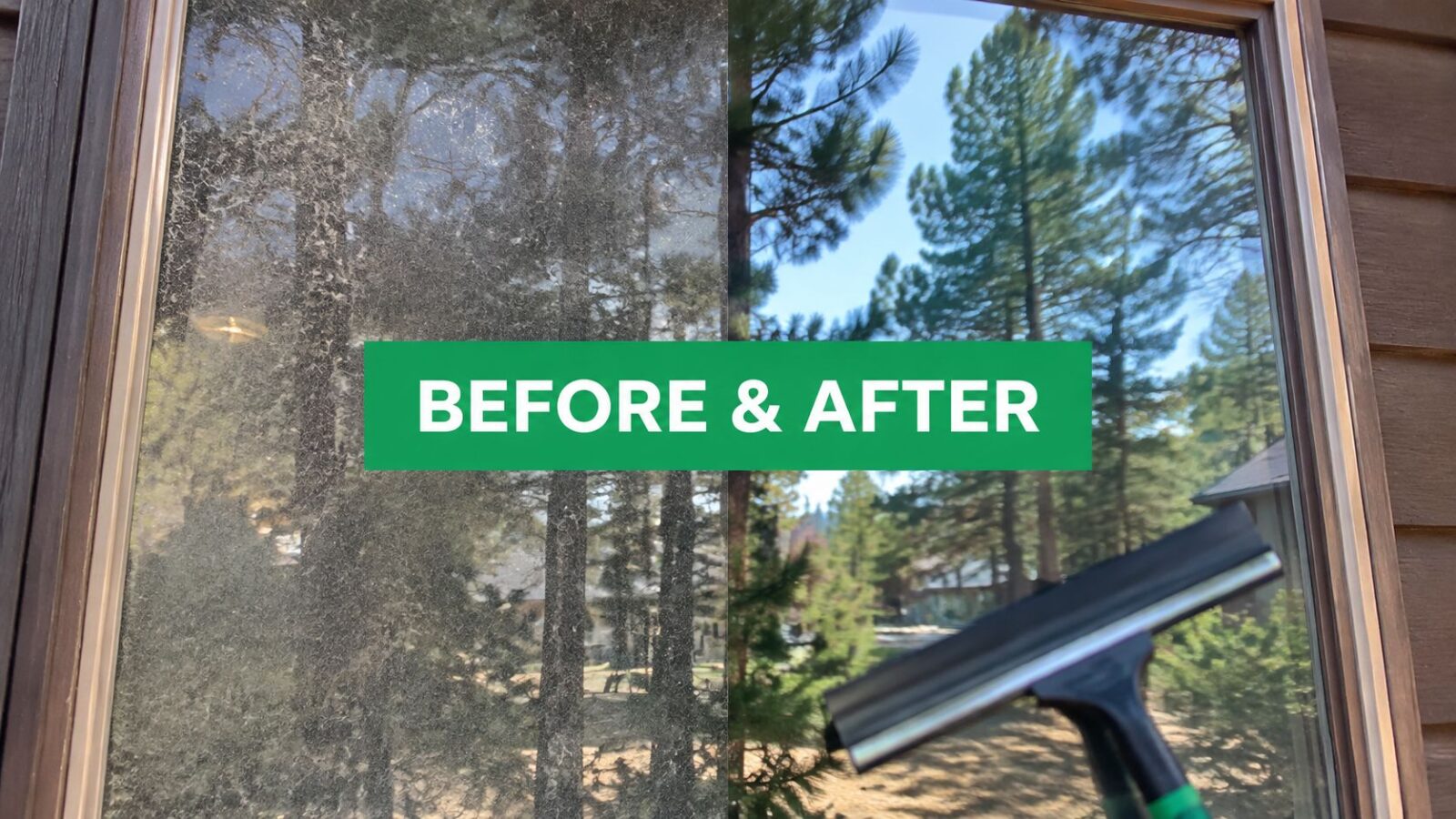
The strongest before-and-after cleaning photos don't just show a dirty pane becoming clear. They show where the work happened, how the technician reached it, which equipment made the result possible, and how the customer's home or business was protected. That distinction matters because a 2018 randomized study found that the way paired images are presented can change whether viewers notice the improvement, with an animated flicker format improving change detection compared with static layouts, especially among participants younger than 45. The study's findings support a practical lesson: the image set and the documentation method both shape trust.
Pine Country Window Cleaning has served Flagstaff and Northern Arizona since 1999. The seven examples below compare professional service documentation with stock-photo options from Shutterstock, iStock, Adobe Stock, Depositphotos, Pexels, and Pixabay. The focus stays on squeegees, ladders, water-fed poles, pure-water brushes, lifts, screen care, safety, communication, and respectful treatment of each property, not household rag, newspaper, or spray-bottle methods. For search visibility, captions and alt text should naturally name the service, setting, equipment, and visible transformation. If you're organizing a large collection, organize a photo dump elegantly without losing the context behind each image.
1. Pine Country Window Cleaning
A real service photo carries information that a polished stock image usually can't. It can show a Flagstaff home, cabin, storefront, hotel, campus building, or high-rise with the actual access challenge still visible. The before frame identifies the condition. The after frame proves what changed. The technician, equipment, safety setup, and matching camera angle explain how the result was achieved.
Pine Country Window Cleaning is a locally owned Flagstaff company serving Northern Arizona since 1999. Its crews use professional squeegees, ladders, extension poles, water-fed poles, pure-water brushes, boom lifts, scissor lifts, and a 95-ft atrium lift for difficult access. The company says its technicians are background-checked and OSHA safety-trained, and it has served homes, cabins, hotels, NAU facilities, car dealerships, medical buildings, and high-rise properties. That range matters when a photo needs to demonstrate more than surface cleanliness.
What the transformation should prove
A useful Pine Country image pair keeps the frame consistent. The same window, screen, sill, or glass wall should appear from the same angle, with enough surrounding detail to identify the zone. That approach follows property-management guidance recommending job titles, dates, preparers, client details, PPE status, exact areas cleaned, and matching before and after images in an auditable record. The property-management photo guidance also emphasizes tracking zones cleaned, photos uploaded, and maintenance issues reported.
The company removes, cleans, and reinstalls every screen with every service, rather than treating screen care as an optional add-on. Pine Country's window-cleaning transformation page shows why that detail belongs in the customer story. A clear pane paired with a dusty or damaged screen doesn't communicate full-service care.
The customer impact
The best result is not only a streak-free window. It's a cleaner view, better presentation for a listing or rental, and confidence that the crew worked carefully around furnishings, landscaping, finishes, pets, and business operations. Pine Country also provides gutter and downspout cleaning, pressure washing, post-construction window cleaning, and seasonal snow shoveling and removal, allowing customers to coordinate broader property care.
Pros
- Local experience: Serving Northern Arizona since 1999, with experience across residential and commercial settings.
- Professional access: In-house boom lifts, scissor lifts, and a 95-ft atrium lift support challenging work.
- Customer care: Fast scheduling, responsive communication, courteous technicians, and a 100% satisfaction guarantee.
- Full service: Window cleaning, screen care, gutters, pressure washing, post-construction work, and seasonal snow removal.
Cons
- Estimate required: Flat-rate pricing isn't published online, so customers need to request a free estimate.
- Regional focus: Service centers on Flagstaff and Northern Arizona, and availability outside the area should be confirmed.
Practical rule: A before-and-after pair earns trust when the viewer can verify that the same surface, angle, and service zone appear in both frames.
2. Shutterstock
Stock photography works best when you need a visual concept before you have a matching local project. Shutterstock has a broad catalog of cleaning imagery, including windows, pressure washing, limescale, ovens, tile, and other maintenance tasks. Its before-and-after cleaning search is useful for finding paired concepts, split-screen compositions, and close-ups of specific surfaces.
The main advantage is selection. A marketing team preparing separate pages for residential windows, commercial glass, pressure washing, and move-out cleaning can search by service rather than settle for one generic image. Advanced filtering helps narrow results by orientation, style, subject, and composition. Shutterstock also offers on-demand packs, subscriptions, Unlimited tiers, enterprise tools, and API options, which can help organizations managing assets across multiple properties or teams.
Where it performs well
Shutterstock is a strong choice when the image must illustrate a problem that hasn't yet been photographed locally. A limescale-covered shower door, stained tile, or heavily soiled exterior surface can make an educational article easier to understand. For a window company, however, stock still needs careful labeling. A staged image shouldn't be presented as a Pine Country project, and a stock technician shouldn't imply that the company used equipment or methods shown in the frame.
Use stock visuals to support the service explanation, then direct readers to Pine Country's photo gallery for authentic examples of the company's work. That separation protects credibility.
Pros
- Broad selection: Easier to locate niche cleaning scenarios and specialized surfaces.
- Flexible buying: On-demand and subscription options suit different publishing schedules.
- Scaled workflows: Enterprise and API tools support larger content operations.
Cons
- Complex plans: Multiple tiers and license choices require careful review.
- Higher premium cost: More polished or specialized assets may cost more than smaller libraries.
Shutterstock is the practical pick for variety. It's less convincing when the reader needs proof of a specific Flagstaff property transformation.
3. iStock by Getty Images
iStock is useful when a cleaning visual must look polished, controlled, and suitable for commercial communication. Its library covers bathroom, kitchen, glass, and maintenance scenarios that can support content for cleaners, property managers, real estate marketers, and facilities teams. The iStock plans and pricing page outlines credit and subscription options, as well as standard and extended license distinctions.
The practical advantage is consistency. A small business can choose imagery that matches its brand, check the usage terms, and place the asset in a service page, brochure, advertisement, or property-management presentation. Getty's wider commercial infrastructure and indemnification framework may also matter when the image will receive paid distribution or appear in materials reviewed by multiple stakeholders.
Match the license to the job
A standard license may cover routine marketing use, but the application determines whether it is appropriate. A service-page image has different requirements from an image placed on merchandise, resale products, or a product template. Buyers should confirm the license before publication instead of treating every commercial use as interchangeable.
The visual lesson is straightforward: use iStock to explain a cleaning method, not to imply a completed Pine Country project. A staged worker, polished bathroom, or spotless glass panel can show the type of service being discussed. It cannot document the actual work area, equipment used, access method, or final condition at a customer's property.
For authentic proof, a job record should pair the same area before and after service, with timing and relevant condition notes. Lighting, camera position, and visible boundaries should remain comparable. A real transformation becomes easier to trust when the reader can identify what changed and why.
Visual order also affects judgment. A visually “clean” room and a “messy” version of the same room received messiness scores of 9.3 and 70.1 on a 0–100 scale in a 2021 sociological experiment. The published experiment shows how strongly presentation can shape perception, but it does not establish that a stock image records a genuine service outcome.
Best fit
- Curated quality: A polished option for small-business marketing.
- License guidance: Standard and extended terms make usage decisions easier to review.
- Commercial infrastructure: Getty backing can suit organizations with formal approval processes.
Watch points
- Narrower niche depth: Some specialized cleaning situations have fewer options than Shutterstock.
- Broader-use restrictions: Resale and merchandise applications may require extended licensing.
iStock fits projects where quality, licensing clarity, and cost control matter more than the largest possible search pool. Use it to frame the service, then rely on documented property photos for trust.
4. Adobe Stock
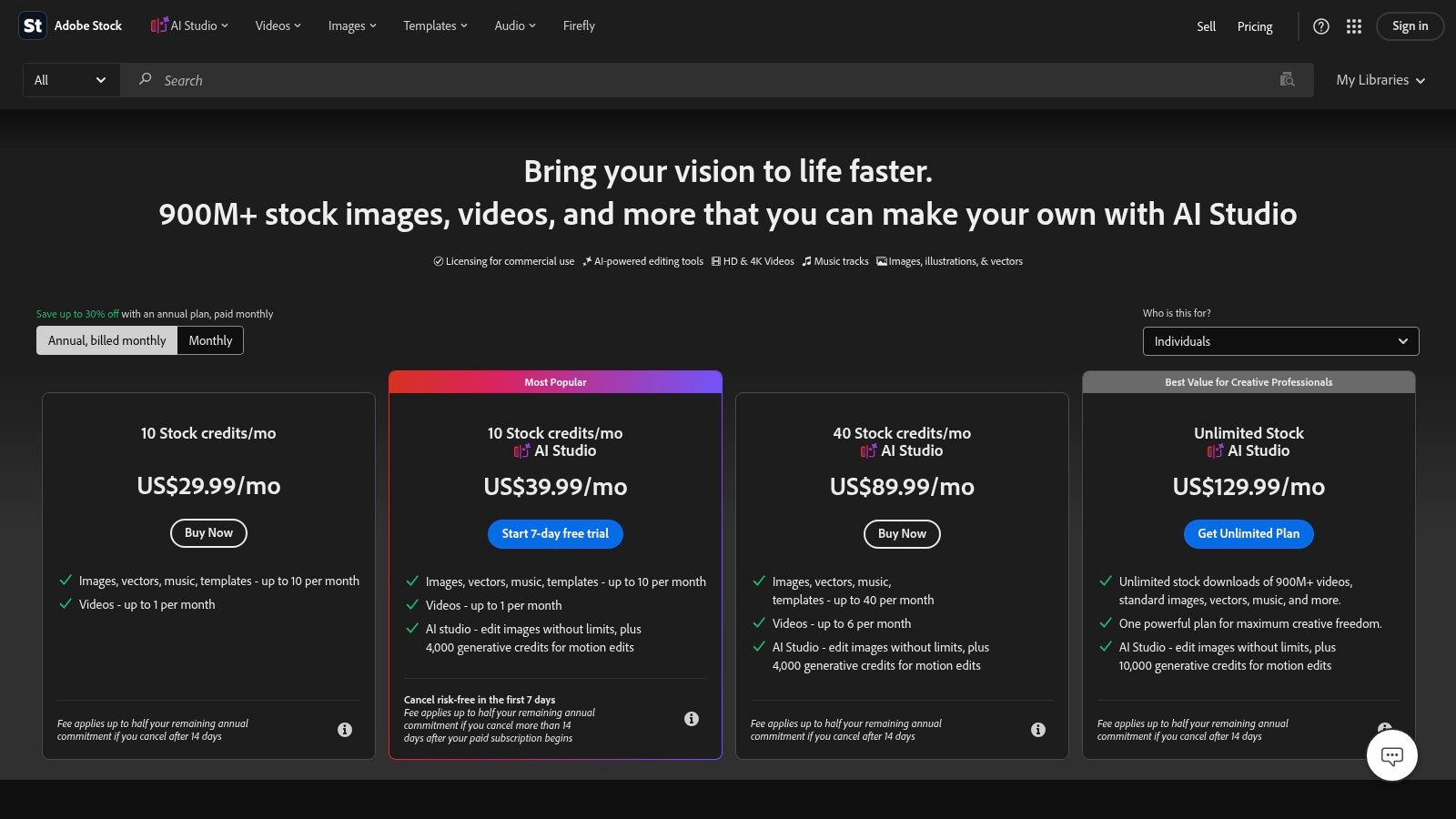
Adobe Stock fits teams that produce service pages, brochures, advertisements, and social graphics in Adobe Creative Cloud. Its library includes polished cleaning and maintenance imagery, and the Adobe Stock plans page outlines subscription choices and standard-license restrictions.
The practical benefit is an integrated design workflow. A designer can search for a cleaning image, place it in a layout, test different crops, and match the visual style used across a campaign. That saves production time for an article header, a property-management presentation, or a seasonal maintenance post.
A stock image can show the service category. It cannot document a customer's property.
For example, a staged squeegee close-up can illustrate glass-cleaning technique, but it does not establish that a specific home was serviced, that screens were removed and replaced, or that an atrium window was reached safely. The setting, visible problem, equipment, and customer impact remain unverified.
Use Adobe Stock to explain the work, then use job records to prove it. A credible before-and-after pair should show the same pane or service zone under comparable conditions. Consistent framing and lighting help customers assess the visible change and distinguish actual restoration from a favorable stock composition.
Image quality also affects technical comparison. In paired-image restoration work, PSNR is commonly considered alongside SSIM and LPIPS for fidelity and visual similarity. A Restoration Score can compare perceived degradation before and after on a 0–5 scale. The restoration benchmark concerns restoration imagery rather than window cleaning, but it supports a useful field practice: stable image conditions make visual differences easier to judge.
For service teams, the trade-offs are clear:
- Brand consistency: Strong fit for polished marketing materials.
- Creative Cloud integration: Efficient for designers already using Adobe tools.
- License review: Standard-use limits and broader applications require attention.
- Budget pressure: Other libraries may suit publishers with tighter spending limits.
Adobe Stock works best for design consistency and production efficiency. Pair its illustrative visuals with dated, property-specific photos that show the affected surface, the equipment used, and the customer-facing result.
5. Depositphotos
Depositphotos works well when a service business needs varied cleaning visuals without building every page around one narrow style. Its before-and-after cleaning collection covers kitchens, bathrooms, glass, upholstery, pressure-washed surfaces, appliances, and tile or grout.
That range supports a gallery organized by property and service type. A window company can select glass for a visibility lesson, a pressure-washing image for an exterior entry, or a post-construction surface for a maintenance page. Match the setting to the customer's concern, then explain what the image shows and what it cannot prove.
Match the transformation to the service
A cloudy shower door gives mineral buildup a recognizable context. A brighter exterior pane suggests improved visibility, while a pressure-washed walkway shows the difference between surface soil and a maintained entrance. Use the caption to identify visible outcomes, such as clearer glass, cleaner frames, or a more presentable entry.
The image should not carry claims about equipment or workmanship that it does not show. For stronger trust signals, pair the stock visual with a dated project photo showing the property, affected surface, crew method, and final condition. That combination helps customers separate an illustrative example from a contractor's documented result.
Licensing still requires a check before publication. Depositphotos offers subscriptions, image packs, business options, releases, and licensing information, but conditions can vary by media type or plan. Confirm the specific use before placing an image in advertising, a downloadable template, or a broadly distributed campaign.
Pros
- Good value: Cost-effective for practical service imagery.
- Useful variety: Covers common residential and commercial cleaning situations.
- Flexible purchasing: Subscriptions and packs suit different content volumes.
- Legal resources: Releases and licensing details are easy to find.
Cons
- Less polished interface: Browsing and support materials may feel less refined.
- Term differences: Plan and media conditions need careful review.
Depositphotos suits credible visual explanation at a controlled cost. For a contractor's proof gallery, locally captured images remain more persuasive because they connect the visible transformation with a real property, crew, equipment, and defined service scope.
6. Pexels
Pexels works well when a service page needs a general cleaning visual quickly and the content budget is limited. Its before-and-after cleaning search includes tagged results for cleaning, maintenance, and window-related subjects. Downloads are straightforward, and the Pexels License permits commercial use in many routine projects without required attribution, although attribution is appreciated.
Use these images for blog posts, social media, educational pages, and early creative testing. A small property-care company can find a technician, clear window, or clean room image before committing to a paid library. For teams that want to turn free pictures into videos, the same stock visual can support a short educational sequence, provided the result is presented as illustrative rather than as documented project evidence.
Evaluate the image before publishing
Pexels offers speed, but little uniqueness. Other cleaning companies may select the same asset, and genuine paired before-and-after sets can be difficult to locate. A photo of someone cleaning glass demonstrates an action only. It does not establish the worker's training, property location, equipment, or whether screens and surrounding surfaces were handled correctly.
Match the visual to the point you need to explain. A window-cleaning image can introduce a service, while a company-owned project photo should demonstrate the actual change in glass, frames, screens, or entry areas. Pine Country's portfolio gives readers a more relevant view of real property-care work than a generic free image. Stock attracts attention. Documented project photography supports the hiring decision.
Practical strengths
- No purchase cost: Useful for blogs, social posts, and educational content.
- Fast downloads: JPG and MP4 options support quick publishing.
- Simple search: General cleaning themes are easy to browse.
- Commercial usefulness: The license covers many routine business applications.
Trade-offs
- Limited paired sets: True before-and-after sequences may be hard to find.
- No exclusivity: Competitors can publish the same asset.
- Variable relevance: A general cleaning photo may not represent professional window work.
Pexels suits speed and zero-cost publishing. Use it for explanation and concept testing, then rely on property-specific photos to document completed Flagstaff service.
7. Pixabay
Pixabay is useful for early visual concepts. Its free library includes cleaning, pressure washing, windows, and maintenance images, organized through topical tags. The before-and-after cleaning search can help marketers locate separate images for a side-by-side layout when a genuine paired sequence is unavailable.
Use those assets to test headlines, page layouts, or social creative. A dirty-surface image beside a clean-surface image can explain the idea of transformation, but it must be labeled as illustrative. Unrelated photographs do not verify that one property, zone, or service produced the visible change.
Check the asset before it supports a claim
Pixabay's custom license lists permitted uses and restrictions. Review the license summary and the individual asset before publication. Recognizable trademarks, logos, and other protected elements can create advertising problems, particularly in paid campaigns, commercial materials, and property-focused promotions.
The image also needs to match the property and service being discussed. Pixabay's library ranges from useful background visuals to generic photographs with little connection to professional work. A local window company should not use a free image to suggest that its technicians cleaned a specific home, cabin, storefront, hotel, or campus facility.
A practical workflow is to use Pixabay for ideation, then replace the concept image with documented project photography before publishing a service page. Keep the same zone, camera angle, and framing where possible. That gives customers a clearer basis for judging the result and gives the business a more credible record of its work.
- Zero-cost testing: Supports early concepts and creative experiments without an asset purchase.
- Broad free library: Tags cover general cleaning and maintenance subjects.
- Simple assembly: Separate images can support a side-by-side comparison.
- License documentation: The FAQ and summary identify important restrictions.
- Usage prohibitions: Logos, trademarks, and some advertising contexts require review.
- Uneven quality: Specificity and production value vary between assets.
- Few true pairs: Dedicated before-and-after sets are less common than general cleaning photographs.
Pixabay fits projects where budget and experimentation come first. It should not replace a documented gallery when customers need the same surface, angle, and condition verified.
Before & After Cleaning Photos: 7-Source Comparison
| Service | Implementation complexity | Resource requirements | Expected outcomes | Ideal use cases | Key advantages |
|---|---|---|---|---|---|
| Pine Country Window Cleaning | Low for customers to book; high operational complexity (specialized crew/equipment) | On‑site technicians, boom/scissor/atrium lifts, OSHA training | Professional, safety‑compliant cleaning and property maintenance | Local residential/commercial, high‑rise, post‑construction, seasonal work | Local experience, safety certifications, heavy equipment, satisfaction guarantee |
| Shutterstock | Low (web/API licensing) but tiered plan choices add decision complexity | Budget for subscriptions/packs or enterprise plan; API for scale | Large selection of high‑quality before/after images with commercial licenses | Large campaigns, varied creative needs, enterprise asset pipelines | Biggest catalog, advanced search, flexible licensing and enterprise tools |
| iStock by Getty Images | Low (credits/subscriptions); predictable purchase flow | Moderate budget for credits/subs; license selection (standard vs extended) | Curated, commercially suitable images with Getty backing | SMB marketing, predictable ad use, where legal indemnity matters | Clear licensing, good price/quality balance, Getty indemnification |
| Adobe Stock | Low (especially if using Adobe CC); license limits may require review | Subscription/credits; best with Adobe Creative Cloud integration | Consistent high‑quality assets and streamlined workflow | Creative Cloud users, professional marketing and design teams | Adobe integration, reliable legal framework, consistent asset quality |
| Depositphotos | Low (packs/subs) with straightforward search; interface less polished | Lower‑cost subscriptions or image packs | Good practical cleaning visuals at better value | Cost‑sensitive SMBs and practical marketing creatives | Competitive pricing, broad real‑world image selection |
| Pexels (Free) | Very low (instant downloads); permissive license but non‑exclusive | No budget required; time to search/curate | Free, usable images for blogs/social; lower exclusivity and variable specificity | Social posts, blog content, testing ideas on a tight budget | Zero cost, permissive commercial license, fast downloads |
| Pixabay (Free) | Very low (instant downloads); check license for restricted uses | No cost; time to assemble/curate images | Wide variety of free visuals; variable quality and fewer paired before/after sets | Non‑exclusive content, A/B testing, low‑budget projects | Large free library, easy to try ideas without expense |
Final Thoughts
Before-and-after cleaning photos work because they make an invisible service visible. A customer can't see every pass of a squeegee, every rinse from a pure-water brush, or every safety decision made while a technician works from a ladder, pole, or lift. The paired image gives that work a clear outcome, but only when the photograph is honest and well documented.
The strongest gallery combines setting, problem, method, equipment, customer impact, and trust signals. A Flagstaff cabin may need careful access around landscaping and uneven ground. A hotel or NAU facility may require communication around guests, staff, and operating hours. A storefront needs clean glass without disrupting customers. A post-construction project needs attention to residue, frames, screens, and the difference between construction dust and permanent surface damage.
Stock platforms still have a place. Shutterstock offers breadth, iStock balances curation and licensing, Adobe Stock supports polished Creative Cloud workflows, Depositphotos provides practical variety, and Pexels and Pixabay help teams publish when budgets are limited. None of them can prove that a local crew completed a specific job. They're visual aids, not service records.
Customer care also belongs in the image story. Privacy-conscious workflows should remove or blur personal papers, family photographs, addresses, labels, medication bottles, and other identifying details, while getting explicit approval before images are taken or published. This cleaning-photo privacy guidance addresses the risk that dramatic documentation can expose more than the property owner intended.
Pine Country Window Cleaning brings that evidence-based approach to residential and commercial work across Northern Arizona. The company was started in 1999 by Flagstaff native David Kaminski, and Pine Country says its crews use ladders and extension poles with safety training to reach windows efficiently and safely. Its company information also identifies Pine Country as Flagstaff's largest window cleaning company. The practical standard is simple: protect the home or business, communicate clearly, clean the full scope, care for every screen, and photograph the result so the customer can see what was done.
Get a clearer view of your next project with Pine Country Window Cleaning, offering residential and commercial window cleaning, screen removal, screen cleaning and reinstallation, gutters, pressure washing, and post-construction service across Flagstaff and Northern Arizona. Request a free estimate or schedule service with a safety-trained local team that treats your home, cabin, storefront, or facility with care.