

Most advice on how to clean residential windows starts with a spray bottle, a rag, and a promise of quick results. That approach can look acceptable until Northern Arizona sunlight hits the glass and reveals lint, water lines, and a film that grabs the next layer of dust. A professional result comes from controlling water, soil, access, and drying time, not from wiping harder.
On a Flagstaff property, the right method also depends on the window's height, the surrounding terrain, the screens, and the season. A ground-floor pane beside a paved walkway is a different job from a second-story cabin window above landscaping. The goal isn't just clear glass. It's a clean home, protected floors and furnishings, secure screens, and a process that doesn't put anyone on an unstable ladder.
Why Rags, Windex, and Newspaper Are Not How Windows Get Cleaned
The familiar DIY combination of a rag, blue glass cleaner, and newspaper is the wrong starting point for the finish most homeowners want. A spray-and-wipe routine spreads a small amount of liquid across the pane, but it doesn't suspend and remove the full soil load. Once the glass dries, sunlight exposes streaks, fibers, and hazy residue.
In Flagstaff, ammonia-based glass cleaners can also leave a surfactant film that attracts dust and pollen. Rags and paper towels may redeposit fibers on wet glass, while newspaper ink can smear on modern low-E coatings. The problem isn't that homeowners lack effort. The problem is that the tool is being asked to lift, carry, and remove dirt without a proper rinse and extraction step.

The professional toolkit
A working crew uses a lambswool applicator, a scrubber, a bucket with a wash sleeve, and a professional-grade channel squeegee fitted with a fresh rubber blade. A scrim or microfiber detailing cloth handles edges and corners, while clean water is kept separate for rinsing and final checks.
You can review the equipment differences in this guide to professional home window cleaning tools. The essential change is not a particular brand. It's the workflow:
- Wash: Wet the pane and loosen soil so it stays suspended in the cleaning solution.
- Squeegee: Pull the dirty liquid off the glass instead of pushing it around.
- Detail: Catch the narrow water line left at the edges with a dry cloth.
- Inspect: Check the pane from changing angles before packing up.
A professional crew doesn't clean residential windows with rags, spray bottles, or newspaper. We use squeegees, ladders, extension poles, and pure-water brushes because those tools match the physical job. Glass needs controlled wetting and controlled removal, especially when dry air and strong sun can evaporate a thin spray before the dirt has been lifted.
Working principle: If the water dries before the soil leaves the pane, streaking has already started.
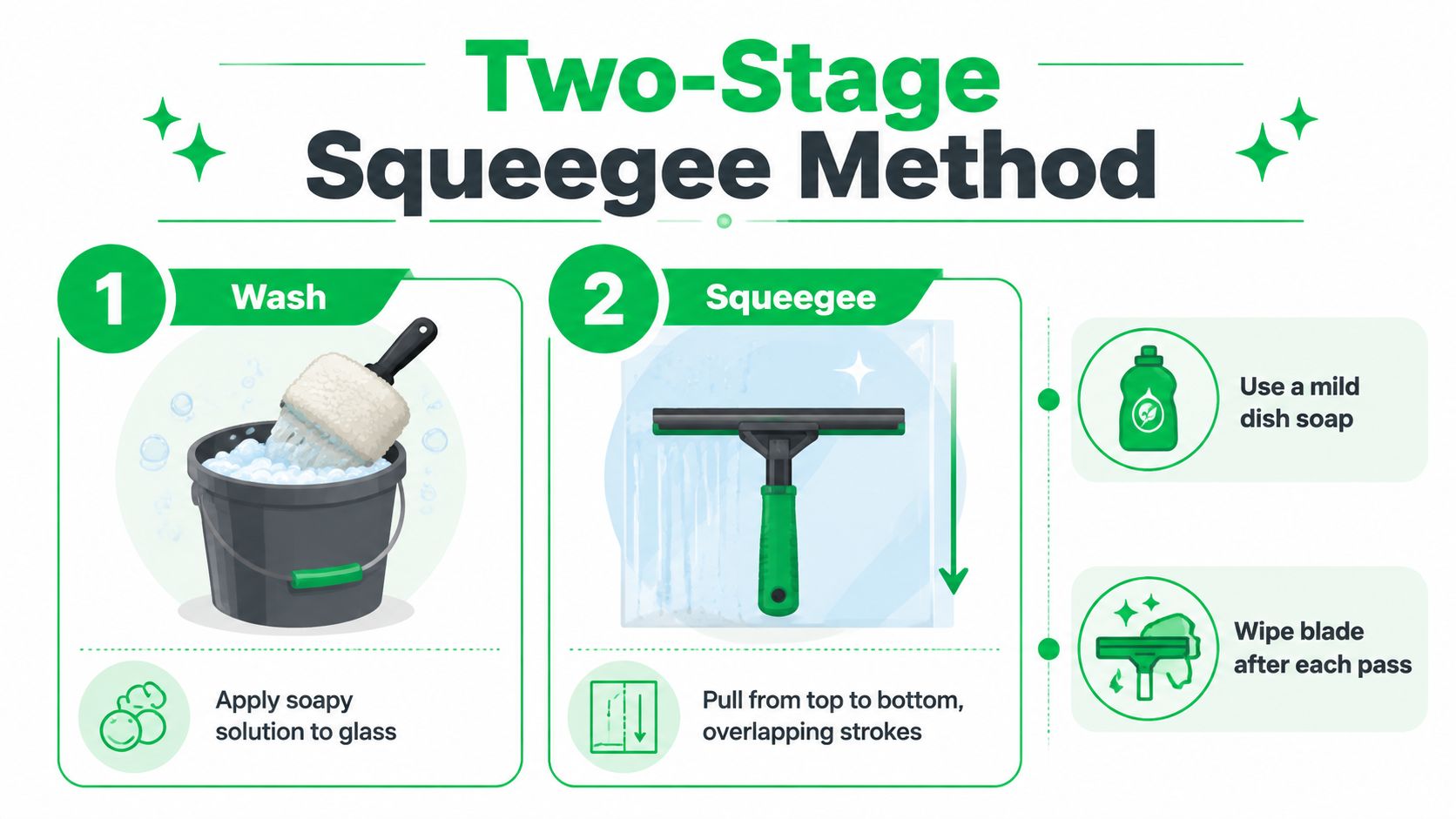
The Two-Stage Squeegee Method Professionals Actually Use
The reliable process has two stages. First, the glass is washed. Second, the liquid is removed with a squeegee. Kärcher describes the same basic sequence, wetting and loosening soil first, then removing the liquid with overlapping squeegee passes and detailing the edges with a dry microfiber cloth in its window-cleaning guidance.
Stage one, wash the glass
Fill a bucket with a mild dish-soap solution. Dip the lambswool applicator or wash sleeve, wring it so it's wet rather than dripping, and work the pane in overlapping S-patterns. The overlapping motion keeps the surface uniformly wet and lifts dust, pollen, and ordinary grime into the solution instead of leaving dry tracks behind.
Don't let the pane dry during this stage. On a warm, low-humidity Flagstaff day, work in manageable sections or shade the glass where possible. The cleaner should remain fluid long enough for the squeegee to remove it.
Stage two, extract the water
Start at a top corner and make a horizontal pass across the upper edge. Then pull the squeegee in straight, overlapping strokes from top to bottom. Wipe the rubber blade with a clean microfiber after every pass. A dirty or wet blade can carry loosened grit back across the pane.
On a wide picture window, fan the blade through the glass, keeping the rubber in contact with the surface as you change direction. On a second-story pane, reverse the working direction when access requires it, but keep the strokes overlapping and controlled. The objective is the same, clear the liquid before it evaporates.
Finish by wrapping a dry scrim or microfiber around your index finger and running it along all four edges. That catches the thin water line the squeegee leaves behind and cleans the corners without flooding the frame.
For exterior glass that can't be reached comfortably by hand, crews may use a pure-water brush on a telescoping pole. The system uses 100% deionized water, which helps rinse the pane without leaving the minerals found in ordinary tap water. Ladders and extension poles provide access according to the window and the property, as described in Pine Country's explanation of how pure-water window cleaning works.
The pole method isn't a shortcut for poor technique. The brush still needs thorough agitation, and the rinse needs enough flow to carry loosened soil away. On mineral-heavy glass, a technician may need a different restoration approach rather than pretending ordinary maintenance will erase established staining.
Inside the Home What a Careful Interior Service Looks Like
Interior work starts before the first pane gets wet. A technician checks the path through the home, uses boot covers or clean indoor shoes, and places drop cloths along the working route. Furniture usually moves slightly away from the window, not out of the room, so the crew can reach the frame without turning the house upside down.
Screens come out first. We place them on a pad outside or in a designated washing area, keeping dusty mesh away from interior sills. Each screen is washed separately, rinsed, dried, inspected, and reinstalled securely. The professional window screen cleaning process matters because a spotless pane can still look dull when pollen and grit remain across the mesh.

The frame comes before the glass
Tracks and sills collect grit that can turn into muddy drips when solution reaches them. A careful technician vacuums loose debris first, then uses a small brush around corners, weep holes, and hardware. Only after that preparation does the two-stage glass method begin.
The crew works top to bottom and room to room. Drop cloths protect hardwood and carpet from stray moisture, while sashes and hardware receive a wipe-down rather than being left with solution around the edges. On older homes and cabins, that attention is important because dust often hides in the track long after the glass appears clean.
The final inspection
After squeegeeing, the technician details all four edges and corners with a dry scrim or microfiber cloth. The pane is checked from several angles, because a streak that disappears straight on may show clearly when the sun moves across the room.
Screens go back only after they're dry and seated correctly. A loose screen can rattle, leave gaps, or fall out during the next window operation. Before moving the drop cloths to the next window, the technician checks the sill, floor, furniture position, and surrounding trim. Caring for the home is part of the service, not an extra step after the glass is finished.
Exterior Cleaning Methods Matched to Your Property
Exterior access determines the method more than the cleaning chemical does. A stable ground-floor pane, a second-story cabin window above landscaping, and a clerestory over a great room shouldn't receive the same setup.
| Method | Best For | Ladder Needed | Finish on Hard-Water Spots | Typical Cost per Pane |
|---|---|---|---|---|
| Hand-cleaning with applicator and squeegee | Ground-floor and easily reached glass | No, or a low stable step | Strong for routine soil, limited for established mineral staining | Varies by estimate |
| Pure-water pole cleaning | Second-story glass, landscaping, and broad exterior runs | Usually no | Clean rinse on ordinary mineral residue, restoration may be needed for bonded spots | Varies by estimate |
| Lift access or rope work | Tall great rooms, clerestories, and difficult mountain properties | No conventional ladder, specialized access applies | Depends on glass condition and restoration needs | Varies by estimate |
Hand-cleaning
A technician uses a bucket, applicator, and squeegee from a stable position on flat ground or a suitable low step. This gives close control around divided lites, frames, and stubborn spots. It's often the most direct choice for accessible glass, but it becomes inefficient when every pane requires repeated ladder repositioning.
Pure-water poles
A telescoping carbon-fiber pole feeds deionized water to a brush. The technician agitates the glass and rinses it, keeping feet on the ground while reaching many second-story panes. This works well for cabins in Munds Park, stucco homes near Lake Mary Road, and windows above beds or landscaping that shouldn't be trampled.
The trade-off is visual control. Hand-cleaning lets the technician detail an edge immediately. Pole work depends on proper brush movement, rinse technique, and a final inspection from the ground. It also isn't a magic eraser for hard-water stains that have bonded to the glass.
Lift or rope access
Tall two-story great rooms, clerestory windows, and mountain homes may require a lift or specialized rope access. The equipment adds planning and cost, but it can be safer and more efficient than forcing a ladder into an unsuitable position. The right choice depends on siding height, window count, terrain, glass type, and the access points available on the property.
Seasonal and Cabin Cleaning Cadence for Flagstaff and Munds Park
Northern Arizona homes need a weather-based cleaning plan. A universal calendar misses what lands on the glass. One homeowner guide recommends cleaning about every six months, while another FAQ describes a yearly or one-to-two-times-yearly schedule depending on pollutants and allergens, showing why exposure matters more than a fixed rule. See the local window cleaning FAQ for that range of guidance.
Spring through early summer
Spring brings cottonwood and juniper pollen, along with spring dust. The residue can collect on screens, tracks, and sills, then form a yellow film along the lower glass. City homes often benefit from a spring cleaning before windows are opened regularly.
Cabins surrounded by ponderosa need closer inspection. Trees place more material on screens and tracks, and shaded elevations may stay dirty longer after weather moves through.
Monsoon and wildfire exposure
Monsoon season, from July through early September, pushes fine dust and wildfire ash onto screens and north-facing panes. A post-storm clean makes more sense than cleaning immediately before a storm, because the next weather event can cover the glass again.
Wildfire ash deserves prompt attention. Fine particulate should be removed after a Coconino wildfire event that deposits ash, rather than left to combine with moisture and become harder to rinse away.

Fall and winter
Fall leaf drop affects Munds Park and Forest Highlands, especially in tracks and corners. Winter brings snow, freeze-thaw conditions, hard-water spotting, and road film or cinder spray near the I-17 and Route 66 corridors. Cleaning before the first hard freeze can prevent residue from sitting through repeated cold cycles.
A practical starting point is two cleans per year for city homes and three for cabins surrounded by ponderosa. Adjust upward after heavy dust, smoke, pollen, or construction. Property managers should also align service with rental turnovers so guests don't arrive to storm residue or dirty screens.
Northern Arizona rule: Schedule around what the property receives, not what the calendar says.
When DIY Stops Being Safe on Ladders and High Glass
Ground-floor windows are reasonable DIY territory when the homeowner can keep both feet on stable ground and maintain control of the tools. A stable six-foot stepladder on flat concrete may be manageable for a confident person, but a ladder on uneven terrain, a sloped cabin driveway, decomposed granite, or a snow-covered deck changes the risk immediately.
Window cleaning has a formal safety history because falls and access methods have always been central hazards. California Title 8 Section 3282 establishes safety requirements for cleaning windows in all buildings, and OSHA notes that the ANSI/ASME 39.1-1987 standard was adopted on June 4, 1987. Public guidance also emphasizes standing on the floor, using long-handled tools, avoiding body extension outside windows, and never leaning against window grilles, as outlined by the Hong Kong Occupational Safety and Health Council.
The stop points
Hire trained help when the job involves:
- Clerestory glass: Windows above a stair landing often leave no stable ladder footprint.
- Sunken living rooms: Tall picture windows may place the ladder near a drop or uneven transition.
- Second-story panes: A ladder needs a safe landing, not a hopeful angle against siding.
- Deck-height glass: Railings and narrow platforms restrict movement and rescue options.
- Wind or snow: Weather can turn ordinary access equipment into an unstable work position.
A hospital-based review found that failure to use safety belts and lack of suitable anchorage contributed to all 20 reported injury cases in that dataset, according to the published review of window-cleaning injuries. That finding reinforces the boundary. A professional crew should use feet-on-the-ground pole work, properly positioned ladders, or a certified lift, not a casually leaned extension ladder.
Choosing a Flagstaff Window Cleaning Crew and What to Expect
A professional crew should explain its safety and protection procedures before discussing the final shine. Ask about liability insurance, workers' compensation, ladder training, and experience with pure-water systems. These details determine who carries responsibility if equipment damages glass or siding, or if someone is injured during the work.
The visit should begin with an arrival window and a walk around the property. The technician checks window types, screens, tracks, skylights, storm windows, landscaping, deck access, and panes that need specialized equipment. A useful estimate separates routine cleaning from hard-water restoration and recommends a service cadence based on the property's exposure.
What happens on the property
Expect the crew to:
- Protect interior floors and furnishings with drop cloths and clean footwear.
- Remove screens and confirm whether screen and track cleaning are included.
- Wash, squeegee, and detail interior panes.
- Clean reachable exterior glass by hand and use pure-water poles for suitable high panes.
- Arrange lift access when the structure requires it.
- Check the glass and surrounding areas before loading equipment.
Pine Country Window Cleaning has operated since 1999 and was started by Flagstaff native David Kaminski. Its service process describes professional squeegees, ladders, extension poles, and pure-water brushes. The company also states that it removes, cleans, and reinstalls screens with each service.
Before a cabin appointment, clear decks and narrow walkways, secure pets, open gates, and identify skylights or storm windows. Flagstaff and Munds Park properties often combine pine debris, dust, snow exposure, and difficult access, so those details affect both the estimate and the work plan.
Cleaning will not repair damaged glass, failed seals, or fogged panes. If a window no longer seals properly, use a resource explaining when window and door replacement becomes more appropriate than maintenance to compare replacement with continued cleaning.
The practical choice depends on access and time. Handle safe, ground-floor glass yourself if you can accept the labor. Hire a crew for high panes, screen-heavy homes, recurring cabin service, or any job where protecting the property matters as much as removing the dirt.
Pine Country Window Cleaning provides residential window cleaning for Flagstaff and Munds Park homes and cabins, including squeegee work, pure-water pole cleaning, screen removal, screen washing, and secure reinstallation. Visit Pine Country Window Cleaning to request an estimate or schedule recurring service around your property's access and Northern Arizona exposure.