
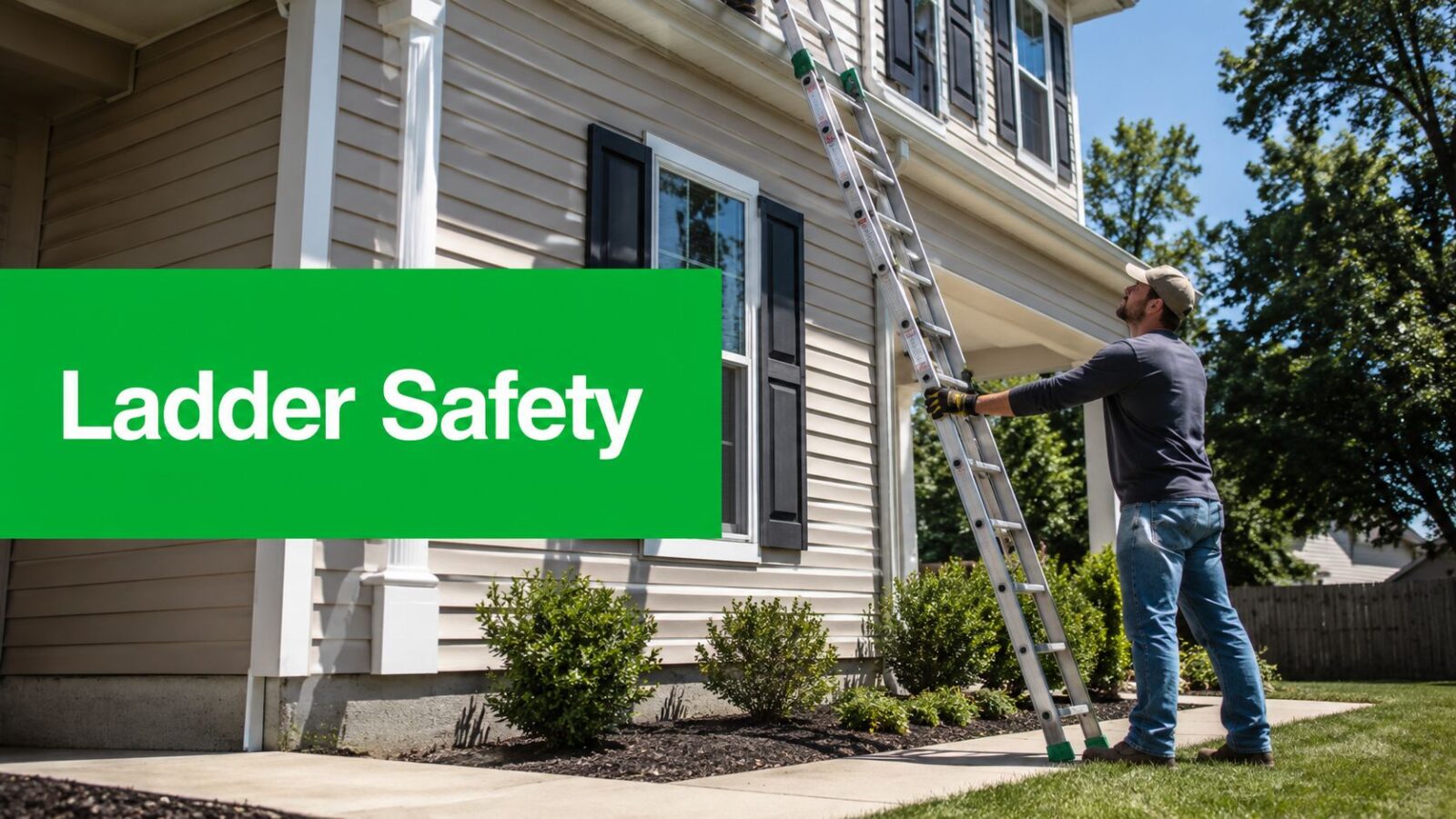
You're on a two-story cabin ladder in Flagstaff, gloves on, squeegee bucket below, and the next step feels routine until the ground shifts a little under the feet. That's usually the moment people realize ladder safety isn't abstract. It's the difference between finishing a set of windows cleanly and turning a normal day into an emergency.
For homeowners, cabin owners, and facility managers, ladder safety requirements touch the same real tasks, gutter cleaning, exterior window washing, holiday lighting, fixture changes, and post-construction cleanup. The rule set exists because ladders are common, temporary, and unforgiving. Whether the job is on a single-family home, a hotel, or a dealership façade, the margin for error stays thin.
Why Ladder Safety Matters on Every Property
A cold morning on a Flagstaff cabin usually starts the same way. One person leans an extension ladder against the eave, another spots from the ground, and the job seems straightforward until someone notices the base sitting on pavers that aren't as level as they looked from the driveway. That's not a contractor-only story. It's a property-owner story too, because anyone who owns a ladder ends up making the same judgment calls.
The tasks are familiar. Gutter cleaning after monsoon debris. Exterior window washing before guests arrive. Swapping a hard-to-reach light bulb in a vaulted entry. Hanging holiday lights on a roofline. Cleaning up dust and residue after a remodel. Each one asks the same question, can this ladder be set up safely, or should a different access method take over?
The rules are meant for everyday jobs
OSHA-aligned ladder guidance gives those everyday decisions concrete checks, not vague caution. Portable straight ladders should follow the 4:1 rule, with 1 foot out for every 4 feet up, and the side rails should extend at least 3 feet above the landing so there's a real handhold when stepping on or off (USF ladder safety guidance). The same guidance also expects three points of contact and prohibits using the top rung or top cap unless the ladder is designed for it (USF ladder safety guidance).
That matters on homes and commercial sites alike because the risk isn't the label on the building. It's the moment someone reaches too far, steps onto the top cap, or sets the base where it can slide. Ladder safety requirements are really setup requirements, and setup is where most jobs succeed or fail.
Practical rule: If the ladder feels “almost right,” stop and reset it. Almost right is how people end up overreaching from the top step.
In our line of work, the right setup protects more than the climber. It protects gutters from crushing, siding from scuffs, landscaping from ruts, and customers from the kind of damage that shows up after the crew leaves.
The Core Setup Rules Every User Should Know
A ladder is a temporary stairway, not a shelf, and the setup numbers reflect that. On a Flagstaff house, a storefront, or a commercial atrium, the difference between a safe climb and a bad one usually comes down to how the ladder is placed before anyone leaves the ground. The 4:1 angle keeps the ladder from kicking out, the 3-foot extension gives the climber a handhold at the top, and three points of contact keep the body anchored while moving up or down. Those are the basics that matter on a driveway, on a roofline, and beside a commercial atrium.
Measure the angle and the top before anyone climbs
For a straight or extension ladder, place the base 1 foot out for every 4 feet of working height (MonitorQA's OSHA ladder safety overview). That setup is not for looks. It helps reduce slip and transfer risk when a tech steps on or off the ladder with a bucket, squeegee, or gutter tool in hand. Then check the top. The side rails should rise 3 feet above the landing surface so there is something solid to hold while transitioning (USF ladder safety guidance).
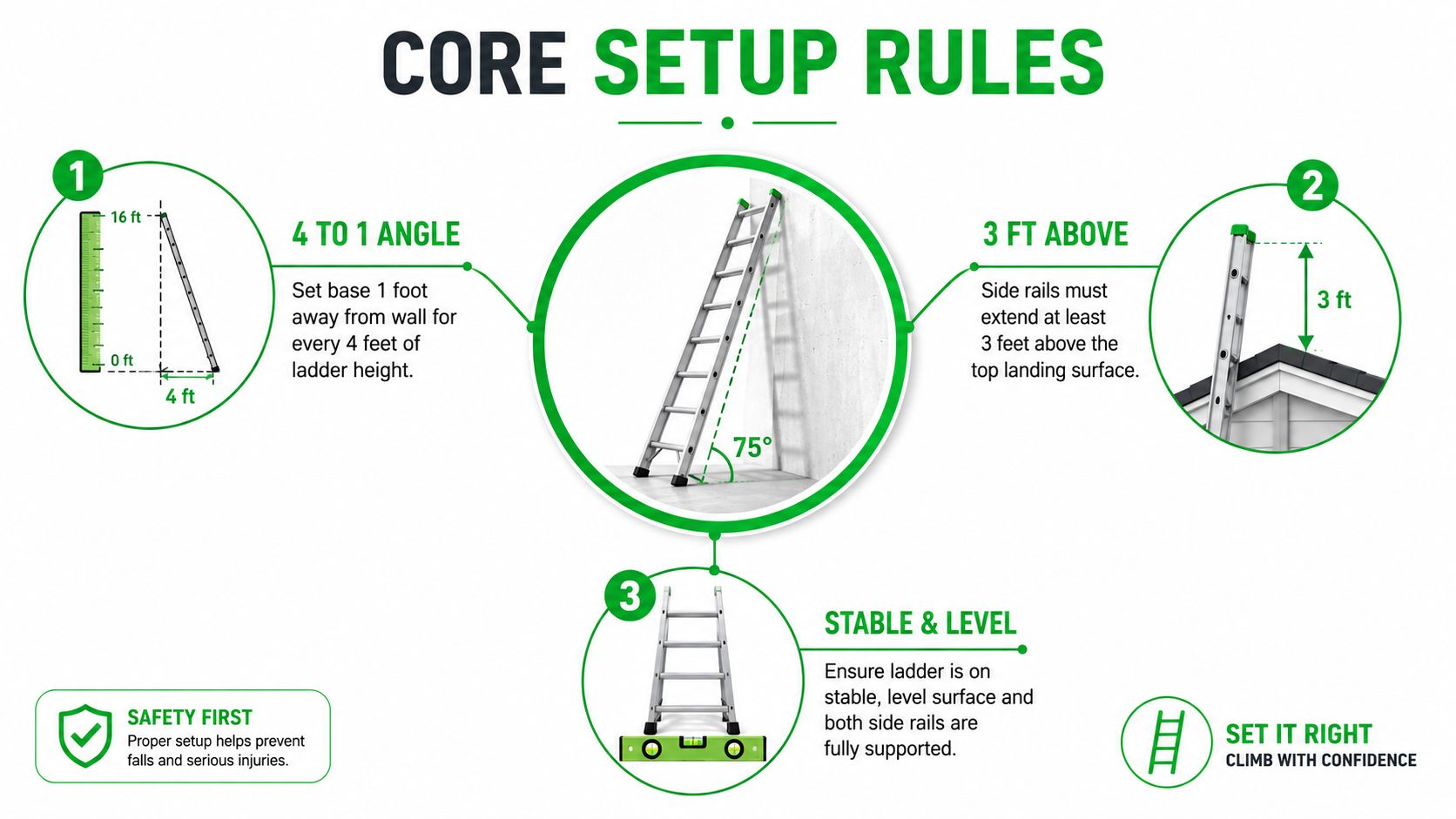
The fastest field check is visual, then physical. Set the base, step back, and see whether the rails look too steep, too shallow, or visibly unstable. On real jobs, especially where pavers, gravel, or compacted dirt shift under load, that quick read often catches trouble before a boot hits the first rung. If the ladder needs constant correction just to stand still, it is not ready for a window run or a gutter clean.
Know the two top-step mistakes that keep repeating
The top rung and top cap are not standing platforms unless the ladder is specifically designed for that use (USF ladder safety guidance). The reason is simple. The higher the body climbs, the less room there is for balance correction, and a small shift at the top turns into a much bigger one. That is where people reach too far for a pane edge, a fascia board, or a blocked gutter section and lose control.
A ladder should feel like a controlled transition point, not a place to park your weight.
The other mistake is trying to make the ladder solve a reach problem it cannot solve. If the work area sits too far off to one side, if the surface is uneven enough that the feet keep wandering, or if the landing is awkward enough that the rails cannot extend cleanly, the job is already asking too much from the ladder. That is the point where a boom lift or scissor lift makes more sense than forcing a setup that only looks acceptable from the ground.
For a quick self-check, look at three things before the next project. Is the ladder angled correctly. Does it extend above the landing. Can you keep three points of contact all the way up and down. If any answer is no, reset the ladder or pick a different access method. For more field notes and setup reminders, see our ladder safety tag.
How the 2016 Walking-Working Surfaces Rule Changed Fixed Ladders
Fixed ladders were once treated like permanent hardware that could carry a lot of old assumptions with them. OSHA's 2016 Walking-Working Surfaces rule changed that approach by pushing fixed ladders toward engineered fall protection instead of relying on cages alone. That shift still affects what shows up on commercial buildings, towers, and industrial structures.
What changed on ladders over 24 feet
For fixed ladders over 24 feet, installations after November 19, 2018 now require a personal fall arrest system or a ladder safety system (WorkersLaw summary of OSHA ladder regulations). Older fixed ladders with cages or wells were allowed for a transition period until 2036, which is the key phaseout point for compliance planning.
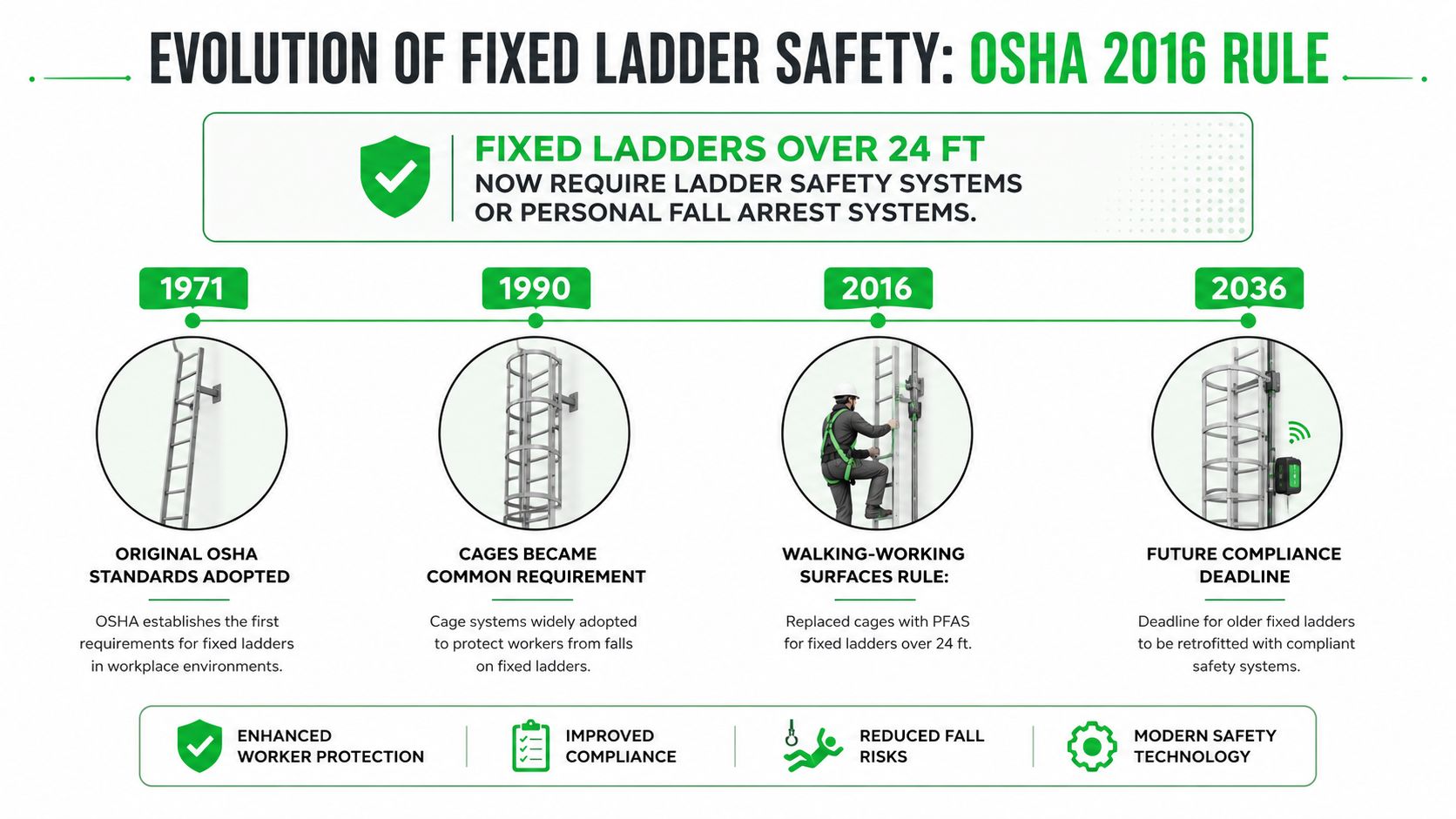
That timeline matters on real jobs. A ladder on an older commercial building can still look normal from the ground and still fall short of current expectations once you inspect the climb path, the anchoring, and the protection system. On window-cleaning and façade work in Flagstaff, that difference decides whether you send a tech up a fixed ladder at all, or whether the access plan shifts to a boom lift or scissor lift because the task, the height, or the landing makes the ladder the wrong tool.
The structural minimums are part of the safety story
The rule also sets physical requirements. Fixed ladders must support at least two loads of 250 pounds each, rung spacing must stay between 10 and 14 inches, and there must be at least 7 inches of clearance between the rung centerline and the structure (WorkersLaw summary of OSHA ladder regulations). Those are not abstract engineering details. They are the measurements that keep a climber from fighting flex, cramped foot placement, or a body position that turns a routine ascent into a reach-and-shift problem.
On a commercial roof, service wall, or equipment access point, those dimensions matter because they shape how safely a cleaner can carry tools, keep contact, and come back down without getting pinned into a bad stance. A fixed ladder is engineered access. A portable ladder depends on setup discipline. Both fall under ladder safety requirements, but they solve different problems on the job.
Uneven Ground, Pavers, Ice, and Other Surface Traps
The base tells the truth about a ladder faster than the angle does. A ladder can sit at the right slope and still fail if the feet are on ice, loose gravel, sloped turf, or pavers that shift under load. In Flagstaff, that's the world. You're not always on clean concrete, you're often on landscaping, snow, decomposed granite, or a patio that's settled a little over time.
Stable footing beats a perfect-looking setup
CCOHS guidance says portable ladders should use slip-resistant feet or blocking, should not be used on ice or mud, and should not be placed in passageways or where vehicles or people can strike them. California DOSH similarly points workers toward firm, level, dry, non-slip surfaces and recommends leg levelers or mudsills when needed (California DOSH positioning guidance). That's the practical decision tree most workers need.
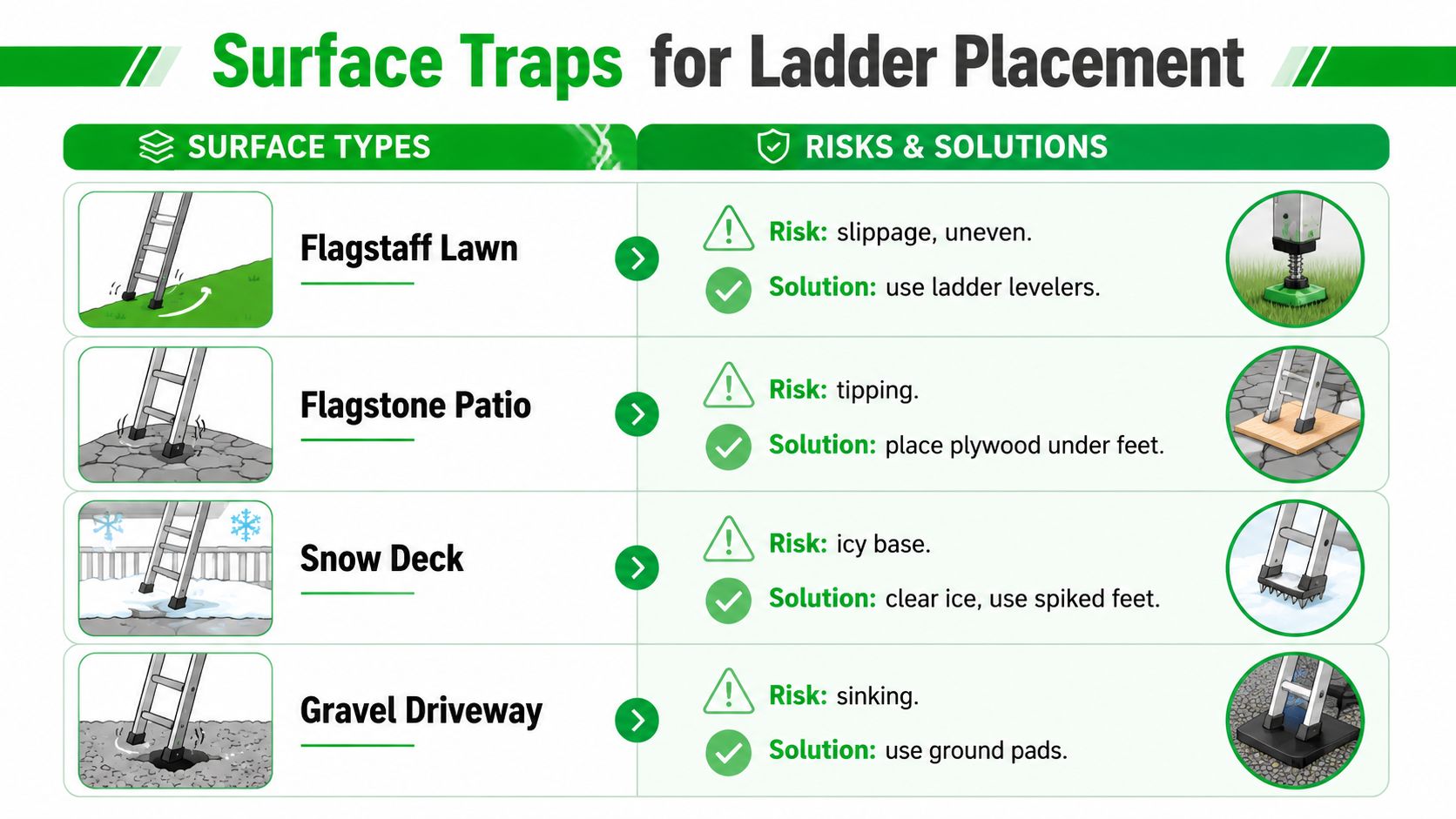
If the ladder sits on a sloped lawn, levelers can help. If the base is on gravel, ground pads help spread the load. If snow or ice is present, the right move is usually to clear it or wait. A ladder that can't stay planted isn't a ladder problem anymore, it's a surface problem.
The safest answer is sometimes to walk away
Good access beats risky access every time.
That's the part people don't say enough. If the task can be done with a safer means of access, use it. On some homes, that means moving to a pole system or a lift. On some properties, it means postponing the work until the surface is safe. Surface conditions are the silent partner in every ladder setup, and when they're bad, the ladder loses its margin no matter how carefully it's angled.
When a Ladder Is the Wrong Tool for the Job
A ladder only makes sense when the task is short, the access path is controlled, and the worker can keep balance without fighting the job. Once the work gets higher, longer, or more awkward, the ladder stops being the cleanest answer. That's where access equipment and fall protection become part of the safety decision, not an afterthought.
Height and hand-use change the equation
CCOHS says a harness and tied-off lanyard are required when working 3 m (10 ft) or more off the ground or when working with both hands (Virtual College ladder angle and access guidance). OSHA-focused guidance also notes that ladders used to access surfaces must extend 3 feet above the support point, and fixed ladders over 24 feet require fall protection (Virtual College ladder angle and access guidance). That combination tells you something important. The higher the job and the more hand work it takes, the faster a ladder becomes the wrong access tool.
Right tool, right height, right task
For window cleaning, that usually means shifting to the tool that fits the surface instead of forcing the ladder to do everything.
- Pure-water water-fed poles work well when the glass is reachable from the ground.
- Scissor lifts make sense for certain flat, vertical approaches.
- Boom lifts are often the safer route for façades, tall pines, and hard-to-reach elevations.
- A 95-foot atrium lift solves some interior height problems that a ladder can't.
Pine Country Window Cleaning uses those kinds of access methods on properties where ladder work would be the wrong choice, and the company's high-window approach reflects that kind of task-based thinking. You can see the broader access logic in how high windows are cleaned.
Hiring a contractor becomes part of the ladder safety equation. A property manager doesn't just need someone who can climb. They need someone who knows when not to climb.
A 60-Second Pre-Climb Inspection Anyone Can Run
A ladder inspection works best when it's short enough that people do it. The point is to catch the obvious failure points before the first step, not after the ladder is already in place and the task feels urgent. It is a quick, mechanical, and required pre-use check.
Start with the rating and the structure
OSHA requires non-self-supporting and self-supporting portable ladders to support at least four times the maximum intended load (OSHA ladder safety publication). Check that the ladder rating is visible, and make sure the intended load includes the worker, tools, and materials, not just body weight. If the label is missing or unreadable, that ladder is already suspect.
Then run the hands over the ladder itself
Inspect the side rails for cracks, splinters, dents, or corrosion. Check the rungs for looseness, bends, or contamination like oil or grease. Look at the feet and non-slip pads, because worn contact points can turn a stable setup into a slide. Make sure spreader locks and hardware are moving and locking correctly, and don't ignore rivets, bolts, or rope systems where they're part of the ladder design.
Practical rule: If a ladder needs a repair you've been putting off, tag it and take it out of service. “Good enough for one more job” is how damaged ladders stay in circulation.
A simple tag, a separation from the working stack, and a clear rule for removal beat argument every time. Inspection should be a habit, not a special event.
Training, Documentation, and What to Ask a Contractor
A safe ladder job is usually the result of training, not luck. People on the crew need to know how the ladder should be set, when to stop climbing, and what to do when the work changes mid-job. For a homeowner or facility manager, that's worth asking about directly, because training and documentation tell you how seriously a contractor treats work at height.
Competency matters more than a one-time briefing
Awareness training tells someone the rules. Hands-on competency tells you they can apply them on a sloped driveway, a roofline, or a service court where the ladder feet don't sit perfectly flat. Supervisors should also keep records of who climbed what ladder and where, because a company that tracks equipment and site use tends to catch problems earlier.
If you want a practical reference point on crew training and compliance habits, articles on training and compliance show why records and follow-through matter in day-to-day operations. The safety idea carries over cleanly to ladder work, because a documented process is easier to repeat than a verbal promise.
Ask these three questions before you hire
- Who on the crew is trained for ladder work and higher-access work?
- What equipment do you bring when a ladder is the wrong tool?
- How do you document ladder inspections, damage, and removal from service?
For customers comparing bids, those questions say a lot. A crew that answers clearly usually works more predictably on site.
Pine Country Window Cleaning also offers a clean and safe services overview that reflects the same kind of jobsite discipline, along with background-checked technicians, OSHA safety training, and in-house access equipment. That matters on cabins, commercial buildings, and post-construction projects where a ladder alone won't cover every surface.
Common Ladder Violations and How to Prevent Them
The violations we see most often are the ones that look harmless on the ground. A ladder gets leaned against a weak gutter edge. Someone climbs to the top cap for a quick reach. A worker tries to carry a tool, a scraper, and a bottle at the same time, then loses steady contact. A door swings open into the ladder path because no one checked the landing zone first.
| Common Violation | OSHA / ANSI Rule | Practical Fix |
|---|---|---|
| Leaning the ladder at the wrong angle | Use the 4:1 rule for portable straight ladders | Measure the base placement before climbing, especially on driveways, patios, and service courts where the footing changes fast |
| Standing on the top rung or top cap | Do not use the top rung or cap unless the ladder is designed for it | Keep the working position lower and set the ladder height correctly before anyone leaves the ground |
| Using a damaged ladder | Use only ladders that are structurally sound and inspected before use | Tag it out of service immediately, even if the damage seems minor |
| Setting up on unstable footing | Use stable footing, and avoid slip or tip conditions | Move to firm, level ground or switch access methods when the surface is soft, uneven, or icy |
| Carrying tools in hand while climbing | Maintain three points of contact | Use a tool belt, hoist tools separately, or have a ground worker pass what you need |
| Working too high without fall protection | Use fall protection on fixed ladders over 24 feet and when the task demands it | Move to a lift, scaffold, or fall-protected access system |
On real jobs, the mistake is usually choosing a ladder for a task that needs a different access plan. Cleaning upper-story windows on a Flagstaff commercial façade, reaching over a deep setback, or working around slick pavers can turn a simple setup into a bad one fast. A ladder works for short, controlled access. Once the reach gets awkward, the surface gets unreliable, or the work area puts your body outside a safe stance, a boom lift or scissor lift is the better call.
The crews that stay safe build that decision into the job before anyone unloads equipment. They inspect the site, choose the right access tool, and stop treating every elevation problem as if a ladder can solve it. That is the difference between a routine exterior cleaning and a fall event that shuts the job down.
If you want a practical reference point on crew training and compliance habits, articles on training and compliance show why records and follow-through matter in day-to-day operations. The same idea applies here, because a crew that documents inspections, damage, and removal from service is easier to trust on roofs, gutters, windows, and façades.
If you're planning exterior cleaning, gutter work, or any service where height is part of the job, schedule a free estimate with Pine Country Window Cleaning. We handle ladder-based work, lift access, window cleaning, and exterior care for homes and commercial properties across Northern Arizona. Visit Pine Country Window Cleaning to get the right access plan for your property.