
Two days after a window cleaning visit, a homeowner in Munds Park calls the office. The glass looks great, but the crew showed up during nap time, parked across the driveway, and the invoice didn't match the quote. That kind of call is why customer satisfaction metrics matter. A clean pane doesn't cancel out a bad arrival, a confusing bill, or a rough handoff at the door.
For a service business, the job is bigger than the streak-free finish. It's about how the visit felt, how easy it was to book, how well the office handled questions, and whether the homeowner would invite the crew back next season. If you want a practical way to think about that experience, start with the basics in choosing cleaning services in Flagstaff and then measure the moments that shape trust.
A simple inbox or text thread can hide a lot of frustration. If your team uses a tool to streamline customer inquiries, you're already halfway to catching problems before they turn into lost rebooks. The point isn't to collect more noise. It's to catch the few signals that tell you when a good job still left a customer annoyed.
Why a Flagstaff Homeowner Hangs Up Frustrated
The homeowner on the phone isn't angry because the windows look bad. She's frustrated because the experience felt careless. The crew was polite, the glass is clear, but the day was disrupted, the parking blocked the driveway, and the final bill didn't match what she expected. That's the gap between a technically fine job and a customer who's ready to complain to a neighbor.
Customer satisfaction metrics earn their keep. They show you that a happy outcome on the glass can still hide friction in scheduling, communication, access, or billing. A local crew can remove screens, clean screens, reinstall them, use ladders, poles, and pure-water brushes, and still lose trust if the office side feels messy. The score has to capture the visit, not just the result.
Practical rule: if the customer is satisfied with the work but irritated by the process, the process still counts.
For a Northern Arizona service business, that matters because one unhappy call can cost repeat business, referrals, and seasonal rebooks. A five-star review doesn't always mean the whole experience was smooth. Sometimes it just means the homeowner liked the final view enough to stay polite.
The same issue shows up online. A few strong reviews can mask a pattern of avoidable complaints until the next busy season exposes it. That's why reputation work matters alongside job quality, and why managing customer reviews effectively belongs in the same conversation as field service. If you want a service business to grow, you can't only ask, “Did the glass come out clean?” You also need to ask, “Did we make the visit easy to live through?”
The Core Customer Satisfaction Metrics Every Service Business Should Track
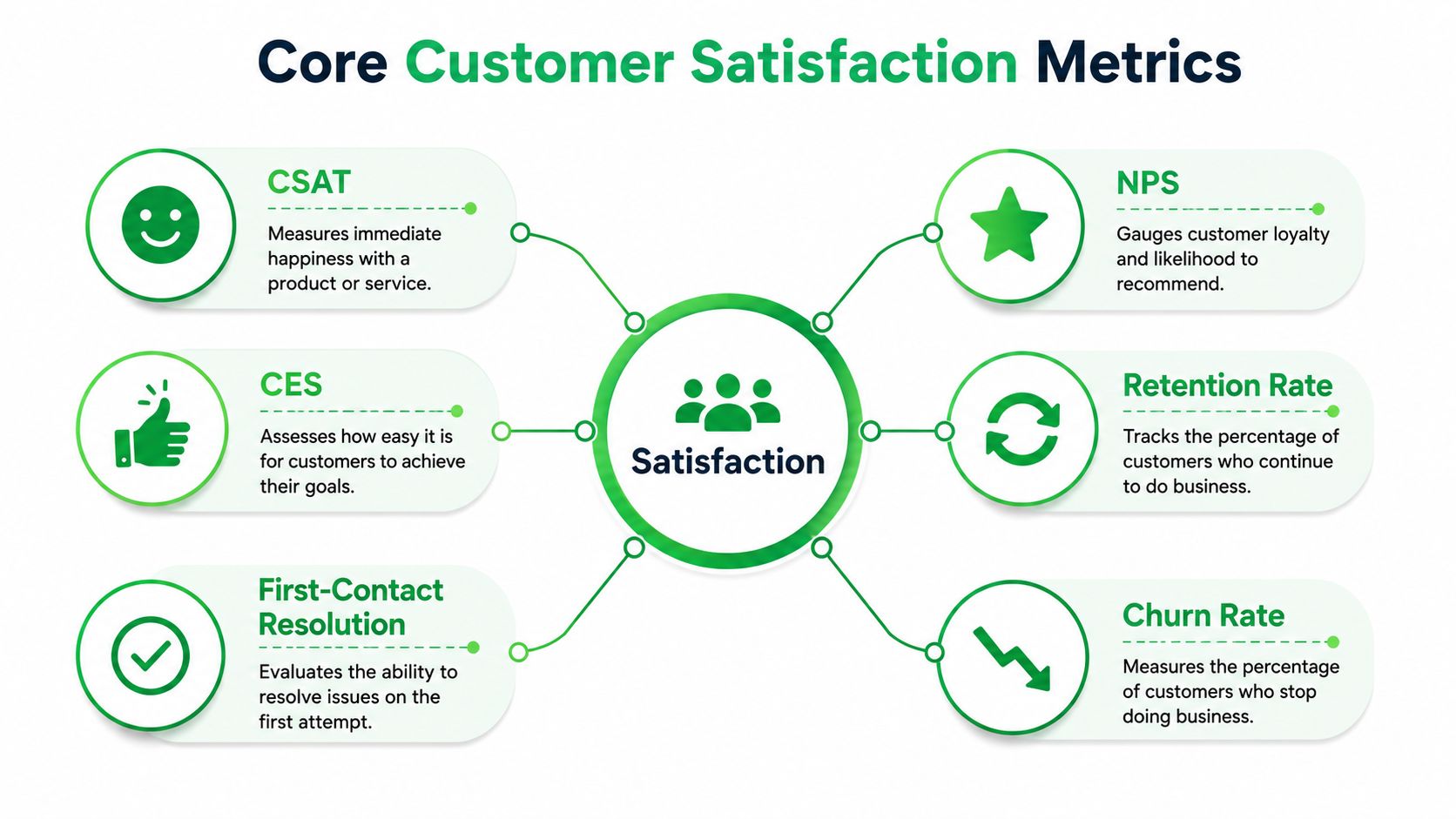
The easiest mistake is treating every metric like a standalone score. They work better as a small system. CSAT tells you how a specific visit felt. NPS tells you whether a homeowner would recommend you to a neighbor. CES shows whether booking, paying, and getting service felt easy or like a hassle.
Start with the customer-facing numbers
CSAT, or Customer Satisfaction Score, is the quickest read on a single interaction. It captures whether the customer was satisfied after the visit, support call, or follow-up. In window cleaning, that might mean asking after the crew leaves, after a reschedule, or after a billing question gets resolved. It's best for immediate feedback, not long-term loyalty.
NPS, or Net Promoter Score, asks a different question. It measures whether the customer would recommend your business, which is really a loyalty question in plain clothes. That matters for a company built on referrals, seasonal repeat work, and neighbors asking neighbors who they trust on their property.
CES, or Customer Effort Score, is about ease. Did the customer have to chase the office? Was the schedule clear? Did the homeowner have to repeat the same details twice? High effort can poison an otherwise solid experience, especially when the customer just wants the job handled cleanly and without back-and-forth.
Add the operations metrics behind the scenes
Retention rate and churn rate translate satisfaction into business movement. Retention shows who comes back. Churn shows who doesn't. You don't need a giant dashboard to notice the pattern, but you do need a consistent way to see whether happy customers stay and frustrated ones drift away.
First-contact resolution, or FCR, belongs to the office and the support side. It measures whether the team solved the issue on the first touch. If someone calls about a missed screen or a quote question, did the office settle it right then, or did the homeowner need a second call? That matters because the customer remembers the hassle, not the internal handoff.
A small business doesn't need every possible metric. It needs the few that answer different questions.
When you're deciding what to track, think in layers. Use CSAT for the visit, NPS for loyalty, CES for ease, retention and churn for repeat business, and FCR for office performance. If you also watch response rate, you'll know whether the numbers are trustworthy or just underreported noise. That's enough for a lean dashboard without turning the office into a reporting factory.
A useful policy point sits behind all of this. If you're trying to keep reviews and testimonials organized as part of your reputation process, building trust online through customer reviews and testimonials is part of the same measurement habit. Metrics tell you what happened. Reviews tell you how people describe it when they're not filling out a form.
How to Calculate NPS, CSAT, and CES the Right Way
The formulas are simple. The tricky part is using the right one for the right question. CSAT is usually calculated as the percentage of positive responses out of total responses, which fits a quick satisfaction check after a specific job. If 8 out of 10 customers mark the top choice as satisfied, the score is 80. The math is plain, and the answer is only useful if the question matched the moment.
NPS uses a different structure. It's the percentage of promoters minus the percentage of detractors, and the score can run from -100 to 100. That makes it a loyalty signal, not a job-quality score. In a service business, NPS works best when you want to know whether a homeowner would send a friend your way after living with the result for a while.
CES should stay focused on effort. If the survey uses a numeric scale, a lower average means the process felt easier. That's a big deal for scheduling, billing, and callback handling, because easy service tends to feel more professional even when the work itself is similar. Customers notice the friction long before they talk about process design.
Here's the practical version for a window cleaning office. If a homeowner gives a high CSAT after the job but a low CES after booking, the crew may be doing great while the office is making the process harder than it needs to be. If NPS is weak, you've got a loyalty problem, not just a satisfaction problem. And if the scores disagree, that's useful. It means the customer is telling you exactly where the experience broke.
| Metric | Formula | Scale | What Counts as Good |
|---|---|---|---|
| CSAT | Positive responses ÷ total responses × 100 | Usually 1 to 5 or 1 to 7 top-box format | Higher is better |
| NPS | % promoters minus % detractors | -100 to 100 | Higher is better |
| CES | Average effort rating or easy minus difficult, depending on survey design | Often 1 to 7, lower can mean easier in numeric formats | Lower effort is better |
The best way to trust the math is to keep the survey format stable. Don't switch scales every month. Don't change the wording unless you're ready to compare a new measure to a new standard. Consistency makes the dashboard readable, which is the whole point.
Survey Questions and Timing That Get Honest Answers
A useful score starts with a useful question. If the wording is clumsy or the timing feels random, people skip the survey or tap through it without thinking. For a residential window cleaning crew, the survey should feel short, clear, and tied to the job the homeowner just watched unfold.
A Flagstaff homeowner can tell right away whether the question fits the moment. If the crew just finished the job, a CSAT question can ask, “How satisfied were you with today's window cleaning service?” That works because the customer still remembers the arrival, the work, and the cleanup. If the office is checking the booking process, CES can ask, “How easy was it to book your appointment today?” That catches friction before anyone steps onto the property.
NPS works better after the customer has had time to live with the result. A seasonal email or a follow-up message can ask, “How likely are you to recommend our company to a neighbor?” That question gets at loyalty, not just a good feeling right after the visit. A homeowner may like the glass but still remember a missed call, a confusing message, or a rough patch in communication.
Keep the survey short enough to finish on a phone or tablet without effort. Send the follow-up within two hours of the job when you can, because memory fades quickly. Add one open-ended question after the rating, such as, “What would have made this a perfect visit?” That is where you learn about driveway access, screen handling, or a scheduling miss that did not show up in the score.
The number tells you something is off. The comment tells you what it is.
Make the survey fit the field
A survey should sound like it came from a crew that worked the property. If the team removes screens, cleans them, and reinstalls them on every service, the survey should reflect that care for the home. The homeowner should feel that the business noticed the property, respected the space, and handled ladders, poles, and pure-water brushes with care. That context matters because the customer is not only rating glass. They are rating trust on the driveway and around the entryway.
For a service-business owner who wants a practical way to handle upset customers without turning feedback into a fight, a framework for handling angry customers in a repair shop is a useful reference. A second, office-friendly guide is customer satisfaction and review management guidance, which helps when you are choosing which touchpoint should trigger which question. Use the survey to learn, not to prove a point.
Building a Simple Dashboard and Reporting Cadence
A dashboard only works if someone opens it. For a small service business, the cleanest setup is a single page with CSAT, NPS, and response rate at the top, then a short list of recent comments below. That keeps the office focused on the few numbers that explain whether the experience is landing well or slipping.
Keep the weekly review tight
Weekly is for action. The office should scan the newest scores, read every detractor comment, and flag any issue that needs a callback. If the same complaint shows up more than once, it doesn't belong in the “watch later” pile. It belongs in the next crew briefing.
A good weekly view should also separate job types. A callback on a cabin, a storefront, or a home near forested roads may point to different friction than a repeat maintenance account. If the comment mentions scheduling, access, or billing, the office can route it before the issue hardens into a lost customer. That's much easier than waiting for a bad review to explain what the dashboard ignored.
Use monthly and quarterly for pattern spotting
Monthly is for trend review. That's when you look for shifts in loyalty, effort, and repeat business behavior. Quarterly is the time to compare your numbers to the relevant industry range and internal history, especially with CSAT, where benchmarks vary by sector and shouldn't be treated as universal. Recent benchmarking puts average CSAT across industries at about 78%, with a healthy target range of 70% to 90%. SaaS and technology often sit around 75% to 78%, retail and e-commerce around 76% to 85%, and healthcare and financial services close to 80%. Those ranges come from customer satisfaction benchmarking guidance, and they're useful mainly because they remind you that “good” depends on the kind of service you run.
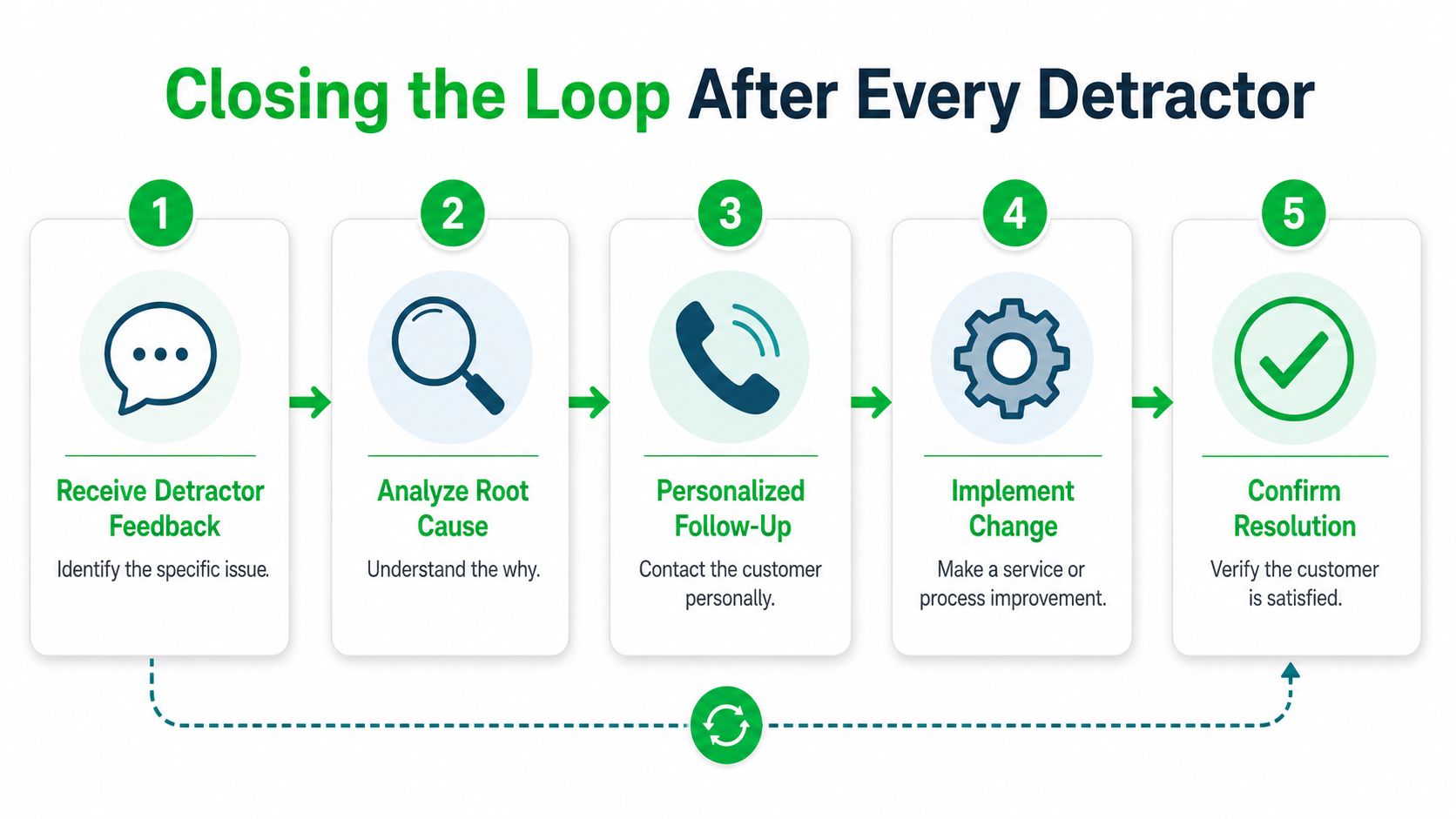
Set one simple rule for response handling. Any low score that signals a detractor gets a same-day look and a call back within 24 hours if the complaint is valid. That keeps the dashboard tied to action instead of turning into a report that gets skimmed and forgotten.
Closing the Loop After Every Detractor
The work pays off here. A detractor is a live chance to recover the relationship before the customer tells three neighbors, leaves the account dormant, or stops rebooking. When a homeowner gives a poor score, the first job is to call, listen, and fix the issue without defensiveness.
Start with a simple response pattern. Promoters get a thank-you and a review request. Passive customers get a short follow-up asking what would have made the visit better. Detractors get a personal call from the owner within twenty-four hours, plus a clear explanation of what will happen next. That process turns a survey into service recovery instead of a file cabinet of ignored answers.
For Pine Country Window Cleaning, that can mean a rebook prompt for a happy customer, a service recovery visit when something went wrong, and a written log of what the office fixed. That log matters because it keeps the same issue from surfacing again with the next schedule, the next crew, or the next property. The point of the score is not to admire the number. It is to start the conversation that repairs trust.
A practical framework for handling angry customers in a service setting, as laid out in advice for service business owners, keeps the focus on response, not ego. The same principle applies in the field. A homeowner who feels heard can often stay a customer, even after a bad day.
If you want a window cleaning team that respects the home, removes and reinstalls screens on every service, and keeps communication straightforward from quote to follow-up, take a look at Pine Country Window Cleaning. Their Chamber of Commerce member profile gives another view of the same local business presence. They have been serving Northern Arizona since 1999, and they are set up for the kind of dependable scheduling and clear follow-through that makes customer satisfaction metrics worth tracking in the first place.