
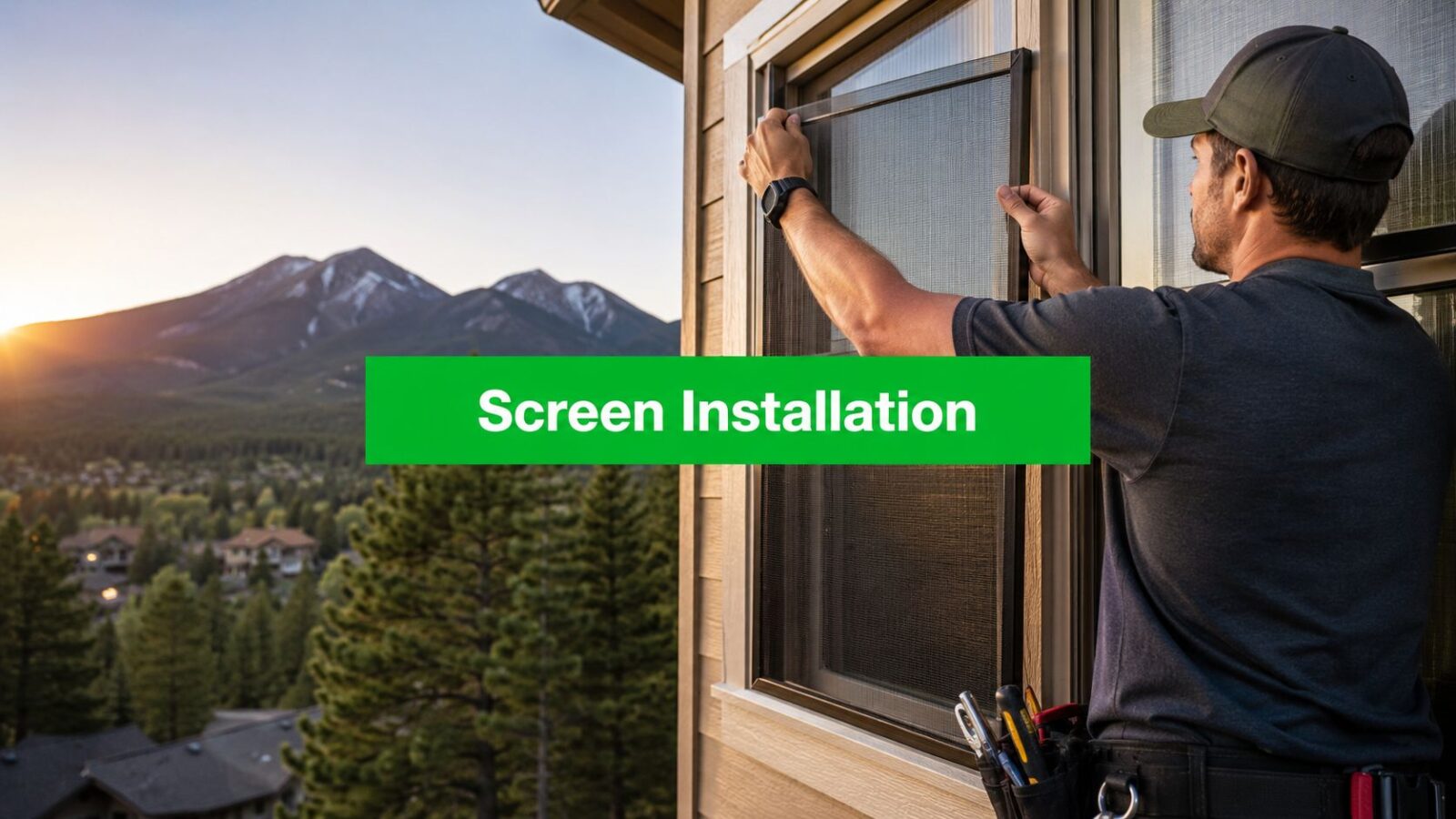
When you open a window in Flagstaff, you want the cool air, the pine scent, and the view. You don't want a torn mesh panel, a frame that won't sit flat, or a screen that rattles every time the afternoon wind picks up. That's usually the moment people realize screens aren't just accessories. They're part of how a home works.
Around here, screens take more abuse than many homeowners expect. High-elevation sun is hard on materials. Pollen and dust build up in corners and tracks. Seasonal temperature swings can expose weak frames and loose spline. At cabins, second homes, rentals, and commercial properties, a neglected screen often gets noticed only after it starts affecting comfort, appearance, or both.
Why Your Window Screens Matter More Than You Think
A lot of homeowners start with the same complaint. The windows are fine, but the screens look tired. One has a small tear. Another is bowed at the corner. A third blocks more of the view than it should because the mesh has faded, loosened, or warped over time. In a place like Flagstaff, where people buy homes for light, trees, and mountain views, that matters more than it sounds.
A professional screen installation service fixes more than appearance. It helps your windows ventilate properly, keeps insects out, and gives the exterior of the home a cleaner, more cared-for look. It also improves the day-to-day experience of living in the space. If you open windows often, you notice right away when screens fit correctly and when they don't.
Related demand in the installed screen category is also strong. The screen door installation services market is projected at $3.75 billion in 2025 and projected to reach $5.66 billion by 2034, with a 4.70% CAGR from 2026 to 2034, according to Strategic Revenue Insights on screen door installation services. That projection matters because it points to something homeowners already feel on the ground. Screen work is an ongoing maintenance and upgrade category, not a one-time purchase.
For some homes, the need goes beyond insect control. If your west-facing rooms heat up fast, it's worth learning how specialty products can cut UV with solar screens before you choose a replacement mesh.
For property owners who already think about upkeep as a whole-home issue, screen work fits naturally into broader residential property maintenance, not as an isolated repair.
Good screens do two jobs at once. They protect airflow and they protect the look of the window.
That's one reason screen issues get more attention than they used to. People want clean glass, better views, and windows they can use.
What a Professional Screen Service Really Covers
The phrase “screen repair” typically conjures up a single image. New mesh gets rolled into an old frame, and that's the end of it. In practice, a real screen installation service covers selection, fit, frame condition, site conditions, and how the screen will perform after a full season of use.
The material choice matters
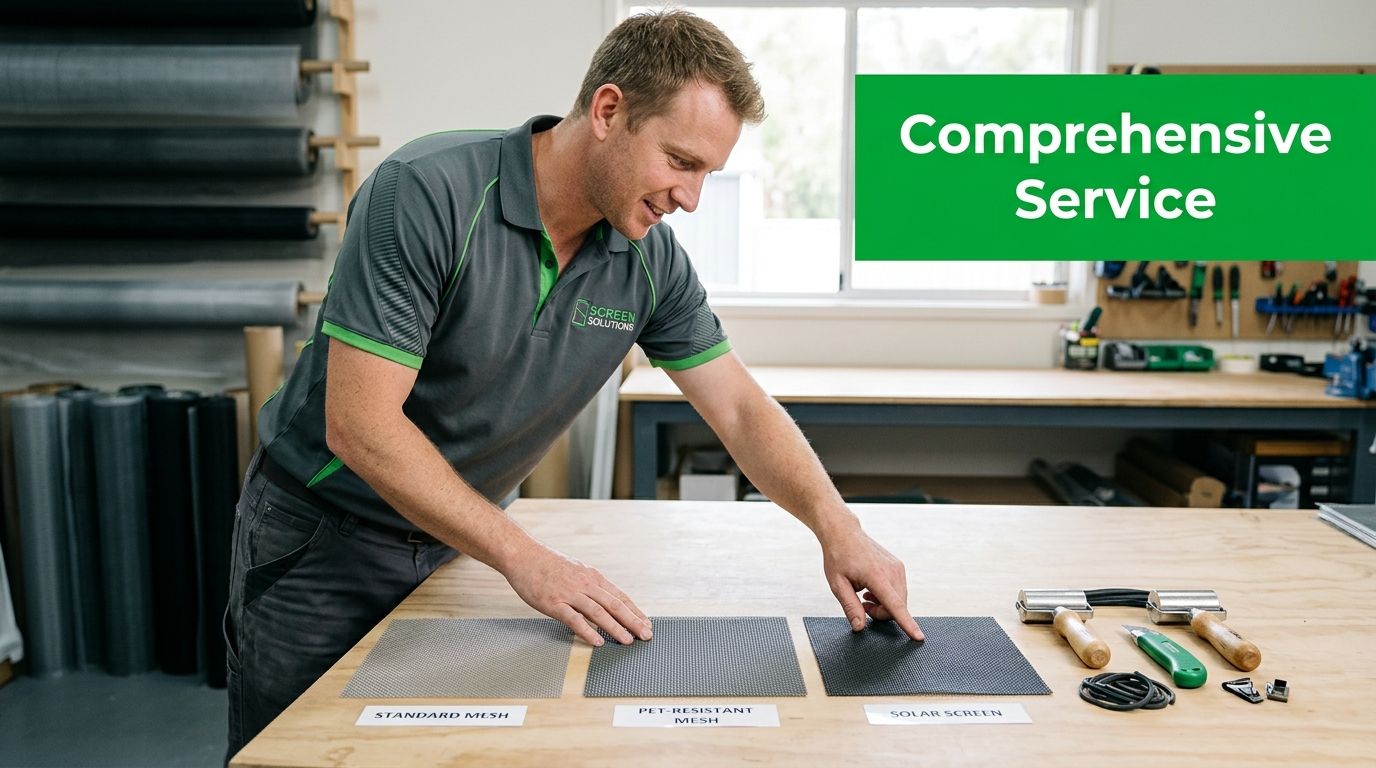
The first question isn't just “Do you want a new screen?” It's “What do you need the screen to do?”
Some homeowners care most about airflow. Others want better visibility. Some need a tougher mesh because pets push on lower panels or because a rental gets heavy use. At high-visibility windows, people often gravitate toward more transparent mesh. That can work well, but there's a tradeoff. Better views don't remove the need for a strong install.
A properly seated spline can require roughly 50 to 60 pounds of force to pull out, which is why tension and installation quality directly affect how well a screen stands up to wind and repeated use, as noted in this technical discussion of screen spline retention and visibility tradeoffs.
What a service call should include
A thorough installer usually addresses more than the mesh itself:
- Frame inspection: A bent or twisted frame won't hold tension evenly.
- Measurement: Custom openings and older homes rarely forgive guesswork.
- Mesh recommendation: Visibility, durability, and privacy don't all improve at the same time.
- Hardware check: Tabs, corners, plungers, clips, and track fit all affect how the finished screen behaves.
- Finish and appearance: The right mesh can improve curb appeal. The wrong one can look patched together.
For homeowners planning several interior updates at once, window treatments often come into the same conversation. If you're coordinating the look of a room after replacing damaged screens, this guide on how to enhance your home with new blinds is a useful companion read.
Why this ties into window care
Screens and glass should never be treated as separate systems. A crew that regularly removes, cleans, and reinstalls screens sees the problems early. Loose corners, stretched mesh, brittle spline, damaged tabs, and bad fit usually show up during routine service before they turn into a full replacement issue.
That's one reason it helps to work with providers who already handle screens as part of their window washing service. They're not approaching your screen like a one-off object. They're seeing how it fits the window, the frame, the tracks, and the way the property is used.
The right mesh in the wrong frame still gives you a poor result.
That's the practical difference between basic rescreening and a professional service that's trying to solve the problem.
The Professional Installation Process Explained
Good screen work looks simple only after it's finished. The process itself requires careful handling, especially when the frame is older, the opening isn't perfectly square, or the mesh is a stiffer specialty product.
Removal and prep come first
A careful technician starts by removing the existing screen without twisting the frame or scarring the surrounding finish. On a home with painted trim, stained wood, or older hardware, that matters. The goal is to protect the window opening while diagnosing what failed.
Then comes prep. The frame gets checked for square, corner condition, and wear at the spline channel. Dirt, pollen, and fine debris need to be cleared out before anything new goes in. On jobs that involve recurring home care, this is familiar territory. Pine Country Window Cleaning removes, cleans, and reinstalls screens as part of its regular service work, so the handling side of the job is part of routine field practice rather than an occasional add-on.
Tension has to be controlled
Amateur work often gives itself away. If the mesh is pulled unevenly, the frame can rack out of square. If the corners aren't supported correctly, the screen may look acceptable for a few days and then start to sag or lift at the edges.
For fixed screen systems, installers need to control how the frame behaves during tensioning. With aluminum frames and stainless-steel mesh, proper fastener placement is used to keep the frame square under mesh preload, which helps prevent sag and edge lift, according to this architectural specification for fixed framed screen assemblies.
Final fit should be quiet and clean
A finished screen should sit flat, engage correctly, and come in and out without fighting the opening. It shouldn't buzz in the wind, bow at the center, or leave visible gaps along the frame.
This short video gives a useful visual sense of professional exterior care and the kind of handling discipline that matters around windows and screens:
A strong install isn't just tight. It's evenly tight.
That's why a proper process matters. The craftsmanship is in the setup, the tensioning, and the fit, not just in snapping a screen back into place.
DIY Screen Repair vs Professional Installation
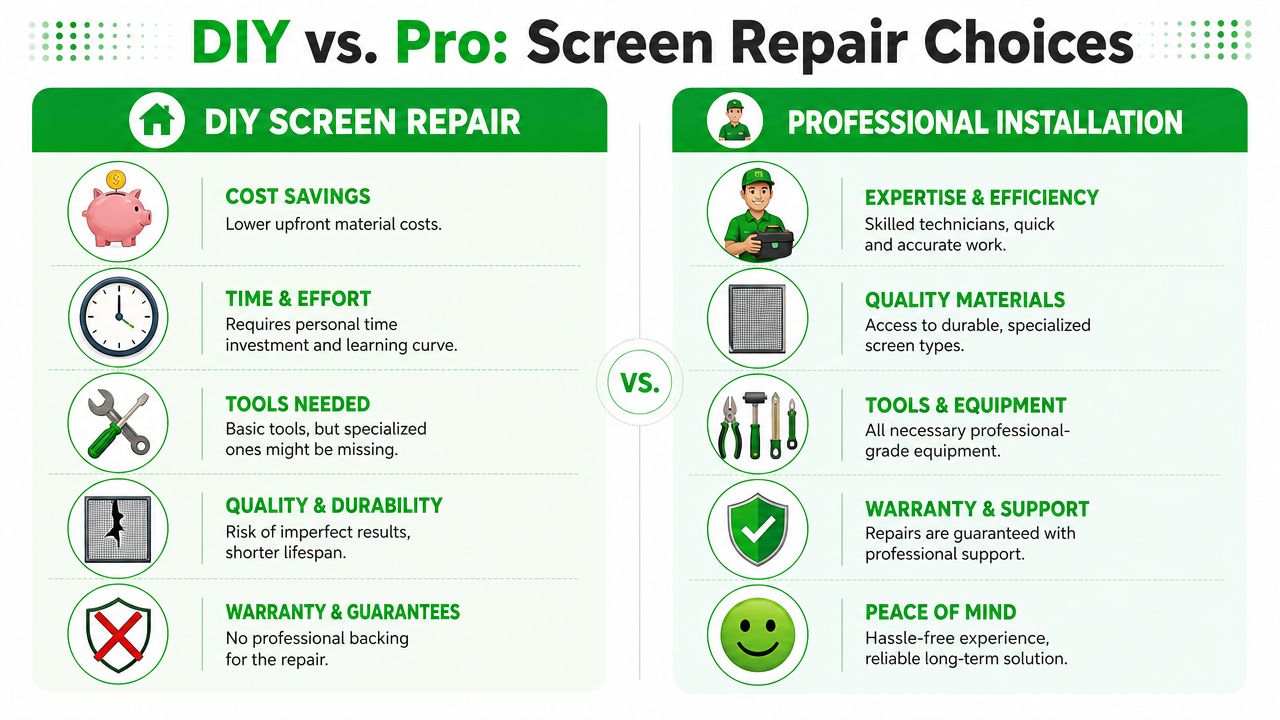
Some screen jobs are reasonable DIY projects. Some aren't. The trick is knowing which kind you have before you buy material, cut mesh, and find out the frame was the actual problem all along.
When DIY can work
If the frame is still straight, the opening is standard, and the damage is limited to old mesh or worn spline, a handy homeowner may be able to do a basic rescreen. For a workshop window, a utility room, or a low-risk opening at ground level, that can be a sensible weekend job.
DIY also makes more sense when appearance isn't critical. A minor ripple or slightly uneven corner may be acceptable in a less visible area.
Where DIY usually runs into trouble
Most off-the-shelf kits assume a standard right angle. Real homes don't always cooperate. One source on enclosure screen layouts notes that certain no-dig stake methods work only when screens are installed at a right angle, which reinforces a broader field reality. Non-standard geometry can determine whether a standard method works at all, as explained in this discussion of straight-line versus right-angle screen installation constraints.
That matters most when you're dealing with:
- Irregular openings: Older homes and additions often aren't perfectly square.
- Bent frames: New mesh won't fix a distorted structure.
- Hard-to-reach windows: Ladder work changes the safety equation quickly.
- Specialty mesh: Some materials are less forgiving during tensioning.
- Visible elevations: Front-facing and view-facing screens need to look right, not just function.
A simple side-by-side comparison
| Decision factor | DIY screen repair | Professional installation |
|---|---|---|
| Best fit | Straightforward rescreening on standard openings | Custom fit, specialty mesh, damaged frames, difficult access |
| Tools | Basic hand tools may be enough for simple work | Purpose-built tools and field experience |
| Time | Your own time, plus trial and error | Faster execution for most complex jobs |
| Finish quality | Can be acceptable, but mistakes show | More consistent fit, appearance, and retention |
| Problem solving | Limited when openings or frames are irregular | Better suited for field adjustments |
| Safety | Fine at easy access points | Smarter choice at height or on awkward windows |
If the opening is unusual, the frame is compromised, or the window is hard to reach, the job usually stops being a DIY savings and starts becoming a rework risk.
That doesn't mean homeowners shouldn't tackle simple projects. It means the project should match the conditions.
Budgeting for Your Screen Project Costs and Timelines
The cost of a screen project depends on what's being replaced. Some jobs are straightforward rescreens. Others involve custom sizing, frame repair, specialty mesh, or difficult access. That's why estimates can vary so much from one property to the next.
Nationally, window screen replacement typically averages $317 to $322 per screen, with common ranges around $147 to $523, labor rates around $50 to $80 per hour, and material costs of roughly $0.25 to $2.50 per square foot, according to Angi's window screen replacement cost guide. Some providers also note that custom or specialty screens can reach $1,188+ for a single job in more complex cases. Those numbers are useful because they show this isn't a flat-price category.
What moves the price up or down
A few variables do most of the work in an estimate:
- Size of the opening: Larger screens use more material and are harder to tension evenly.
- Type of mesh: Standard mesh and specialty mesh don't carry the same material or handling demands.
- Condition of the frame: A solid frame can often be reused. A damaged one changes the scope.
- Access: Ground-floor screens are one thing. Tall windows, atriums, and awkward elevations are another.
- Project type: A simple rescreen isn't priced like a custom fit with hardware issues.
Timeline expectations
Timelines are usually driven less by the installation itself and more by diagnosis and material matching. If the screen is standard and the frame is usable, the turnaround is often straightforward. If the screen needs to be custom-built, matched to an older opening, or coordinated across multiple windows, it takes more planning.
For homeowners comparing upkeep projects, it also helps to understand glass service costs alongside screen work. This overview of residential window cleaning cost can help you think about the whole scope of exterior window maintenance instead of pricing each item in isolation.
A cheap screen that fits poorly usually costs more in frustration than it saves on paper. In Flagstaff, that's even more true because strong sun, wind exposure, and seasonal debris expose weak materials and poor workmanship quickly.
Finding the Right Partner and Maintaining Your Investment
Hiring a screen company shouldn't feel like guesswork. The right provider should be able to explain materials clearly, identify whether the frame or the mesh is the problem, and describe how they handle installation without hiding behind vague promises.
Questions worth asking
Before you book a service, ask practical questions that reveal how they work:
- Are your technicians insured and safety trained? This matters on ladders, second-story access, and large properties.
- Do you work on custom or irregular openings? If the answer is vague, that's a warning sign.
- What do you inspect besides the mesh? You want someone who checks frame condition, tabs, corners, and fit.
- How do you prep the frame before installation? Good prep often separates durable work from callbacks.
- Do you regularly handle screens as part of other field services? Frequent screen handling builds better instincts.
What professional care looks like
One reliable indicator is contamination control. A quality installer will clean the screen and frame first, then attach the screen progressively from the bottom up so dust and air are less likely to get trapped at the corners, as shown in this installation quick-start guide covering cleaning and progressive attachment.
That same mindset carries into maintenance after the install.
- Keep debris off the screen and sill: Dust, pollen, and needles collect surprisingly quickly.
- Don't force a sticking screen back into place: Find out whether the frame is bent or the track is obstructed.
- Check corners and pull tabs regularly: Small issues are easier to correct before the mesh loosens.
- Schedule routine cleaning: Clean glass and clean screens wear better and look better together.
A well-installed screen still needs gentle, regular care if you want it to last and keep looking right.
A company's reputation matters too, but not just in the star-rating sense. Look for detailed feedback about communication, punctuality, cleanliness, and whether technicians respected the property. If you manage a service business yourself, this primer on boosting your business's online reviews explains why specific, high-quality review feedback is more useful than generic praise.
In a town like Flagstaff, local knowledge counts. Homes here range from newer subdivisions to cabins, custom builds, rentals, and large commercial sites. The crews who work in those conditions every week usually make better decisions about access, materials, and long-term fit.
If you need help with screens, windows, or overall exterior glass care, Pine Country Window Cleaning is a practical local option for Flagstaff and Northern Arizona properties. Since 1999, the team has worked on homes, cabins, storefronts, and large commercial buildings, with screen removal, cleaning, and reinstallation built into regular window service. If your screens are torn, loose, bent, or overdue for attention, reach out for an estimate and get a clear recommendation based on the condition of your windows and frames.