

You're looking through a storm-streaked upstairs window when rain starts spilling over the gutter beside the porch. The glass needs attention, but that overflow is harder to ignore. At a Flagstaff home or mountain cabin, those aren't always separate maintenance problems. They're signs that the same exterior needs a closer look after pine debris, snowmelt, and summer rain.
A combined gutter cleaning and window cleaning visit should leave you with clear glass, working drainage, and a useful account of anything the crew couldn't resolve through cleaning. The difference is in the details: how technicians reach the work, handle screens, test downspouts, and protect the home while they're there.
Why Flagstaff Homeowners Bundle These Two Services
An upstairs pane can stay streaked long after winter, while a gutter problem remains unnoticed until a July monsoon sends water over the edge. If you only visit your cabin occasionally, you might discover both during the same weekend. Booking separate contractors then means arranging access twice, explaining the property twice, and working around separate arrival windows.
The practical case for bundling starts with treating glass, frames, screens, and roof drainage as connected parts of the exterior. They experience the same weather, even though technicians clean them with different tools. A crew working around the building can notice staining below an overflowing gutter, a loose downspout, or haze that appears to sit between window panes rather than on the surface.
Those observations aren't a building inspection or a repair diagnosis. They're useful maintenance notes that help you decide what needs attention next.
What a combined visit changes
Consider a vacation home where the owner needs to coordinate a gate code, an alarm, and a property manager. The difficult part may be getting someone inside, not washing the glass. A coordinated appointment lets the crew plan interior access and exterior work together instead of asking the owner to repeat that process.
- Household disruption: You arrange access and discuss sensitive areas during one appointment.
- Equipment planning: The crew assesses ladder positions, pole access, and any lift requirements together.
- Maintenance records: You receive a clearer picture of the exterior's condition rather than unrelated service notes.
A combined visit can also avoid a separate travel charge and repeated setup, depending on how the contractor prices the work. That's worth asking about, not assuming.
Practical rule: Bundle the services when both are due, but don't delay a drainage problem just to wait until the windows need cleaning.
For short-term rentals, busy commercial properties, and second homes, the strongest benefit is often coordination. A property manager can arrange work between occupancies, identify access restrictions in advance, and collect observations from the same visit. The result should feel like a small exterior property checkup, with clear boundaries around what cleaning can and can't fix.
What Professional Window Cleaning Actually Involves
Professional window cleaning starts with choosing a method that suits the glass and the work position. Squeegees, ladders, extension poles, and pure-water brushes each have a role. A technician shouldn't use the same approach on an accessible interior pane, a coated window above landscaping, and glass carrying construction residue.
Before washing, the crew checks the glass type, coatings, films, sealants, adjacent materials, and visible damage. Loose grit needs to come off before friction-based detailing. ASTM International's architectural-glass cleaning work addresses methods intended to minimize scratched-glass problems and handle stained or damaged surfaces, reinforcing why inspection belongs before cleaning.
Squeegee work and pure-water cleaning
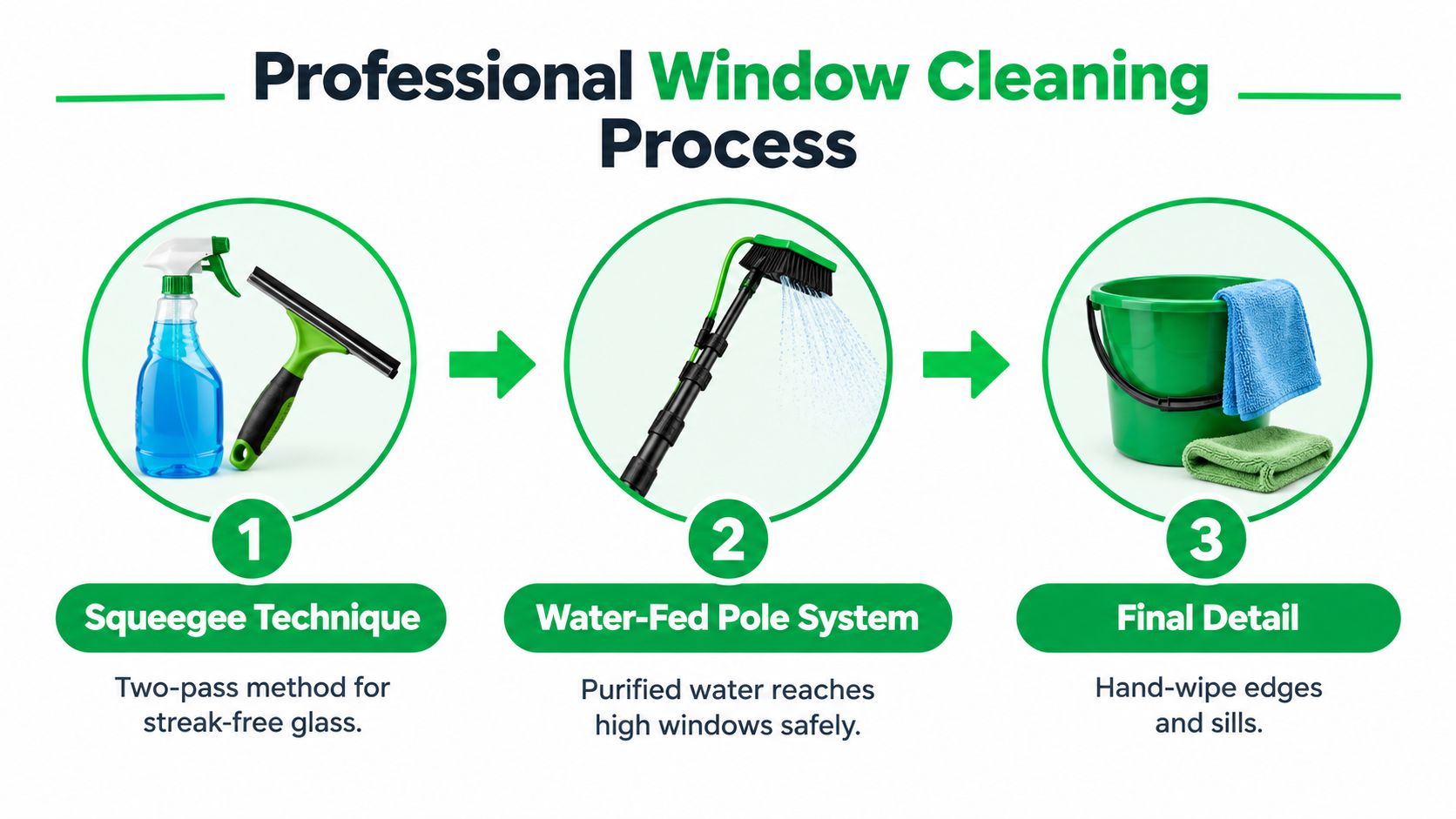
With traditional squeegee work, the technician wets and agitates the surface, then controls the blade angle and movement to remove the cleaning solution. Edge detailing matters because water left along a frame can run back onto finished glass. A clear center with wet corners isn't a finished window.
For suitable exterior glass, a water-fed pole delivers treated water through a non-abrasive brush, followed by a thorough rinse. The National Glass Association's guidance, citing International Window Cleaning Association techniques, specifies no more than 20 ppm total dissolved solids, describes tap water as unacceptable for this process, and explains that the pure-water rinse is generally allowed to evaporate on the glass.
The workflow below illustrates the main equipment choices and finishing work.
Screens and the finished result
We remove screens, clean them, and reinstall them with every service. Technicians should check attachment points, keep each screen associated with its opening, and report damaged mesh or bent frames rather than forcing a poor fit.
A final review should distinguish removable dirt from persistent staining or pre-existing damage. Aggressive scraping isn't a substitute for identifying the surface, and standard washing shouldn't be sold as glass restoration.
For rental owners coordinating broader turnover work, Edinhart Realty and Property Management's cleaning guide for rental investors is a useful companion resource when organizing the cleaning scope. Our professional window washing service provides the window-specific work, while the owner or manager coordinates the rest of the property.
How Gutter and Downspout Cleaning Protects Your Home
A gutter can look empty and still fail to drain. Roof runoff has to travel from the shingle edge into the channel, through the outlet and elbow, down the downspout, and into an appropriate discharge area. Clearing only the visible channel leaves too much of that route unchecked.
Compacted pine needles can obstruct an elbow. An underground leader can remain blocked or frozen below a clean downspout. When water can't leave as intended, it may overflow near walls, saturate fascia components, or concentrate beside the foundation.
The photograph shows the kind of access involved in examining the channel and its connections.

Follow the water to the outlet
A complete cleaning should include manual debris removal and downspout-flow testing. After removing leaves, needles, cones, and sediment, the technician flushes the downspout and checks the outlet. If water backs up or doesn't emerge where expected, that result needs investigating or documenting, not overlooking.
- Channel condition: Look for corrosion, separated seams, loose attachments, and places where water remains.
- Downspout performance: Confirm discharge rather than assuming an open inlet means an open pipe.
- Ground conditions: Note splashback, erosion, pooling, and the direction water travels after leaving the outlet.
The U.S. Department of Energy's foundation drainage guidance warns that roof water can saturate surrounding soil and wick through foundations. It recommends discharge onto sloping final grade more than 5 feet from the foundation, or into an underground catchment system more than 10 feet away that isn't connected to the foundation drain.
Cleaning versus drainage repair
Peeling fascia, damp crawl spaces, and soil erosion warrant attention, but cleaning alone may not correct them. A detached gutter, failed seam, or unsuitable discharge route needs repair or drainage work. For homeowners comparing that distinction, 7 Summits Roofing's gutter installation in Colorado Springs is a relevant resource for the installation side, not a Flagstaff cleaning service.
An empty gutter is only part of the result. The water still needs somewhere appropriate to go.
Debris handling matters beyond the property line, too. The EPA's storm-drain stewardship guidance explains that curbs and gutters quickly convey runoff to storm drains while removing little or no pollution. That municipal guidance isn't a roof-gutter specification, but it supports a sensible practice: collect removed debris rather than washing it into downstream drainage.
Seasonal Timing for Flagstaff and Northern Arizona
A fixed spring-and-fall schedule is easy to remember. It's less useful when the weather and debris loading don't follow it.
NOAA's Flagstaff climate description identifies a semi-arid climate where more than 90 consecutive days can pass without measurable precipitation. Yet snowfall can exceed 100 inches in a month and 200 inches in a season, with annual snowfall ranging from under 12 inches to over 200 inches. Those variations make condition-triggered inspections more useful than treating every year alike.
Use weather events as inspection prompts
The aim isn't to clean automatically after every change in weather. It's to check whether conditions justify service.
- Before the first major freeze or snow event: Arrange an inspection while access is still manageable, especially beneath pines or where drainage has been unreliable.
- After the main late-winter or early-spring melt: Check for displaced components, accumulated debris, and outlets that aren't draining.
- After unusually intense monsoon storms: Look for fresh overflow marks, debris movement, and changes around discharge areas.
Snow load, ice, roof pitch, pine buildup, and known downspout problems should influence urgency. A gutter that recently performed poorly deserves attention sooner than one that has stayed clear and discharged properly.
Inspection doesn't always mean full cleaning
An inspection and a cleaning are different services. Between major weather events, a ground-level visual check and a controlled flow test by someone with safe access may be sufficient. Dense debris, uncertain discharge, or evidence of overflow calls for a more complete visit.
Don't run a hose into frozen drainage just to see what happens, and don't climb onto wet or icy access surfaces to meet a calendar date. Schedule around workable conditions and let the crew assess the site.
For cabins and vacation rentals, arrange checks around periods when someone can observe the property rather than relying on your next personal visit. Our seasonal gutter maintenance guidance can help organize those appointments.
A window-cleaning appointment can fit into that maintenance rhythm, but appearance shouldn't dictate the drainage schedule. If a storm reveals a gutter problem, address it even when the glass still looks good.
Safety, Equipment, and Access on a Real Visit
Before unloading equipment, a careful crew assesses the work positions. Sloping ground, wet decking, overhead lines, fragile roofing, and limited driveway space can change the access plan. Height alone doesn't determine whether a ladder, pole, or lift is appropriate.
The CDC's ladder-fall safety information reports 161 workplace deaths and 22,710 workplace injuries associated with ladders in 2020. Those figures are a practical reason to evaluate training and access planning, not just the finished appearance.
Ladder mechanics aren't optional
OSHA's ladder guidance calls for three-point contact while climbing or descending, facing the ladder, and keeping the body near the middle of the step. When an extension ladder provides access to another level, its rails must extend at least 3 feet, or 0.9 meters, above the landing to provide a handhold.
Stable setup and securing the ladder matter just as much as climbing technique. A technician shouldn't compensate for a poor position by leaning farther sideways.
Access first: If the planned work requires overreaching or unstable footing, change the equipment or postpone the task.
For Pine Country's crews, equipment options include boom lifts, scissor lifts, and an in-house 95-foot atrium lift for challenging properties. Those machines still require suitable access and properly trained operation. A water-fed pole may avoid unnecessary climbing on suitable glass, while other surfaces or restoration needs require a different method.
Respect for the home is part of the work
Our technicians are background-checked and OSHA safety-trained. Homeowners should also ask any provider to confirm insurance and explain who supervises unusual access work.
Property care should be visible in ordinary decisions:
- Inside: Use drop cloths where needed and shoe covers, or remove boots when requested and safe.
- Screens: Keep them supported in a protected location, not piled where someone could step on them.
- Outside: Park considerately, preserve driveway access, and avoid obstructing neighbors.
Tell the crew about delicate finishes, pets, alarmed windows, and rooms you don't want entered. Good communication prevents avoidable surprises.
Pricing, Bundling, and What Affects the Quote
A useful quote describes the work before assigning a price. Window count alone won't explain the difference between accessible glass and panes above a steep sloped incline. Likewise, gutter length doesn't tell the contractor how much compacted debris is present or whether an underground leader needs testing.
For windows, the main questions concern pane count, building height, screen count, interior versus exterior scope, and glass condition. For gutters, the contractor needs information about length, roof pitch, access, debris loading, downspouts, and discharge arrangements.
What Typically Affects a Combined Cleaning Quote
| Pricing Driver | Window Cleaning Impact | Gutter Cleaning Impact |
|---|---|---|
| Property size | More panes and screens require more handling | Longer channels require more debris removal |
| Height and access | Difficult openings may need specialized equipment | Upper gutters and steep terrain change access |
| Existing condition | Mineral staining or construction residue may need separate treatment | Dense buildup or damaged components need closer evaluation |
| Included scope | Interior glass, exterior glass, and detailing must be defined | Flushing, outlet checks, and leader testing should be specified |
| Occupancy and scheduling | Furnishings, guests, or business hours affect access | Gates, parking restrictions, and exterior access affect setup |
Compare equivalent scopes
Separate appointments may make sense when the services aren't due together. A combined appointment can consolidate travel, setup, and scheduling, so it may come in equal to or lower than separate bookings during the same season. Ask for both options in writing, including any trip or equipment charges.
For another example of how cleaning services present bundled choices, Maid in America package deals provides a household-cleaning reference. It's not a local window-and-gutter price benchmark, so compare scope rather than transferring prices between services.
- Describe access clearly: Mention slopes, locked areas, tall glass, and limited parking.
- Identify problem areas: Send photographs of staining, overflow locations, or known blockages.
- Clarify exclusions: Ask whether restoration, repairs, or underground drainage work require separate approval.
Our gutter cleaning cost information helps frame the drainage portion of that conversation. The right comparison isn't the lowest total. It's the price for the work your property needs, with no ambiguity about what happens if the crew finds a problem.
How Pine Country Window Cleaning Handles a Combined Job
Flagstaff native David Kaminski started Pine Country Window Cleaning in 1999, and the company has operated locally since then. We're Flagstaff's largest window cleaning company, a Flagstaff Chamber of Commerce member, and an International Window Cleaning Association-recognized team.
The company's website introduces its residential and commercial services.

A combined job begins with a free estimate by phone or online and a conversation about access, occupancy, and the areas needing attention. Responsive scheduling and clear communication matter whether you're home for the appointment or coordinating from outside Northern Arizona. The crew should know about locked gates, delicate interiors, and tenant arrangements before arriving.
From arrival to final walkthrough
The technicians confirm the scope, choose suitable equipment, and coordinate the work so the household or business can keep functioning. At completion, the conversation should cover the finished cleaning, drainage observations, and any damage or maintenance concern that needs another trade. Our 100% satisfaction guarantee supports resolving concerns about the cleaning itself.
Customers can also arrange pressure washing, post-construction window cleaning, and seasonal snow shoveling and removal. Having those services available helps owners coordinate maintenance across seasons, although each task needs its own scope and appropriate conditions.
The company video offers another introduction to the service.
Your Next Steps Between Visits
This month, walk the property from ground level and record anything that changes after rain or melt.
- Drainage: Note overflow stains, loose downspouts, and water pooling near the foundation.
- Glass: Photograph persistent haze or staining, including whether it appears on the surface or between panes.
- Indoor moisture: Record recurring condensation by room and season.
The EPA's indoor-air guidance connects condensation with moisture-control concerns and recommends indoor humidity around 30–50%. Persistent moisture may need an HVAC, building-envelope, or moisture professional. Cleaning isn't a substitute for finding the cause.
Pine Country serves homeowners, cabin and second-home owners, short-term rentals, property and facility managers, dealerships, hotels, and NAU-area buildings in Flagstaff, Pine Canyon, Forest Highlands, Flagstaff Ranch, and Munds Park. Call (928) 527-0671 for a free estimate, or schedule online before the next major snow event.
Pine Country offers gutter and downspout cleaning alongside professional window cleaning, with screen care and courteous attention to your home. Visit Pine Country Window Cleaning to request a free estimate or arrange a combined visit that fits your property's weather exposure and access needs.