
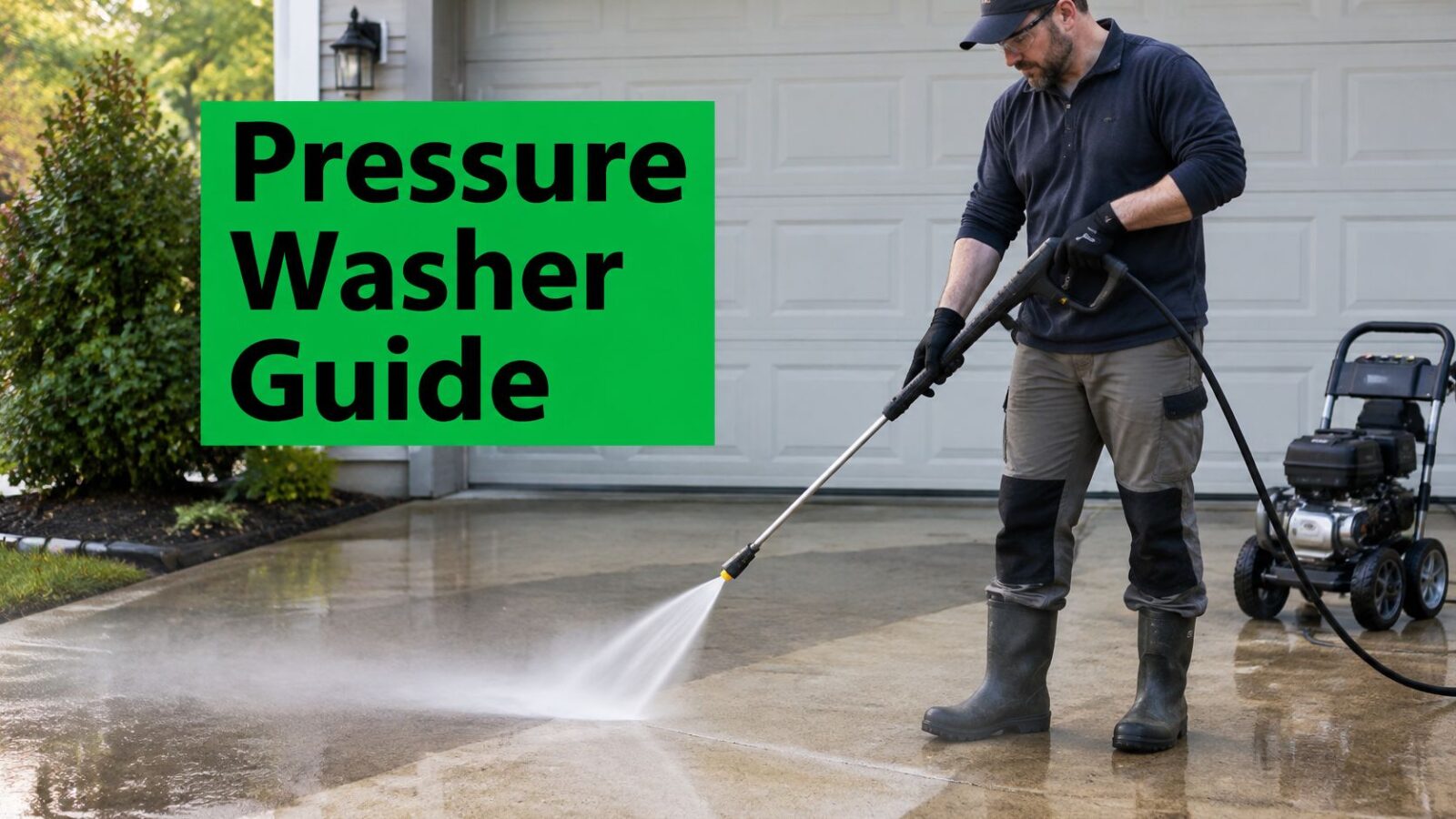
A zero-degree nozzle on a standard home unit concentrates water tightly enough to carve through wood siding, etch concrete, and cause serious skin injury before you even release the trigger, according to Consumer Reports guidance reported by KRGV. That single detail flips the usual buying advice upside down. Most shoppers look at the biggest pressure rating printed on the box and assume more force means cleaner stone, decks, or siding.
In real exterior maintenance, raw pressure is only half the equation, and it's the half that ruins property when it isn't controlled. Getting clean results from a pressure washing machine comes down to pairing water flow with the right tip angle, proving your settings on a hidden test patch first, running the wand safely, and keeping dirty wash water out of local storm drains.
What a Pressure Washing Machine Does
A pressure washing machine uses a gas engine or electric motor to drive a high-pressure pump that pushes water through a reinforced hose and a narrow nozzle orifice. A standard garden hose moves water gently across a surface, while a pressure washer forces that stream at high velocity to break the bond holding dirt, algae, mildew, pine residue, and flaking coatings onto exterior materials.
Pressure loosens the dirt, and flow carries it away.
That simple split explains why mechanized exterior cleaning reaches far beyond weekend driveway rinses. Homeowners rely on these machines for weathered decks and concrete patios, cabin owners clear winter road grit and sticky pine sap, and property managers, hotels, car dealerships, campuses, and construction crews use them to maintain high-traffic buildings and lots.
Worldwide demand reflects how exterior maintenance has shifted away from hand scrubbing. A P&S Intelligence market analysis estimated global pressure-washer revenue at roughly USD 2.84 billion in 2023, rising to USD 2.95 billion in 2024 and projected to reach USD 3.91 billion by 2030 at a 4.8% compound annual growth rate from 2024 through 2030, with electric-powered machines holding the largest power-source share. Revenue estimates vary across research firms based on currencies, sales channels, and product definitions, yet the steady upward curve is consistent across residential and commercial markets.
Before you pull a trigger or buy a unit, settle three practical decisions in order:
- Match the numbers to the surface: Confirm the starting pressure, water flow, and spray tip suited to concrete, wood, siding, or vehicles.
- Prove the setting first: Run a small test patch in an out-of-sight spot and inspect it dry so you don't scar an entire wall or deck.
- Control safety and runoff: Protect yourself from high-pressure injection hazards and route dirty wash water where local rules allow.
PSI and GPM Numbers to Start From
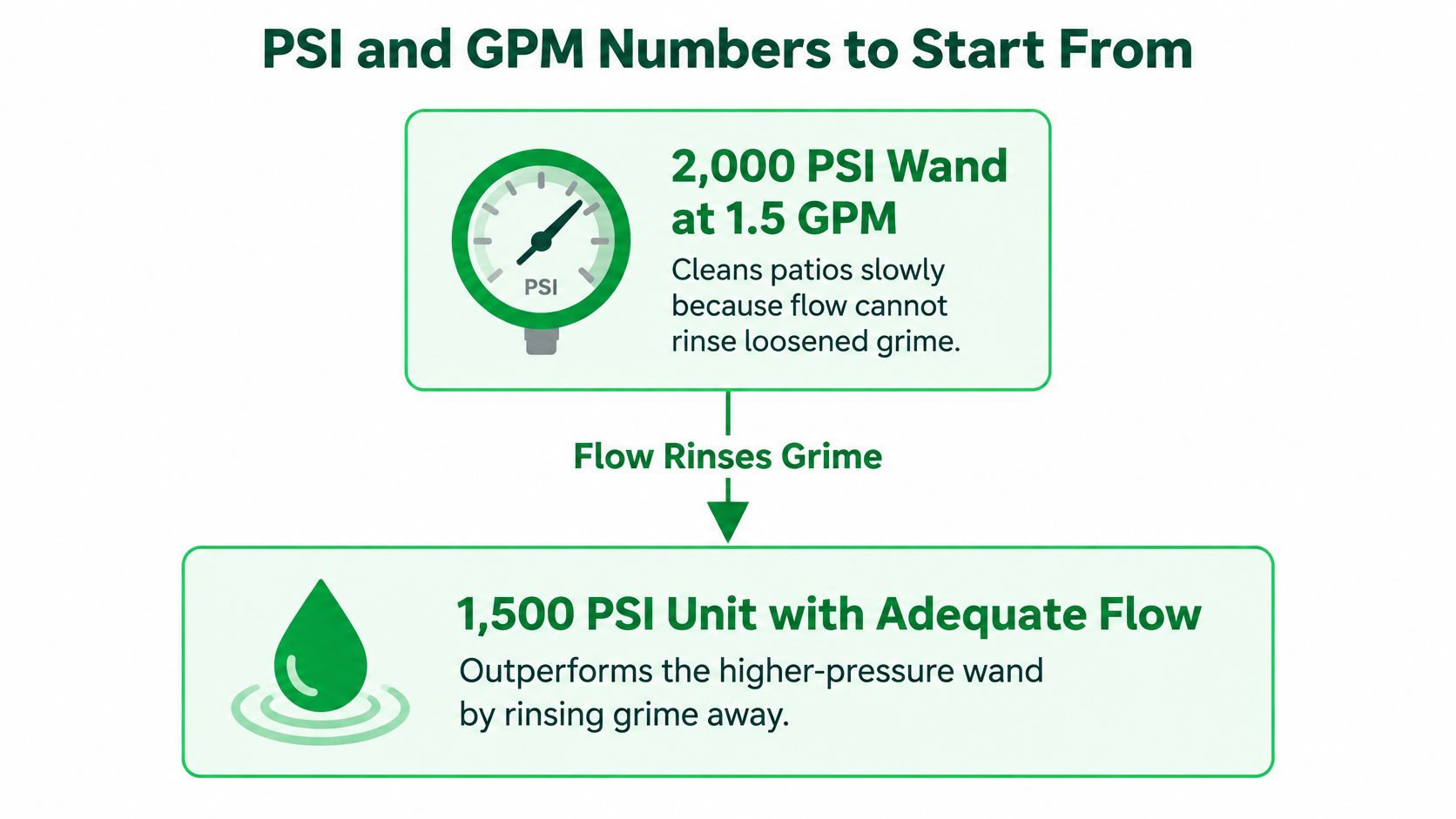
Say you try to wash a dusty flagstone patio with a 2,000 PSI wand that only pushes 1.5 GPM. The jet breaks grime off the stone, yet there isn't enough water volume to sweep the muddy slurry away, so you end up walking over the same strip twice. Switch to a 1,500 PSI setup with stronger gallons per minute (GPM) flow, and the patio clears faster because the water volume flushes loosened soil off the pavers in one clean sweep.
That trade-off is built into pump physics. As the Pumptec Engineering Guide explains, cleaning power relies on pounds per square inch (PSI) to concentrate impact and dislodge bonded soil, paired with GPM flow to transport that debris away. Cranking up PSI on a low-flow machine rarely improves speed and raises the chance of surface damage.
The chart below illustrates why higher flow outperforms higher pressure alone during routine rinsing.
Use this lookup chart to set a safe starting point before any job.
| Job | Typical PSI | Nozzle to start with |
|---|---|---|
| Outdoor furniture, cars, boats | Up to 1,500 PSI (steady rinse flow) | 40-degree wide tip |
| Siding, decks, painted trim (test first) | 1,300 to 2,000 PSI (start low, wide fan) | 25 to 40-degree tip |
| Driveways, sidewalks, patios | 2,000 to 3,000 PSI (higher GPM speeds rinsing) | 25-degree tip |
| Heavy grease, equipment, commercial surfaces | 3,000 to 4,000 PSI (high flow, heat for oil) | 15 to 25-degree tip |
Work through the chart in strict sequence rather than jumping straight to full output:
- Find the row matching your exact surface material.
- Start at the bottom of that PSI range with the widest listed spray tip snapped firmly into the lance.
- Swap to the next narrower tip before turning up pump pressure if light soil stays behind.
- Step slightly closer or slow your sweeping pace before adding PSI.
- Pause after one pass and inspect the cleaned strip before committing to the full area.
How Nozzle Angles and Plumbing Restrictions Change Output
Your spray tip acts as a second throttle because fan width spreads or concentrates the exact same pump output. A 40-degree white tip spreads a gentle fan suited for painted vehicles, patio chairs, and delicate trim. Moving to a 25-degree green tip gives you an everyday pattern for sidewalks, brick, and concrete patios. A 15-degree yellow tip narrows the impact enough to strip failing paint or fuzz up softwood if you pause in one spot, while a pinpoint 0-degree red tip has no place on residential siding, wood, or stone.
Hoses and fittings affect performance just as much as the nozzle. Positive-displacement pumps keep trying to push steady volume across operating pressures, so undersized fittings, tight hose kinks, overly long discharge lines, or an incorrectly sized nozzle orifice force pump-side pressure and motor load higher. Operators also have to prevent dead-heading, where a blocked tip or closed trigger traps pumped water and risks wrecking the pump head, motor, and plumbing.
I would never regulate pressure by half-squeezing the trigger. Instead, run through this quick spec-sheet check before starting:
- Verify rated output together: Make sure the stated PSI and GPM are measured at the same operating point, not as separate peak claims.
- Match the nozzle orifice: Pair the tip size to the pump's rated pressure and flow so you don't starve or overload the head.
- Check your inlet water supply: Confirm the outdoor spigot delivers slightly more flow than the pump demands, and adjust working pressure using the machine's unloader valve or pressure regulator.
How to Test an Unfamiliar Surface Before You Commit
Even seasoned technicians don't guess on an unfamiliar exterior wall or weathered porch. Northern Arizona sun, dry dust, pine resin, and hard winter freeze-thaw cycles weaken older paint, mortar, and cedar long before cracks show up from the street. Testing a hidden square foot takes five minutes and saves thousands in repairs.
Six Steps to Prove a Safe Setting
- Pick a low-visibility test spot. Look behind a downspout, under the bottom deck step, or along an inside corner where a minor mark won't ruin curb appeal.
- Dial down and stand back. Set your machine to the bottom of the surface's PSI range, install the widest tip listed for that material, and hold the nozzle roughly two feet from the surface.
- Make one slow, overlapping pass and wait for it to dry completely. Walking away feels slow, yet wet masonry and timber hide surface scarring until every drop evaporates.
- Inspect the dry patch closely for failure signs. Look for lifting or chalking paint, crumbling mortar or grout, fuzzy raised wood fibers, tiny pits in stucco, circular etch marks on concrete, or dampness creeping behind siding seams and into interior wall framing.
- Back off immediately if any failure sign appears. Switch to a wider spray tip, move back to three feet, drop pump pressure, and retest that exact same patch. If damage still shows up, stop using high pressure and switch to targeted cleaning solutions with proper dwell time or gentle hand brushing.
- Record the passing setup. Take a quick phone photo of the dry test area and note the nozzle color and working distance so your settings stay identical across the rest of the job.
Field rule: Never judge a test patch while it's still damp. Water darkens wood and stone and masks raised grain, chalking paint, and micro-pitting until the surface dries out.
Surfaces That Punish Guessing
Six exterior materials demand extra patience because a single careless pass leaves permanent scars: older masonry with soft lime mortar, painted lap siding, window-adjacent wood trim, textured stucco, weathered wood decking, and automotive clear coat. Textured exterior walls are especially tricky, so reviewing how to pressure wash stucco safely before pulling a trigger helps you avoid blowing holes into the finish coat or driving water into the lath underneath.
One boundary never bends: window glass and window seals are never a pressure-washing target. Pressurized streams shatter dual-pane thermal seals, force dirty water past weatherstripping, and bend aluminum screen frames. Glass belongs to squeegees, soft pure-water brushes on telescoping poles, and proper screen care rather than a pressure wand.
Running the Machine Safely
High-pressure water looks harmless compared to a saw blade, yet it cuts flesh just as fast. According to the University of Kentucky's pressure washer safety guidance, a pressurized stream can abrade skin layer by layer, creating wounds that heal poorly and scar badly. The same guidance highlights an OSHA accident investigation where a 3,000-PSI washer jet sliced directly through safety footwear and caused a severe injection wound when a worker's foot crossed the spray path.
Before firing up an engine or plugging in a cord, run a quick hazard check covering mechanical pressure, cleaning chemicals, and flying grit, just as the CDC recommends in that occupational guidance. The sequence below shows how fast a brief slip turns into an emergency.

Seven Safety Habits Before and During Every Wash
- Inspect hoses, quick-connect couplings, nozzle tips, and electrical cords before turning on the water. A worn hose jacket or loose coupler can rupture under operating load and whip sideways or fire a razor-thin jet at close range.
- Establish a clear exclusion zone around your sweep path. Keep children, pets, and bystanders well behind you because ricocheting gravel, loose mortar, and paint flakes fly fast.
- Wear rated eye protection, hearing protection, work gloves, torso coverage, and sturdy footwear suited to the task. Ordinary leather boots don't reliably stop a direct jet, and full personal protective equipment shields your eyes, skin, and ears from debris and chemical mist.
- Start with the lowest pressure and widest fan tip that lifts the soil. Less kickback keeps the lance controllable and cuts down arm fatigue over long stretches.
- Keep both hands on the wand, plant your feet on level footing, and never aim toward people, animals, or your own boots. Trigger surge can snap a loosely held wand downward straight across a shin or toe.
- Rely on the manufacturer's unloader or pressure regulator rather than idling with a closed trigger or clogged tip. Trapped pressure overheats pump seals and puts fittings under dangerous stress.
- Treat any puncture or suspected water injection as an immediate medical emergency, even if the skin mark looks tiny. Pressurized fluid and surface bacteria drive deep into underlying tissue through a pinpoint cut, requiring urgent hospital evaluation to prevent severe infection or tissue loss.
Remember one sobering truth every time you lace up your boots: protective gear reduces your exposure to splashback and flying grit, yet no standard workwear makes direct nozzle contact safe.
Applying It to Real Properties and Their Runoff
Technique on the wall only solves half the job. What runs off the concrete or siding matters just as much as how clean the surface looks afterward, especially across Flagstaff, Munds Park, Forest Highlands, and Pine Canyon where driveways drain straight toward mountain washes.
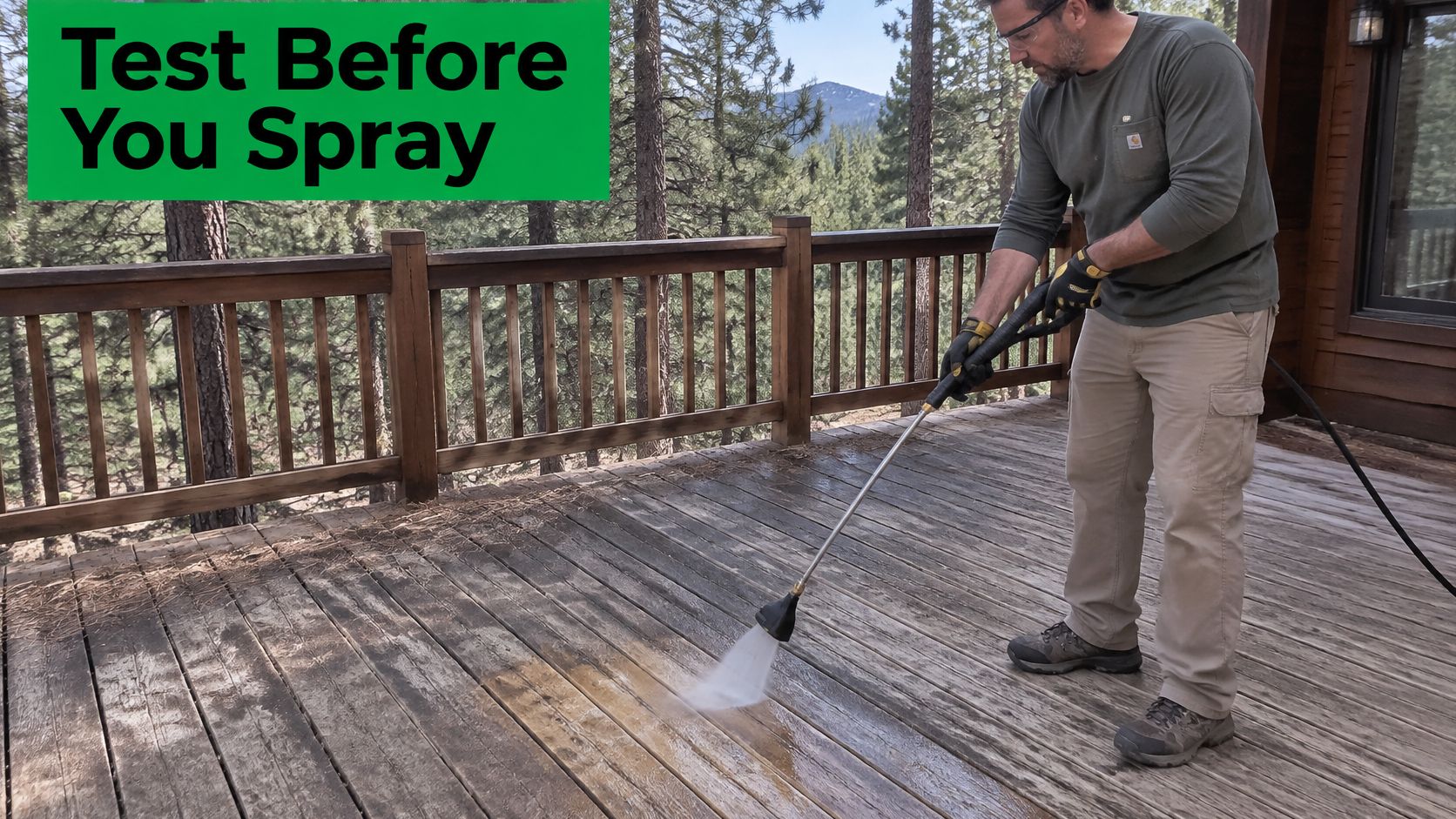
Here's a look at controlled deck washing with proper eye and hand protection before water even hits the ground.
Matching Settings to Real Property Surfaces
Different exterior jobs around Northern Arizona call for completely different setups:
- Flagstaff cabin decks: Weathered softwood loaded with pine sap and dust needs low pressure, a wide fan tip, and a hidden test pass so you don't raise wood splinters or strip aged stain.
- Driveways with winter grit and oil spots: Sweep dry cinders off first, treat the oil spot with a degreaser (and hot water if you have it), rinse with strong flow, and capture every drop of chemical runoff.
- Painted siding and textured stucco: Stand back and angle passes slightly downward so pressurized water doesn't get forced upward behind lap seams or around window trim.
- Car dealership lots: High-volume vehicle rinsing requires wide tips and restrained output to clear dust and road grime without lifting clear coat or rubber seals.
- Short-term rental patios and walkways: Fast guest turnarounds work best when you dry-sweep debris first and keep rinsing controlled so muddy spray stays off sliding glass doors and outdoor furniture.
- Post-construction masonry: Start at the lowest effective setting and let masonry cleaners dwell on stubborn mortar splatter instead of blasting fresh joints. Once porous walls are completely clean and dry, Neasden Hardware's guide on protecting brick walls from rain offers a practical look at breathable water-sealing options that help guard masonry against freeze-thaw damage.
Where Wash Water Can and Cannot Go
Most how-to guides stop at "rinse thoroughly," leaving homeowners wondering whether wash water can run down the gutter into the street. According to the WSSC Water Mobile Cleaners and Power Washers Best Management Practices guide, pressure-washing runoff can carry suspended solids, oil and grease, metals, nutrients, detergents, and PFAS, and water containing chemicals or detergents must never enter storm drains.
In mountain communities, street inlets channel roof grit, vehicle oil, fuel drips, loose paint chips, and winter deicing salt straight toward creeks and groundwater. Watch this walkthrough for a clear look at managing exterior wash flow around residential surfaces and drainage points.
Deciding how to handle wastewater follows a straightforward path:
- Plain water on an unsealed surface: If you're rinsing dust or mud off clean concrete or wood without detergents, degreasers, or flaking paint, small volumes can generally be directed onto flat grass or gravel well away from curb drains so soil filters out sediment.
- Detergents, degreasers, oil, or stripped paint: Place rubber drain mats, berms, or sandbags over nearby storm inlets before starting, collect the dirty wash water with a wet vacuum or pump, and dispose of it to an approved sanitary sewer or recycling setup after checking local municipal rules.
- Uncertain local rules: Call your city's sewer or stormwater authority before turning on the spigot, or explore eco-friendly pressure washing methods that minimize harsh chemistry from the beginning.
Before starting any hose, answer two sorting questions: Is the surface sealed, painted, bare wood, or bare masonry, and what contaminants will ride in the water leaving it?
Choosing Electric, Gas, Cold or Hot Water Models
Most property owners don't need a heated commercial skid sitting in the garage. A 2025 Fortune Business Insights pressure washer market assessment valued the global industry at USD 3.24 billion and reported that cold-water pressure washers captured 62% of the product-type market. Applying that share to the total valuation implies roughly USD 2.01 billion in cold-water equipment revenue, though that implied figure is an approximation because the share and market valuation may rest on slightly different reporting bases.
Cold-water machines cover exterior walls, concrete, decks, driveways, and routine property washing by pairing pressure, flow, and targeted cleaners. Hot-water models add a fuel-fired or electric heating coil, which earns its keep mostly on baked-on grease, motor oil, hydraulic fluid, and gum across shop floors and commercial equipment.
Electric Versus Gas Power Sources
Power source comes down to noise, mobility, and maintenance tolerance. Electric models weigh less, run much quieter, produce zero exhaust, and start instantly, making them practical for decks, patios, and cabins with an outdoor GFCI outlet nearby. Their limitations are cord reach and lower water flow. Gas models roam across long driveways and remote lots without extension cords and deliver higher GPM for faster concrete rinsing, yet they demand gasoline storage, engine oil changes, winterizing, and outdoor ventilation.
| Machine type | Best for | Main trade-off | Typical buyer |
|---|---|---|---|
| Electric cold-water | Decks, siding, vehicles, occasional home use | Cord length limits reach and flow is lower | Homeowners and cabin owners |
| Gas cold-water | Driveways, large patios, frequent use | Noise, fuel, exhaust and regular maintenance | Serious DIY users and contractors |
| Electric hot-water | Garage floors, oil, grease and equipment | Higher cost, heating time and more upkeep | Mechanics and small shops |
| Gas hot-water | Heavy grease and large industrial surfaces | Heavy, costly, needs ventilation and servicing | Commercial maintenance crews |
If your main exterior headache is mildew on siding or algae on roof eaves rather than deep oil stains on concrete, you don't need a massive gas machine at all. Weighing pressure washing vs. soft washing keeps you from buying excess PSI for delicate surfaces that respond better to low-pressure cleaning solutions.
Buy for your largest regular seasonal job, not the single toughest project you'll tackle once every five years. Rent commercial equipment for one-off cleanups.
Your Next Step Match the Machine or Hire It Out
I would buy a cold-water electric pressure washing machine in the 1,300 to 2,000 PSI range if your chores are ground-level, repeat seasonal tasks on surfaces you've already test-patched. Hire a professional crew when the work reaches second-story walls or rooflines, involves heavy degreasers, requires aerial lifts, sits close to fragile glass and frames, or triggers municipal drain containment rules you aren't equipped to manage.
Run your project through these six decision points before spending money on a machine:
- Surface type: Poured concrete handles moderate pressure well, while stucco, painted trim, and weathered decks punish minor mistakes.
- Area size: A small back porch takes an hour with an electric wand; a long driveway or commercial lot turns into an all-weekend chore without commercial flow.
- Frequency: Regular spring and fall rinses justify owning a unit, whereas a once-every-few-years siding wash rarely pays back purchase and maintenance costs.
- Chemicals needed: Once degreasers or cleaners enter the wash, drain protection and wastewater capture become mandatory.
- Height and access: Fighting wand kickback while perched on an extension ladder is a recipe for a fall. Even in dedicated window maintenance, high-level access follows strict engineering controls: California's Title 8 Section 3287 window-cleaning rule bans extension ladders over 40 feet, requires a second worker bracing the base of any ladder taller than 18 feet, and enforces a 1:4 setup ratio, while Cal/OSHA portable-ladder rules mandate nonslip devices, level footing, and alignment with the ANSI/IWCA 1-14.1 safety standard. Ground-based water-fed pole systems also reduce ladder exposure by sending purified, low-mineral water through a telescoping brush head that lifts grime and dries spot-free from the ground.
- Where the runoff goes: If your driveway slopes directly into a street inlet or neighboring yard, bring in a team prepared to manage wash water properly.
Caring for Your Home and Windows the Right Way
If you're in Flagstaff, Munds Park, or anywhere across Northern Arizona and would rather leave exterior washing to trained pros, Pine Country Window Cleaning is here to help. Founded in 1999 by Flagstaff native David Kaminski, we're Flagstaff's largest window cleaning company, serving homes, cabins, hotels, NAU facilities, car dealerships, medical buildings, and high-rise properties. Alongside gutter cleaning, pine needle cleanup, and seasonal snow removal, we offer pressure washing for driveways, sidewalks, garages, roof shingles, roof eaves, and home siding, matching nozzles and pressure carefully to every surface.
We care about our customers and protect every home we step onto, which is why our OSHA safety-trained technicians never aim a pressure wand at glass or screens. For windows, we use professional squeegees, secure ladders only where safe, in-house commercial lifts reaching up to 95 feet for tough heights, and pure-water brushes on poles that rinse frames and glass spot-free. Every standard residential window service includes outside and inside glass, wiping inside and outside window frames, wiping inside window sills, and carefully removing, cleaning, and reinstalling your bug screens. Call or schedule online for a free estimate, and a friendly member of our team will come look at your property in person first.
Whether your driveway needs winter grit cleared away, your siding needs a careful wash, or your home's windows and bug screens are due for a thorough, streak-free service, our crew is ready to handle the job safely from start to finish. Schedule your free on-site estimate with Pine Country Window Cleaning and let our Flagstaff team inspect your property and recommend the safest approach for every surface.