Stand near a west-facing window in Reno late in the afternoon, and you'll see the problem right away. Even glass that looked clean a week ago starts catching the high-desert sun with a dull, milky haze, gray buildup trapped along the screens, and gritty sills that streak the moment moisture touches them. Whether you own a home in the foothills or manage a multi-story storefront downtown, finding dependable window cleaning in Reno takes more than picking the lowest estimate online.
Most local service pages treat glass care like a simple cosmetic chore. In northern Nevada, three operational realities separate a lasting clean from a wasted visit: wildfire smoke residue that behaves differently from ordinary dust, municipal water rules that shape exterior runoff control, and fall-protection standards for any glass above ground level.
At Pine Country Window Cleaning, Flagstaff's largest window cleaning company founded by Flagstaff native David Kaminski in 1999, we've built our trade around commercial squeegees, ladders, extension poles, and pure-water brushes. Taking genuine care of customers and protecting their homes comes down to matching the right method, timing, and safety setup to the exact building in front of you.
Window Cleaning Services in Reno at a Glance
Regular glass maintenance across Reno and Sparks is a routine property upkeep job, not an occasional luxury. According to the U.S. Census Bureau QuickFacts for Reno, Reno reached an estimated population of 283,621 on July 1, 2025, while neighboring Sparks held 111,902 residents, forming a combined urban population of roughly 395,523. Across Washoe County, the same Census dataset reports 231,737 housing units in 2025, with Reno owner-occupied homes carrying a median value of $548,300 from 2020 to 2024 and a 49.8% owner-occupancy rate.
Commercial demand runs just as deep alongside that residential base. Data from the U.S. Census Bureau Washoe County comparison table records 14,199 employer establishments in 2023, 40,270 nonemployer establishments in 2024, and 2,531 building permits issued in 2025. Start by matching your property to the right service category before comparing schedules or quotes.
| Service | Best for | Typical scope | Access method | Typical frequency |
|---|---|---|---|---|
| Residential exterior and interior | Single-family homes and condos | Inside and outside glass, frames, sills and screens | Ladder and extension pole | Every 3 to 6 months |
| Second homes and cabins | Seasonal or vacant properties | Exterior glass, frames and debris clearing | Ladder and extension pole | Before and after each season of use |
| Commercial storefront | Retail, dealerships and medical offices | Storefront and entry glass | Pole or lift | Monthly to quarterly |
| Multi-story and atrium | Hotels, campuses and atriums | Upper-floor and atrium glass | Powered platform, boom lift or scissor lift | Quarterly to twice a year |
| Post-construction | New builds and renovated properties | Glass, frames, dust and construction residue | Ladder, pole or lift | Once, before occupancy or listing |
Reading the Service Matrix for Your Property
Match your building to a single row first, then adjust your visit cadence based on site exposure. A single-family home tucked behind mature trees faces sap and spring pollen, whereas a hillside home open to afternoon gusts collects abrasive desert grit much faster.
Commercial storefronts on busy corridors need frequent glass maintenance because fingerprints, exhaust haze, and entry-door smudges hurt visibility within days. By contrast, a newly built or remodeled property requires a one-time post-construction clean to strip drywall dust, silicone traces, stickers, and paint overspray safely before move-in or final inspection.
A smart schedule starts with your property category, then bends around local wind, construction dust, and regional smoke rather than a rigid calendar date.
Rental units and vacation homes sit between residential and commercial demands. If a property stays closed for months at a time, booking an exterior wash right before arrival and again after closing season keeps mineral buildup and organic debris from baking into the glass under intense high-desert UV light.
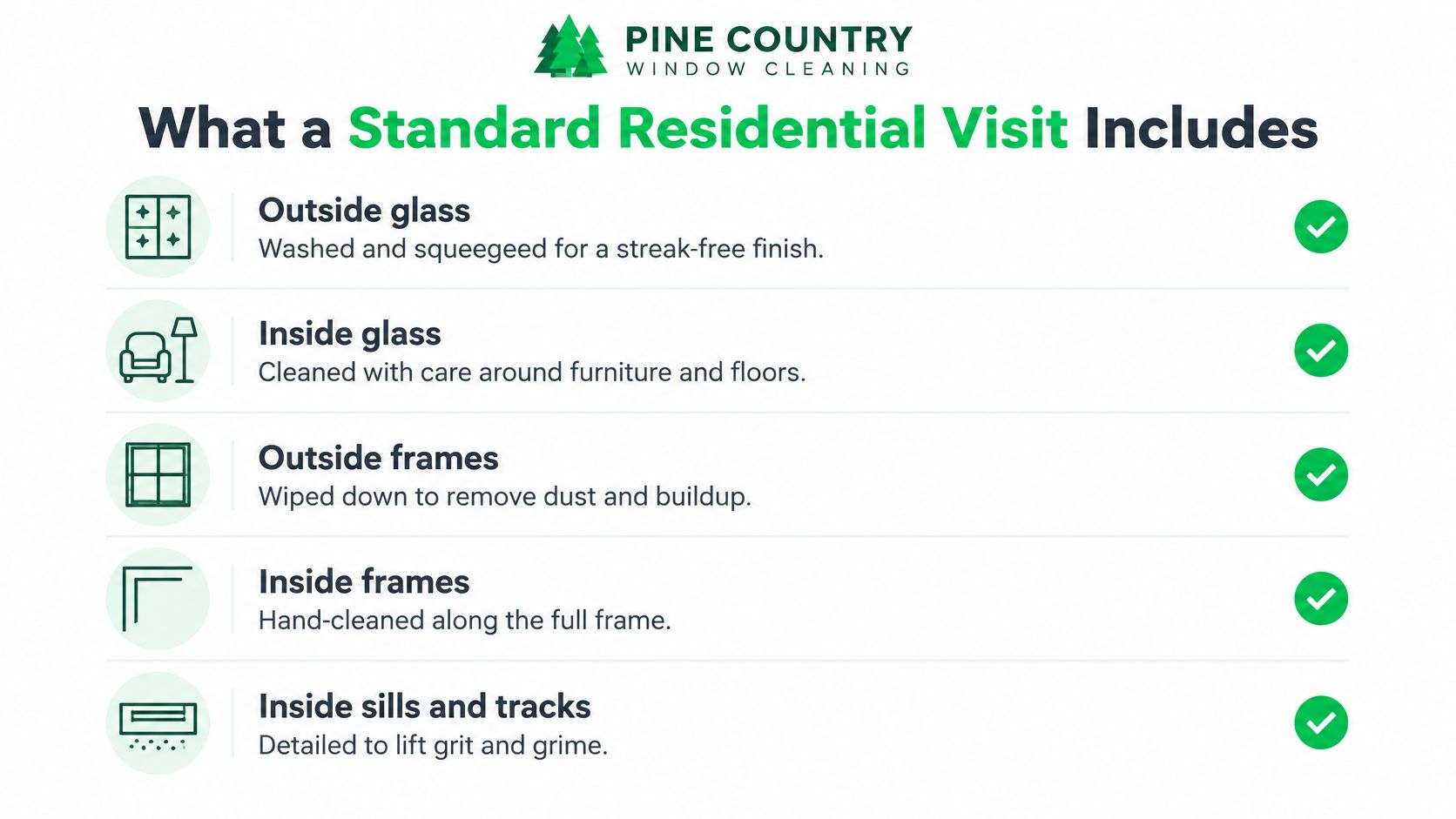
What a Standard Residential Visit Includes
Homeowners often compare two quotes that look miles apart in price without realizing they're looking at completely different scopes of work. Using our published residential process at Pine Country Window Cleaning as a concrete benchmark shows what a thorough home visit should cover from start to finish.
When our technicians arrive at a customer's home, a standard service includes outside windows, inside windows, removing, cleaning, and reinstalling bug screens, wiping inside and outside window frames, and wiping inside window sills. We rely on professional squeegees, properly fitted ladders, extension poles, and pure-water brushes rather than household shortcuts.
How Screen Handling and Pure Water Protect Your Home
Caring for a customer's home shows up in the details you notice after the truck pulls away: clean flooring around interior panes, intact window trim, and screens that seat cleanly without bent corners. Screen work shouldn't be treated as a paid upgrade or rushed while the screen stays clipped into the sash. Here's how we handle every screen on every residential visit:
- Remove each screen carefully: Technicians unlatch and pull every bug screen out of the frame so the glass, corners, and perimeter seals are completely accessible without prying against soft aluminum or vinyl.
- Clean each screen separately: Each mesh panel and frame gets washed away from the window opening so trapped dust, pollen, and cobwebs never wash back onto clean glass.
- Reinstall after the final inspection: Once the pane and frame are dry and checked for clarity, the screen goes back into place securely, preventing wet streaks and letting the crew spot any loose latches or damaged frames before leaving.
On exterior glass, we deliver pure water filtered to remove dissolved minerals and contaminants straight to the top of a pole fitted with a soft brush. Because those minerals are stripped out beforehand, the final rinse evaporates completely clear instead of leaving white spotting behind.
Add-Ons and What Drives Residential Quotes
Even a residential visit draws a clear line between routine window cleaning and specialty restoration work. At Pine Country Window Cleaning, our standard service does not include cleaning deep window tracks, removing paint or stain from glass, hard water mineral removal, sunscreen removal, cleaning and reinstalling specialty screens, ceiling fans, or interior mirrors. Customers pay extra for those tasks because they demand specialized scrapers, mineral treatments, or extra labor time.
Four variables drive almost every residential quote:
- Total scope: Interior-and-exterior work takes roughly double the setup and indoor care compared to an exterior-only wash.
- Window height and layout: Multi-story gables, steep rooflines, and French panes with divided lites take longer than single-story picture windows.
- Access method: Ground-level glass reached with pure-water poles prices lower than steep slopes requiring ladder stabilizers or specialty lifts.
- Visit frequency: Properties kept on a recurring schedule avoid heavy baked-on buildup and stay faster to service.
Before you confirm any appointment, ask the company to put both the included scope and the exact rate for every add-on in writing. That single sheet prevents awkward surprises when the final invoice arrives.
When to Schedule Cleaning Around Reno's Smoke and Seasons
Say a regional wildfire pushes heavy haze across the Truckee Meadows for five straight days. Once the sky clears, you try washing a patio pane, yet the glass turns cloudy and sticky under the blade instead of clearing up. That's not ordinary dust acting up.
A peer-reviewed air-quality analysis indexed on Europe PMC measured average smoke-day PM2.5 concentrations in the Reno-Sparks area at 35.17 ± 25.60 µg/m³, with 18 of 50 smoke-affected days exceeding the EPA's 24-hour PM2.5 standard of 35 µg/m³. During the fire-prone late-summer stretch, wildfire smoke accounted for 56 to 65% of Reno's PM2.5 and 18 to 26% of its carbon monoxide. Technically, those fine particles and organic carbon compounds settle into a thin, hydrophilic surface film on exterior glass and frames.
When that film gets wet with standard cleaning solution, it can redistribute across the pane instead of rinsing cleanly, causing blade drag, persistent haze, and rapid re-soiling. Regional wildfire air-quality reporting from KUNR Public Radio citing Desert Research Institute findings adds that smoke days raised measured air pollutants six- to tenfold, while polycyclic aromatic hydrocarbons climbed 6.3 to 47 times higher than on smoke-free days.
| Trigger | When to book | Why it matters |
|---|---|---|
| Wildfire smoke event | Once air quality returns to moderate or better | Smoke film smears when wet and needs a dry pre-wipe |
| Late-summer fire season | Early fall, before winter | Deposits build up over the season and set in |
| Spring pollen | Early spring | Pollen sticks to screens and sills first |
| Post-construction or renovation | Before occupancy or listing | Dust, adhesive and construction residue are removed once |
| Short-term rental turnover | Between guests | Marks and fingerprints show up on glass and frames |
Operating Rules for Smoke and Seasonal Timing
Good timing saves both labor and rework. If you're planning seasonal upkeep, checking general guidance on the best time to clean windows helps, yet Reno's smoke seasons add stricter field rules you should follow:
- Hold off during active smoke or high wind: Washing glass while ash and fine particles are still drifting coats wet sills and frames again before the crew packs up.
- Check AQI before opening windows: Keep windows shut during poor air-quality advisories so smoke particles stay outside; aggressive indoor dusting or vacuuming during an active event can stir fine particles back into the living space.
- Pre-remove loose soot before squeegeeing: Technicians need a dry pre-wipe or controlled flush to lift loose particulate off the glass, frames, and screens before pulling a squeegee blade across the surface, reducing scratches and smear trails.
- Address the whole assembly after heavy haze: Smoke collects on screens, exterior frames, sills, and rubber seals, not just the center of the glass. Keep in mind that window cleaning handles surface residue and never substitutes for HEPA air filtration, fresh HVAC filters, or professional fire-restoration work if indoor materials suffered heavy smoke intrusion.
For commercial property managers, logging smoke events alongside service dates also protects your maintenance budget. Written records help distinguish routine atmospheric soot from failing insulated-glass seals, irrigation hard-water etching, or leftover contractor debris.
Scheduling rule: If your home or building has sat under wildfire haze for more than a few days, wait until air quality stabilizes at moderate or better before booking, then schedule a full exterior, screen, and frame wash once the air clears.
Water Rules and Runoff Control for Reno Exterior Work
Homeowners across Washoe County frequently pause before booking exterior glass work because they're worried about breaking drought rules. According to Reno outdoor water guidance published by Water Restrictions, the Truckee Meadows Water Authority service area follows a year-round three-days-per-week outdoor watering schedule, with no watering allowed between 11 a.m. and 7 p.m.
Those rules are written primarily for outdoor irrigation, not automatically to ban professional window washing. Still, treating water conservation casually is a mistake for homeowners, HOAs, and commercial managers alike. The main compliance issues on exterior jobs are uncontrolled water runoff, detergent or chemical discharge reaching storm drains, and scheduling exterior work during compliant daytime or early-morning hours.
| Method | Water use | Runoff control | Best for |
|---|---|---|---|
| Purified-water system | Filtered or purified water | Minimal detergent runoff | Homes and storefronts with reachable glass |
| Squeegee-and-bucket | Small, controlled amount | Controlled at the work area | Routine residential exterior |
| Low-water spot cleaning | Lowest volume | Limited to the spot being cleaned | Light jobs and touch-ups |
Comparing Low-Runoff Exterior Methods
Purified-water pole systems run tap water through multi-stage filtration resins until dissolved solids drop out, feeding a soft brush at the end of an extension pole. Because the system relies on pure water rather than heavy soaps, it produces minimal chemical runoff and leaves nearby landscaping untouched. It's an efficient choice for two-story homes, commercial storefronts, and properties prioritizing eco-friendly window cleaning with documented practices rather than vague marketing claims.
Traditional squeegee-and-bucket work uses far less water than most homeowners assume. A skilled technician works from a single bucket carrying a small, controlled volume of water and biodegradable slip solution, keeping moisture confined to the pane and immediately below the sill rather than hosing down driveways or sidewalks.
Low-water spot cleaning uses the smallest water footprint of all, targeting localized fingerprints, bird droppings, or entry-door marks between full seasonal visits. It won't replace a complete wash after heavy dust or smoke, yet it keeps high-traffic glass crisp without unnecessary water use.
Because municipal irrigation rules and commercial wastewater ordinances can vary between city limits, county parcels, and HOA bylaws, verify local expectations before large exterior washdowns begin. Ask any contractor three direct questions about water handling: where their water comes from, whether detergents stay out of storm drains, and how they schedule work to limit midday evaporation and wasted flow.
Vetting Providers and High-Access Safety
A suspiciously low bid on a Reno home or commercial building usually saves money in one of three places: skipping bug screens, stretching ladders past safe heights, or skipping proper insurance and runoff controls. Asking five sharp questions up front exposes those shortcuts before anyone sets foot on your property.
| Question to ask | Good answer | Red flag |
|---|---|---|
| Do you clean screens? | Screens are removed, cleaned separately, and reinstalled as part of the visit | Screens skipped, wiped in place, or left dirty |
| What is your water source? | Filtered or purified water with minimal, controlled runoff | An unclear answer about water volume or detergents |
| How do you reach upper floors? | Names the specific ladders, poles, lifts, anchors, and trained crew | Ladder use pushed above a safe working height |
| Are your crew insured and trained? | Provides current proof of insurance and OSHA safety training | Hesitating or refusing to show documentation |
| Which add-ons cost extra? | Supplies a written list of add-on rates before the visit starts | Surprise line items appearing on the final invoice |
Notice how each good answer relies on verifiable specifics rather than generic promises. When we care for our customers and their properties, clear expectations before the job protect everyone on site.

High-Access Work Is a Fall-Protection Operation
Once window cleaning moves onto upper stories, sloped atriums, or multi-level commercial facades, stop viewing it as a simple glass-cleaning task. Treat it as a building-maintenance and fall-protection operation.
The OSHA Powered Platforms Fact Sheet outlines federal requirements under 29 CFR 1910.66, which governs exterior building maintenance including window cleaning. That standard requires engineered structural supports, tie-in guides, certified anchoring devices, compliant personal fall-arrest systems, competent-person training, and written emergency procedures covering power or equipment failures.
OSHA guidance also identifies powered platforms and swinging scaffolds as safer alternatives to boatswain's chairs whenever those systems can practically reach the windows. Improperly selected, anchored, or stabilized access gear exposes technicians and bystanders to falls, suspension trauma, struck-by injuries, and dropped-tool hazards. Selecting the right equipment, whether that's a pole system from the ground or a boom lift, scissor lift, or dedicated atrium lift, protects workers while speeding up large facade projects; property owners tackling high glass can also review safe methods for cleaning high windows before hiring out the work.
Building Manager Pre-Work Verification Checklist
Hotels, hospitals, university campuses, multi-story retail centers, and glass atriums carry the highest stakes because heavy pedestrian traffic and complex rooflines leave zero margin for improvised rigging. Before any crew mobilizes on a multi-story Reno site, facility managers should verify seven concrete items:
- Access-method assessment: Require a written plan explaining why the crew chose specific lifts, suspended platforms, or extension poles for each elevation of the facade.
- Roof anchors and tie-back confirmation: Verify that existing roof anchors or tie-back points have current load certifications before anyone attaches a line.
- Equipment inspection records: Ask to see recent maintenance and pre-use inspection logs for boom lifts, scissor lifts, harnesses, and rigging gear.
- Ground-level exclusion zones: Confirm how cones, barricades, and spotters will keep guests, patients, and delivery traffic clear of falling-object zones below the work area.
- Weather and wind limits: Set clear stop-work thresholds for Reno's sudden afternoon wind gusts and storm cells so crews never gamble with platform stability.
- Written rescue plan: Ensure the team has a documented procedure for retrieving a suspended or stranded worker quickly if a motor fails or power drops.
- Platform-specific crew training: Verify that every technician stepping into a lift or harness holds documented training for that exact piece of equipment, not just general ladder familiarity.
Keeping track of insurance certificates, anchor certifications, and lift training across multiple vendors gets messy fast on large commercial portfolios. Many facility teams use dedicated software for managing contractor compliance from Safety Space so every certificate, safety checklist, and sign-off stays verified before work begins.
Checking Against the ANSI/IWCA Safety Standard
Even on residential properties and low-rise buildings where heavy roof rigging isn't required, formal industry safety guidance should guide every ladder placement and pole setup. OSHA recognizes the ANSI/IWCA 1-14.1 Window Cleaning Safety standard through the OSHA and IWCA Alliance as a core resource for window cleaners, building owners, architects, and regulators.
Part A of ANSI/IWCA 1-14.1 focuses on the safe use of access equipment in the field, while Part B covers how that equipment is designed, manufactured, installed, and maintained. OSHA's alliance with the International Window Cleaning Association specifically targets slips, trips, falls from heights, and proper use of ladders, scaffolding, and high-reach tools.
Before approving a bid for any two-story home or commercial building, ask whether the crew works to ANSI/IWCA 1-14.1 safety standards and request current proof of insurance and OSHA training documentation.
If a contractor brushes off that question or claims formal safety standards only apply to skyscrapers, keep looking. Safe crews welcome the scrutiny because they've already invested in the training and gear to answer it cleanly.
Confirm Coverage and Book Your First Reno Visit
Before reserving a date, confirm the provider's service area, get the full scope in writing, and establish how access will be handled. A quote is only useful if the crew serves your address and can reach the glass included in the price.
Pine Country Window Cleaning, founded in 1999 by owner and Founder & CEO David Kaminski, serves Flagstaff and Munds Park in Northern Arizona, with its Tempe team supporting large commercial projects in Arizona. For a Reno property, confirm that your chosen contractor dispatches crews to your ZIP code before scheduling an estimate. An online search result alone does not establish coverage.
What a Transparent Booking Process Looks Like
I recommend a property assessment before accepting a binding price, particularly when upper-story access, smoke film, or hard-water spotting could affect the work. Ask what the estimate includes and which conditions could change it.
Pine Country sends a staff member to look at a home, building, or project after a customer calls or schedules online. Its standard residential service includes exterior and interior windows, bug-screen removal, cleaning and reinstallation, frame wiping inside and out, and interior sill wiping. Window tracks, paint or stain removal, and hard-water removal cost extra. Have your Reno provider make those same scope distinctions explicit rather than assuming “window cleaning” includes every surface or deposit.
Questions should have a clear contact route. Pine Country's customer service representatives are available 24/7/365 at (928) 527-0671 or office@pinecountrywindows.com.
Your Pre-Booking Sequence
Use this checklist to turn an estimate into a workable appointment:
- Match your property to the right service tier: Specify residential maintenance, cabin upkeep, storefront cleaning, multi-story work, or post-construction cleaning. Identify interior glass and screens rather than leaving their inclusion implied.
- Time the appointment around real triggers: Discuss lingering wildfire smoke before choosing a date, and identify remodeling dust or seasonal haze that could affect timing. Ask how smoke conditions could change the appointment instead of treating a particular AQI category as an automatic clearance.
- Run the five vetting questions and safety checks: Confirm screen handling, water-use and runoff arrangements, OSHA training, insurance, and ANSI/IWCA 1-14.1 alignment. Ask how the proposed access method affects scheduling and whether equipment placement needs to be settled beforehand.
- Walk the property and lock the scope in writing: Review access points, ladder footing, furniture clearance, and visible deposits. Request an itemized scope separating standard cleaning from extra-cost work before approving the visit.
Book when coverage, access, timing, and price are clear. For Flagstaff, Munds Park, or other Northern Arizona properties, contact Pine Country Window Cleaning to request an on-site estimate and confirm coverage. For Reno, apply the same booking checks to a contractor serving your address.