
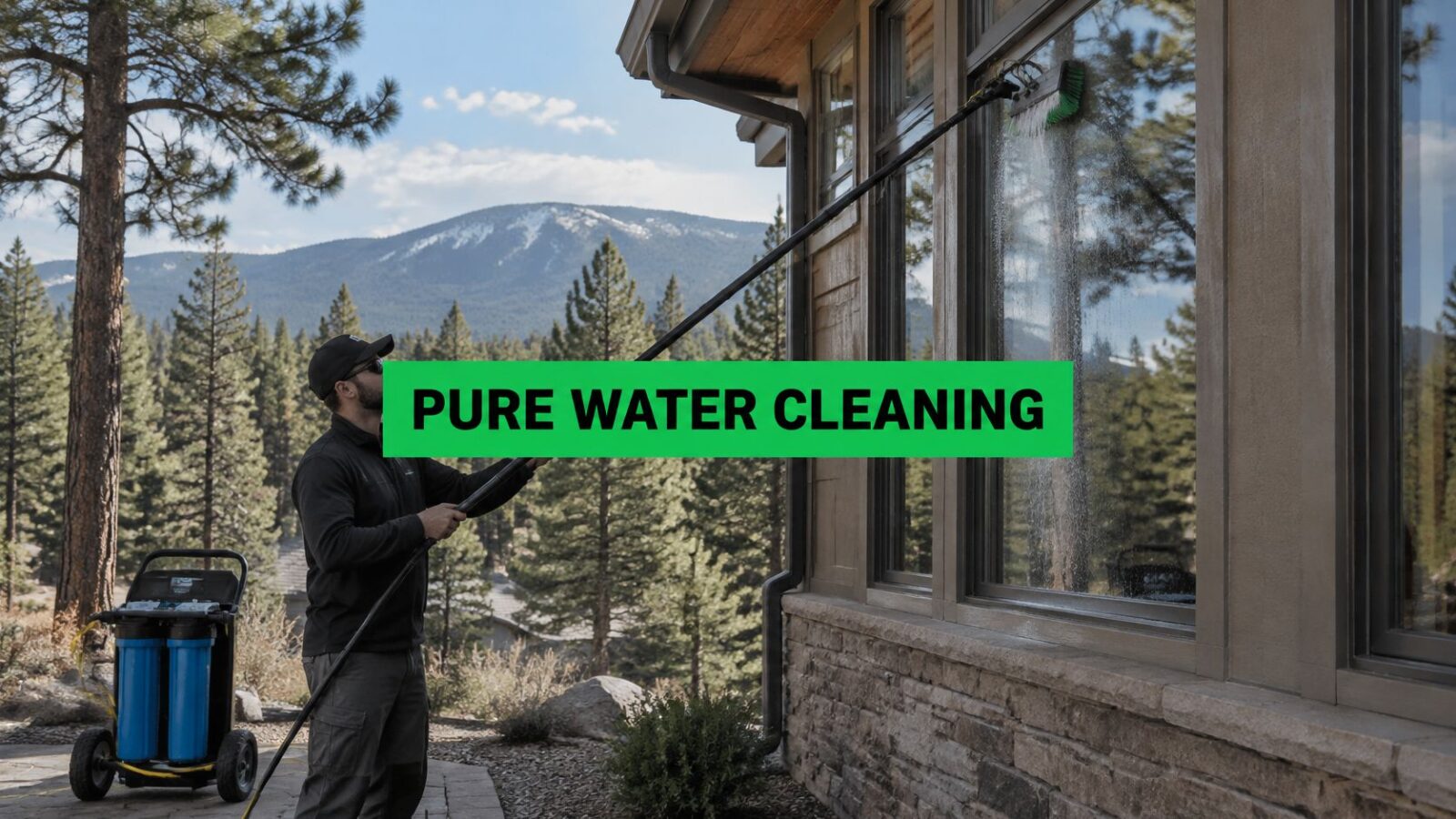
If purified water dries without spots, why do some freshly cleaned windows still need extra attention? The missing distinction is between water that leaves no mineral residue and glass that already has stubborn contamination or damage. A professional needs to identify both before promising a result.
Water fed pole window cleaning can be an excellent choice for exterior glass. Understanding how the equipment works, what technicians test, and which problems need separate detailing helps you judge a quote by its scope rather than its promises.
What Water Fed Pole Window Cleaning Is
Water fed pole window cleaning means a technician stays on the ground, works a telescoping pole fitted with a soft brush, and sends purified water up to the glass to scrub and rinse it in one continuous operation.
Say your home has upper-storey windows above a planted border. Instead of placing a ladder beside each window, the technician extends the pole from a suitable working position and guides the brush across the glass. A hose supplies treated water throughout the cleaning.
The equipment is easier to understand when you separate its parts:
- The telescoping pole provides reach. Carbon fiber makes long poles lighter and more controllable than older, heavier materials.
- The soft brush head loosens dirt through physical contact. Water alone isn't a substitute for careful agitation.
- The purified-water supply delivers rinse water with dissolved minerals removed before it reaches the window.
Think of a garden hose connected to a much more thorough filtration system, then attached to a brush that can reach upstairs. The important difference isn't pressure. It's the water quality and the technician's control of the brush.
This photograph shows the basic working arrangement.
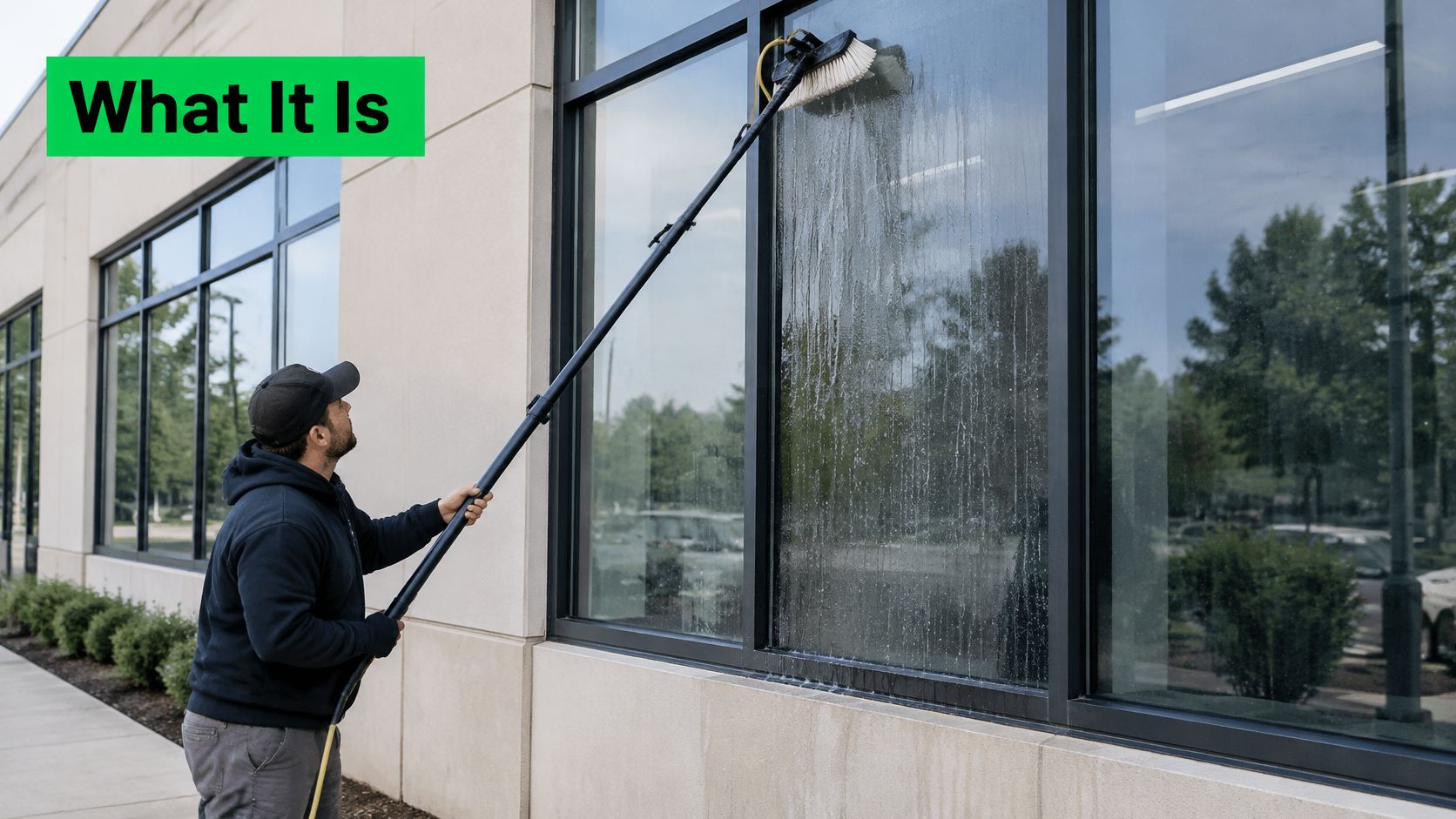
Why the glass is left wet
With suitable water and a thorough rinse, many exterior panes can air-dry without a squeegee pass. Pine Country's explanation of pure-water cleaning describes how filtered water, a telescopic pole, and a soft-bristled brush work together to remove dirt without leaving the mineral deposits associated with untreated water.
That looks different from familiar ladder-and-squeegee work, but the objective is the same: clean glass with no residue left behind. You'll commonly encounter the method on tall homes, cabins with debris around their frames, and commercial glazing that's difficult to approach safely.
Water Fed Poles Compared With Traditional Methods
Window cleaning methods compared
| Method | Typical Reach | Spot Risk | Operator Position | Best Fit |
|---|---|---|---|---|
| Ladder and squeegee | Ladder height, with exterior work above 35 feet ruled out by Cornell University's window-washing program | Hand-drying errors can leave marks | On a ladder at height | Short, low runs with clear access |
| Water fed pole with purified water | Often approximately 60 to 70 feet, as described in Window Genie's account of modern pole systems | Low with properly purified water and complete rinsing | On the ground | Multi-storey and hard-to-reach panes |
| Boom or scissor lift | Set by the lift's rated working height and site access | Determined by the cleaning method used | In a raised platform | Large commercial projects |
Start with safe access, not a preference for a particular tool. Cornell's requirements apply to its own window-washing program, not as a universal height rule for every property. They illustrate why a professional can't treat every high window as a straightforward ladder job.
A pole's stated reach isn't a promise that every window within that height can be cleaned from any position. Roof projections, deep setbacks, fences, and the available standing area affect whether a technician can place the brush properly.
Lifts solve a different access problem. They can position a worker beside difficult glazing, but they need suitable access, setup space, and ground conditions. A raised platform doesn't determine the finish; the technician still needs an appropriate cleaning method at the glass.
Where poles save unnecessary handling
For a suitable exterior route, water fed poles offer practical advantages:
- Less ladder repositioning: The technician can move between reachable panes without climbing beside each one.
- Fewer hand-drying passes: The rinse can finish routine exterior glass without direct squeegee access.
- Less chemical handling: Many maintenance cleans don't need detergent.
- A repeatable workflow: Brush contact and rinsing can follow a consistent pattern across similar panes.
Those advantages don't make traditional tools obsolete. A squeegee gives the technician close control on accessible glass, and conventional methods remain useful for interiors and detailed work.
A short, low, single-storey run with clear access may be quicker with traditional equipment, using a ladder only where justified. Conversely, repeated upper-storey panes can make ground-based pole work the more practical choice.
Practical rule: Choose poles for suitable height and repetition. Choose close-access tools for short, low jobs and work that needs direct detailing.
The best crew selects equipment for the window and the site rather than forcing every job into the same method.
How Purified Water Dries Without Spots
Tap water contains dissolved minerals. When it evaporates, those minerals can leave spots or a pale film on glass.
A water-fed system treats the water before it reaches the brush, reducing the dissolved material that could remain behind. The brush still does the cleaning: it loosens dirt, and the rinse carries it off the pane.
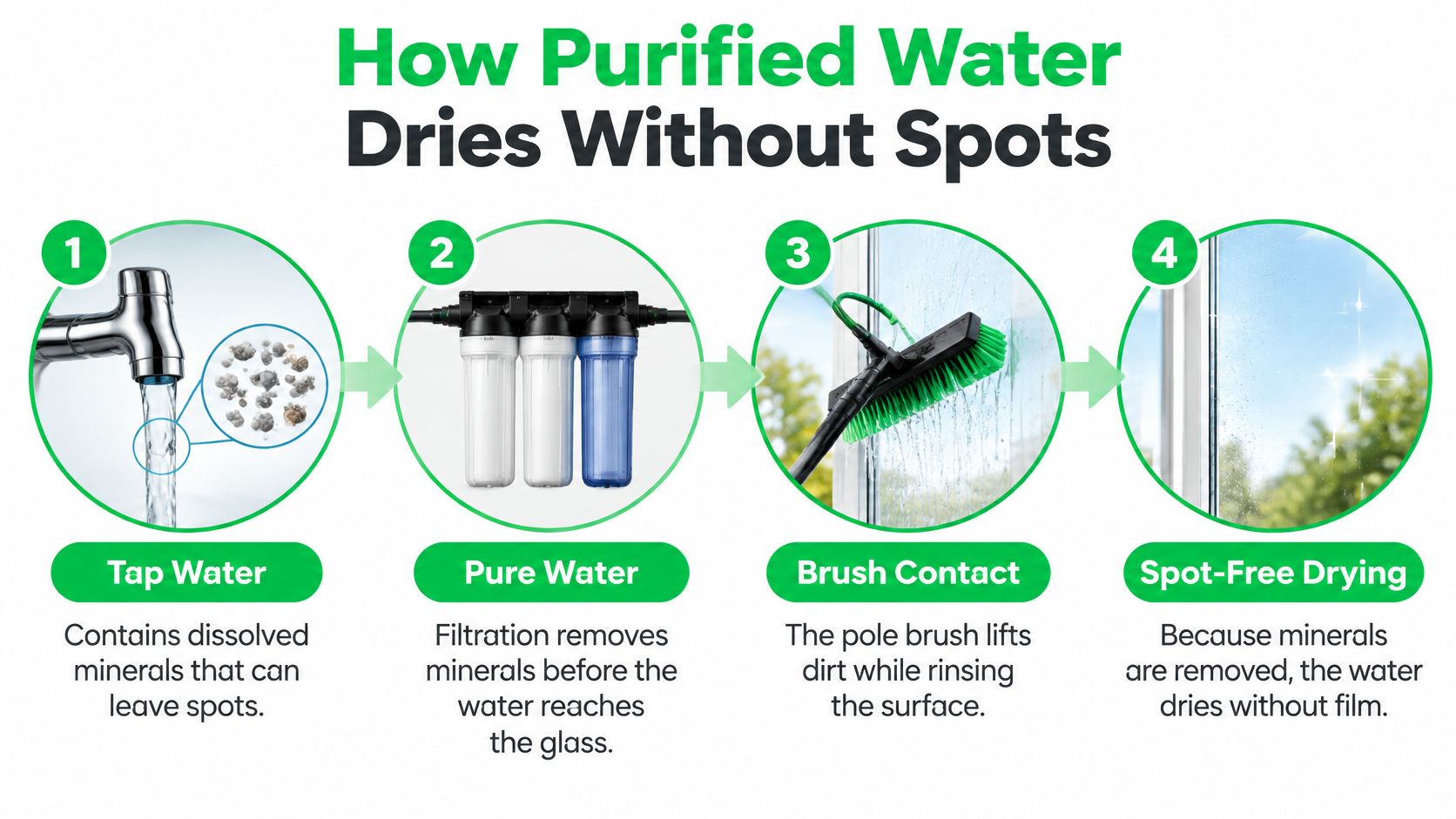
Filtration stages and their roles
| Stage | What It Removes | Role in the Process |
|---|---|---|
| Carbon filtration | Chlorine and organic material | Pre-treatment before finer stages |
| Reverse osmosis | A large share of dissolved minerals | Main reduction of dissolved solids |
| Deionization | Remaining charged ions | Final polish for spot-free drying |
| TDS check at outlet | Measures dissolved solids rather than removing them | Confirms water quality before use |
Purification systems may use different combinations of filters. The goal is to reduce dissolved solids to a very low level; a TDS meter checks the treated water at the outlet. The reading helps confirm that the filtration system is producing suitable water, but it does not guarantee that every pane will clean up in one pass.
Reverse osmosis reduces many dissolved contaminants, while deionization removes remaining charged ions. The outcome depends on the treated water reaching the glass, not just on which components the system contains.
The cleaning cycle
The brush loosens dirt, and the rinse carries it away. The sequence matters:
- Agitate the glass. Brush the pane, paying attention to edges and visibly dirty areas.
- Rinse the working area. Water jets carry loosened soil off the glass.
- Move the brush away for the final rinse. This lets rinse water flow over the pane without the brush touching it.
- Let the glass air-dry. Properly treated water is less likely to leave mineral residue as it evaporates.
This video provides another view of the equipment and working process.
Test the output, not the equipment's label
A filter system can appear ready even when its media needs attention. CleanLink's discussion of water-fed equipment describes how exhausted resin or a failing membrane can let dissolved material pass through and contribute to spotting.
Check the treated water at the purification outlet or pole, and repeat the check during a larger job. Testing only the incoming tap water does not show what is reaching the glass. If the output reading rises, the filtration media may need replacing or regenerating.
A clear pane is only part of a good result. The brush must loosen the soil, and the rinse must carry it away without leaving dirty runoff across cleaned glass. Many routine exterior cleans can be done without detergent, but the work still needs adequate brushing, rinsing, and inspection.
When Purified Water Needs Detailing Help
Purified water isn't a one-pass fix for every pane. It can prevent new mineral residue from the rinse without removing an old mineral deposit, a bonded contaminant, or damage already present in the glass.
The distinction matters when comparing a maintenance clean with restoration or post-construction work. Zarla's window-cleaning business guide discusses equipment choices and service planning, including the need to distinguish routine cleaning from specialized work.
Conditions that need separate treatment
| Condition | Why Purified Water Alone Falls Short | Treatment Needed |
|---|---|---|
| Hard-water mineral etching | Etching is damage to the glass surface, not loose dirt | Assessment for restoration; deposits may need separate mineral removal |
| Paint or stain on glass | Solid residue doesn't dissolve in the rinse | A glass-compatible removal method |
| Silicone or construction residue | Material is bonded to the surface | Specialized detailing |
| Oxidized frames | The frame surface is chalky or deteriorated | Frame assessment, restoration, and detailing |
| Bird residue | Adhered deposits may resist routine brushing | Pre-treatment before rinsing |
| Screens | Mesh traps dust and pollen | Remove, clean, inspect, and reinstall |
Don't confuse mineral deposits with etching. Deposits sit on the surface and may respond to suitable treatment; etched glass may remain marked after those deposits are removed. Our guide to removing hard-water stains from windows explains why these marks need separate attention.
Agree on the exceptions before accepting a quote
Source-water hardness affects the demand on filtration. Filter condition and resin exhaustion affect output quality, while dirty seals, deteriorating frames, and contaminated screens can affect the finish after rinsing.
Use a pre-work check that separates those issues:
- Verify the purified-water output. Confirm that the technician tests against the spot-sensitive cleaning benchmark rather than assuming the filters are working.
- Walk representative panes with the owner or manager. Include an ordinary window and a visibly troublesome one, not just the easiest glass.
- Write down the scope. Identify frame and sill work, screen handling, and any stain removal or construction detailing.
For our standard residential visits, bug-screen removal, cleaning, and reinstallation are included, along with frame wiping and inside-sill wiping. Paint or stain removal, hard-water removal, and track cleaning are extra work, not hidden parts of a routine wash.
Chemical-free routine cleaning doesn't mean every surface can be finished in a single pass.
Before accepting a quote, settle whether exception work is included or priced separately. A promise of identical one-pass results for every surface overlooks the condition of the property.
Safety and Access for Ground-Level Work
A telescopic water-fed pole can replace some ladder or rope-access work with ground-level operation. The UK Health and Safety Executive's window-cleaning best-practice guide identifies telescopic poles as an option for avoiding work at height where reasonably practicable.
Ground-based doesn't mean hazard-free. Long poles can become difficult to control, hoses can obstruct walkways, and runoff can make pavement slippery. Equipment must never be used near overhead electrical lines or in high winds.
This working position illustrates the access benefit, but the surrounding site still needs assessment.
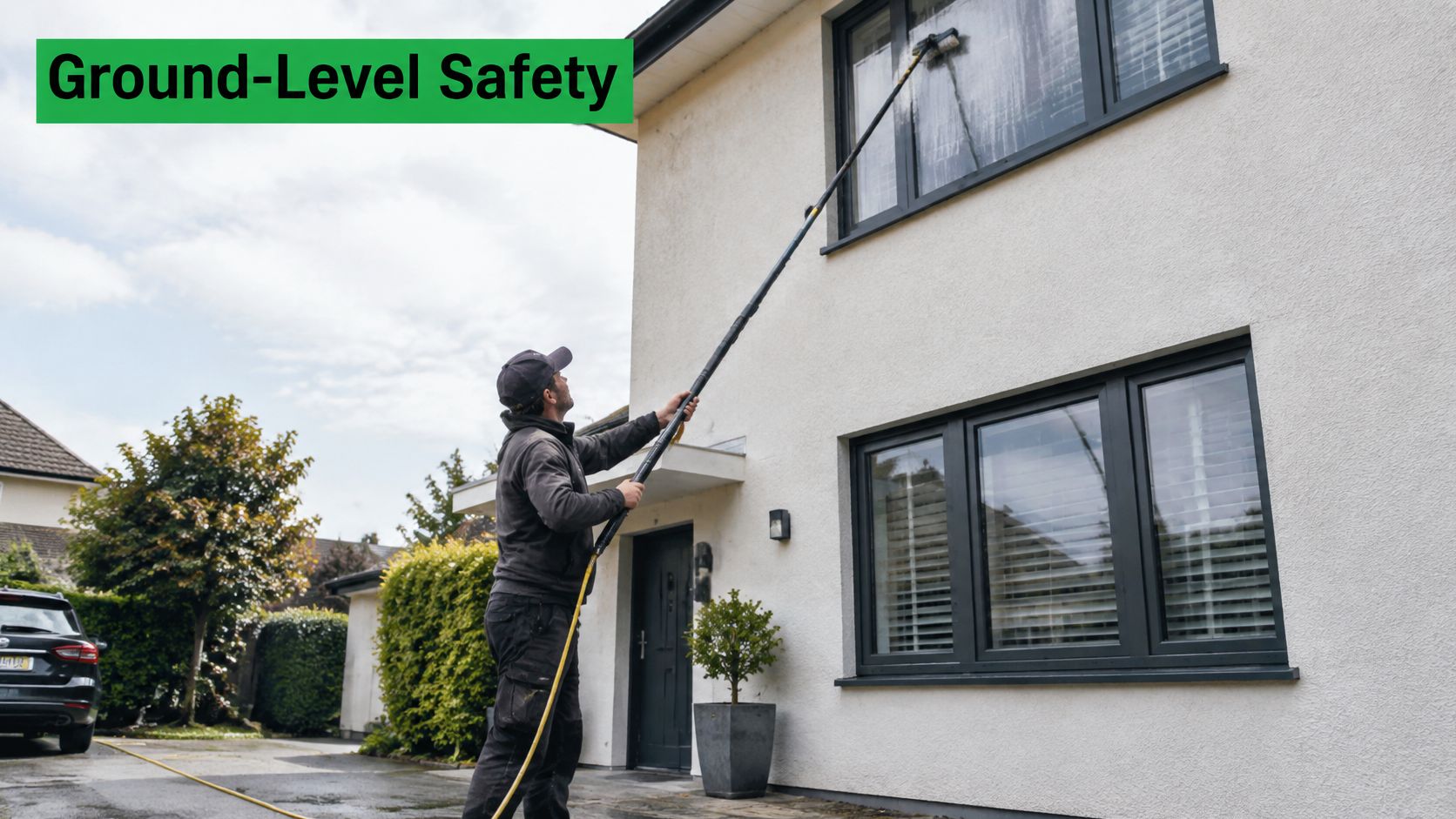
Match each hazard with a control
Purified water must still be treated as potentially conductive in actual working conditions. Water treatment isn't electrical protection, and a crew must maintain safe clearance rather than trusting the purity of the rinse.
A site plan should address the practical controls:
- Reach and weather assessment: Confirm a stable working position and suitable conditions.
- Exclusion zones: Keep people away from areas beneath pole work.
- Secured equipment: Check pole sections, connections, and equipment placement.
- Controlled hose routing: Avoid creating trip points across entrances and pedestrian routes.
- Slip prevention: Manage wet surfaces, particularly at busy doors.
- A stop-work decision: Lower the equipment when wind makes the pole unstable.
Commercial managers should coordinate those controls with traffic and pedestrian arrangements. At homes and cabins, the crew also needs to consider decks, landscaping, outdoor furniture, and where runoff will travel.
Our guide to cleaning high windows helps homeowners understand why access planning matters before selecting equipment.
Standards worth discussing
OSHA's fall-protection standards page identifies 29 CFR 1910 Subpart D, including ladder requirements under 1910.23, and personal-protective-equipment requirements under 1910.132; it also identifies ANSI/IWCA 1-14.1, whose Part A addresses access-equipment safety guidance and Part B addresses equipment manufacture, design, installation, and maintenance.
Our window cleaners are background-checked and industry safety-trained. For a managed property, the pre-work conversation should establish which standards apply and how the crew will document site controls.
Before the first pane is cleaned, expect a plan for equipment placement, overhead hazards, public access, and runoff. A good finish doesn't excuse an unmanaged work area.
Which Flagstaff Homes and Properties Suit the Method
| Property Type | Where Pole Cleaning Fits | What Needs Planning |
|---|---|---|
| Single-family homes | Upper-storey windows and exterior view glass | Landscaping, roof projections, and screen access |
| Cabins and second homes | Elevated exterior panes and repeat maintenance | Access arrangements and accumulated frame debris |
| Offices and medical buildings | Repeated glazing along planned routes | Entrances, occupants, and pedestrian movement |
| Hotels and campuses | Suitable façades with many similar windows | Guest access and coordinated work areas |
| Dealerships and storefronts | Elevated display glass and difficult exterior sections | Vehicles, customer routes, and low-glass alternatives |
| New construction | Routine rinsing after appropriate residue removal | Bonded debris, frame protection, and detailing scope |
The strongest fit depends on height, access, and maintenance needs, not the building's label. A cabin with clear ground access may suit a pole better than a lower commercial window hidden behind a deep canopy.
For single-family homes, the benefit is often access to upstairs glass without repeatedly positioning equipment beside the house. At a second home, clear arrangements for gates, screens, and the final inspection matter as much as the cleaning method.
Local exposure changes the work
Flagstaff and Munds Park properties don't all collect the same contamination. Dust, pine debris, seasonal pollen, snow-related residue, and wildfire particulate can collect around glass, frames, and screens according to exposure.
A sheltered cabin among trees may need particular attention around frame recesses and screens. An exposed dealership may need a different maintenance schedule and a plan that keeps workers and hoses away from vehicles and customers.
Cooler months can suit exterior work when conditions are appropriate, but freezing surfaces and runoff that could turn to ice change the decision. The appointment should follow site conditions, not a blanket seasonal promise.
Screens belong in the service
Screens can hold dust, pollen, and debris beside newly cleaned glass. Pine Country's professional-cleaning service description treats screen removal and cleaning as part of a complete visit rather than a glass-only task.
We remove screens, clean them separately, inspect them during handling, and reinstall them with every service. We also take care around the home, including the frames, interior sills, and access areas our team uses.
The right method fits the property. It doesn't require the property to fit the equipment.
Water fed poles are especially useful where ladders would be slow or introduce avoidable access risks. New construction still needs a separate assessment so routine cleaning doesn't become an attempt to brush away bonded building residue.
Typical Costs and Booking a Free Estimate
What details should you have ready before asking for a window-cleaning estimate? A useful quote reflects the glass, access, and any extra work the property needs.
| Price Factor | How It Changes the Quote |
|---|---|
| Window count and size | More panes and larger glass add labour time |
| Storeys and access | Greater height can increase equipment and setup time |
| Screens and frames | Removing, cleaning, and reinstalling screens takes time within the agreed service |
| Residue needing detailing | Paint, silicone, and mineral stains require separately scoped work |
| Visit frequency | Scheduled repeat visits can change the per-visit quote |
A large fixed pane, a divided window, and upper-storey glass behind an obstruction can take different amounts of time to clean. There is no useful universal rate without knowing the property's scope. The residential window-cleaning cost guide explains the factors that can affect an estimate.

Make the estimate specific
Use the booking conversation to define the work, especially where purified-water pole cleaning may need help from another method:
- Confirm the cleaning scope. Identify which windows suit pole cleaning and which need another approach.
- Confirm screen handling. Residential service includes removing, cleaning, and reinstalling bug screens.
- List exceptions in writing. Ordinary frame wiping is different from paint, silicone, or hard-water removal, which may require separately scoped work.
- Discuss repeat visits and agree how scheduling and pricing will be handled.
Pine Country Window Cleaning has served Flagstaff since 1999 and is locally owned and operated. Its window cleaners are background-checked and industry safety-trained.
Care for the customer and the home
Clear communication helps set expectations before work begins. Pine Country Window Cleaning answers calls, arranges a visit to look at a home or project, and guarantees its work.
Call to schedule and request a free estimate, or book online. Before contacting the company, note the approximate window count, number of storeys, access restrictions, and any areas with residue that may need extra detailing.
Pine Country Window Cleaning uses pure water filtered to remove contaminants and minerals, delivered to a soft brush at the top of a pole. For suitable windows, this method cleans exterior glass; residue that needs extra detailing should be included in the agreed scope. To request an estimate, visit Pine Country Window Cleaning and describe your windows, access concerns, and any stains.